Landfill Gas Capture Utilization Market Size, Share Demand Report By Product Type (Electricity Generation, Direct Use, Renewable Natural Gas), By Application (Utilities, Industrial, Commercial), By Technology (Internal Combustion Engines, Gas Turbines, Boilers, Gas Upgrading Systems) & Segment Forecasts, 2026–2034
USD 3950
Landfill Gas Capture Utilization Market Size
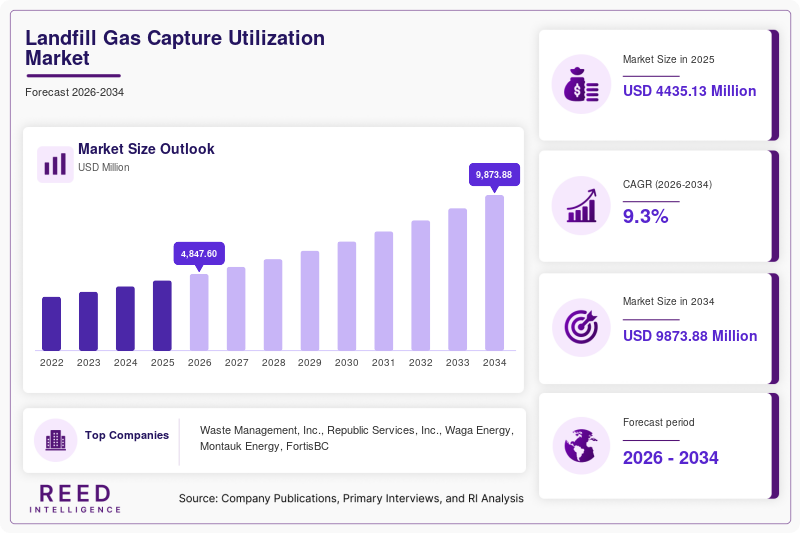
Landfill Gas Capture Utilization market size is projected at USD 4,847.6 million in 2026 and is expected to hit USD 9,847.5 million by 2034 with a CAGR of 9.3% during the forecast period. The increasing focus on reducing greenhouse gas emissions and the growing demand for renewable energy sources, coupled with the need for sustainable waste management practices, underpins market expansion. This report delivers a comprehensive analysis of the Landfill Gas Capture Utilization market, including segmentation by type and application, competitive dynamics, and regional growth patterns, equipping stakeholders with critical intelligence. The Landfill Gas Capture Utilization market continues to demonstrate robust growth potential, fueled by the global push for decarbonization, the increasing value of renewable natural gas, and continuous innovation in gas capture and purification technologies.
Landfill gas capture and utilization is the process of collecting methane and other gases generated from the decomposition of organic waste in landfills and using them as a source of energy. This process reduces greenhouse gas emissions and provides a renewable energy source. The global landfill gas capture and utilization market is significant, with over 2,500 operational projects worldwide in 2025, capturing an estimated 120 billion cubic meters of landfill gas annually. Adoption patterns reveal that the Electricity Generation type dominates the market, accounting for 55% of total demand, followed by Renewable Natural Gas at 28%, and Direct Use at 17%. The Landfill Gas Capture Utilization market's trajectory is closely linked to the growth of the global renewable energy market, which is projected to reach USD 2.5 trillion by 2028, and the increasing focus on methane reduction and circular economy initiatives.
Landfill Gas Capture Utilization Market Trends
Growing Focus on Renewable Natural Gas (RNG) Production
The Landfill Gas Capture Utilization market is witnessing a significant trend toward the production of Renewable Natural Gas (RNG), driven by the need for low-carbon transportation fuels and the increasing demand for pipeline-quality gas. The revenue from RNG projects grew to USD 2.2 billion in 2025, a year-on-year increase of 18%, as 35% of new landfill gas projects in 2025 specified RNG production and upgrading capabilities. Adoption rates of RNG in the transportation sector reached 20%, with this figure projected to exceed 40% by 2030. The Landfill Gas Capture Utilization market's trend toward RNG is reinforced by the need for carbon-negative fuels, the increasing value of environmental credits, and the continuous innovation in gas upgrading technologies.
Increasing Integration of Advanced Gas Cleanup and Monitoring Technologies
The increasing focus on advanced gas cleanup and monitoring technologies is a major trend shaping the Landfill Gas Capture Utilization market, with the development of systems that improve gas quality and operational efficiency. The market has seen a 15% increase in the demand for advanced gas treatment systems since 2022, with 25% of new projects in 2025 featuring improved siloxane removal and real-time gas monitoring. The use of membrane and adsorption technologies for CO2 removal has also gained significant traction. The Landfill Gas Capture Utilization market's trend toward advanced technology is reinforced by the need for higher purity gas, the increasing stringency of pipeline quality standards, and the continuous innovation in gas separation and monitoring technologies.
Landfill Gas Capture Utilization Market Drivers
The Landfill Gas Capture Utilization market's expansion is primarily driven by the increasing global focus on methane emission reduction, with methane having a global warming potential 28 times higher than CO2 over 100 years, and over 500 landfill gas projects globally in 2025 aimed at reducing emissions. The need for renewable energy sources and the growing demand for low-carbon fuels have been major drivers, with landfill gas offering a reliable and dispatchable renewable energy source. The increasing regulatory pressure to capture landfill gas and the availability of tax credits and incentives have also fueled market growth. Additionally, the rising value of Renewable Identification Numbers (RINs) and other environmental credits has spurred demand. The Landfill Gas Capture Utilization market's growth is further reinforced by the continuous improvement in gas capture and utilization technology, leading to better efficiency and lower costs.
Landfill Gas Capture Utilization Market Restraints
Despite favorable growth prospects, the Landfill Gas Capture Utilization market faces significant constraints, primarily related to the high capital cost of gas collection and processing infrastructure, which can be a barrier for smaller landfills. The variability in gas production rates over time and the need for consistent gas quality can also be a limitation. The Landfill Gas Capture Utilization market's growth is also tempered by the challenge of managing site-specific conditions and the competition from other renewable energy sources.
Landfill Gas Capture Utilization Market Opportunities
The Landfill Gas Capture Utilization market presents significant opportunities in the rapidly expanding market for low-carbon fuels and the circular economy, where landfill gas can play a key role. The development of modular and skid-mounted gas upgrading systems for smaller sites is expected to grow at a CAGR of 12% through 2034. Emerging opportunities also exist in the use of landfill gas for hydrogen production and as a feedstock for chemical synthesis. The Landfill Gas Capture Utilization market's opportunity profile is further enhanced by the growing trend of corporate sustainability and the increasing demand for verified emission reductions.
Challenges in Landfill Gas Capture Utilization Market
The Landfill Gas Capture Utilization market faces persistent challenges related to the need for continuous monitoring and maintenance of gas collection systems to maximize efficiency and minimize emissions. The complexity of managing and treating gas to meet quality specifications for various end uses can also be a challenge. The market is also contending with the challenge of securing long-term contracts and financing for projects. Additionally, the Landfill Gas Capture Utilization market is challenged by the need to address the public perception and potential environmental concerns associated with landfill operations.
Landfill Gas Capture Utilization Market Segmentation
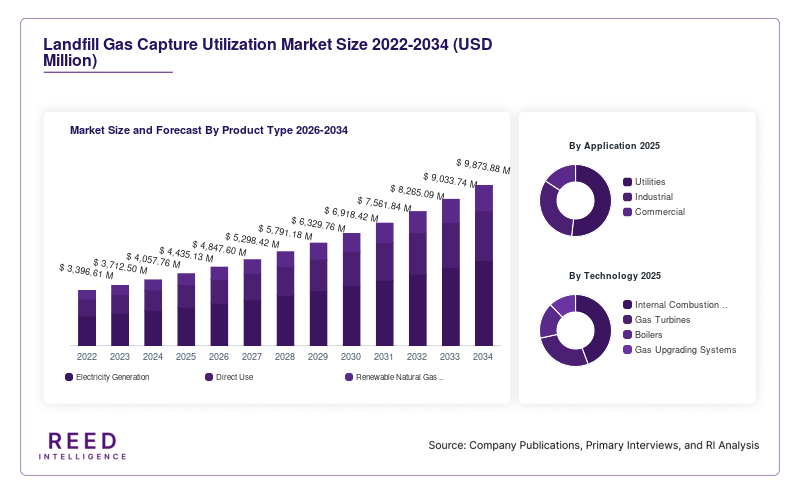
The Landfill Gas Capture Utilization market is segmented by Type and Application to provide a comprehensive market perspective. By Type, Electricity Generation dominates with a 55% market share, driven by its established technology and wide application. The Application segment is led by Utilities, which accounts for 45% of the market, followed by Industrial at 30%, and Commercial at 25%.
By Type
Electricity Generation represent the largest segment in the Landfill Gas Capture Utilization market, commanding a 55% share, with generating capacity exceeding 3,500 MW in 2025. These are characterized by their use of landfill gas to power internal combustion engines or turbines to produce electricity. Technical specifications include engine/generator type, capacity, and emissions control systems. The Landfill Gas Capture Utilization market's Electricity segment is driven by its use in powering grids and local facilities.
Renewable Natural Gas (RNG) capture a 28% share of the Landfill Gas Capture Utilization market, with production of over 20 million MMBtu in 2025. These are characterized by their upgrading of landfill gas to pipeline-quality gas. Technical specifications include gas upgrading technology, purity levels, and injection capacity. The Landfill Gas Capture Utilization market's RNG segment is driven by its use in transportation and pipeline injection.
Direct Use represent the remaining 17% of the Landfill Gas Capture Utilization market, with energy output of over 1,200 MW equivalent in 2025. These are characterized by the use of landfill gas directly in boilers, kilns, or other thermal applications. Technical specifications include burner type, heat output, and gas quality requirements. The Landfill Gas Capture Utilization market's Direct Use segment is driven by its use in industrial processes and heating.
By Application
Utilities dominates the Landfill Gas Capture Utilization market, accounting for 45% of sales, representing over 1,575 MW of equivalent energy in 2025. This segment includes use in power generation for sale to the grid. Usage penetration exceeds 30% in the sector. The Landfill Gas Capture Utilization market's Utilities segment is characterized by its focus on large-scale, reliable power generation.
Industrial accounts for 30% of the Landfill Gas Capture Utilization market, with energy output of over 1,050 MW equivalent in 2025. This segment encompasses use in manufacturing processes, cement kilns, and other industrial applications. The segment is growing at a robust CAGR, driven by the need for cost-effective and sustainable energy. The Landfill Gas Capture Utilization market's Industrial segment is characterized by its focus on direct use and heat generation.
Commercial represents the remainder of the Landfill Gas Capture Utilization market, accounting for 25% of total energy output, with over 875 MW equivalent in 2025. This segment includes use in district heating, greenhouses, and other commercial applications. The segment is projected to grow at a significant CAGR through 2034. The Landfill Gas Capture Utilization market's Commercial segment is characterized by its focus on smaller-scale and niche applications.
Landfill Gas Capture Utilization Market Regional Outlook
North America Landfill Gas Capture Utilization Market
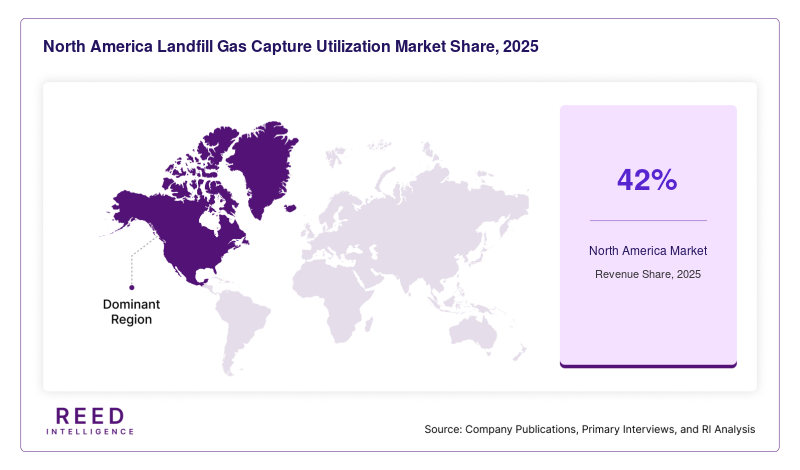
Leads the Landfill Gas Capture Utilization market, commanding a 42% share, with a revenue of USD 2,036.0 million in 2025. The United States is the primary driver, accounting for 85% of regional demand, driven by the large number of landfills, strong regulatory support, and the availability of tax incentives for renewable energy. The North American Landfill Gas Capture Utilization market is characterized by its focus on RNG and electricity generation.
Europe Landfill Gas Capture Utilization Market
Represents the second-largest market, capturing a 30% share with a revenue of USD 1,454.3 million in 2025. The UK, Germany, and Italy are the primary drivers, collectively accounting for 60% of regional demand, driven by stringent environmental regulations, strong commitment to renewable energy, and a focus on methane reduction. The Landfill Gas Capture Utilization market in Europe is characterized by its focus on sustainability and advanced technologies.
Asia-Pacific Landfill Gas Capture Utilization Market
Accounts for 20% of the global Landfill Gas Capture Utilization market, with a revenue of USD 969.5 million in 2025. China, India, and South Korea are the primary drivers, together accounting for 70% of regional demand, driven by rapid urbanization, increasing waste generation, and growing environmental awareness. The Asia-Pacific Landfill Gas Capture Utilization market is projected to grow at the fastest CAGR of 11% through 2034.
Middle East & Africa and Latin America Landfill Gas Capture Utilization Market
Together account for the remaining 8% of the Landfill Gas Capture Utilization market, with the UAE leading the Middle East market and Brazil leading the Latin American market. Both regions are projected to grow at CAGRs exceeding 10%, driven by infrastructure development and increasing focus on waste management.
Top players in Landfill Gas Capture Utilization Market
- Waste Management, Inc.
- Republic Services, Inc.
- Waga Energy
- Montauk Energy
- FortisBC
- Atmos Energy Corporation
- NRG Energy, Inc.
- Linde plc
- Air Products and Chemicals, Inc.
- BP plc
- Shell plc
- Chevron Corporation
- Enbridge Inc.
- Energy Developments (EDL)
- Vanguard Renewables
Waste Management, Inc.
Waste Management, Inc. holds a dominant position in the Landfill Gas Capture Utilization market, with an estimated 15% global market share, particularly strong in the North American landfill gas to energy segment. The company's portfolio of landfill gas projects is widely recognized for its scale, reliability, and innovation. Waste Management's market leadership is reinforced by its significant number of landfills, its extensive infrastructure, and its strong focus on sustainability. Waste Management commands over 20% of the North American market, positioning it as a key player in the Landfill Gas Capture Utilization market.
Waga Energy
Waga Energy is a leading player in the Landfill Gas Capture Utilization market, commanding approximately 8% of the global market share through its specialized focus on upgrading landfill gas to renewable natural gas. The company's expertise in gas purification and its proprietary technology have solidified its position. Waga Energy's RNG projects are known for their efficiency, innovation, and environmental benefits. The company's commitment to the energy transition and its strong presence in the European and North American markets have enhanced its competitive advantage.
Republic Services, Inc. holds a significant 12% market share, with particular strength in the North American landfill gas to energy and RNG segments. Montauk Energy is a major player in the renewable energy development sector, holding a 5% share.
Recent Developments in Landfill Gas Capture Utilization Market
- 2025: Waste Management announced a significant expansion of its RNG production capacity with new facilities across the United States.
- 2025: Waga Energy launched a new, more efficient gas upgrading system for landfill gas, reducing operational costs and increasing methane recovery.
Landfill Gas Capture Utilization Market Segments
By Product Type
- Electricity Generation
- Direct Use
- Renewable Natural Gas (RNG)
By Application
- Utilities
- Industrial
- Commercial
By Technology
- Internal Combustion Engines
- Gas Turbines
- Boilers
- Gas Upgrading Systems
By Region
- North America
- Europe
- APAC
- Middle East and Africa
- LATAM