Lanthanum Nitrate Market Size, Share & Demand Report By Purity Level (High Purity (>99.9%), Ultra-High Purity), By Application (Catalysts, Optical Materials, Chemical Synthesis, Others), By End-Use Industry (Chemical Industry, Electronics Industry, Energy Sector, Others), By Form (Powder, Liquid), By Region & Segment Forecasts, 2026–2034
USD 3950
Market Overview
The global Lanthanum Nitrate Market size was valued at approximately USD 620 million in 2026 and is projected to reach USD 1.05 billion by 2034, expanding at a CAGR of 6.8% during the forecast period (2026–2034). The market growth is being supported by increasing demand for rare earth compounds in advanced industrial and environmental applications, particularly in catalyst manufacturing and specialty glass production.
A key global factor driving the expansion of the Lanthanum Nitrate Market is the rising adoption of rare earth-based catalysts in petroleum refining and automotive emission control systems. As industries transition toward cleaner and more efficient processes, lanthanum nitrate has gained traction due to its role in improving catalytic efficiency and reducing emissions.
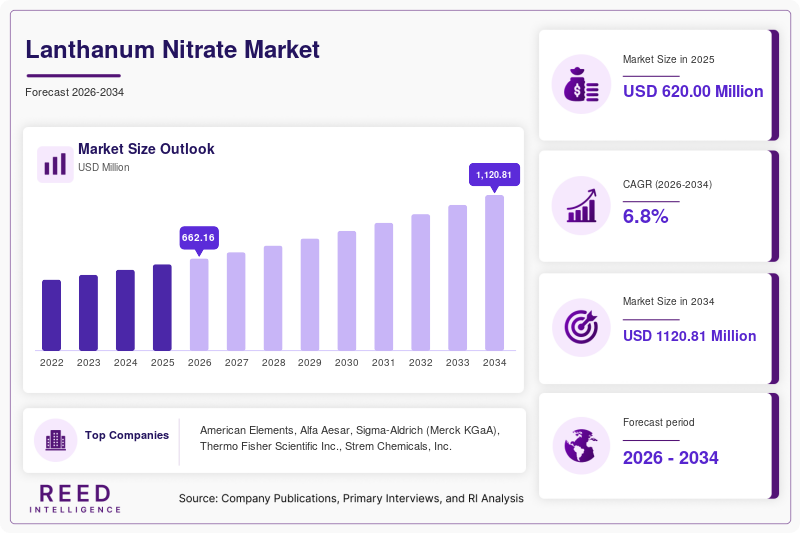
Key Highlights:
- Asia Pacific dominated the market with a share of 42% in 2025, while the Middle East & Africa is expected to register the fastest CAGR of 7.5% through 2034.
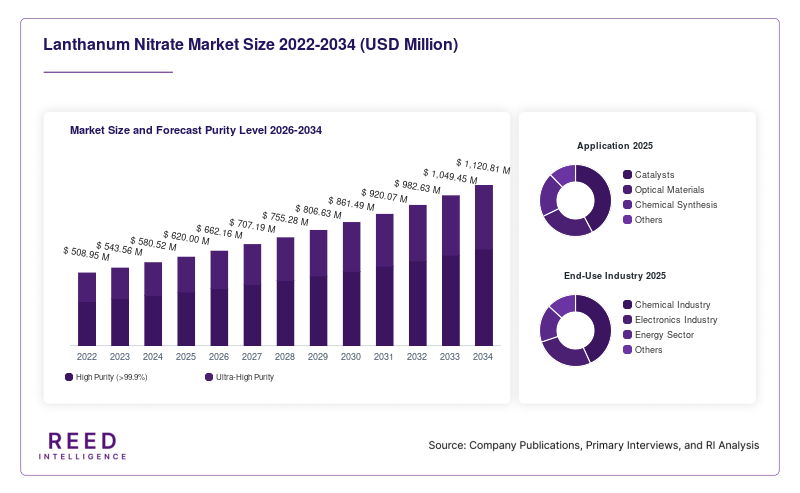
- By application, catalysts held the largest share at 38%, whereas optical materials are projected to grow at the fastest CAGR of 7.9%.
- By purity level, high-purity lanthanum nitrate (>99.9%) led with 55% share, while ultra-high purity grades are forecasted to grow at a CAGR of 8.1%.
- China remained the dominant country, with market values of USD 210 million in 2024 and USD 225 million in 2025.
Market Trends
Expansion of Rare Earth-Based Catalysts in Green Technologies
A notable trend shaping the Lanthanum Nitrate Market is the growing integration of rare earth-based catalysts in environmentally sustainable technologies. Industries such as petrochemicals and automotive manufacturing are increasingly relying on lanthanum nitrate to enhance catalytic performance and reduce emissions. The compound’s ability to stabilize catalysts and improve efficiency has made it a preferred material in fluid catalytic cracking and emission control systems. This trend is further reinforced by stricter environmental regulations, pushing manufacturers to adopt cleaner production methods.
Rising Demand in Optical and Electronic Applications
Another significant trend is the increasing utilization of lanthanum nitrate in optical materials and advanced electronics. The compound is used in producing high-refractive-index glass, specialty lenses, and phosphors. As consumer electronics, renewable energy devices, and telecommunications infrastructure expand globally, the demand for high-performance materials continues to grow. This has led to increased research and development activities focused on enhancing the purity and performance characteristics of lanthanum nitrate, thereby boosting its adoption in high-tech applications.
Market Drivers
Increasing Demand from Petroleum Refining Industry
The petroleum refining sector remains a primary driver of the Lanthanum Nitrate Market. The compound is widely used in catalyst formulations for refining processes, particularly in fluid catalytic cracking units. As global energy consumption rises and refineries strive for higher efficiency, the need for effective catalyst materials continues to grow. Lanthanum nitrate enhances catalyst stability and improves yield, making it an essential component in modern refining operations.
Growth in Electronics and Advanced Materials Sector
The rapid expansion of the electronics and advanced materials sector is another major driver. Lanthanum nitrate is used in the production of specialty glass, phosphors, and electronic components. The increasing demand for smartphones, displays, and renewable energy systems has led to higher consumption of rare earth compounds. Additionally, ongoing advancements in material science are enabling new applications, further supporting market growth.
Market Restraint
Supply Chain Volatility of Rare Earth Elements
A major restraint affecting the Lanthanum Nitrate Market is the volatility in the supply chain of rare earth elements. The production of lanthanum nitrate depends heavily on the availability of raw materials, which are concentrated in a limited number of regions. This concentration creates risks related to geopolitical tensions, export restrictions, and price fluctuations.
Additionally, the extraction and processing of rare earth elements involve complex and environmentally sensitive processes, which can lead to regulatory challenges and increased production costs. These factors may limit the scalability of production and create uncertainties for manufacturers and end-users.
Market Opportunities
Emerging Applications in Renewable Energy Systems
The growing adoption of renewable energy systems presents a significant opportunity for the Lanthanum Nitrate Market. The compound is increasingly being used in advanced energy storage solutions and fuel cell technologies. As countries invest in clean energy infrastructure, the demand for high-performance materials is expected to rise, creating new growth avenues.
Expansion in Developing Economies
Developing economies offer substantial growth potential due to rapid industrialization and increasing investments in manufacturing and infrastructure. Countries in Asia, Africa, and Latin America are witnessing rising demand for catalysts, electronics, and specialty materials. This expansion is expected to drive the consumption of lanthanum nitrate, particularly in emerging industrial sectors.
Segmental Analysis
By Purity Level
High-purity lanthanum nitrate (>99.9%) accounted for the largest share of approximately 55% in 2025. This dominance was due to its widespread use in catalysts and electronic applications where consistency and performance are critical.
Ultra-high purity grades are expected to grow at the fastest CAGR of 8.1% during the forecast period. The increasing demand for precision materials in optics and advanced electronics will drive this segment, as higher purity levels enhance product performance.
By Application
Catalysts represented the dominant application segment, holding a 38% share in 2025. The use of lanthanum nitrate in refining and emission control systems contributed significantly to this dominance.
Optical materials are projected to grow at the fastest CAGR of 7.9%. The rising demand for high-quality lenses and display technologies is expected to drive growth, supported by advancements in optical engineering.
By End-Use Industry
The chemical industry held the largest share of 34% in 2025, driven by extensive use of lanthanum nitrate in catalyst production and chemical synthesis.
The electronics industry is anticipated to grow at the fastest CAGR of 7.6%. The increasing demand for consumer electronics and renewable energy devices will drive the adoption of lanthanum nitrate in this segment.
By Form
Powder form dominated the market with a share of 60% in 2025 due to its ease of handling and application in industrial processes.
Liquid form is expected to grow at a CAGR of 6.9% as it offers advantages in certain chemical processes and formulations, particularly in controlled reaction environments.
Regional Analysis
North America
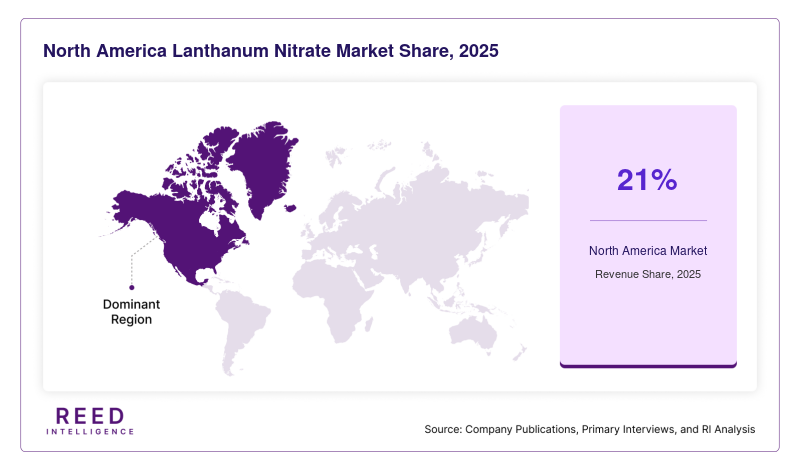
North America accounted for approximately 21% of the Lanthanum Nitrate Market share in 2025 and is expected to grow at a CAGR of 6.3% during the forecast period. The region’s growth is supported by advancements in chemical manufacturing and increasing adoption of rare earth materials in high-tech industries.
The United States dominated the regional market due to its strong presence in petroleum refining and advanced materials research. Investments in domestic rare earth production and processing facilities have strengthened supply chain resilience, supporting market expansion.
Europe
Europe held around 18% of the market share in 2025 and is projected to grow at a CAGR of 6.1% through 2034. The region has been focusing on sustainable technologies and reducing dependency on external sources for rare earth elements.
Germany emerged as the leading country, driven by its robust automotive and chemical industries. The demand for emission control catalysts and specialty materials has contributed to steady market growth.
Asia Pacific
Asia Pacific dominated the Lanthanum Nitrate Market with a share of 42% in 2025 and is expected to grow at a CAGR of 7.0% during the forecast period. The region’s dominance is attributed to large-scale production and consumption of rare earth compounds.
China led the market, supported by its extensive rare earth reserves and well-established processing infrastructure. The country’s strong manufacturing base in electronics and chemicals has further driven demand.
Middle East & Africa
The Middle East & Africa region accounted for approximately 10% of the market share in 2025 and is anticipated to register the fastest CAGR of 7.5% through 2034. The region is increasingly investing in industrial diversification and advanced materials.
Saudi Arabia emerged as a key contributor due to its expanding petrochemical sector. The adoption of advanced catalysts in refining processes has supported market growth.
Latin America
Latin America held around 9% of the market share in 2025 and is expected to grow at a CAGR of 6.5% during the forecast period. The region is witnessing gradual growth in industrial and manufacturing activities.
Brazil dominated the regional market, driven by its growing chemical and energy sectors. Investments in refining and industrial infrastructure have contributed to increasing demand for lanthanum nitrate.
Competitive Landscape
The Lanthanum Nitrate Market is moderately fragmented, with several global and regional players competing on product quality, purity levels, and supply chain capabilities. The leading companies focus on expanding production capacity and investing in research to enhance product performance.
A prominent market leader is American Elements, which has strengthened its position through continuous product innovation and expansion of its rare earth portfolio. The company recently introduced advanced high-purity lanthanum nitrate solutions for electronic applications, reinforcing its competitive edge.
Other key players are focusing on strategic partnerships, mergers, and geographic expansion to gain market share. The competitive environment is characterized by technological advancements and increasing emphasis on sustainable production practices.
Key Players List
- American Elements
- Alfa Aesar
- Sigma-Aldrich
- Thermo Fisher Scientific
- Strem Chemicals
- GFS Chemicals
- Stanford Materials Corporation
- ProChem Inc.
- Rare Earth Products Ltd.
- Avalon Advanced Materials
- Neo Performance Materials
- Lynas Rare Earths
- China Northern Rare Earth Group
- Indian Rare Earths Limited
- Ganzhou Rare Earth Group
Recent Developments
- In 2025, leading manufacturers expanded production capacity to meet rising demand from the electronics sector.
- In 2024, several companies invested in high-purity processing technologies to improve product quality.
- Strategic collaborations between chemical companies and research institutions increased innovation in catalyst applications.
- Expansion of rare earth mining and processing facilities in Asia supported global supply stability.
Lanthanum Nitrate Market Segments
Purity Level
- High Purity (>99.9%)
- Ultra-High Purity
Application
- Catalysts
- Optical Materials
- Chemical Synthesis
- Others
End-Use Industry
- Chemical Industry
- Electronics Industry
- Energy Sector
- Others
Form
- Powder
- Liquid
By Region
- North America
- Europe
- APAC
- Middle East and Africa
- LATAM