Large Capacity Stationary Fuel Cell Market Size, Share & Demand Report By Type (Solid Oxide Fuel Cells (SOFC), Molten Carbonate Fuel Cells (MCFC), Proton Exchange Membrane Fuel Cells (PEMFC)), By Application (Utility-Scale Power Generation, Data Centers, Industrial Power Supply, Backup Power Systems), By End-Use (Industrial, Commercial, Utilities), By Region & Segment Forecasts, 2026–2034
USD 3950
Market Overview
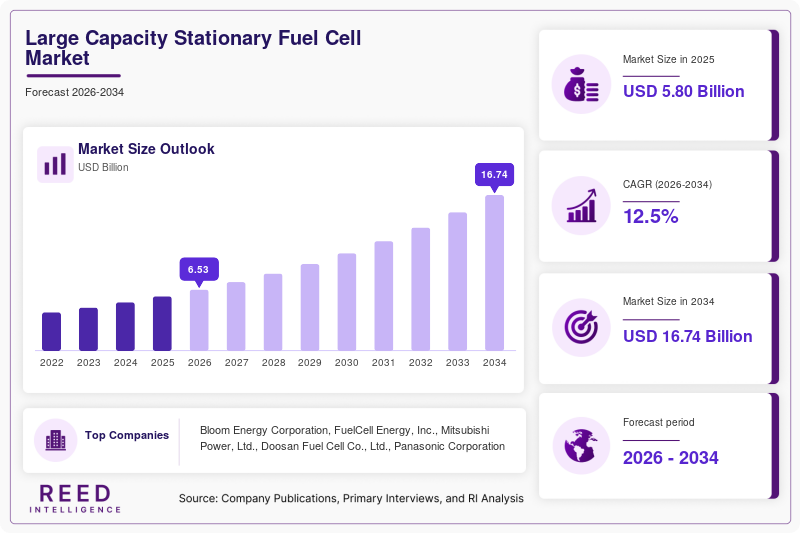
The Large Capacity Stationary Fuel Cell Market was valued at approximately USD 5.8 billion in 2026 and is projected to reach USD 14.9 billion by 2034, expanding at a CAGR of 12.5% during 2026–2034. The market is experiencing steady growth driven by the global transition toward low-emission energy systems and the increasing need for reliable distributed power generation. Large capacity stationary fuel cells, typically deployed in industrial facilities, data centers, and utility-scale applications, offer continuous power generation with lower environmental impact compared to conventional fossil fuel-based systems.
One of the key global factors supporting market expansion is the rising emphasis on decarbonization across energy-intensive industries. Governments and corporations are actively investing in hydrogen-based and natural gas-powered fuel cell systems to meet emission reduction targets while ensuring energy security. Additionally, advancements in solid oxide fuel cell (SOFC) and molten carbonate fuel cell (MCFC) technologies have improved efficiency and reduced operational costs, making them more viable for large-scale deployment.
Key Highlights
- North America dominated the market with a 36.4% share in 2025.
- Asia Pacific is expected to grow at the fastest CAGR of 13.6% during 2026–2034.
- By type, solid oxide fuel cells accounted for the largest share of 41.8%, while molten carbonate fuel cells are projected to grow at a CAGR of 13.9%.
- By application, utility-scale power generation led with a 44.2% share, whereas data centers are expected to expand at a CAGR of 14.1%.
- The United States remained the dominant country, with market values of USD 1.6 billion in 2024 and USD 1.8 billion in 2025.
Market Trends
Integration of Fuel Cells with Renewable Energy Systems
A significant trend in the Large Capacity Stationary Fuel Cell Market is the growing integration of fuel cell systems with renewable energy sources such as solar and wind power. As renewable generation is inherently intermittent, large capacity fuel cells are increasingly deployed to provide stable and continuous power output. This hybrid model enhances grid reliability and reduces dependency on traditional backup systems such as diesel generators. Utilities and independent power producers are investing in such integrated systems to optimize energy efficiency and ensure uninterrupted power supply. Additionally, fuel cells can utilize excess renewable energy to produce hydrogen, which can later be converted back into electricity, supporting long-duration energy storage. This trend is particularly prominent in regions with aggressive renewable energy targets, where maintaining grid stability is critical.
Expansion of Hydrogen Infrastructure and Fuel Cell Adoption
The expansion of hydrogen production, storage, and distribution infrastructure is another notable trend shaping the market. Governments across major economies are allocating significant funds to develop hydrogen ecosystems, including green hydrogen production facilities. This is encouraging the adoption of hydrogen-powered fuel cells for stationary applications. Large capacity fuel cells are increasingly seen as a key technology in the hydrogen economy due to their ability to generate clean electricity with minimal emissions. Industrial users and utilities are entering long-term agreements for hydrogen supply to support fuel cell installations. As hydrogen becomes more accessible and cost-competitive, the adoption of large-scale stationary fuel cells is expected to accelerate across various end-use sectors.
Market Drivers
Rising Demand for Reliable and Continuous Power Supply
The growing need for reliable and uninterrupted power supply is a major driver of the Large Capacity Stationary Fuel Cell Market. Industries such as data centers, manufacturing, and healthcare require continuous electricity to maintain operations and avoid costly downtime. Traditional grid infrastructure often faces challenges related to outages and fluctuations, particularly in regions with aging energy systems. Large capacity fuel cells provide a dependable alternative by offering high efficiency and consistent power output. Unlike conventional generators, fuel cells operate with fewer moving parts, resulting in lower maintenance requirements and improved reliability. Their ability to function independently or alongside the grid makes them highly suitable for critical applications, driving their adoption across various sectors.
Increasing Focus on Emission Reduction and Clean Energy Transition
Global efforts to reduce greenhouse gas emissions and transition toward clean energy sources are significantly driving market growth. Governments are implementing stringent regulations and providing incentives to encourage the adoption of low-emission technologies. Large capacity stationary fuel cells produce electricity with significantly lower emissions compared to fossil fuel-based power plants, making them an attractive option for industries aiming to meet sustainability goals. Additionally, corporations are increasingly committing to carbon neutrality targets, leading to higher investments in clean energy infrastructure. The use of hydrogen as a fuel further enhances the environmental benefits, especially when produced from renewable sources. These factors collectively contribute to the growing demand for large-scale fuel cell systems.
Market Restraint
High Initial Capital Investment and Infrastructure Costs
One of the primary restraints affecting the Large Capacity Stationary Fuel Cell Market is the high initial capital investment required for installation and deployment. Large-scale fuel cell systems involve significant costs associated with equipment, infrastructure, and integration with existing energy systems. Additionally, the development of supporting infrastructure, particularly for hydrogen production and distribution, requires substantial financial resources. This can pose challenges for small and medium-sized enterprises and limit market penetration in cost-sensitive regions.
The complexity of fuel cell technology also contributes to higher installation and maintenance expenses. While operational costs may be lower over time, the upfront investment remains a barrier for many potential adopters. Furthermore, the availability of skilled personnel for installation and maintenance is limited in certain regions, adding to the overall cost burden. For example, in developing economies, the lack of established hydrogen supply chains and technical expertise can delay project implementation and increase project risks. These factors collectively hinder the widespread adoption of large capacity stationary fuel cells despite their long-term benefits.
Market Opportunities
Growth of Data Centers and Digital Infrastructure
The rapid expansion of data centers and digital infrastructure presents a significant opportunity for the Large Capacity Stationary Fuel Cell Market. With the increasing demand for cloud computing, artificial intelligence, and data storage, data centers require reliable and energy-efficient power solutions. Large capacity fuel cells offer a viable alternative to traditional backup systems, providing continuous power with lower emissions and reduced noise levels. Companies operating hyperscale data centers are increasingly exploring fuel cell technologies to enhance energy efficiency and meet sustainability targets. Additionally, the modular nature of fuel cells allows for scalable deployment, making them suitable for both existing and new data center facilities. This growing demand for resilient power solutions is expected to drive market growth in the coming years.
Industrial Decarbonization and Adoption of Hydrogen-Based Systems
Industrial decarbonization initiatives are creating substantial opportunities for the adoption of large capacity stationary fuel cells. Industries such as steel, chemicals, and refining are under pressure to reduce carbon emissions and transition to cleaner energy sources. Fuel cells powered by hydrogen provide a low-emission alternative for industrial power generation and process energy requirements. Governments and industry stakeholders are investing in pilot projects and large-scale deployments to demonstrate the feasibility of hydrogen-based systems. As the cost of green hydrogen continues to decline, its adoption in fuel cells is expected to increase significantly. This trend is likely to open new avenues for market expansion, particularly in regions with strong industrial bases.
Segmental Analysis
By Type
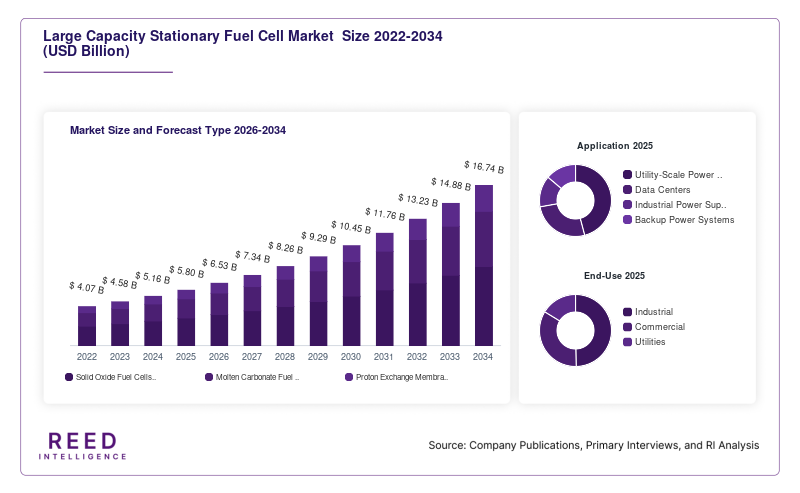
Solid oxide fuel cells (SOFC) dominated the market with a share of 41.8% in 2024. These fuel cells are widely used due to their high efficiency and ability to operate on various fuels, including natural gas and hydrogen. SOFC systems are particularly suitable for large capacity stationary applications, such as utility-scale power generation and industrial facilities. Their ability to provide continuous power with lower emissions makes them a preferred choice among end users. Additionally, advancements in materials and system design have improved their durability and reduced operational costs, further strengthening their market position.
Molten carbonate fuel cells (MCFC) are expected to be the fastest-growing subsegment, with a CAGR of 13.9% during the forecast period. These fuel cells are gaining traction due to their high efficiency and suitability for large-scale applications. MCFC systems can utilize carbon dioxide in the power generation process, making them attractive for industrial applications where carbon capture is a priority. The increasing focus on reducing industrial emissions and improving energy efficiency is driving the adoption of MCFC technology.
By Application
Utility-scale power generation accounted for the largest share of 44.2% in 2024. Large capacity stationary fuel cells are increasingly being deployed in utility-scale projects to provide reliable and efficient power generation. These systems are capable of delivering continuous baseload power, making them suitable for integration with renewable energy sources. Utilities are investing in fuel cell technologies to enhance grid stability and reduce emissions, contributing to the growth of this segment.
Data centers are projected to be the fastest-growing application segment, with a CAGR of 14.1%. The increasing demand for data storage and processing is driving the need for reliable and energy-efficient power solutions. Fuel cells offer several advantages over traditional backup systems, including lower emissions, reduced noise, and higher efficiency. As data center operators focus on sustainability and energy resilience, the adoption of large capacity fuel cells is expected to increase significantly.
By End-Use
The industrial sector dominated the market with a share of 39.6% in 2024. Industries such as chemicals, refining, and manufacturing require continuous power supply for their operations. Large capacity fuel cells provide a reliable and efficient solution, reducing dependence on conventional power sources. The ability to use various fuels and integrate with existing energy systems makes them suitable for industrial applications. Additionally, the focus on reducing carbon emissions is driving the adoption of fuel cells in this sector.
The commercial sector is expected to be the fastest-growing end-use segment, with a CAGR of 13.7%. Commercial establishments, including hospitals, hotels, and office buildings, are increasingly adopting fuel cells to ensure uninterrupted power supply and reduce energy costs. The growing emphasis on sustainability and energy efficiency is encouraging the deployment of fuel cell systems in commercial applications. These factors are expected to drive significant growth in this segment over the forecast period.
Regional Analysis
North America
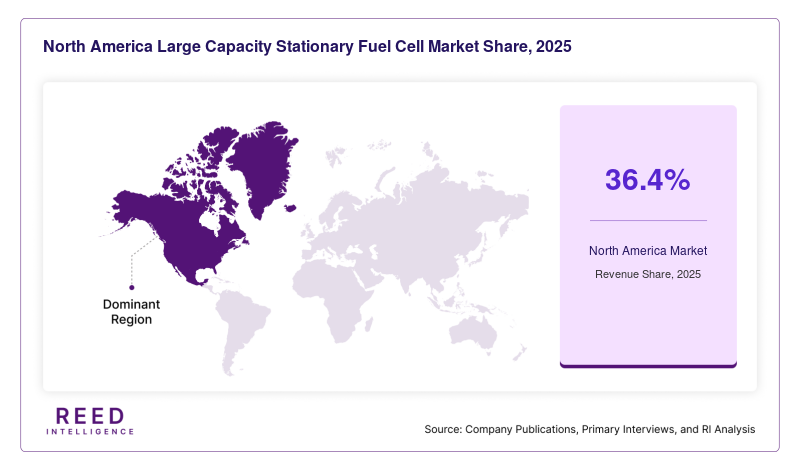
North America accounted for a significant share of approximately 36.4% in 2025 and is expected to maintain steady growth with a CAGR of 11.8% during the forecast period. The region benefits from advanced energy infrastructure and strong investments in clean energy technologies. The presence of established fuel cell manufacturers and supportive government policies has contributed to widespread adoption. Additionally, increasing demand from data centers and industrial applications is driving market expansion.
The United States dominates the regional market due to its focus on reducing carbon emissions and enhancing energy resilience. One unique growth factor is the increasing deployment of fuel cells in microgrid systems, particularly in areas prone to natural disasters. These systems provide reliable backup power and improve grid stability, supporting the adoption of large capacity fuel cells across the country.
Europe
Europe held a market share of around 25.7% in 2025 and is projected to grow at a CAGR of 12.1% through 2034. The region’s commitment to achieving climate neutrality has accelerated the adoption of fuel cell technologies. Government initiatives promoting hydrogen energy and renewable integration are key drivers of market growth. Countries across the region are investing in large-scale fuel cell projects to reduce dependence on fossil fuels.
Germany is the dominant country in the European market, supported by its strong industrial base and focus on energy transition. A unique growth factor is the development of hydrogen valleys, which integrate production, storage, and utilization of hydrogen. These initiatives are fostering the adoption of large capacity stationary fuel cells across industrial and utility sectors.
Asia Pacific
Asia Pacific is expected to be the fastest-growing region, with a CAGR of 13.6% during the forecast period, and held a share of approximately 22.3% in 2025. Rapid industrialization, urbanization, and increasing energy demand are driving market growth. Governments in the region are actively promoting clean energy technologies, including fuel cells, to address environmental concerns and energy security challenges.
Japan leads the regional market due to its early adoption of fuel cell technology and strong government support. A unique growth factor is the country’s focus on building a hydrogen-based society, including large-scale investments in hydrogen infrastructure. This initiative is significantly boosting the deployment of stationary fuel cells across various applications.
Middle East & Africa
The Middle East & Africa region accounted for a market share of 8.1% in 2025 and is expected to grow at a CAGR of 11.5%. The region is gradually adopting fuel cell technologies as part of its efforts to diversify energy sources and reduce reliance on oil and gas. Increasing investments in renewable energy projects are supporting market growth.
Saudi Arabia is the dominant country in this region, driven by its strategic initiatives to develop hydrogen production capabilities. A unique growth factor is the integration of fuel cells in large-scale renewable energy projects, which enhances energy efficiency and supports sustainable development goals.
Latin America
Latin America held a market share of 7.5% in 2025 and is projected to grow at a CAGR of 10.9% during the forecast period. The region is witnessing increasing adoption of clean energy technologies to address energy shortages and environmental concerns. Government policies promoting renewable energy are encouraging the deployment of fuel cell systems.
Brazil dominates the regional market due to its growing industrial sector and focus on sustainable energy solutions. A unique growth factor is the use of fuel cells in remote and off-grid areas, where they provide reliable power supply and reduce dependence on diesel generators.
Competitive Landscape
The Large Capacity Stationary Fuel Cell Market is moderately consolidated, with a mix of established players and emerging companies competing to expand their market presence. Key companies are focusing on technological advancements, strategic partnerships, and large-scale project deployments to strengthen their positions. One of the leading players in the market is Bloom Energy, known for its solid oxide fuel cell technology and extensive deployment across commercial and industrial applications.
Companies are increasingly investing in research and development to improve efficiency, durability, and cost-effectiveness of fuel cell systems. Strategic collaborations with energy providers and industrial companies are also common, enabling market players to expand their customer base and enhance their product offerings. Recent developments include the launch of advanced fuel cell systems with higher capacity and improved performance, as well as partnerships to develop hydrogen infrastructure. These initiatives are expected to intensify competition and drive innovation in the market.
Key Players
- Bloom Energy Corporation
- FuelCell Energy, Inc.
- Mitsubishi Power, Ltd.
- Doosan Fuel Cell Co., Ltd.
- Panasonic Corporation
- Toshiba Energy Systems & Solutions Corporation
- Siemens Energy AG
- Cummins Inc.
- Ballard Power Systems Inc.
- Plug Power Inc.
- Nedstack Fuel Cell Technology
- SFC Energy AG
- Aisin Corporation
- POSCO Energy Co., Ltd.
- Ceres Power Holdings plc
Recent Developments
- In 2025, Bloom Energy announced the deployment of a multi-megawatt fuel cell project for a major data center operator, enhancing energy reliability and sustainability.
- In 2024, FuelCell Energy partnered with a utility company to develop a large-scale hydrogen-powered fuel cell plant for grid applications.
- In 2025, Mitsubishi Power introduced an advanced fuel cell system designed for industrial applications with improved efficiency and reduced emissions.
Large Capacity Stationary Fuel Cell Market Segments
Type
- Solid Oxide Fuel Cells (SOFC)
- Molten Carbonate Fuel Cells (MCFC)
- Proton Exchange Membrane Fuel Cells (PEMFC)
Application
- Utility-Scale Power Generation
- Data Centers
- Industrial Power Supply
- Backup Power Systems
End-Use
- Industrial
- Commercial
- Utilities
By Region
- North America
- Europe
- APAC
- Middle East and Africa
- LATAM