Laryngeal Mask Market Size, Share & Demand Report By Type (Reusable Laryngeal Masks, Disposable Laryngeal Masks), By Material (Silicone, PVC, Others), By Application (Anesthesia, Emergency Care, Others), By End-Use (Hospitals, Ambulatory Surgical Centers, Clinics), By Region & Segment Forecasts, 2026–2034
USD 3950
Market Overview
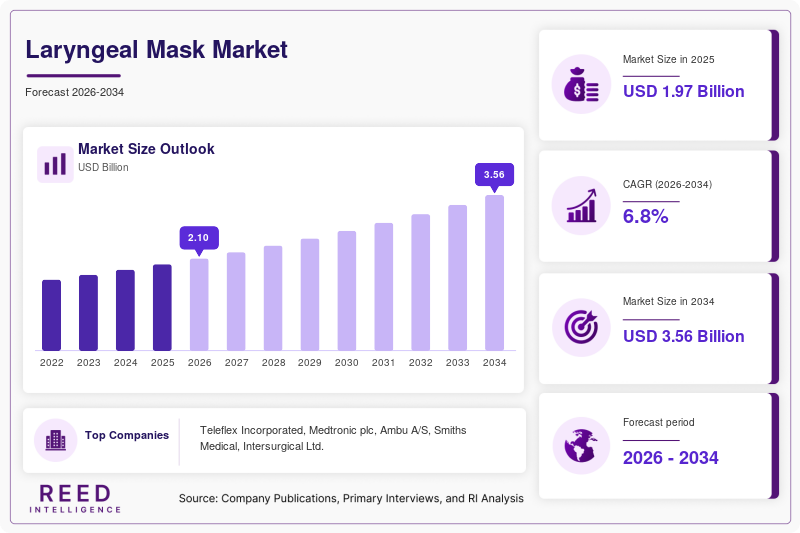
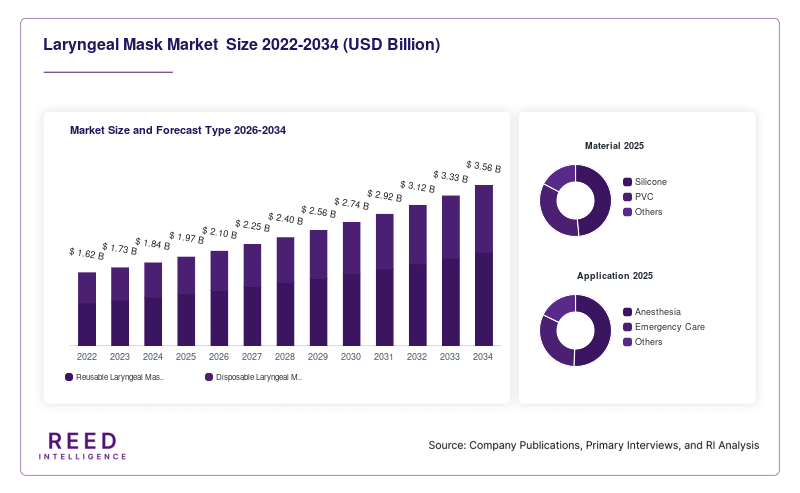
The global Laryngeal Mask Market size was estimated at USD 2.1 billion in 2026 and is projected to reach approximately USD 3.6 billion by 2034, expanding at a CAGR of 6.8% during the forecast period (2026–2034). The market growth is being supported by the increasing adoption of minimally invasive airway management devices in surgical and emergency settings. Laryngeal masks have gained prominence due to their ease of insertion, reduced airway trauma risk, and effectiveness in short-duration procedures, making them a preferred alternative to traditional endotracheal tubes.
A key global factor supporting market expansion is the rising volume of surgical procedures worldwide, particularly in outpatient and ambulatory care settings. The growing emphasis on patient safety and improved anesthesia practices has further accelerated the adoption of advanced airway management devices. Additionally, the rising geriatric population and increasing incidence of chronic diseases requiring surgical intervention have contributed to consistent demand.
Key Highlights:
- North America dominated the market with a 38% share in 2025, while Asia Pacific is projected to grow at the fastest CAGR of 8.2%.
- The reusable laryngeal mask segment led with a 55% share, whereas disposable laryngeal masks are expected to grow at a CAGR of 7.5%.
- Hospitals accounted for the largest end-use segment with 62% share, while ambulatory surgical centers are anticipated to grow at a CAGR of 8.0%.
- The United States led the global market, with estimated values of USD 620 million in 2024 and USD 660 million in 2025.
Market Trends
Increasing Preference for Disposable Airway Devices
The shift toward disposable laryngeal masks is a notable trend shaping the Laryngeal Mask Market. Healthcare providers are increasingly prioritizing infection prevention and control, particularly after heightened awareness of hospital-acquired infections. Disposable devices reduce cross-contamination risks and eliminate the need for sterilization infrastructure, making them suitable for high-volume healthcare settings. This trend is especially visible in developed markets and rapidly expanding healthcare systems in emerging economies. The convenience and compliance benefits offered by single-use devices are expected to drive steady adoption across various healthcare facilities.
Integration of Advanced Design Features
Technological advancements in laryngeal mask design are influencing market dynamics. Manufacturers are focusing on improving device performance through innovations such as better sealing cuffs, gastric access ports, and enhanced anatomical fit. These improvements enhance ventilation efficiency and patient safety during anesthesia. The incorporation of materials that offer flexibility and durability has also contributed to better clinical outcomes. As healthcare providers increasingly demand reliable and user-friendly devices, manufacturers are investing in product development to differentiate their offerings, thereby contributing to sustained market growth.
Market Drivers
Rising Surgical Procedures Globally
The increasing number of surgical interventions worldwide is a key driver of the Laryngeal Mask Market. Growing prevalence of chronic conditions such as cardiovascular diseases, cancer, and respiratory disorders has led to higher surgical volumes. Laryngeal masks are widely used in anesthesia during surgeries, particularly for short and minimally invasive procedures. Their ease of use and reduced complication rates compared to traditional airway management methods make them highly suitable for modern surgical practices.
Expanding Ambulatory Care Infrastructure
The expansion of ambulatory surgical centers and outpatient facilities is significantly driving market growth. These facilities require efficient, cost-effective, and easy-to-use airway management solutions. Laryngeal masks offer faster patient recovery and shorter procedure times, aligning well with the operational needs of outpatient care settings. As healthcare systems continue to shift toward cost-efficient treatment models, the demand for such devices is expected to increase steadily.
Market Restraint
Limited Use in Complex Airway Cases
A major restraint in the Laryngeal Mask Market is the limited applicability of laryngeal masks in patients with complex airway conditions. In cases requiring secure airway control, such as major surgeries or patients with anatomical abnormalities, endotracheal intubation remains the preferred method. This limitation restricts the use of laryngeal masks in certain clinical scenarios, thereby affecting overall market penetration. Additionally, concerns regarding improper placement and airway leakage in specific patient populations may further limit adoption in critical care settings.
Market Opportunities
Growth in Emerging Healthcare Markets
Emerging economies present significant growth opportunities for the Laryngeal Mask Market. Rapid improvements in healthcare infrastructure, increasing healthcare expenditure, and rising awareness about advanced medical devices are driving demand in these regions. Countries in Asia Pacific, Latin America, and parts of Africa are witnessing increased adoption of modern surgical practices, creating a favorable environment for market expansion.
Technological Advancements in Airway Management
Ongoing research and development activities aimed at improving airway management devices offer promising opportunities. Innovations such as second-generation laryngeal masks with enhanced safety features and improved ventilation capabilities are expected to gain traction. These advancements not only address existing limitations but also expand the scope of applications, thereby opening new avenues for market growth.
Segmental Analysis
By Type
Reusable laryngeal masks dominated the market with a 55% share in 2025. Their cost-effectiveness and long-term usability made them a preferred choice in many healthcare settings, particularly in regions with budget constraints.
Disposable laryngeal masks are expected to grow at a CAGR of 7.5% during the forecast period. The increasing focus on infection control and convenience is likely to drive their adoption, especially in high-volume hospitals.
By Material
Silicone-based laryngeal masks held the largest share of 60% in 2025 due to their durability and flexibility. These materials provide better patient comfort and are widely used in reusable devices.
PVC-based laryngeal masks are anticipated to grow at a CAGR of 7.2%. Their cost-effectiveness and suitability for disposable products make them attractive for healthcare providers focusing on hygiene and affordability.
By Application
Anesthesia dominated the application segment with a 68% share in 2025. Laryngeal masks are extensively used during surgical procedures to maintain airway patency and ensure patient safety.
Emergency care is projected to grow at a CAGR of 7.8%. The increasing use of laryngeal masks in emergency situations due to their ease of insertion and rapid airway management capabilities is expected to drive growth.
By End-Use
Hospitals accounted for the largest share of 62% in 2025. The high volume of surgeries and availability of advanced medical equipment contributed to their dominance.
Ambulatory surgical centers are expected to grow at a CAGR of 8.0%. The increasing shift toward outpatient procedures and cost-efficient healthcare delivery models is likely to boost demand in this segment.
Regional Analysis
North America
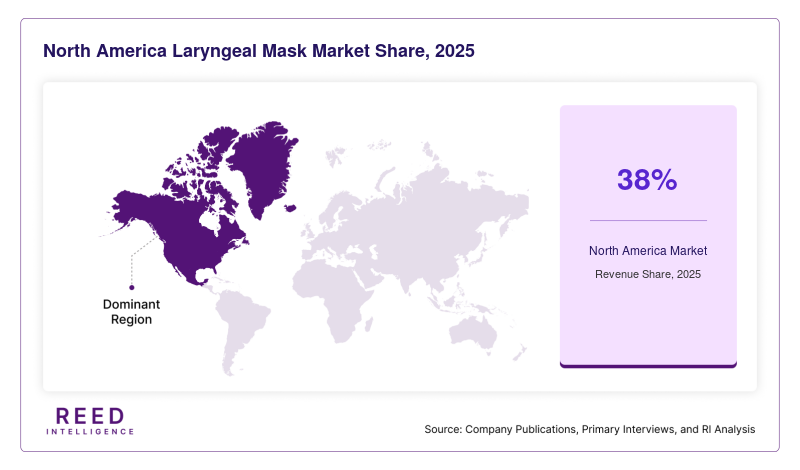
North America accounted for approximately 38% of the global Laryngeal Mask Market share in 2025. The region is expected to grow at a CAGR of 6.2% during the forecast period. The presence of advanced healthcare infrastructure, high surgical volumes, and strong adoption of innovative medical devices contributed to its dominant position.
The United States remained the leading country in this region, driven by high healthcare spending and continuous adoption of advanced anesthesia technologies. The increasing number of outpatient surgeries and emphasis on patient safety have further supported market growth.
Europe
Europe held a 27% market share in 2025 and is projected to grow at a CAGR of 6.5% from 2026 to 2034. The region benefits from well-established healthcare systems and increasing demand for efficient airway management devices.
Germany emerged as the dominant country, supported by its strong healthcare infrastructure and growing number of surgical procedures. The country’s focus on improving clinical outcomes has driven the adoption of advanced laryngeal masks.
Asia Pacific
Asia Pacific accounted for 20% of the market share in 2025 and is expected to witness the fastest CAGR of 8.2% during the forecast period. Rapid healthcare development and increasing surgical volumes have contributed to market growth.
China led the regional market due to its large patient population and expanding healthcare infrastructure. Government initiatives to improve healthcare access and increasing investments in medical technologies have further accelerated growth.
Middle East & Africa
The Middle East & Africa region held a 9% share in 2025 and is projected to grow at a CAGR of 6.9%. Improving healthcare facilities and increasing awareness of advanced medical devices are driving market expansion.
Saudi Arabia dominated the region, supported by significant investments in healthcare infrastructure and growing demand for modern surgical equipment.
Latin America
Latin America accounted for 6% of the market share in 2025 and is expected to grow at a CAGR of 6.7%. The region is witnessing gradual improvements in healthcare systems and increasing adoption of advanced medical devices.
Brazil led the regional market due to its expanding healthcare sector and increasing number of surgical procedures, which have driven demand for laryngeal masks.
Competitive Landscape
The Laryngeal Mask Market is moderately competitive, with several global and regional players focusing on product innovation and expansion strategies. Leading companies are investing in research and development to enhance product performance and meet evolving clinical requirements.
Teleflex Incorporated is recognized as a key market leader, offering a broad portfolio of airway management devices. The company has recently introduced advanced second-generation laryngeal masks with improved sealing and safety features, strengthening its market position. Other players are also focusing on strategic collaborations and product launches to expand their presence in emerging markets.
Key Players List
- Teleflex Incorporated
- Medtronic plc
- Ambu A/S
- Smiths Medical
- Intersurgical Ltd.
- Vyaire Medical, Inc.
- Flexicare Medical Ltd.
- Mercury Medical
- SunMed LLC
- Well Lead Medical Co., Ltd.
- Henan Tuoren Medical Device Co., Ltd.
- Besmed Health Business Corp.
- Armstrong Medical Ltd.
- GaleMed Corporation
- Narang Medical Limited
Recent Developments
- Teleflex Incorporated launched an upgraded laryngeal mask with enhanced cuff design for improved sealing efficiency.
- Ambu A/S introduced a new line of disposable airway management devices targeting infection control needs.
- Medtronic plc expanded its distribution network in Asia Pacific to strengthen regional presence.
- Intersurgical Ltd. developed advanced materials to improve device flexibility and patient comfort.
- Smiths Medical focused on strategic partnerships to enhance product accessibility in emerging markets.
Laryngeal Mask Market Segments
Type
- Reusable Laryngeal Masks
- Disposable Laryngeal Masks
Material
- Silicone
- PVC
- Others
Application
- Anesthesia
- Emergency Care
- Others
End-Use
- Hospitals
- Ambulatory Surgical Centers
- Clinics
By Region
- North America
- Europe
- APAC
- Middle East and Africa
- LATAM