Laser PCB Drilling Market Size, Share Demand Report By Equipment Type (CO₂ Laser Drilling Systems, UV Laser Drilling Systems, Others), By Application (Consumer Electronics, Automotive Electronics, Industrial Electronics, Healthcare Devices), By End-Use Industry (Electronics Manufacturing, Automotive, Healthcare, Telecommunications) By Region & Segment Forecasts, 2026–2034
USD 3950
Market Overview
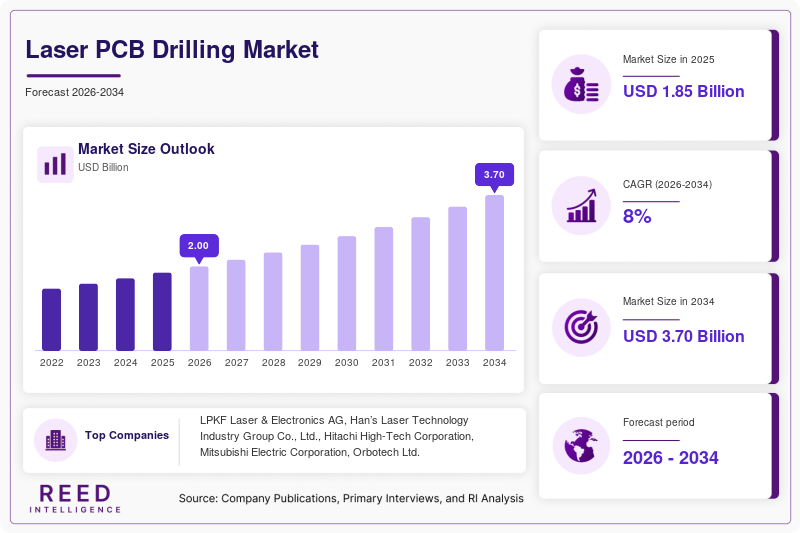
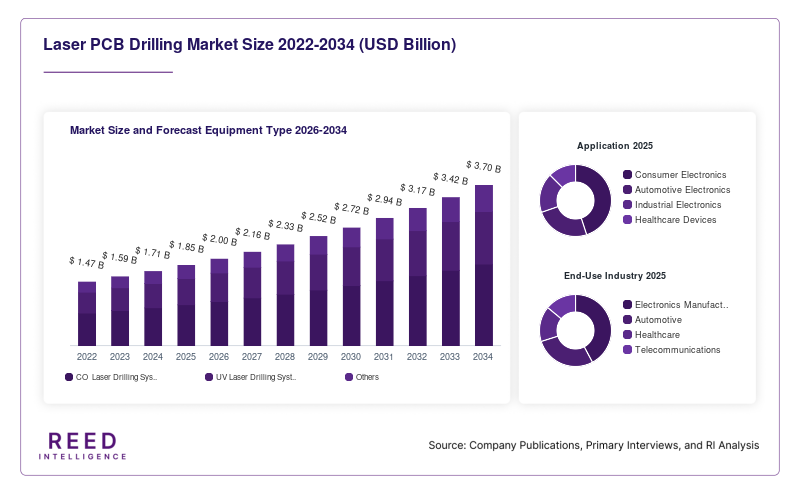
The Laser PCB Drilling Market size valued at USD 1.85 billion in 2026 and expected to reach USD 3.42 billion by 2034, expanding at a CAGR of 8.0% during 2026–2034. This growth trajectory reflects the increasing demand for high-precision drilling technologies in printed circuit board (PCB) manufacturing, particularly as electronics become more compact and complex across industries such as consumer electronics, automotive, telecommunications, and healthcare devices.
A key global factor supporting market growth is the rapid expansion of advanced electronics manufacturing driven by digital transformation and the proliferation of smart devices. The transition toward miniaturized components and high-density interconnect (HDI) PCBs has significantly increased the need for laser drilling solutions that offer superior accuracy, reduced material damage, and improved throughput compared to traditional mechanical drilling methods.
Key Highlights
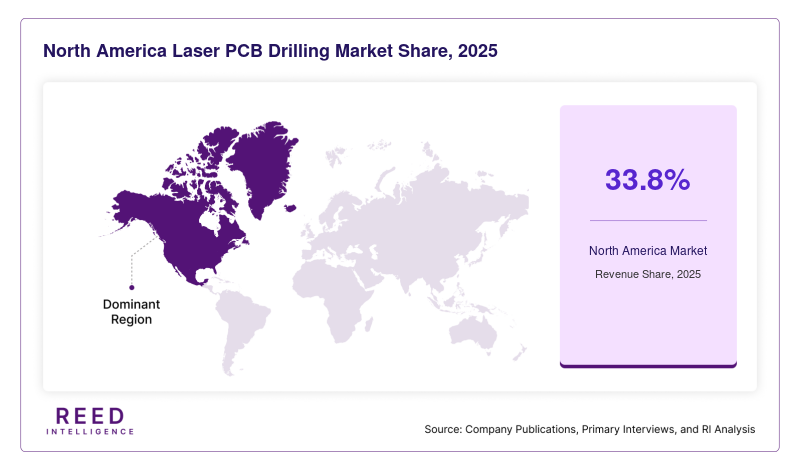
- North America dominated the market with a 33.8% share in 2025.
- Asia Pacific is expected to grow at the fastest CAGR of 9.6% during 2026–2034.
- By equipment type, CO₂ laser drilling systems accounted for the largest share of 41.2%, while UV laser systems are projected to grow at a CAGR of 10.3%.
- By application, consumer electronics led with a 39.5% share, whereas automotive electronics is expected to expand at a CAGR of 9.1%.
- The United States remained the dominant country, with market values of USD 520 million in 2024 and USD 565 million in 2025.
Market Trends
Increasing Adoption of High-Density Interconnect (HDI) Technology
The growing adoption of HDI PCB technology is a major trend shaping the Laser PCB Drilling Market. HDI boards require microvias with precise dimensions, which can only be effectively achieved through laser drilling systems. As smartphones, tablets, and wearable devices continue to shrink in size while increasing functionality, manufacturers are shifting toward HDI designs. Laser drilling ensures minimal thermal impact and high repeatability, which are critical for maintaining performance standards. Additionally, HDI PCBs support faster signal transmission and better electrical performance, further driving their demand. This trend is expected to sustain as industries prioritize compact and efficient electronic components, reinforcing the importance of advanced laser drilling technologies.
Integration of Automation and Smart Manufacturing
Another significant trend is the integration of laser drilling systems with automation and smart manufacturing frameworks. PCB manufacturers are increasingly adopting Industry 4.0 solutions, including robotics, real-time monitoring, and data analytics, to enhance productivity and reduce operational errors. Laser drilling equipment is being designed with advanced control systems that enable automated alignment, process optimization, and predictive maintenance. These capabilities reduce downtime and improve yield rates. Furthermore, integration with manufacturing execution systems allows seamless coordination across production lines. This trend is particularly prominent in large-scale manufacturing hubs, where efficiency and scalability are essential for meeting growing global demand.
Market Drivers
Rising Demand for Miniaturized Electronic Devices
The increasing demand for compact and lightweight electronic devices is a key driver of the Laser PCB Drilling Market. Modern consumer electronics, including smartphones, smartwatches, and wireless earbuds, require highly dense and multilayer PCBs with precise microvias. Laser drilling offers unmatched accuracy and the ability to create smaller holes without damaging surrounding materials. This capability is critical for achieving miniaturization while maintaining performance and reliability. As product innovation continues across consumer electronics and IoT devices, manufacturers are investing in advanced drilling technologies to meet design requirements, thereby driving market growth.
Expansion of Automotive Electronics Sector
The rapid expansion of automotive electronics is another major growth driver. Modern vehicles incorporate advanced electronic systems such as driver assistance systems, infotainment units, and electric powertrains. These systems rely on high-performance PCBs that require precise drilling solutions. Laser drilling enables the production of robust and reliable PCBs capable of withstanding harsh automotive environments. The shift toward electric vehicles and autonomous driving technologies further increases the complexity and volume of electronic components. As a result, automotive manufacturers are increasingly adopting laser drilling systems to enhance production efficiency and ensure quality standards.
Market Restraint
High Initial Investment and Operational Costs
One of the primary restraints in the Laser PCB Drilling Market is the high initial investment required for advanced laser drilling equipment. These systems involve sophisticated components, including high-precision lasers, control systems, and cooling mechanisms, which significantly increase capital expenditure. Small and medium-sized PCB manufacturers often face challenges in adopting such technologies due to budget constraints. Additionally, operational costs, including maintenance, energy consumption, and skilled labor requirements, further add to the financial burden.
The high cost factor can limit market penetration, especially in developing regions where manufacturers may rely on traditional mechanical drilling methods due to lower costs. Furthermore, the need for regular calibration and maintenance to ensure precision adds to operational complexities. For example, a mid-sized PCB manufacturer aiming to upgrade to laser drilling technology may require substantial investment not only in equipment but also in workforce training and facility upgrades. These factors can slow adoption rates and create barriers for new entrants, thereby restraining overall market growth.
Market Opportunities
Growth in Electric Vehicles and Renewable Energy Systems
The increasing adoption of electric vehicles (EVs) and renewable energy systems presents a significant opportunity for the Laser PCB Drilling Market. EVs require complex electronic systems, including battery management systems and power control units, which depend on high-quality PCBs. Laser drilling enables the production of precise and reliable PCBs suitable for these applications. Similarly, renewable energy systems such as solar inverters and wind turbines rely on advanced electronics. As governments worldwide promote clean energy initiatives, the demand for high-performance PCBs is expected to rise, creating new growth avenues for laser drilling technologies.
Advancements in Flexible and Wearable Electronics
The growing market for flexible and wearable electronics offers another promising opportunity. Devices such as fitness trackers, smart clothing, and medical wearables require flexible PCBs that can withstand bending and stretching. Laser drilling is well-suited for processing flexible substrates without causing damage. As healthcare monitoring and consumer electronics continue to evolve, the demand for flexible PCBs is expected to increase. This trend encourages manufacturers to adopt laser drilling systems capable of handling diverse materials and complex designs, thereby expanding market potential.
Segmental Analysis
By Equipment Type
The CO₂ laser drilling systems segment dominated the market in 2024, accounting for approximately 41.2% of the total share. These systems are widely used due to their efficiency in drilling larger holes and processing a variety of materials. CO₂ lasers offer cost-effective solutions for high-volume production, making them suitable for standard PCB manufacturing processes. Their ability to deliver consistent performance and reliability has made them a preferred choice among manufacturers. Additionally, the widespread availability of CO₂ laser systems and their compatibility with existing production lines contribute to their dominant position in the market.
UV laser drilling systems are expected to be the fastest-growing subsegment, with a projected CAGR of 10.3% during the forecast period. These systems provide higher precision and are capable of drilling smaller microvias required for advanced PCBs. The growth of this subsegment is driven by increasing demand for HDI boards and flexible circuits. UV lasers minimize thermal damage, making them suitable for delicate materials. As industries continue to prioritize miniaturization and performance, the adoption of UV laser drilling systems is expected to increase significantly.
By Application
The consumer electronics segment held the largest market share in 2024, accounting for 39.5%. This dominance is attributed to the high demand for smartphones, laptops, and wearable devices. These products require compact and efficient PCBs, which rely on precise drilling technologies. Laser drilling systems enable manufacturers to meet the design requirements of modern electronic devices while maintaining production efficiency. The continuous innovation in consumer electronics further supports the growth of this segment.
Automotive electronics is projected to be the fastest-growing application segment, with a CAGR of 9.1%. The increasing integration of electronic systems in vehicles, including electric and autonomous vehicles, drives this growth. Laser drilling ensures the production of reliable PCBs capable of handling complex automotive applications. As the automotive industry continues to evolve, the demand for advanced PCB solutions is expected to rise, boosting the adoption of laser drilling technologies.
By End-Use Industry
The electronics manufacturing industry dominated the market in 2024, holding a significant share. This segment includes companies involved in the production of consumer electronics, telecommunications equipment, and industrial devices. The demand for high-quality PCBs in these industries drives the adoption of laser drilling systems. Manufacturers rely on these technologies to achieve precision, efficiency, and scalability in production processes.
The healthcare industry is expected to be the fastest-growing end-use segment, with a CAGR of 8.8%. The increasing use of electronic devices in medical applications, such as diagnostic equipment and wearable health monitors, drives this growth. Laser drilling enables the production of reliable and compact PCBs required for medical devices. As healthcare technology continues to advance, the demand for precision manufacturing solutions is expected to increase, creating opportunities for market expansion.
Regional Analysis
North America
North America held a significant share of the Laser PCB Drilling Market, accounting for approximately 33.8% in 2025. The region is expected to maintain steady growth with a CAGR of 7.5% during the forecast period. This growth is supported by strong demand from the consumer electronics and automotive sectors, along with continuous technological advancements in manufacturing processes. The presence of established PCB manufacturers and early adoption of advanced laser technologies contribute to the region’s stable market position.
The United States dominates the regional market, driven by its robust electronics manufacturing ecosystem. A key growth factor is the increasing investment in defense and aerospace electronics, which require highly reliable PCBs. These applications demand precision drilling technologies, making laser drilling an essential component of production processes.
Europe
Europe accounted for a notable share of the market in 2025 and is projected to grow at a CAGR of 7.2% through 2034. The region’s growth is influenced by the strong presence of automotive manufacturers and increasing adoption of advanced electronics in industrial applications. European companies are focusing on sustainable manufacturing practices, which also supports the use of efficient laser drilling technologies.
Germany leads the European market, supported by its well-established automotive industry. A unique growth factor is the country’s emphasis on electric vehicle production, which requires advanced PCB solutions. This drives demand for laser drilling systems capable of producing high-performance components.
Asia Pacific
Asia Pacific is the fastest-growing region, expected to register a CAGR of 9.6% during the forecast period. The region’s dominance in electronics manufacturing and the presence of major PCB producers contribute to its rapid growth. Countries such as China, Japan, and South Korea play a crucial role in driving demand for laser drilling technologies.
China stands out as the dominant country in the region. A key growth factor is the large-scale production of consumer electronics, which requires high-density PCBs. The country’s focus on expanding its semiconductor and electronics industries further accelerates the adoption of laser drilling systems.
Middle East & Africa
The Middle East & Africa region is witnessing gradual growth, with a moderate CAGR expected through 2034. The market is driven by increasing investments in infrastructure and industrial development. Although the region currently holds a smaller share, it presents potential opportunities for expansion as technological adoption increases.
The United Arab Emirates leads the regional market. A unique growth factor is the country’s investment in smart city projects, which require advanced electronic systems. This drives demand for high-quality PCBs and associated manufacturing technologies.
Latin America
Latin America holds a modest share of the Laser PCB Drilling Market and is projected to grow at a CAGR of 6.8% during the forecast period. The region’s growth is supported by increasing industrialization and rising demand for consumer electronics. However, limited technological infrastructure may pose challenges.
Brazil is the dominant country in the region. A key growth factor is the expanding electronics manufacturing sector, supported by government initiatives to promote local production. This encourages the adoption of advanced technologies, including laser drilling systems.
Competitive Landscape
The Laser PCB Drilling Market is characterized by the presence of several established players focusing on technological innovation and strategic collaborations. Companies are investing in research and development to enhance the precision, efficiency, and automation capabilities of their laser drilling systems. The competitive environment is shaped by continuous advancements in laser technology and the integration of smart manufacturing solutions.
One of the leading companies in the market is LPKF Laser & Electronics AG, known for its advanced laser drilling solutions. The company has recently introduced new systems with improved automation features, enabling higher production efficiency. Other key players are also focusing on expanding their product portfolios and strengthening their global presence through partnerships and acquisitions. The competitive landscape remains dynamic, with companies striving to gain a competitive edge through innovation and customer-centric solutions.
Key Players List
- LPKF Laser & Electronics AG
- Han’s Laser Technology Industry Group Co., Ltd.
- Hitachi High-Tech Corporation
- Mitsubishi Electric Corporation
- Orbotech Ltd.
- Schmoll Maschinen GmbH
- Posalux SA
- Excellon Automation Co.
- Tongtai Machine & Tool Co., Ltd.
- Shenzhen Sunshine Laser & Electronics Technology Co., Ltd.
- EO Technics Co., Ltd.
- Via Mechanics Ltd.
- Hanwha Precision Machinery
- Coherent Inc.
- IPG Photonics Corporation
Recent Developments
- In 2025, LPKF Laser & Electronics AG launched a new high-speed laser drilling system designed for HDI PCB production.
- In 2024, Han’s Laser Technology Industry Group introduced an advanced UV laser platform with enhanced precision capabilities.
- In 2025, Mitsubishi Electric Corporation expanded its laser solutions portfolio to support flexible PCB manufacturing.
Laser PCB Drilling Market Segments
Equipment Type
- CO₂ Laser Drilling Systems
- UV Laser Drilling Systems
- Others
Application
- Consumer Electronics
- Automotive Electronics
- Industrial Electronics
- Healthcare Devices
End-Use Industry
- Electronics Manufacturing
- Automotive
- Healthcare
- Telecommunications
By Region
- North America
- Europe
- APAC
- Middle East and Africa
- LATAM