Latam Cosmetic Preservative Market Size, Share & Demand Report By Product Type (Paraben Alternatives & Blended Systems, Organic Acids & Salts, Phenoxyethanol-Based Systems, Alcohols & Glycols, Others), By Application (Skin Care, Hair Care, Color Cosmetics, Toiletries, Natural Cosmetics), By Source (Synthetic, Naturally Derived), By Country & Segment Forecasts, 2026–2034
USD 3950
Market Overview
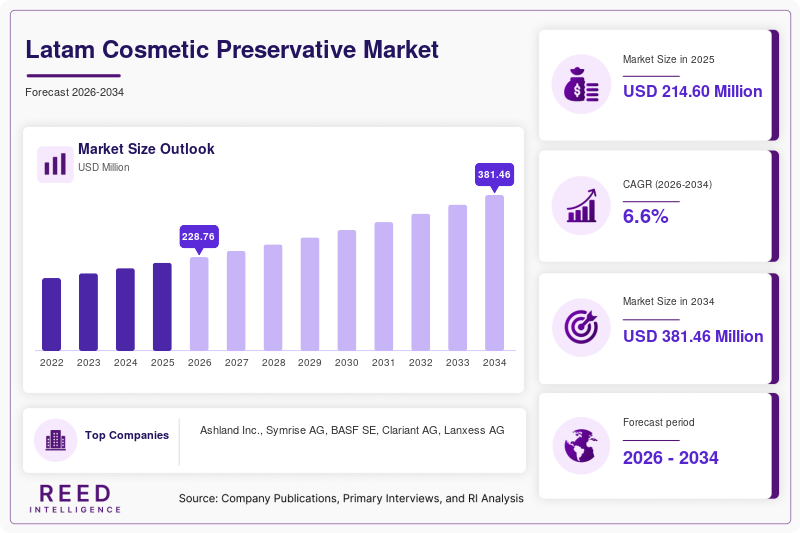
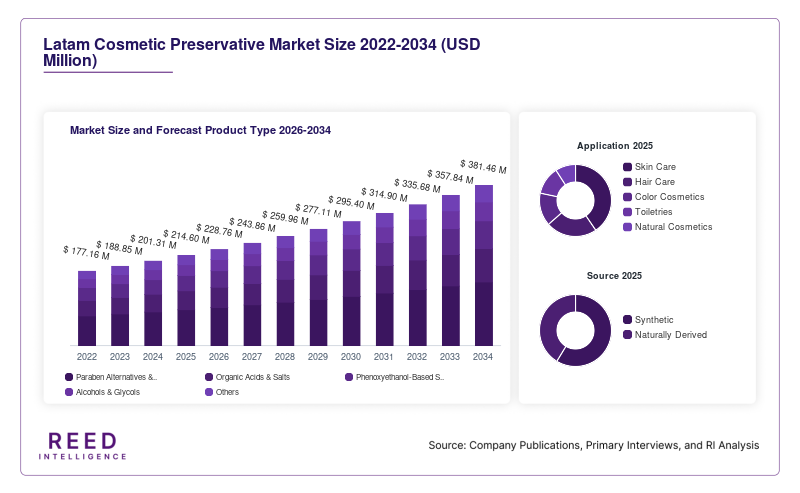
The Latam Cosmetic Preservative Market size was valued at USD 214.6 million in 2026 and is projected to reach USD 356.8 million by 2034, expanding at a CAGR of 6.6% during 2026–2034. Cosmetic preservatives are essential ingredients used to inhibit microbial growth, extend shelf life, and maintain product safety in creams, lotions, shampoos, makeup, deodorants, and personal hygiene products. In Latin America, rising urbanization, increasing disposable income, and stronger consumer awareness regarding product quality are supporting steady demand for advanced preservation systems across mass-market and premium beauty categories.
A major global factor supporting growth has been the continued expansion of skincare and hygiene consumption after the pandemic era. Consumers worldwide now prioritize safe formulations, stable products, and longer-lasting packaging formats. This trend has encouraged regional manufacturers to upgrade ingredient systems and adopt multifunctional preservatives that deliver microbial protection while aligning with mildness and clean-label preferences.
Key Highlights
- Latin America dominated the market landscape with a 41.8% share in 2025.
- Asia Pacific is expected to grow at the fastest CAGR of 7.9% during 2026–2034.
- By product type, parabens alternatives and blended systems accounted for the largest share of 36.4%, while organic acids & salts are projected to grow at a CAGR of 8.1%.
- By application, skin care products led with a 39.6% share, whereas natural cosmetics are expected to expand at a CAGR of 8.5%.
- By function source, synthetic preservatives remained dominant with 58.2% share, while naturally derived preservatives are forecast to grow at 8.8% CAGR.
- Brazil remained the dominant country, with market values of USD 78.5 million in 2024 and USD 83.7 million in 2025.
Market Trends
Shift Toward Mild and Naturally Derived Preservation Systems
Beauty brands across Latin America are reformulating products to meet rising consumer demand for ingredient transparency. Buyers increasingly check labels for claims such as paraben-free, formaldehyde-free, alcohol-balanced, and sensitive-skin friendly. This has accelerated the use of organic acids, glycols, fermented extracts, multifunctional humectants, and plant-derived antimicrobial blends. Preservative suppliers are responding with broad-spectrum systems that maintain performance while reducing irritation concerns. The trend is particularly visible in facial care, baby care, and premium hair care categories where brand trust strongly influences purchasing decisions and reformulation cycles are shorter.
Growth of Water-Light and Hybrid Cosmetic Formats
Manufacturers are introducing water-light gels, serum sticks, masks, refill packs, and hybrid cosmetic products that combine makeup with skincare benefits. These formats often require customized preservation strategies because of changing water activity, packaging exposure, and ingredient interactions. As a result, demand is rising for flexible preservative blends compatible with actives such as niacinamide, peptides, botanical oils, and color pigments. Regional contract manufacturers are investing in stability testing and challenge testing to support these launches. This trend is expanding value opportunities for specialty preservative suppliers rather than only commodity ingredient providers.
Market Drivers
Expansion of Regional Beauty and Personal Care Consumption
Latin America has a strong beauty culture, with frequent consumption of fragrances, hair care, skin care, and color cosmetics across multiple income groups. Growing middle-class populations and organized retail channels continue to widen product access. Modern trade stores, pharmacies, salons, and e-commerce platforms have improved product reach beyond major cities. As cosmetic output increases, the need for reliable preservative ingredients also rises because every water-based formulation requires microbial protection. This demand is especially strong in shampoos, conditioners, body lotions, face creams, and liquid makeup categories with recurring purchase cycles.
Increasing Regulatory Focus on Product Safety
Authorities and industry associations across the region are placing greater emphasis on safety standards, labeling accuracy, and manufacturing quality. Producers must ensure products remain stable throughout transport, storage, and consumer use in varied climates. Latin America includes tropical and humid markets where contamination risks can be higher, making preservation performance especially important. Companies are therefore adopting validated preservative systems, better packaging compatibility testing, and standardized microbial challenge procedures. This regulatory and quality focus supports consistent replacement demand as brands update legacy formulas to meet modern compliance expectations.
Market Restraint
Cost Pressure and Reformulation Complexity
The market faces restraint from volatile raw material costs and the technical complexity of replacing older low-cost preservative systems. Many small and mid-sized cosmetic producers operate under narrow margins and compete heavily on price. Premium alternatives, multifunctional blends, and naturally derived systems often increase formulation costs while requiring new stability tests, packaging checks, and shelf-life validation. If a preservative interacts poorly with fragrance, emulsifiers, or botanical extracts, the product may need full reformulation. This can delay launches and reduce profitability. For example, regional indie brands seeking paraben-free claims often experience higher production costs and shorter pilot timelines, limiting rapid adoption.
Market Opportunities
Rising Demand for Natural and Clean Beauty Brands
The fast growth of natural skincare, vegan cosmetics, sulfate-free shampoos, and eco-positioned products creates a strong opportunity for advanced preservation technologies. Brands in Brazil, Mexico, Chile, and Colombia increasingly market botanical ingredients and minimalist formulas. However, products with aloe vera, fruit extracts, floral waters, and proteins remain highly vulnerable to microbial growth. This creates demand for naturally derived antimicrobials, hurdle technology systems, and multifunctional ingredients that preserve while moisturizing or boosting sensory appeal. Suppliers that provide efficacy data and certification support are well positioned to gain share.
Expansion of Local Manufacturing and Private Label
Retail chains, pharmacies, supermarkets, and online marketplaces are expanding private-label beauty offerings across Latin America. At the same time, regional contract manufacturers are increasing production capacity for domestic and export brands. These developments create opportunities for preservative suppliers that can deliver technical support, rapid sampling, and cost-effective customized blends. Private-label brands typically require scalable ingredients with dependable performance across multiple SKUs. Vendors offering localized warehousing, faster lead times, and regulatory documentation can capture growing business as manufacturing footprints deepen throughout the region.
Segmental Analysis
By Product Type
Paraben alternatives and blended systems held the dominant 2024 share of 36.4%. These solutions combine proven antimicrobial performance with better consumer acceptance than traditional single-ingredient systems. They are widely used in creams, lotions, shampoos, and liquid soaps because formulators need broad-spectrum protection across bacteria, yeast, and mold. Blended systems also simplify manufacturing by reducing separate ingredient additions. In Latin America, mass-market producers favor these options because they balance cost, efficacy, and shelf-life requirements in humid climates and long retail distribution networks.
Organic acids and salts are projected to grow at the fastest CAGR of 8.1% through 2034. Ingredients such as sorbates, benzoates, levulinates, and anisates are increasingly used in clean-label and natural-positioned products. Their growth is supported by rising demand for baby care, facial serums, and mild formulations. Although pH compatibility can be a technical limitation, suppliers are improving buffered blends and multifunctional systems that widen application scope. This makes them attractive for premium brands seeking alternative preservation strategies.
By Application
Skin care products accounted for the largest 2024 share of 39.6%. Moisturizers, cleansers, toners, sunscreens, and anti-aging creams often contain water, botanical extracts, proteins, and active ingredients that require effective preservation. Frequent daily use and longer bathroom storage conditions further increase contamination risk after opening. Latin America’s rising interest in facial care routines, sun protection, and dermocosmetics continues to support strong preservative consumption in this category. Premiumization trends also raise demand for sensory-friendly systems with low odor and good compatibility.
Natural cosmetics are expected to register the fastest CAGR of 8.5% over the forecast period. Consumers increasingly seek vegan, botanical, cruelty-free, and eco-conscious products. These formulas often include plant waters, fruit extracts, and low-synthetic ingredient counts, which can create preservation challenges. As a result, brands require innovative systems using organic acids, glycols, fermentation derivatives, and hurdle approaches. E-commerce growth helps smaller natural brands scale quickly, accelerating ingredient demand across regional markets.
By Source
Synthetic preservatives maintained the leading 2024 share of 58.2% because of cost efficiency, broad efficacy, predictable stability, and long commercial familiarity. Large-volume categories such as shampoos, body washes, deodorants, and household-adjacent personal care products continue to rely on synthetic systems for dependable microbial control. Many regional manufacturers prefer these options due to easier sourcing and established processing guidelines. For economy brands, price sensitivity remains a decisive factor that supports synthetic ingredient demand.
Naturally derived preservatives are forecast to grow at the fastest CAGR of 8.8% through 2034. Demand is driven by label-conscious consumers and premium positioning strategies. These ingredients include fermentation extracts, caprylyl-based boosters, plant-origin aromatic compounds, and organic acid derivatives. Growth is strongest where brands emphasize sensitive-skin, green beauty, or dermatologist-tested claims. As supply chains improve and efficacy data becomes stronger, adoption is expected to widen beyond niche brands into mainstream portfolios.
Regional Analysis
North America
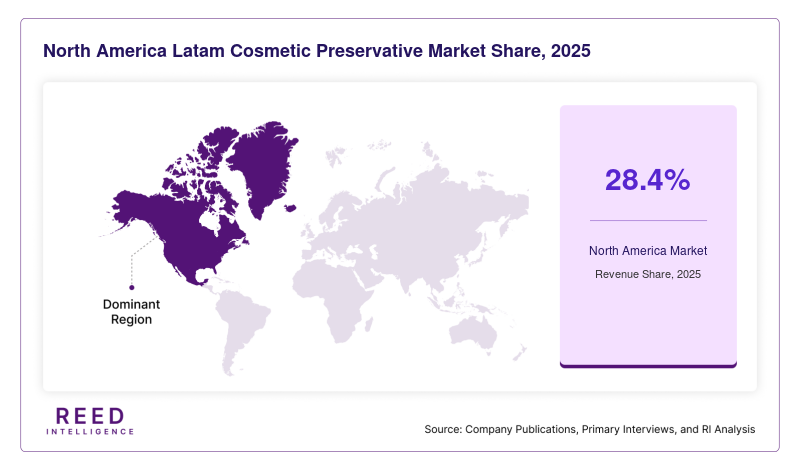
North America held 28.4% of the global market in 2025 and is forecast to grow at a CAGR of 5.7% through 2034. Mature cosmetic manufacturing, strong premium beauty demand, and established compliance systems support steady preservative consumption. The region shows high demand for multifunctional and low-irritation ingredients used in prestige skincare, dermatology-led cosmetics, and salon-grade hair products.
The United States remains the dominant country due to its large personal care industry and high product innovation intensity. A unique growth factor is rapid indie-brand creation through digital channels, which increases demand for outsourced formulation and preservation solutions. Small brands often seek fast, compliant ingredient systems for limited-batch launches.
Europe
Europe accounted for 26.1% share in 2025 and is expected to expand at a CAGR of 5.4%. The region remains important because of premium cosmetics exports, advanced R&D capabilities, and strong consumer preference for ingredient transparency. Demand is concentrated in skin care, anti-aging creams, and fragrance-linked body care formats requiring stable preservation systems.
Germany leads the regional market due to its chemical manufacturing base and formulation expertise. A unique growth factor is the region’s emphasis on sustainability certifications and eco-design packaging. These initiatives encourage new preservative systems compatible with recyclable packs, reduced-water formulas, and sensitive-skin claims.
Asia Pacific
Asia Pacific represented 24.7% of the market in 2025 and is projected to grow at the fastest CAGR of 7.9%. Rapid urbanization, large youth populations, and rising daily skincare usage are driving strong demand. The region is also a major production center for contract manufacturing and cross-border beauty exports.
China dominates regional revenue because of scale, manufacturing depth, and broad category demand. A unique growth factor is fast product cycle turnover, with brands launching seasonal and trend-driven SKUs quickly. This favors preservative suppliers that can support rapid testing and versatile formulations.
Middle East & Africa
Middle East & Africa held 8.6% share in 2025 and is forecast to grow at a CAGR of 6.1%. Demand is supported by rising hygiene awareness, premium fragrance layering culture, and increasing retail modernization. Climate conditions in several countries make product stability and shelf-life especially important, supporting preservative usage.
The United Arab Emirates is the leading market due to strong retail networks and premium import demand. A unique growth factor is tourism-led beauty retail sales, which increase movement of cosmetics across channels and favor products with dependable storage stability in warm environments.
Latin America
Latin America captured 12.2% of the global market in 2025 and is anticipated to grow at a CAGR of 6.6% through 2034. Strong beauty engagement, expanding pharmacy chains, and a growing salon ecosystem continue to support preservative demand. Hair care, deodorants, body lotions, and sun care are major consumption categories.
Brazil leads the region by a wide margin due to its large domestic cosmetics industry and diversified consumer base. A unique growth factor is the popularity of climate-specific products such as anti-frizz hair care, sweat-control products, and sun protection ranges that require robust formulation stability.
Competitive Landscape
The Latam Cosmetic Preservative Market is moderately consolidated, with global specialty chemical companies competing alongside regional distributors and formulation specialists. Leading participants focus on regulatory support, multifunctional blends, fast technical service, and localized inventory. Price competition exists in standard preservative systems, while premium margins are stronger in naturally derived and customized blends.
Ashland remains a market leader due to its broad cosmetic ingredient portfolio and strong technical support network in Latin America. A recent development includes expanded multifunctional preservative offerings for sulfate-free hair care and mild skincare formulas. Symrise continues to strengthen its presence through sensory-compatible preservation systems and fragrance-linked formulation support. BASF leverages scale advantages and integrated supply chains. Clariant focuses on sustainable personal care solutions and naturally positioned ingredients. Lanxess remains active in antimicrobial chemistry with performance-oriented solutions for rinse-off and leave-on products.Regional distributors increasingly partner with these multinationals to improve customer reach, reduce lead times, and provide formulation labs for local brands.
Key Players List
- Ashland
- Symrise
- BASF
- Clariant
- Lanxess
- Evonik Industries
- Lonza
- Arxada
- Schülke & Mayr
- Sharon Personal Care
- Dow
- Croda International
- Solvay
- Innospec
- Galaxy Surfactants
- Brenntag Specialties
- IMCD
- Stepan Company
Recent Developments
- Ashland launched a new multifunctional preservative blend designed for low-pH skincare and serum applications in Latin America.
- Symrise expanded regional technical service capabilities to support faster challenge testing and formulation troubleshooting.
- BASF introduced updated preservative guidance tools for clean beauty brands seeking alternative systems with broad-spectrum efficacy
Latam Cosmetic Preservative Market Segments
Product Type
- Paraben Alternatives & Blended Systems
- Organic Acids & Salts
- Phenoxyethanol-Based Systems
- Alcohols & Glycols
- Others
Application
- Skin Care
- Hair Care
- Color Cosmetics
- Toiletries
- Natural Cosmetics
Source
- Synthetic
- Naturally Derived
Country
- Brazil
- Mexico
- Argentina
- Chile
- Colombia
- Rest of Latin America
By Region
- North America
- Europe
- APAC
- Middle East and Africa
- LATAM