Laundry Detergent Pods Market Size, Share & Trends Analysis Report by Type, Application, Distribution Channel, and Region, Forecasts, 2026–2034
USD 3950
Laundry Detergent Pods Market Size
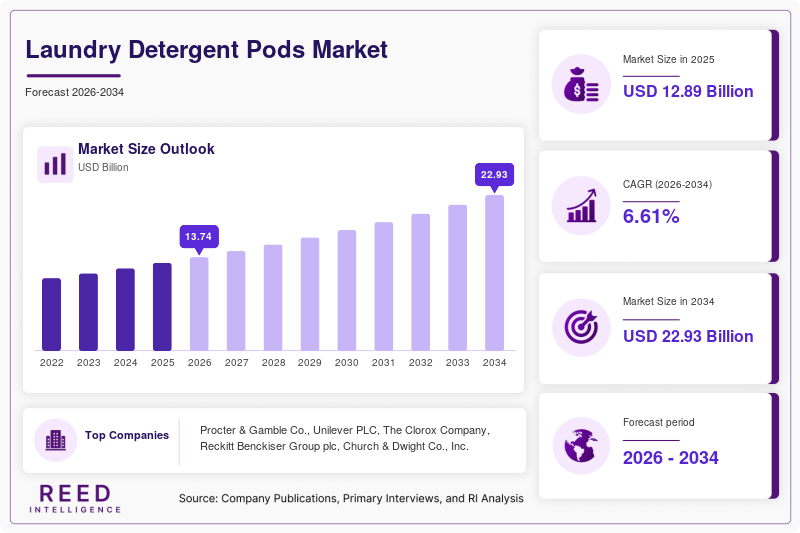
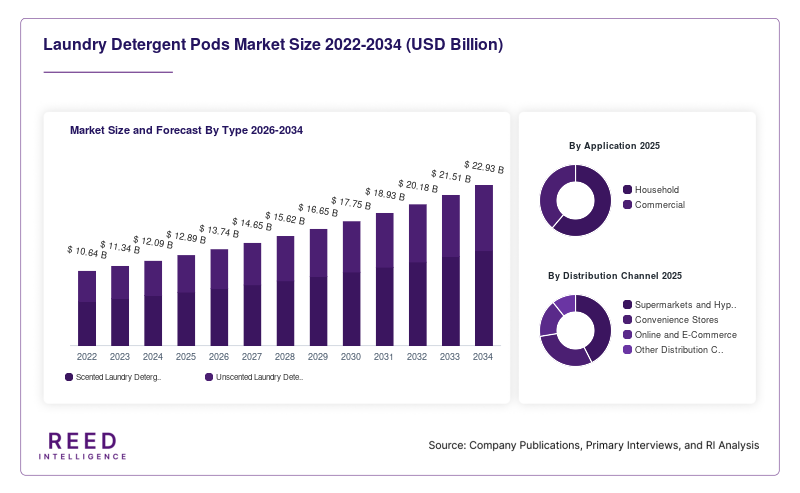
The global laundry detergent pods market size was valued at USD 12.89 billion in 2025 and is projected to grow from USD 13.74 billion in 2026 to USD 22.93 billion by 2034, registering a CAGR of 6.61% during the forecast period from 2026 to 2034.
The laundry detergent pods market comprises concentrated laundry-cleaning products packaged in pre-measured, water-soluble capsules or pouches. These products are designed to simplify detergent dosing, reduce handling mess, and provide a convenient alternative to traditional powder and liquid detergents. Depending on the formulation, pods may combine cleaning agents, fragrances, stain-removal ingredients, fabric-care components, and other additives in a single-dose format.
Demand is influenced by changing household routines, convenience-oriented purchasing, washing-machine adoption, consumer preferences for fragrance and cleaning performance, and the availability of products through supermarkets and online retailers. Laundry detergent pods are used primarily in residential laundry, while specialized products and formats may also serve selected commercial laundry applications.
Laundry Detergent Pods Market Drivers
Convenience and precise dosing: Pre-measured capsules simplify detergent use and reduce the need to measure liquid or powder products for each wash.
Growth in automatic washing-machine use: Laundry pods are positioned for convenient use in compatible washing machines, supporting demand among consumers who prioritize ease of use and consistent dosing.
Demand for premium laundry care: Fragrance options, concentrated formulations, multi-chamber designs, and specialized variants create opportunities for product differentiation and premium positioning.
Expansion of modern retail and e-commerce: Wider distribution through supermarkets, hypermarkets, online stores, and other retail channels improves product accessibility and supports multipack purchasing.
Laundry Detergent Pods Market Restraints
Higher cost per wash in some products: Pods may cost more per load than selected powder or liquid alternatives, making price-sensitive consumers more likely to choose conventional detergent formats.
Child-safety and accidental-exposure concerns: Concentrated detergent capsules require careful storage, clear labeling, and appropriate packaging to reduce the risk of accidental exposure, particularly among children.
Dissolution and washing-condition limitations: Performance can vary with water temperature, washing conditions, machine settings, storage, and formulation. Poor dissolution or residue may affect consumer satisfaction.
Environmental concerns regarding films and packaging: The environmental impact of water-soluble films, plastic packaging, and detergent ingredients remains a consideration for consumers and manufacturers. Product claims need to reflect verified material and disposal characteristics.
Laundry Detergent Pods Market Opportunities
Growth in specialized formulations: Fragrance-free, dye-free, sensitive-skin-oriented, and other differentiated formulations can serve consumers seeking specific product attributes.
Innovation in pod technology: Multi-chamber capsules, improved dissolution, concentrated formulations, and packaging improvements offer opportunities to differentiate products through functionality and usability.
Expansion in emerging markets: Rising access to modern retail and online shopping creates opportunities, although affordability, washing-machine ownership, and established detergent preferences influence adoption.
Commercial laundry applications: Selected hospitality, healthcare, and institutional laundry operations may offer opportunities for appropriate pod formats, subject to operational requirements, product suitability, and procurement economics.
Laundry Detergent Pods Market Segmental Analysis
By Type
Scented laundry detergent pods represent the dominant type segment, accounting for approximately 68% of the market, according to Fortune Business Insights. Fragrance is an important consumer-facing product attribute, and scented products allow manufacturers to differentiate offerings through fragrance profiles, scent longevity, and combinations with other laundry-care features. Product availability across mass-market and premium ranges also supports their position.
Unscented pods serve consumers who prefer detergents without added fragrance or who seek products positioned for particular laundry-care needs. Manufacturers can differentiate these products through formulation transparency, clear labeling, and performance claims supported by product testing. The exact fastest-growing type segment and its CAGR were not independently established from the available source; therefore, a numerical growth rate for unscented pods is not stated.
By Application
Household applications dominate the market, accounting for approximately 74% of market share, according to Fortune Business Insights. Residential consumers use detergent pods for regular clothing, towels, bedding, and other washable household textiles. Pre-measured dosing, compact storage, ease of handling, and access to established brands contribute to their appeal.
Commercial applications include selected hospitality, institutional, and other laundry operations where pre-measured products may simplify dosing and inventory handling. Adoption depends on cost per wash, laundry volume, machine compatibility, procurement requirements, and operational procedures. The available source does not establish a comparable application-specific CAGR, so the fastest-growing application cannot be assigned a verified numerical rate.
By Distribution Channel
Supermarkets and hypermarkets provide broad brand selection, multipack options, promotions, and convenient access to routine household cleaning products. Their physical presence and established supply networks make them important sales channels for laundry detergent pods. Retailers can offer products across different pack sizes, fragrance variants, and price points.
Online and e-commerce channels enable consumers to compare products, read reviews, purchase larger packs, and arrange repeat deliveries. Convenience stores serve immediate and smaller-volume purchases, while other channels may include wholesalers and selected specialist retailers. Although online sales offer expansion opportunities, a verified channel-specific market-share breakdown and CAGR were not established from the available source.
Laundry Detergent Pods Market Regional Analysis
North America Laundry Detergent Pods Market
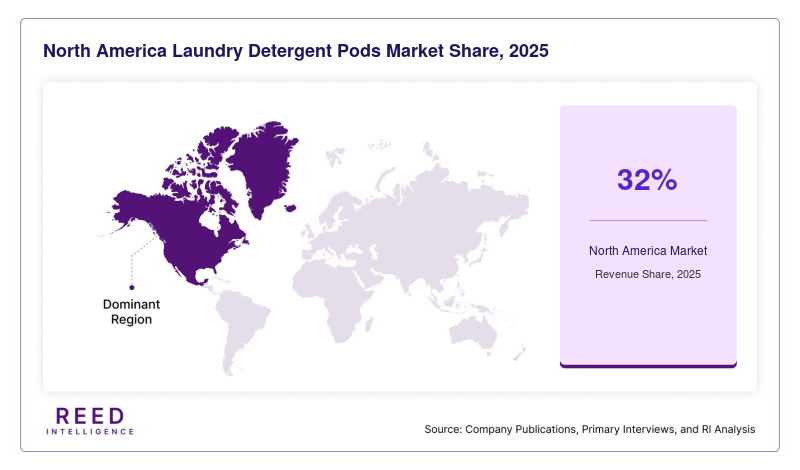
North America dominated the global laundry detergent pods market in 2025, accounting for approximately 32% of global market revenue, according to Fortune Business Insights. Demand is supported by established retail networks, consumer familiarity with unit-dose detergents, automatic washing-machine use, and the availability of products from major household-cleaning brands. The United States is a major market, while Canada contributes through household consumption and modern retail distribution.
Market opportunities include premium multi-chamber pods, fragrance variants, specialized formulations, concentrated products, and improved packaging. Supermarkets, hypermarkets, warehouse retailers, and e-commerce platforms provide access to a wide range of products. North America is the dominant region by market share in the cited assessment; a directly comparable regional CAGR was not provided in the available source.
Europe Laundry Detergent Pods Market
Europe accounted for approximately 27% of the global laundry detergent pods market in 2025, according to Fortune Business Insights. Demand is supported by established household-cleaning markets, broad retail distribution, and interest in convenient detergent formats. Consumers can choose from scented and unscented products, concentrated formulations, and specialized variants designed for different laundry preferences.
Manufacturers have opportunities to differentiate products through packaging improvements, concentrated formulations, fragrance options, and product performance in different washing conditions. Sustainability expectations also influence product development, although environmental benefits depend on the specific formulation and packaging. A directly comparable numerical CAGR for Europe was not available in the cited source.
Asia Pacific Laundry Detergent Pods Market
Asia Pacific represented approximately 29% of the global laundry detergent pods market in 2025, according to Fortune Business Insights. The region includes diverse markets with different levels of pod adoption, household spending, washing-machine penetration, and retail development. Expanding e-commerce, urbanization, and access to modern household products provide opportunities for manufacturers to broaden distribution.
Asia Pacific is identified as the fastest-expanding regional market in the cited assessment. Growth opportunities include affordable pack sizes, products designed for local washing habits, premium formulations, and expanded online availability. However, adoption varies across countries, and conventional powder and liquid detergents remain important alternatives. A precise regional CAGR was not stated in the available source, so no numerical growth rate is assigned.
Latin America Laundry Detergent Pods Market
Latin America's laundry detergent pods market is influenced by household laundry needs, retail development, purchasing power, and the availability of modern detergent formats. Market opportunities include expanding access through supermarkets and online stores, introducing different pack sizes, and developing products that balance convenience with affordability. Adoption varies across countries according to consumer preferences and the relative price of pods compared with powder and liquid detergents.
Manufacturers can target consumers seeking pre-measured dosing, fragrance options, and convenient product storage. Commercial opportunities may also arise in selected hospitality and laundry-service applications. A directly comparable regional market-share percentage and forecast CAGR for Latin America could not be confirmed from the cited market assessment.
Middle East & Africa Laundry Detergent Pods Market
The Middle East & Africa market includes countries with different household-product purchasing patterns, retail infrastructure, and levels of adoption of unit-dose detergents. Demand for laundry detergent pods is influenced by consumer awareness, product availability, affordability, washing practices, and the expansion of organized retail and e-commerce. Imported brands and local distribution arrangements also affect the range of products available to consumers.
Opportunities include convenient pack formats, fragrance-led product differentiation, and wider retail availability. Manufacturers must account for price sensitivity, distribution costs, storage conditions, and consumer familiarity with pod products. The cited source does not provide a directly comparable numerical market share or regional CAGR for Middle East & Africa.
Laundry Detergent Pods Market Competitive Landscape
The laundry detergent pods market is characterized by competition among multinational consumer-goods companies, established detergent brands, and specialized manufacturers. Companies compete through cleaning performance, fragrance, stain removal, convenience, brand recognition, distribution coverage, and price. Product development also focuses on concentrated formulations, multi-chamber technology, packaging safety, and compatibility with consumer laundry routines.
Procter & Gamble, through its Tide brand, is a prominent participant in the category. Other companies operating in laundry care include Unilever, Henkel, Church & Dwight, Reckitt, and The Clorox Company. Competition varies by country and product format, and company-level shares reported by individual research providers may use different market definitions. Fortune Business Insights identifies Procter & Gamble and Unilever among the major players in the laundry detergent pods market.
Key Market Players
- Procter & Gamble Co.
- Unilever PLC
- The Clorox Company
- Reckitt Benckiser Group plc
- Church & Dwight Co., Inc.
- Henkel AG & Co. KGaA
- Seventh Generation Inc.
- Dropps
- Ecozone
- IFB Industries Limited
Laundry Detergent Pods Market Recent Developments
September, 2026 Tide expands its Free & Gentle laundry-care range. Procter & Gamble announced Tide Fresh & Gentle with Coastal Oasis Scent, adding a light, dermatologist-tested fragrance option to its Free & Gentle range. The company stated that the product was developed for consumers seeking a combination of cleaning performance, a lighter fragrance, and a formulation designed for sensitive-skin consumers. The announcement concerns the broader laundry-detergent category rather than a confirmed laundry-pod launch.
April, 2026 P&G highlights concentrated laundry-product innovation. Procter & Gamble described its Tide evo detergent tile as a concentrated laundry-cleaning format developed without excess water or fillers and packaged in recyclable paper packaging. The company highlighted cold-water washing and packaging changes as elements of its product innovation approach. Tide evo is a related laundry-detergent format, not a conventional water-soluble detergent pod.
Laundry Detergent Pods Market Segments
By Type
- Scented Laundry Detergent Pods
- Unscented Laundry Detergent Pods
By Application
- Household
- Commercial
By Distribution Channel
- Supermarkets and Hypermarkets
- Convenience Stores
- Online and E-Commerce
- Other Distribution Channels
By Region
- North America
- Europe
- APAC
- Middle East and Africa
- LATAM