Law Enforcement Firefighting Protective Clothing Fabrics Market Size, Share & Trends Analysis Report By Fiber Type (Aramid, PBI, Modacrylic, Lenzing FR & Cellulosic Blends, FR-Treated Synthetic & Natural Blends), By Fabric Layer & Construction (Outer Shell, Moisture Barrier, Thermal Liner, Station & Wildland Fabrics, Composite & Specialty Fabrics), By Application (Structural Firefighting, Wildland Firefighting, Law Enforcement & Tactical, Hazmat & Special Response) and Forecasts, 2026–2034
USD 3950
Law Enforcement Firefighting Protective Clothing Fabrics Market Size
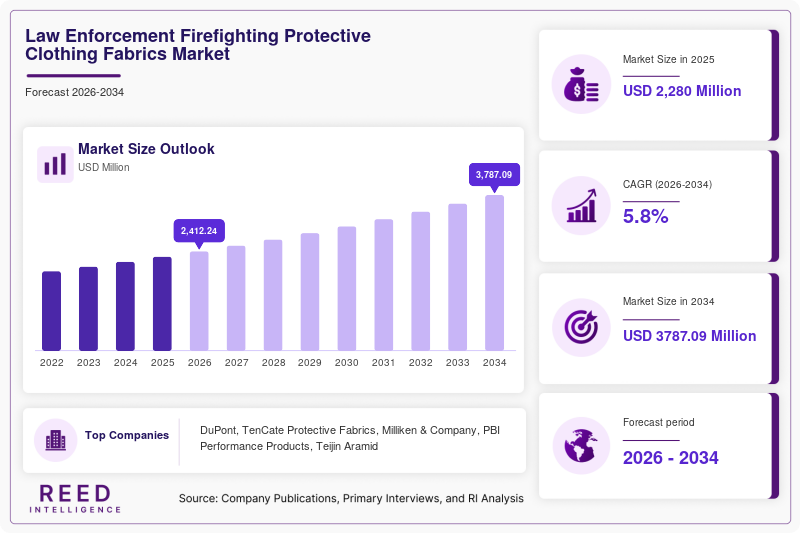
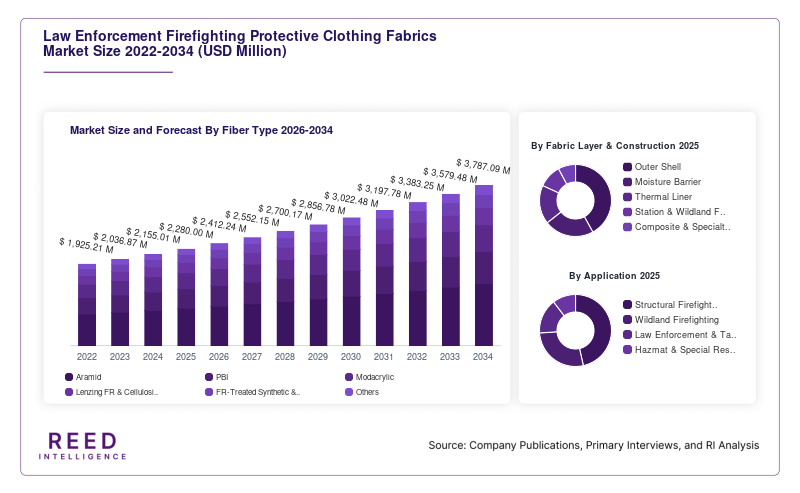
The global law enforcement firefighting protective clothing fabrics market is valued at USD 2,280 Million in 2025 and USD 2,412.24 Million in 2026. The market is projected to reach USD 3,787.09 Million by 2034, registering a 5.8% CAGR during the forecast period.
Law enforcement and firefighting protective clothing fabrics form a specialized technical-textile market serving garments exposed to heat, flame, thermal radiation, abrasion, water, smoke, chemical contamination and, in selected applications, electrical and other secondary hazards. Firefighter turnout ensembles commonly use an outer shell, moisture barrier and thermal liner, with each layer performing a different protection and comfort function. TenCate and Milliken both maintain dedicated fabric portfolios spanning these layers, while ISO 11999-3:2025 establishes minimum design and performance requirements for firefighter clothing exposed to high levels of heat and flame in structural fires.
Material selection is moving beyond conventional heavyweight aramid constructions toward engineered blends that balance thermal protection with lower weight, flexibility and physiological comfort. TenCate's current portfolio includes PBI/aramid and Nomex-based outer shells, while Lenzing's 2026 protective-wear portfolio combines inherently flame-resistant cellulosic fibers with aramid and hybrid cellulosic/modacrylic constructions.
Law Enforcement Firefighting Protective Clothing Fabrics Market Drivers
Stricter performance requirements are increasing demand for engineered multi-layer fabrics
The release of ISO 11999-3:2025 updated international requirements for firefighter clothing used in structural-fire environments, including design, performance, marking and manufacturer instructions. In parallel, North American procurement increasingly references consolidated firefighter PPE requirements under the NFPA 1970 framework. These requirements favor suppliers with tested, certifiable fabric systems rather than commodity flame-resistant textiles.
Lightweight protection is becoming a central purchasing criterion
Firefighter protective clothing must balance insulation and flame protection against heat stress and mobility. TenCate explicitly highlights the industry movement toward lighter fabrics, while Lenzing's 2026 portfolio launch emphasized physiological comfort and reported independent testing showing lower increases in core body temperature for selected LENZING FR/aramid constructions versus conventional alternatives.
PFAS-free fabric development is creating a replacement and innovation cycle
Firefighter organizations are increasingly examining the chemistry used in turnout gear. IAFF has issued guidance on PFAS in firefighter gear, while NIST and NIOSH continued research and operational guidance in 2026. This is encouraging manufacturers to redesign moisture barriers, finishes and other components without sacrificing thermal, water and chemical resistance.
Law Enforcement Firefighting Protective Clothing Fabrics Market Restraints
Certification, testing and multi-hazard performance raise development costs
Protective fabrics must achieve demanding combinations of flame resistance, thermal performance, strength, abrasion resistance, moisture management and durability. Compliance with international and regional standards increases testing, qualification and product-development costs and can lengthen adoption cycles for new fabric platforms.
High-performance fibers remain more expensive than conventional textiles
Aramid, PBI, specialized cellulosic FR fibers and engineered composite systems provide higher performance but generally carry a premium relative to standard textile constructions. This can constrain adoption among smaller departments and public agencies operating under fixed procurement budgets, especially where existing certified garments remain serviceable.
Law Enforcement Firefighting Protective Clothing Fabrics Market Opportunities
PFAS-free outer shells, barriers and thermal liners can unlock replacement demand
The transition from conventional finishes and materials toward non-PFAS systems creates opportunities across every fabric layer rather than only at the outer shell. Milliken's Horizon, Assure and Equinox platform demonstrates the commercial direction toward coordinated multi-layer systems covering the outer shell, moisture barrier and thermal liner.
Cellulosic-aramid and hybrid constructions can expand the comfort-performance segment
Lenzing's April 2026 launch of its three-tier protective-wear platform demonstrates growing commercial interest in combining inherent flame resistance with moisture management, lower heat stress and sustainability characteristics. These hybrid architectures can broaden the use of FR fabrics in firefighting, police, utilities and other high-temperature occupations.
Wildland and cross-trained response teams create demand for lighter specialized fabrics
Wildfire exposure is increasing demand for fabrics designed for long-duration outdoor operations rather than only short-duration structural fire attack. In the U.S., NIFC recorded more than 8.5 million acres burned year-to-date through September 18, 2026, illustrating the scale of active wildfire response and associated PPE requirements.
Fiber Type Analysis
Aramid fabrics dominate because they provide the established balance of thermal resistance, strength and durability
Aramid fabrics account for 43% of the market and register a 5.4% CAGR. Aramid remains the core material family for high-performance protective clothing because manufacturers can engineer meta-aramid, para-aramid and blended constructions to balance flame resistance, tensile strength, abrasion resistance and weight. Current TenCate and DuPont portfolios continue to feature Nomex- and Kevlar-based constructions across firefighter and law-enforcement applications.
PBI is the fastest-growing fiber segment, with a 7.2% CAGR and a 10% market share. PBI-based outer shells are gaining attention where premium thermal protection, break-open resistance, strength and reduced weight are prioritized. PBI Peak5 and PBI Max illustrate the product-development focus on higher thermal protection and improved mobility without simply increasing garment weight.
Modacrylic fabrics continue to serve applications requiring inherent flame resistance, softness and comfort, particularly when blended with other fibers. Their role is expanding in hybrid systems designed around comfort and multifunctionality rather than maximum structural-fire thermal exposure.
Lenzing FR and other cellulosic blends are gaining relevance as suppliers target moisture management, lower heat stress and sustainability alongside flame resistance. Lenzing's 2026 portfolio specifically addresses firefighting, military and police applications through inherently FR cellulosic/aramid systems and hybrid constructions.
FR-treated synthetic and natural blends remain important for applications where cost, comfort and application-specific flame resistance are prioritized. TenCate continues to offer FR-treated textile systems based on cotton and blends with polyester, para-aramid and polyamide.
Other materials, including specialty high-performance fibers and customized hybrid constructions, serve niche applications where specific thermal, chemical, mechanical or ergonomic characteristics justify specialized formulations.
Fabric Layer & Construction Analysis
Outer-shell fabrics lead because they carry the primary thermal and mechanical protection burden
Outer-shell fabrics hold 48% of the market and grow at a 5.3% CAGR. The outer shell is exposed directly to flames, radiant heat, abrasion, cuts, water and the physical stresses of firefighting. Consequently, buyers place significant value on strength retention, thermal performance, color stability and durability. TenCate's PBI and Nomex outer shells and Milliken's Horizon platform illustrate the continuing product emphasis on this layer.
Moisture-barrier fabrics are the fastest-growing layer, recording a 7.4% CAGR. Demand is being supported by the need to combine water and chemical resistance with breathability and lower exposure to problematic chemistries. Milliken's Assure, positioned as a non-PFAS and non-halogenated FR moisture barrier, reflects the direction of innovation in this layer.
Thermal liners continue to evolve toward lighter constructions with better wicking, moisture management and donning/doffing characteristics. Milliken Equinox and TenCate thermal-liner products demonstrate the industry's focus on balancing insulation with physiological comfort.
Station and wildland fabrics emphasize lower weight, breathability, durability and long-duration wear. Wildland-specific designs are especially important because crews can work for extended periods in high ambient temperatures and difficult terrain.
Composite and specialty fabrics address applications requiring combinations of thermal protection, mechanical reinforcement, contamination protection or specialized intervention capability.
Application Analysis
Structural firefighting remains the largest application as certified turnout systems anchor procurement
Structural firefighting represents 44% of the market and grows at a 5.4% CAGR. Structural fire attack requires garments capable of protecting against high heat and flame exposure while also meeting requirements for physical durability and moisture management. ISO 11999-3:2025 provides a current international reference for clothing used in these conditions, reinforcing the importance of certified multi-layer constructions.
Wildland firefighting is the fastest-growing application, with a 7.3% CAGR. The expansion reflects the scale and duration of wildfire response and the distinct requirements of outdoor operations, where excessive garment insulation can increase heat stress. NIFC reported 8.52 million acres burned in the United States through September 18, 2026, compared with 4.44 million over the comparable period of 2025.
Law enforcement and tactical applications record a 6.0% CAGR. Advanced FR fabrics are increasingly incorporated into garments intended for tactical response, high-temperature environments and multi-hazard operations. DuPont specifically markets Nomex for military and law-enforcement uses alongside firefighting and emergency response.
Hazmat and special-response applications register a 5.1% CAGR. These users require fabrics that can combine thermal performance with resistance to liquid, particulate or chemical exposure, resulting in demand for multilayer constructions and specialized barrier technologies.
Law Enforcement Firefighting Protective Clothing Fabrics Regional Analysis
North America Law Enforcement Firefighting Protective Clothing Fabrics Market
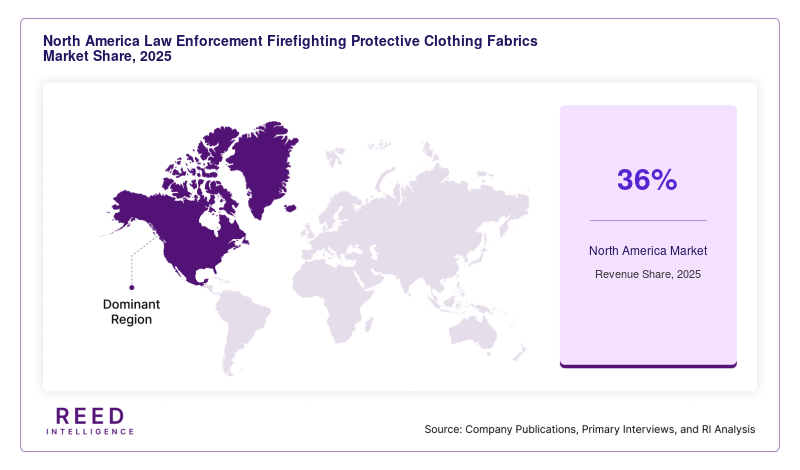
North America represents 36% of the market and records a 5.2% CAGR. The region benefits from mature fire-service procurement systems, established standards, replacement cycles and a dense supplier base spanning aramid, PBI and technical fabric manufacturers. NFPA requirements and U.S. occupational safety rules provide a strong compliance framework for firefighting protective clothing.
Europe Law Enforcement Firefighting Protective Clothing Fabrics Market
Europe records a 5.6% CAGR, supported by EN/ISO compliance, established firefighter procurement systems and rising emphasis on PFAS reduction and sustainable protective-textile chemistry. Lenzing's 2026 protective-wear portfolio and Hainsworth's next-generation firefighting fabric development illustrate the region's emphasis on combining protection with comfort and environmental performance.
Asia-Pacific Law Enforcement Firefighting Protective Clothing Fabrics Market
Asia-Pacific is the fastest-growing region, with a 6.9% CAGR and a 27% market share. Expanding industrialization, urban firefighting requirements, growing emergency-response capabilities and increasing adoption of internationally benchmarked PPE are supporting demand. Lenzing's April 2026 Asia-Pacific launch at CIOSH Shanghai also demonstrates the strategic importance of the region for next-generation protective-fabric suppliers.
Middle East and Africa Law Enforcement Firefighting Protective Clothing Fabrics Market
The Middle East and Africa record a 5.9% CAGR, with demand concentrated around industrial fire response, petrochemical facilities, emergency services and high-temperature working environments. Protective clothing suppliers increasingly emphasize fabrics suitable for hot climates, where garment weight and thermal comfort are important purchasing considerations. Sioen, for example, maintains specialized firefighting solutions for high-temperature environments and different regional operating conditions.
LATAM Law Enforcement Firefighting Protective Clothing Fabrics Market
LATAM records a 5.5% CAGR, supported by investment in emergency services, industrial protection and firefighting capability. Partnerships with regional organizations are helping international manufacturers build local relationships and specification awareness. In January 2026, SIOEN FIRE announced a 2026 partnership with the Organización de Bomberos Americanos, highlighting efforts to deepen engagement across the Latin American firefighting ecosystem.
Law Enforcement Firefighting Protective Clothing Fabrics Market Competitive Landscape
The competitive landscape is characterized by a mix of fiber producers, technical-fabric manufacturers and vertically integrated protective-clothing companies. Competition increasingly revolves around proprietary fiber blends, lightweight constructions, certification, PFAS-free chemistry, thermal performance, breathability, abrasion resistance and the ability to provide complete multi-layer systems.
TenCate maintains a broad firefighting portfolio spanning PBI and Nomex outer shells, thermal liners, stationwear and wildland fabrics. Milliken is differentiating through a coordinated non-PFAS system covering all three major turnout layers. Lenzing is pursuing a cellulosic-centered portfolio that combines inherent FR fibers with aramid and hybrid constructions. PBI continues to compete in premium outer-shell applications where high thermal protection and strength are critical.
Key Market Players
- DuPont
- TenCate Protective Fabrics
- Milliken & Company
- PBI Performance Products
- Teijin Aramid
- Lenzing AG
- Hainsworth Protective Fabrics
- Sioen Industries
- Honeywell
- Ansell
- Klopman
- Carrington Textiles
- Schoeller Textiles
- Westex by Milliken
- Lakeland Industries
- Viking Life-Saving Equipment
- Texport
- Gore-Tex / W. L. Gore & Associates
- Tencate Advanced Composites and related technical-textile businesses
- Regional specialist protective-fabric manufacturers
Law Enforcement Firefighting Protective Clothing Fabrics Market Recent Development
September 2026 – PFAS litigation increases scrutiny of protective-gear materials, A federal judge allowed a lawsuit involving Connecticut firefighters and more than 20 companies, including DuPont, 3M and Honeywell, to proceed. The case alleges PFAS contamination associated with firefighter protective gear, increasing legal and procurement scrutiny around chemical content and disclosure in protective clothing.
July 2026 – Sioen wins Dutch police protective-equipment tender, Sioen announced that it won a European public tender from the Dutch police for new ballistic and stab-resistant body armor. While the award is centered on finished protective equipment, it expands Sioen's law-enforcement protection footprint and supports demand for advanced textile and protective-material technologies in police applications.
June 2026 – Sioen showcases new firefighter-protection developments at INTERSCHUTZ
Law Enforcement Firefighting Protective Clothing Fabrics Market Segments
By Fiber Type
- Aramid
- PBI
- Modacrylic
- Lenzing FR & Cellulosic Blends
- FR-Treated Synthetic & Natural Blends
- Others
By Fabric Layer & Construction
- Outer Shell
- Moisture Barrier
- Thermal Liner
- Station & Wildland Fabrics
- Composite & Specialty Fabrics
By Application
- Structural Firefighting
- Wildland Firefighting
- Law Enforcement & Tactical
- Hazmat & Special Response
By Region
- North America
- Europe
- APAC
- Middle East and Africa
- LATAM