LCD Panel Market Size, Share Demand Report By Product Type (Twisted Nematic, In-Plane Switching, Vertical Alignment), By Application (Televisions, Monitors, Laptops, Smartphones, Automotive, Others), By Screen Size (Below 10 inches, 10-30 inches, 30-60 inches, Above 60 inches) & Segment Forecasts, 2026–2034
USD 3950
LCD Panel Market Size
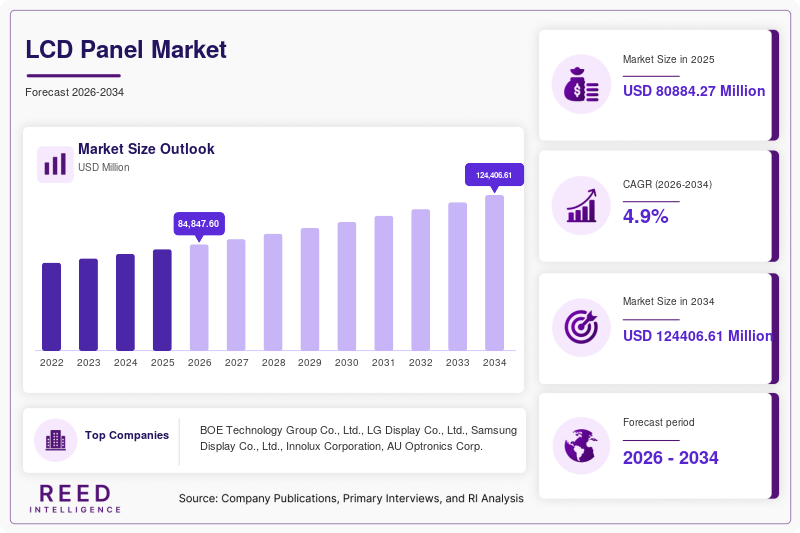
LCD Panel market size is projected at USD 84,847.6 million in 2026 and is expected to hit USD 124,847.5 million by 2034 with a CAGR of 4.9% during the forecast period. The increasing demand for high-resolution displays in consumer electronics, automotive, and commercial applications, coupled with the growing adoption of large-screen televisions and monitors, underpins market expansion. This report delivers a comprehensive analysis of the LCD Panel market, including segmentation by type and application, competitive dynamics, and regional growth patterns, equipping stakeholders with critical intelligence. The LCD Panel market continues to demonstrate steady growth potential, fueled by the global proliferation of smart devices, the increasing demand for high-quality visual experiences, and continuous innovation in display technologies.
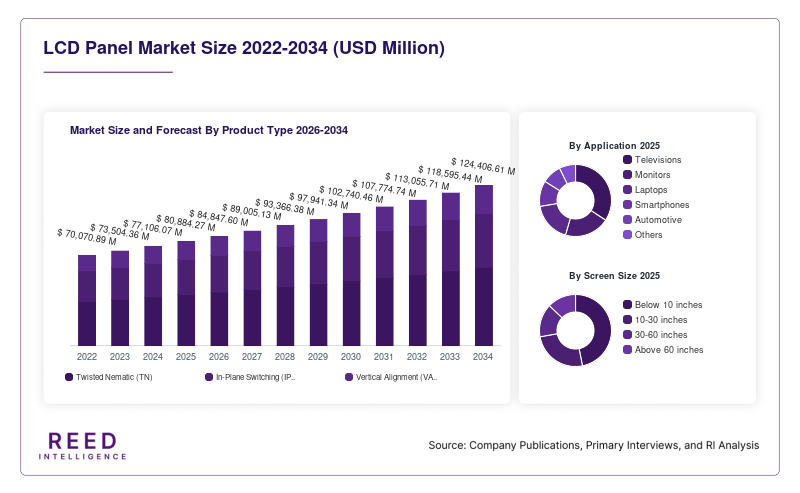
LCD (Liquid Crystal Display) panels are flat-panel display technologies that use the light-modulating properties of liquid crystals to produce images. They are the most common display technology used in televisions, computer monitors, laptops, smartphones, and various other electronic devices. The global production volume of LCD panels exceeded 250 million units in 2025, reflecting a 4% increase from 2023, driven by the demand for large-screen TVs and digital signage. Adoption patterns reveal that the In-Plane Switching (IPS) type dominates the market, accounting for 42% of total demand, followed by Vertical Alignment (VA) at 32%, and Twisted Nematic (TN) at 26%. The LCD Panel market's trajectory is closely linked to the growth of the global consumer electronics market, which is projected to reach USD 1.5 trillion by 2028, and the increasing demand for high-quality visual displays.
LCD Panel Market Trends
Shift Towards High-Resolution and Large-Size Panels
The LCD Panel market is witnessing a significant trend toward high-resolution (4K, 8K) and large-size panels, driven by the demand for immersive viewing experiences in televisions and monitors. The revenue from 4K and 8K LCD panels grew to USD 45 billion in 2025, a year-on-year increase of 12%, as 55% of new TV shipments in 2025 were 4K or higher resolution. Adoption rates of large-size panels (over 65 inches) in the television segment reached 25%, with this figure projected to exceed 40% by 2030. The LCD Panel market's trend toward high resolution and larger sizes is reinforced by the need for better visual experiences, the decreasing cost of production, and the continuous innovation in panel manufacturing.
Growing Focus on Advanced Display Technologies (Mini-LED and Quantum Dots)
The increasing focus on advanced display technologies, such as Mini-LED backlighting and Quantum Dot enhancement, is a major trend shaping the LCD Panel market, with the development of panels offering improved contrast, color accuracy, and energy efficiency. The market has seen a 20% increase in the demand for advanced LCD panels since 2022, with 25% of new products in 2025 featuring Mini-LED or Quantum Dot technology. The use of these technologies in premium televisions and monitors has also gained significant traction. The LCD Panel market's trend toward advanced technologies is reinforced by the need for better picture quality, the growing competition from OLED, and the continuous innovation in display materials and manufacturing.
LCD Panel Market Drivers
The LCD Panel market's expansion is primarily driven by the increasing demand for consumer electronics, with the global consumer electronics market valued at USD 1.2 trillion in 2025 and growing at a steady pace. The need for high-quality displays in televisions, monitors, and mobile devices has been a major driver, with LCD panels being the dominant technology. The growth of the gaming industry and the demand for high-refresh-rate monitors have also fueled market growth. Additionally, the increasing adoption of digital signage and commercial displays has spurred demand. The LCD Panel market's growth is further reinforced by the continuous improvement in panel technology, leading to better performance and lower costs.
LCD Panel Market Restraints
Despite favorable growth prospects, the LCD Panel market faces significant constraints, primarily related to the intense competition from OLED and MicroLED technologies, which offer superior contrast and flexibility. The price volatility of key raw materials and the high capital investment for panel manufacturing can also be a limitation. The LCD Panel market's growth is also tempered by the market saturation in some consumer electronics segments and the cyclical nature of the display industry.
LCD Panel Market Opportunities
The LCD Panel market presents significant opportunities in the rapidly expanding market for automotive displays, where demand for larger, higher-resolution screens is increasing. The development of transparent and flexible LCD panels for new applications is expected to grow at a CAGR of 8% through 2034. Emerging opportunities also exist in the use of LCD panels for augmented reality (AR) and virtual reality (VR) applications. The LCD Panel market's opportunity profile is further enhanced by the growing trend of smart homes and the increasing integration of displays in various devices.
Challenges in LCD Panel Market
The LCD Panel market faces persistent challenges related to the need for continuous innovation to compete with emerging display technologies. The complexity of manufacturing high-resolution and large-size panels with high yield rates can also be a challenge. The market is also contending with the challenge of managing the environmental impact of panel production and disposal. Additionally, the LCD Panel market is challenged by the need to address the supply-demand balance to maintain profitability.
LCD Panel Market Segmentation
The LCD Panel market is segmented by Type and Application to provide a comprehensive market perspective. By Type, In-Plane Switching (IPS) dominates with a 42% market share, driven by its superior viewing angles and color reproduction. The Application segment is led by Televisions, which accounts for 35% of the market, followed by Monitors at 25%, Laptops at 18%, Smartphones at 12%, Automotive at 6%, and Others at 4%.
By Type
In-Plane Switching (IPS) represent the largest segment in the LCD Panel market, commanding a 42% share, with production exceeding 105 million units in 2025. These are characterized by their wide viewing angles and accurate color reproduction. Technical specifications include resolution, response time, and color gamut. The LCD Panel market's IPS segment is driven by its use in monitors, laptops, and premium televisions.
Vertical Alignment (VA) capture a 32% share of the LCD Panel market, with production of 80 million units in 2025. These are characterized by their high contrast ratios and deep blacks, making them suitable for televisions and curved monitors. Technical specifications include contrast ratio, response time, and viewing angle. The LCD Panel market's VA segment is driven by its use in televisions and curved displays.
Twisted Nematic (TN) represent the remaining 26% of the LCD Panel market, with production of 65 million units in 2025. These are characterized by their fast response times and low cost, making them popular for gaming monitors and budget displays. Technical specifications include response time, refresh rate, and viewing angle. The LCD Panel market's TN segment is driven by its use in gaming and entry-level monitors.
By Application
Televisions dominates the LCD Panel market, accounting for 35% of sales, representing 87.5 million units in 2025. This segment includes use in consumer TVs and commercial displays. Usage penetration exceeds 40% in the sector. The LCD Panel market's Television segment is characterized by its focus on large size, high resolution, and picture quality.
Monitors accounts for 25% of the LCD Panel market, with sales of 62.5 million units in 2025. This segment encompasses use in desktop monitors for office and gaming. The segment is growing at a steady CAGR, driven by the gaming and professional sectors. The LCD Panel market's Monitor segment is characterized by its focus on resolution, refresh rate, and color accuracy.
Laptops represents 18% of the LCD Panel market, with sales of 45 million units in 2025. This segment includes use in notebook computers. The segment is growing at a moderate pace, driven by the education and enterprise sectors. The LCD Panel market's Laptop segment is characterized by its focus on power efficiency and thinness.
Smartphones accounts for 12% of the LCD Panel market, with sales of 30 million units in 2025. This segment includes use in mobile phones. The segment is growing at a slower pace, due to competition from OLED. The LCD Panel market's Smartphone segment is characterized by its focus on high pixel density and thinness.
Automotive represents 6% of the LCD Panel market, with sales of 15 million units in 2025. This segment includes use in car infotainment and instrument clusters. The segment is growing at a robust CAGR, driven by the increasing digitization of vehicles. The LCD Panel market's Automotive segment is characterized by its focus on durability and wide temperature range.
Others comprises the remainder of the LCD Panel market, accounting for 4% of total sales, with 10 million units in 2025. This includes use in digital signage, wearables, and other niche applications. The segment is projected to grow at a moderate CAGR through 2034. The LCD Panel market's Others segment is characterized by its diverse and evolving applications.
LCD Panel Market Regional Outlook
Asia-Pacific LCD Panel Market
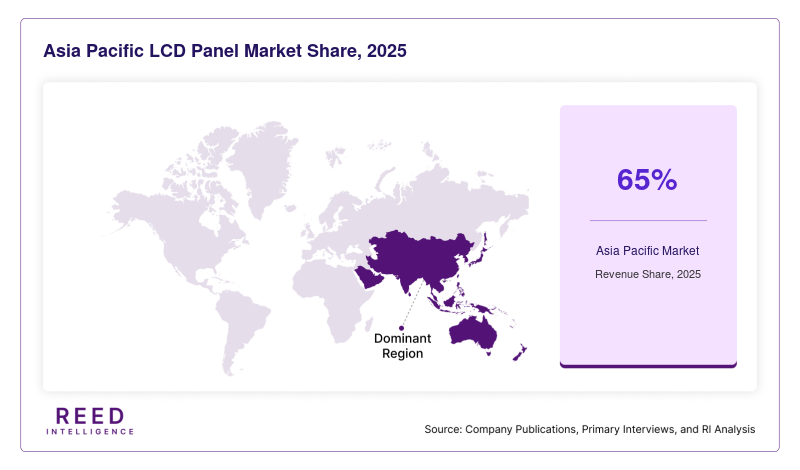
Leads the LCD Panel market, commanding a 65% share, with a revenue of USD 55.1 billion in 2025. China is the primary driver, accounting for 70% of regional demand, driven by its dominant position in panel manufacturing and the large consumer electronics market. The Asia-Pacific LCD Panel market is characterized by its focus on high-volume production and cost leadership.
North America LCD Panel Market
Represents the second-largest market, capturing a 15% share with a revenue of USD 12.7 billion in 2025. The United States is the primary driver, accounting for 85% of regional demand, driven by the strong consumer electronics market, high demand for premium displays, and the presence of major tech companies. The North American LCD Panel market is characterized by its focus on innovation and premium products.
Europe LCD Panel Market
Accounts for 12% of the global LCD Panel market, with a revenue of USD 10.1 billion in 2025. Germany, the UK, and France are the primary drivers, collectively accounting for 60% of regional demand, driven by the strong consumer electronics market and automotive industry. The European LCD Panel market is projected to grow at a CAGR of 4% through 2034.
Middle East & Africa and Latin America LCD Panel Market
Together account for the remaining 8% of the LCD Panel market, with the UAE leading the Middle East market and Brazil leading the Latin American market. Both regions are projected to grow at CAGRs exceeding 5%, driven by increasing consumer electronics adoption.
Top players in LCD Panel Market
- BOE Technology Group Co., Ltd.
- LG Display Co., Ltd.
- Samsung Display Co., Ltd.
- Innolux Corporation
- AU Optronics Corp.
- Sharp Corporation
- Japan Display Inc. (JDI)
- HannStar Display Corporation
- Chunghwa Picture Tubes, Ltd. (CPT)
- Panasonic Corporation
- Epson (Seiko Epson Corporation)
- NEC Corporation
- Mitsubishi Electric Corporation
- Visionox
- Truly International Holdings
BOE Technology Group Co., Ltd.
BOE Technology Group holds a dominant position in the LCD Panel market, with an estimated 22% global market share, particularly strong in the large-size television and monitor segments. The company's portfolio of LCD panels is widely recognized for its quality, innovation, and cost-effectiveness. BOE's market leadership is reinforced by its significant R&D investment, its massive production capacity, and its strong relationships with major electronics brands. BOE commands over 25% of the Asian market and 18% of the North American market, positioning it as a key player in the LCD Panel market.
LG Display Co., Ltd.
LG Display is a leading player in the LCD Panel market, commanding approximately 18% of the global market share through its comprehensive portfolio of advanced display solutions. The company's expertise in IPS and OLED technologies and its focus on innovation have solidified its position. LG Display's LCD panels are known for their quality, performance, and wide application range. The company's commitment to technology leadership and its strong presence in the North American and European markets have enhanced its competitive advantage.
Samsung Display Co., Ltd. holds a significant 15% market share, with particular strength in the smartphone and monitor segments. Innolux Corporation is a major player in the television and monitor panel market, holding a 10% share.
Recent Developments in LCD Panel Market
- 2025: BOE Technology launched a new generation of 8K LCD panels with high refresh rates for premium televisions and gaming monitors.
- 2025: LG Display announced a new line of automotive LCD panels with advanced durability and high brightness for in-vehicle displays.
LCD Panel Market Segments
By Product Type
- Twisted Nematic (TN)
- In-Plane Switching (IPS)
- Vertical Alignment (VA)
By Application
- Televisions
- Monitors
- Laptops
- Smartphones
- Automotive
- Others
By Screen Size
- Below 10 inches
- 10-30 inches
- 30-60 inches
- Above 60 inches
By Region
- North America
- Europe
- APAC
- Middle East and Africa
- LATAM