Lcr Meter Market Size, Share & Demand Report By Type (Benchtop LCR Meters, Handheld LCR Meters), By Frequency Range (Low Frequency, Medium Frequency, High Frequency), By Application (Electronics Manufacturing, Automotive Electronics, Telecommunications, Aerospace & Defense, Others), By End-Use (Industrial, Research & Development Laboratories, Educational Institutions), By Distribution Channel (Direct Sales, Distributors, Online Sales), By Region & Segment Forecasts, 2026–2034
USD 3950
Market Overview
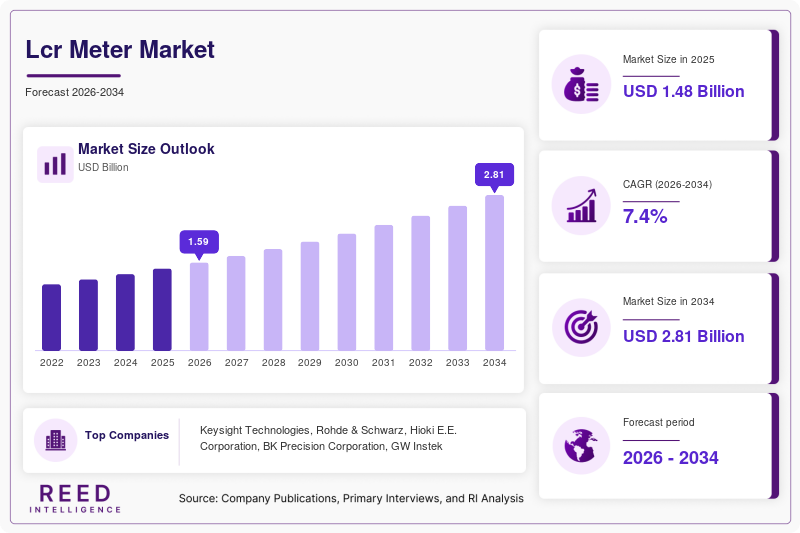
The Lcr Meter Market was valued at approximately USD 1.48 billion in 2026 and is projected to reach USD 2.61 billion by 2034, expanding at a CAGR of 7.4% during 2026–2034. The market growth is primarily supported by the rising global demand for high-precision electronic testing equipment across industries such as consumer electronics, automotive electronics, telecommunications, and industrial automation.
One of the major global factors fueling the expansion of the Lcr Meter Market is the rapid miniaturization of electronic components. As devices become smaller and more complex, manufacturers increasingly require accurate measurement tools for inductance (L), capacitance (C), and resistance (R), which significantly boosts the adoption of advanced LCR meters.
Key Highlights
- Dominant region: Asia Pacific held approximately 41.3% market share in 2025, while North America is projected to grow at the fastest CAGR of 7.9% during the forecast period.
- Leading subsegments:
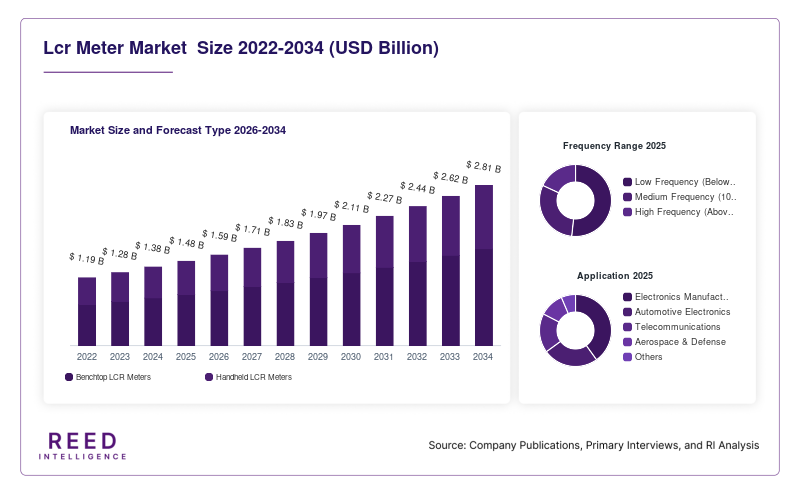
- By Type: Benchtop LCR meters dominated with 56.2% share in 2025, while handheld LCR meters are expected to grow at a CAGR of 8.1%.
- By Application: Electronics manufacturing led with 48.7% share, while automotive electronics is projected to grow at 8.5% CAGR.
- By End-Use: Industrial sector dominated with 44.5% share, while R&D laboratories are expected to grow at 8.3% CAGR.
- Dominant country: The United States recorded a market value of USD 320 million in 2024 and USD 343 million in 2025, driven by advanced semiconductor and electronics industries.
Market Trends
Rising Integration of Digital and Smart Measurement Features
Modern LCR meters are increasingly equipped with digital interfaces, touchscreen displays, and connectivity features such as USB, LAN, and Bluetooth. These advancements allow real-time data monitoring, remote operation, and integration with automated testing systems. This trend is particularly strong in high-volume manufacturing environments where efficiency and accuracy are critical.
Growing Adoption in Electric Vehicle and Renewable Energy Testing
The increasing focus on electric vehicles (EVs) and renewable energy systems has created demand for precise component testing. LCR meters are widely used to evaluate batteries, capacitors, and inductive components in EV powertrains and solar inverters. This trend is expected to shape long-term demand patterns in the Lcr Meter Market.
Market Drivers
Increasing Demand for Precision Testing in Electronics Manufacturing
The rapid growth of consumer electronics, including smartphones, wearables, and IoT devices, has significantly increased the need for accurate component testing. LCR meters enable manufacturers to maintain quality control by measuring electrical properties with high precision, which is essential in mass production environments.
Expansion of Automotive Electronics Sector
The automotive industry is undergoing a transformation with the integration of advanced electronics in safety systems, infotainment, and electric powertrains. LCR meters are essential for testing electronic components used in these systems, driving consistent demand across automotive manufacturing and testing facilities.
Market Restraint
High Cost of Advanced LCR Meters
Advanced LCR meters with high-frequency measurement capabilities and automation features can be expensive. This cost factor limits adoption among small-scale manufacturers and educational institutions, particularly in price-sensitive markets.
Market Opportunities
Growth in Semiconductor Testing Applications
The semiconductor industry continues to expand due to increasing demand for chips in various applications. LCR meters play a critical role in testing passive components and integrated circuits, creating opportunities for manufacturers to develop specialized solutions tailored to semiconductor testing environments.
Increasing Demand from Research and Development Activities
R&D laboratories across industries are investing in high-precision instruments to support innovation. The need for accurate component characterization in emerging technologies such as nanotechnology and advanced materials presents significant growth opportunities in the Lcr Meter Market.
Segmental Analysis
By Type
The benchtop LCR meters segment dominated the Lcr Meter Market with a 56.2% share in 2025, owing to their high accuracy, wide frequency range, and suitability for laboratory and industrial applications.
The handheld LCR meters segment is expected to grow at the fastest CAGR of 8.1% during the forecast period, driven by their portability and ease of use in field testing and maintenance applications.
By Frequency Range
The low-frequency LCR meters (below 100 kHz) segment held the largest share of 47.5% in 2025, as they are widely used in standard component testing applications.
The high-frequency LCR meters (above 1 MHz) segment is projected to grow at a CAGR of 8.4%, supported by increasing demand for testing high-speed electronic components in advanced applications.
By Application
The electronics manufacturing segment dominated with a 48.7% share in 2025, due to extensive use in quality control and component testing processes.
The automotive electronics segment is anticipated to grow at a CAGR of 8.5%, driven by the increasing integration of electronic systems in vehicles and the shift toward electric mobility.
By End-Use
The industrial sector accounted for 44.5% share in 2025, as LCR meters are widely used in production and testing environments.
The R&D laboratories segment is expected to grow at a CAGR of 8.3%, supported by increasing investments in innovation and advanced material testing.
By Distribution Channel
The direct sales segment dominated with a 52.1% share in 2025, as manufacturers prefer direct procurement from suppliers for customized solutions.
The online sales segment is projected to grow at a CAGR of 8.2%, driven by the increasing adoption of digital procurement platforms and ease of product comparison.
Regional Analysis
North America
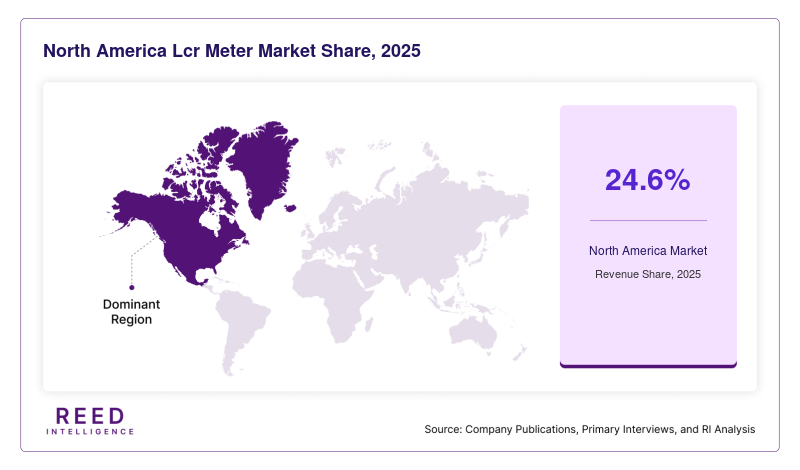
North America accounted for 24.6% of the Lcr Meter Market share in 2025 and is projected to grow at a CAGR of 7.9% during the forecast period. The United States dominated the region due to strong investments in semiconductor manufacturing and advanced electronics testing infrastructure. The presence of well-established testing equipment manufacturers has further supported market growth.
Europe
Europe held approximately 21.2% market share in 2025 and is expected to grow at a CAGR of 7.1%. Germany emerged as the dominant country, driven by its strong automotive and industrial manufacturing base. The increasing adoption of automation technologies in production facilities has contributed to steady demand for LCR meters.
Asia Pacific
Asia Pacific led the global market with 41.3% share in 2025 and is forecasted to grow at a CAGR of 7.6%. China dominated the region due to its large-scale electronics manufacturing industry and expanding semiconductor ecosystem. The presence of contract manufacturers and component suppliers has significantly boosted the adoption of LCR meters.
Middle East & Africa
The Middle East & Africa region accounted for 6.8% market share in 2025 and is projected to grow at a CAGR of 6.5%. United Arab Emirates led the region, supported by investments in industrial automation and electronics assembly sectors. The gradual development of manufacturing infrastructure is expected to support market growth.
Latin America
Latin America held around 6.1% share in 2025 and is expected to grow at a CAGR of 6.8%. Brazil dominated the region due to its expanding electronics and automotive industries. Government initiatives to promote local manufacturing have contributed to increased demand for testing equipment.
Competitive Landscape
The Lcr Meter Market is moderately competitive, with several established players focusing on product innovation and technological advancements. Leading companies include Keysight Technologies, Rohde & Schwarz, Hioki E.E. Corporation, BK Precision Corporation, and GW Instek. Among these, Keysight Technologies stands out as a market leader due to its comprehensive product portfolio and strong global presence.
The company has recently introduced advanced LCR meters with enhanced automation capabilities and improved measurement accuracy, targeting high-end industrial and research applications. Other players are focusing on expanding their product lines with portable and cost-effective solutions to cater to small and medium enterprises.
Strategic initiatives such as partnerships, acquisitions, and product launches are common in the market as companies aim to strengthen their market position. The increasing emphasis on digital integration and smart testing solutions is expected to intensify competition over the forecast period.
Key Players List
- Keysight Technologies
- Rohde & Schwarz
- Hioki E.E. Corporation
- BK Precision Corporation
- GW Instek
- Chroma ATE Inc.
- Extech Instruments
- Kikusui Electronics Corporation
- IET Labs Inc.
- Tonghui Electronics
- Scientific Mes-Technik Pvt. Ltd.
- Megger Group Limited
- Aim-TTi (Thurlby Thandar Instruments)
- Stanford Research Systems
- Mastech Group
Recent Developments
- In 2025, several manufacturers introduced LCR meters with enhanced frequency ranges and improved user interfaces to support advanced testing applications.
- Companies have increasingly focused on integrating IoT-enabled features for remote monitoring and control.
- New product launches in portable LCR meters have targeted field engineers and maintenance professionals.
- Strategic collaborations between testing equipment manufacturers and semiconductor companies have been observed to develop customized solutions.
- Expansion of distribution networks in emerging markets has been a key strategy to increase market penetration.
Lcr Meter Market Segments
Type
- Benchtop LCR Meters
- Handheld LCR Meters
Frequency Range
- Low Frequency (Below 100 kHz)
- Medium Frequency (100 kHz–1 MHz)
- High Frequency (Above 1 MHz)
Application
- Electronics Manufacturing
- Automotive Electronics
- Telecommunications
- Aerospace & Defense
- Others
End-Use
- Industrial
- Research & Development Laboratories
- Educational Institutions
Distribution Channel
- Direct Sales
- Distributors
- Online Sales
By Region
- North America
- Europe
- APAC
- Middle East and Africa
- LATAM