Leadframes Market Size, Share & Demand Report By Material Type (Copper Leadframes, Alloy Leadframes, Iron-Nickel Leadframes), By Package Type (Quad Flat Package Leadframes, Small Outline Package Leadframes, Dual Inline Package Leadframes, Power Package Leadframes), By End-Use Industry (Consumer Electronics, Automotive Electronics, Industrial Automation, Telecommunications, Healthcare Electronics) By Region & Segment Forecasts, 2026–2034
USD 3950
Market Overview
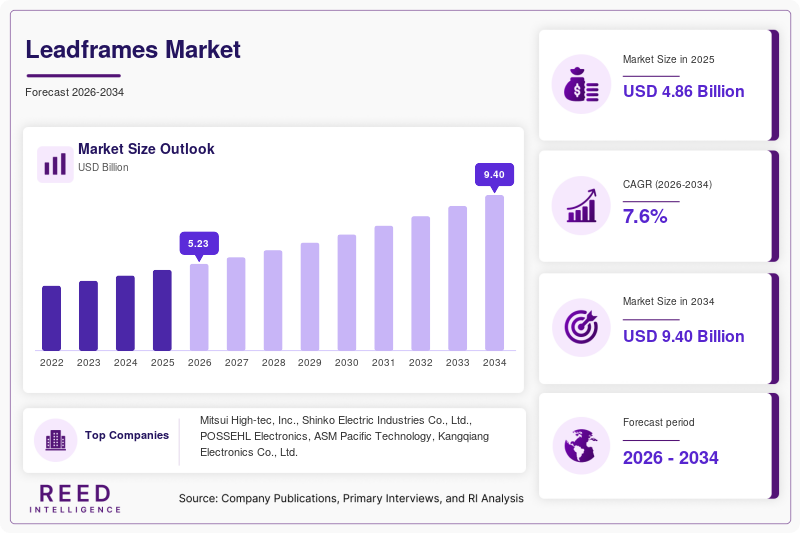
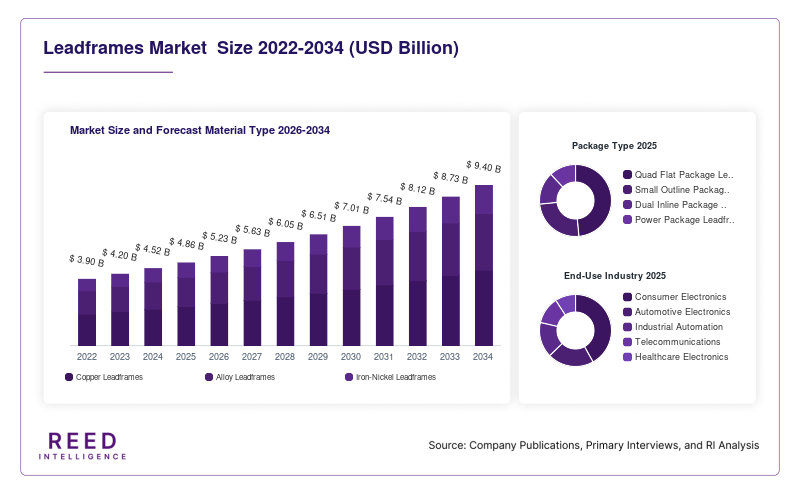
The global Leadframes Market size was valued at USD 4.86 billion in 2026 and is projected to reach USD 8.74 billion by 2034, expanding at a CAGR of 7.6% during the forecast period from 2026 to 2034. Leadframes are essential semiconductor packaging components used for integrated circuits, transistors, and power devices. They provide mechanical support and electrical connectivity for semiconductor chips across consumer electronics, automotive systems, industrial automation, telecommunications, and medical equipment. The increasing penetration of advanced semiconductor devices in electric vehicles, AI-enabled electronics, and industrial IoT systems continues to support long-term market growth.
A major global factor accelerating Leadframes Market growth is the rising demand for semiconductor packaging solutions driven by rapid digitalization and electronic miniaturization. Manufacturers are increasingly investing in compact, thermally efficient, and high-performance semiconductor packages to meet the requirements of modern electronic devices. The expansion of 5G infrastructure, electric mobility, cloud computing, and edge AI technologies has significantly increased the production of semiconductor components, thereby boosting demand for leadframes across multiple industries. In addition, government investments in semiconductor manufacturing localization across Asia Pacific, North America, and Europe are creating new opportunities for leadframe suppliers and packaging solution providers.
Key Highlights
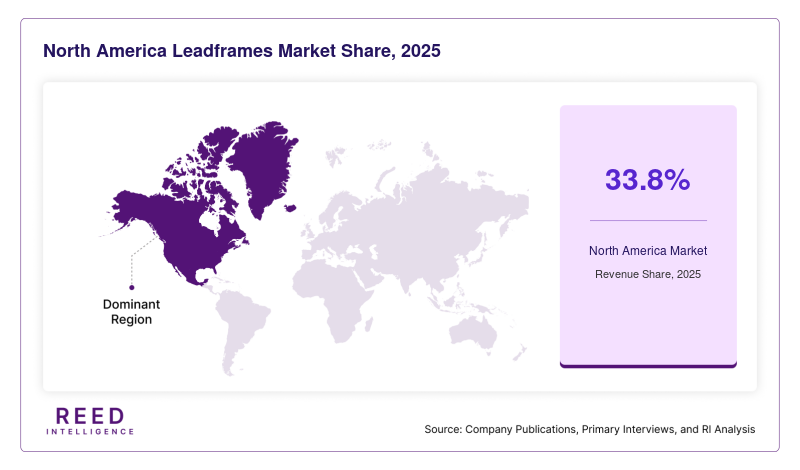
- North America dominated the market with a 33.8% share in 2025, while Asia Pacific is expected to grow at the fastest CAGR of 9.4% during 2026–2034.
- By material type, copper leadframes accounted for the largest share of 54.6%, while alloy-based leadframes are projected to grow at a CAGR of 8.9%.
- By package type, quad flat package leadframes led with a 37.4% share, whereas small outline package leadframes are expected to expand at a CAGR of 8.6%.
- By end-use industry, consumer electronics held a 42.1% share, while automotive electronics are projected to grow at a CAGR of 9.8%.
- The United States remained the dominant country, with market values of USD 1.18 billion in 2024 and USD 1.29 billion in 2025.
Market Trends
Rising Adoption of Advanced Semiconductor Packaging Technologies
The Leadframes Market is experiencing a major shift toward advanced semiconductor packaging technologies that support higher efficiency, reduced size, and improved thermal performance. Manufacturers are increasingly integrating multi-chip modules, high-density interconnects, and compact package designs into modern electronics. This trend is especially visible in automotive electronics, wearable devices, smartphones, and industrial sensors where space optimization and reliability are critical. Semiconductor companies are demanding thinner and more conductive leadframes that can support high-speed data transmission and efficient heat dissipation. The growing adoption of AI processors and power semiconductor devices has also increased the use of precision-engineered copper alloy leadframes with improved corrosion resistance and conductivity. As electronics continue to become smaller and more powerful, leadframe manufacturers are focusing on innovation in etching technologies, plating processes, and stamping capabilities to maintain performance standards across next-generation semiconductor packaging applications.
Expansion of Electric Vehicle and Renewable Energy Electronics
The increasing deployment of electric vehicles and renewable energy systems has emerged as an important trend shaping the Leadframes Market. Electric vehicles require a large number of semiconductor components for battery management systems, power modules, charging infrastructure, infotainment systems, and advanced driver assistance systems. These applications depend heavily on durable and thermally efficient leadframes capable of operating under high temperatures and demanding electrical conditions. Renewable energy installations, including solar inverters and wind power systems, also rely on power semiconductors packaged using advanced leadframes. As governments continue promoting energy transition and transportation electrification, semiconductor demand is rising substantially across the automotive and energy sectors. Leadframe manufacturers are therefore investing in high-conductivity materials, improved stamping precision, and customized package configurations that support power-intensive electronic systems. This transition is expected to reshape product development strategies across the semiconductor packaging ecosystem during the forecast period.
Market Drivers
Growth in Consumer Electronics Manufacturing
The rapid expansion of global consumer electronics manufacturing continues to drive the Leadframes Market. Smartphones, laptops, gaming consoles, smart home devices, and wearable electronics require semiconductor packages that provide stable electrical performance and durability. Leadframes are widely used in integrated circuits and discrete semiconductor packages due to their cost efficiency and reliable conductivity. The growing consumer preference for compact and multifunctional electronic devices has increased semiconductor complexity, thereby driving demand for precision leadframe solutions. Countries such as China, South Korea, Taiwan, Vietnam, and India have expanded electronics production capacities to support rising global demand. In addition, increasing disposable income and digital connectivity are encouraging the adoption of advanced electronics across emerging economies. Semiconductor packaging companies are responding by increasing production automation and improving leadframe material quality to support higher-volume manufacturing requirements and evolving device architectures across consumer electronics applications.
Increasing Investments in Semiconductor Manufacturing Facilities
Large-scale investments in semiconductor fabrication and packaging facilities are significantly contributing to Leadframes Market growth. Governments and private companies are allocating substantial funding toward semiconductor supply chain localization to reduce dependence on imports and strengthen technological resilience. New fabrication plants and outsourced semiconductor assembly and test facilities require stable leadframe supply chains for integrated circuit packaging operations. North America and Europe are increasing domestic semiconductor production through strategic incentives, while Asia Pacific continues to dominate global manufacturing capacity. This rise in manufacturing infrastructure is supporting demand for etched and stamped leadframes across multiple semiconductor categories. Furthermore, increasing adoption of automation, robotics, and industrial electronics is driving semiconductor production volumes, which directly impacts leadframe consumption. Leadframe suppliers are expanding manufacturing capacities, enhancing precision tooling technologies, and forming long-term partnerships with semiconductor packaging companies to secure stable market positions and support growing industry requirements.
Market Restraint
Volatility in Raw Material Prices and Supply Chain Disruptions
Fluctuations in the prices of copper, nickel, silver, and specialty alloys represent a major restraint for the Leadframes Market. Leadframe manufacturing heavily depends on conductive metals and precision plating materials that are vulnerable to commodity price volatility and geopolitical disruptions. Rising raw material costs can reduce profit margins for manufacturers and increase overall semiconductor packaging expenses. Supply chain disruptions caused by trade restrictions, transportation delays, or regional manufacturing imbalances also create operational uncertainty for semiconductor packaging providers. Smaller manufacturers often face challenges in maintaining stable procurement costs and inventory management during periods of market instability. In addition, increasing environmental regulations related to metal processing and chemical plating operations can elevate compliance costs for leadframe manufacturers. These challenges may slow capacity expansion projects and create pricing pressure across the semiconductor packaging value chain, particularly in highly competitive consumer electronics and industrial semiconductor markets.
Market Opportunities
Increasing Demand for Automotive Power Semiconductors
The growing use of automotive power semiconductors presents strong opportunities for the Leadframes Market. Electric vehicles, hybrid vehicles, and intelligent transportation systems require advanced semiconductor components capable of handling high power loads and thermal stress. Leadframes used in automotive semiconductor packages must deliver excellent electrical conductivity, thermal stability, and long operational life under harsh conditions. The rapid integration of ADAS technologies, vehicle electrification, and connected car systems is significantly increasing semiconductor content per vehicle. Automotive manufacturers are also demanding highly reliable packaging solutions that comply with strict safety and durability standards. As a result, leadframe suppliers are developing innovative copper alloy structures and plating technologies optimized for automotive power modules. The growing transition toward electric mobility across China, Europe, the United States, and Japan is expected to generate long-term demand for high-performance leadframe products during the forecast period.
Expansion of Industrial Automation and Smart Manufacturing
The rising adoption of industrial automation and smart manufacturing systems is creating substantial opportunities for leadframe manufacturers. Industrial robotics, machine vision systems, programmable logic controllers, and IoT-enabled manufacturing equipment require advanced semiconductor devices for sensing, processing, and communication functions. Leadframes play a critical role in ensuring efficient semiconductor packaging for these industrial electronics applications. Manufacturing companies are increasingly investing in automated production lines and digital monitoring systems to improve operational efficiency and reduce downtime. This industrial transformation is accelerating semiconductor demand across factory automation, energy management, logistics, and process industries. Leadframe manufacturers are therefore focusing on customized designs that support industrial-grade reliability, high-frequency operation, and thermal management requirements. The expansion of Industry 4.0 initiatives in developed and emerging economies is expected to create stable growth opportunities for semiconductor packaging material suppliers over the coming years.
Segmental Analysis
By Material Type
Copper leadframes accounted for the largest share of the Leadframes Market in 2024, representing approximately 54.6% of total revenue. Copper remains the preferred material due to its excellent electrical conductivity, thermal performance, and cost efficiency. Semiconductor manufacturers widely use copper leadframes in integrated circuits, power semiconductors, and automotive electronic systems because they support efficient heat dissipation and stable signal transmission. The increasing production of smartphones, laptops, industrial controllers, and consumer electronics has further strengthened demand for copper-based leadframes. Manufacturers are also improving plating technologies and corrosion resistance characteristics to enhance the long-term reliability of copper leadframes across high-performance semiconductor applications. In addition, the material supports compatibility with modern semiconductor packaging designs, making it a preferred option across multiple industries and electronic product categories.
Alloy-based leadframes are projected to witness the fastest CAGR of 8.9% during the forecast period. These leadframes are gaining popularity in applications requiring enhanced mechanical strength, improved thermal stability, and resistance to harsh operating conditions. Automotive power modules, aerospace electronics, and industrial automation systems increasingly rely on alloy-based materials to ensure performance durability under extreme temperatures and electrical loads. Semiconductor manufacturers are adopting advanced alloy compositions that improve package reliability while reducing material fatigue during high-frequency operation. The growing integration of power electronics in electric vehicles and renewable energy systems is also supporting demand for alloy-based leadframes. As semiconductor packaging technologies continue to evolve, alloy materials are expected to gain stronger market penetration in applications where thermal management and structural integrity are critical operational requirements.
By Package Type
Quad flat package leadframes held the dominant market share of 37.4% in 2024 due to their widespread use in integrated circuits and microcontrollers across consumer electronics and industrial devices. These leadframes provide high pin density, reliable connectivity, and efficient package design for compact semiconductor applications. Manufacturers prefer quad flat package configurations because they support miniaturization trends while maintaining stable electrical performance. Growing demand for portable electronics, communication devices, and embedded processing systems continues to increase the adoption of this package type. In addition, quad flat package leadframes are cost-effective for high-volume manufacturing, making them suitable for large-scale semiconductor production environments. Their compatibility with automated assembly processes further supports operational efficiency and packaging consistency across semiconductor fabrication and testing facilities worldwide.
Small outline package leadframes are anticipated to grow at the fastest CAGR of 8.6% through 2034. These leadframes are increasingly used in compact electronic devices where space optimization and lightweight packaging are important considerations. Automotive electronics, wearable devices, industrial sensors, and IoT modules are driving adoption of small outline package configurations due to their reduced footprint and improved thermal performance. Semiconductor manufacturers are also focusing on advanced molding and miniaturization technologies that enhance the reliability of these package designs. The expansion of edge computing devices and smart consumer products is further accelerating demand for small outline package leadframes. As electronic systems continue to become smaller and more power efficient, manufacturers are expected to increase investments in precision leadframe production processes that support advanced package miniaturization and higher semiconductor integration density.
By End-Use Industry
Consumer electronics represented the largest share of the Leadframes Market in 2024, accounting for approximately 42.1% of total revenue. Smartphones, tablets, gaming systems, laptops, and wearable electronics require extensive semiconductor integration supported by reliable leadframe packaging solutions. The growing demand for high-performance and multifunctional electronic devices has significantly increased semiconductor production volumes worldwide. Leadframes remain essential components within integrated circuit packages used across communication, display, and processing functions in modern electronics. Rising digital connectivity, increasing internet penetration, and expanding adoption of smart devices across emerging economies continue to support market growth within this segment. Semiconductor manufacturers are also investing in automated leadframe manufacturing technologies to improve production efficiency and maintain packaging precision for high-volume consumer electronics applications.
Automotive electronics are expected to register the fastest CAGR of 9.8% during the forecast period. The rapid adoption of electric vehicles, connected car technologies, and advanced driver assistance systems is increasing semiconductor content across automotive platforms. Power modules, battery management systems, radar sensors, and infotainment systems all require durable semiconductor packaging supported by advanced leadframes. Automotive applications demand high thermal stability, vibration resistance, and long operational lifecycles, encouraging the use of specialized leadframe materials and package configurations. Governments worldwide are promoting vehicle electrification and emission reduction policies, which are accelerating semiconductor demand across the automotive industry. Leadframe manufacturers are therefore developing innovative packaging materials and high-reliability designs tailored to the evolving requirements of electric mobility and intelligent transportation technologies.
Regional Analysis
North America
North America accounted for 33.8% of the global Leadframes Market share in 2025 and is expected to maintain stable growth during the forecast period at a CAGR of 6.8%. The region benefits from strong semiconductor research infrastructure, advanced packaging technologies, and growing investment in domestic chip manufacturing. The United States continues to support semiconductor localization initiatives aimed at strengthening supply chain resilience and reducing dependence on imports. Increased production of automotive electronics, aerospace systems, and industrial automation equipment is also supporting leadframe demand across the region.
The United States remains the dominant country within North America due to its extensive semiconductor ecosystem and high adoption of advanced electronic technologies. One unique growth factor supporting the regional market is the rapid expansion of AI-focused semiconductor manufacturing. Demand for high-performance processors used in cloud computing, AI acceleration, and data centers has increased the need for advanced packaging solutions and thermally efficient leadframes. Several semiconductor companies are also investing in next-generation packaging technologies that require precision copper leadframe materials for enhanced electrical performance.
Europe
Europe represented 24.1% of the global Leadframes Market in 2025 and is projected to grow at a CAGR of 6.9% through 2034. The region benefits from strong automotive manufacturing capabilities, industrial automation adoption, and rising semiconductor investments. European countries are focusing on strengthening domestic semiconductor production capacities to support strategic industries including electric vehicles, renewable energy, and telecommunications. Increasing use of semiconductor devices in industrial control systems and smart energy infrastructure is contributing to leadframe consumption across the region.
Germany remains the leading country within the European market due to its strong automotive electronics sector and industrial manufacturing base. A unique growth factor driving the German market is the expansion of electric mobility production facilities. Automotive manufacturers are significantly increasing semiconductor integration in electric drivetrains, battery management systems, and ADAS technologies. This trend is encouraging demand for durable and high-conductivity leadframes capable of supporting automotive-grade semiconductor packaging applications across the country.
Asia Pacific
Asia Pacific held 29.7% of the global Leadframes Market share in 2025 and is expected to register the fastest CAGR of 9.4% during the forecast period. The region dominates global semiconductor manufacturing and electronics production activities. Countries including China, Taiwan, South Korea, Japan, and Singapore host major semiconductor fabrication and packaging facilities that generate substantial demand for leadframes. Rapid expansion of consumer electronics production, increasing EV manufacturing, and strong government support for semiconductor investments are accelerating regional market growth.
China continues to dominate the Asia Pacific market due to its extensive electronics manufacturing infrastructure and rising semiconductor self-sufficiency initiatives. One distinct growth factor supporting the Chinese market is the expansion of domestic semiconductor packaging companies. The country is heavily investing in outsourced semiconductor assembly and test facilities to strengthen local supply chains and reduce import dependence. This expansion is increasing demand for stamped and etched leadframes across integrated circuits, power semiconductors, and communication devices used in consumer and industrial electronics.
Middle East & Africa
The Middle East & Africa region accounted for 5.4% of the global Leadframes Market in 2025 and is projected to grow at a CAGR of 6.2% through 2034. Growth in the region is supported by increasing investments in telecommunications infrastructure, renewable energy projects, and industrial automation technologies. Governments are encouraging digital transformation initiatives and expanding smart city development programs that require semiconductor-enabled electronic systems. Although semiconductor manufacturing capacity remains limited compared to other regions, increasing electronics imports and industrial modernization continue to support market demand.
Saudi Arabia remains the dominant country in the regional market due to large-scale investments in industrial diversification and digital infrastructure projects. A unique factor supporting growth in the country is the rapid expansion of smart infrastructure development. Advanced electronic systems used in transportation, energy management, and communication networks require semiconductor components packaged with efficient leadframe solutions. Growing adoption of automation technologies across oil and gas facilities is also contributing to semiconductor demand within industrial applications.
Latin America
Latin America captured 7.0% of the global Leadframes Market share in 2025 and is expected to grow at a CAGR of 6.5% during the forecast period. Increasing electronics consumption, automotive production, and telecommunications expansion are supporting market growth across the region. Countries are gradually improving industrial automation adoption and digital connectivity infrastructure, leading to higher semiconductor usage in consumer electronics and industrial equipment. The region is also benefiting from rising foreign investments in automotive assembly and electronics manufacturing operations.
Brazil dominates the Latin American market due to its strong automotive manufacturing sector and expanding consumer electronics demand. One unique growth factor driving the Brazilian market is the increasing deployment of industrial IoT technologies across manufacturing industries. Companies are integrating smart sensors, automation equipment, and energy-efficient production systems into industrial operations. This trend is increasing demand for semiconductor packages and associated leadframe components used in industrial monitoring and control applications throughout the country.
Competitive Landscape
The Leadframes Market remains moderately consolidated, with several global and regional manufacturers competing through technological innovation, production capacity expansion, and strategic partnerships with semiconductor packaging companies. Major market participants are investing in advanced etching technologies, automated stamping systems, and environmentally compliant plating processes to improve manufacturing efficiency and product quality. Competition is also increasing in the development of high-conductivity and thermally efficient leadframe materials suitable for automotive and industrial semiconductor applications.
Mitsui High-tec, Inc. remains one of the leading companies in the market due to its strong semiconductor tooling capabilities and broad leadframe product portfolio. The company recently expanded its precision stamping production facilities to support increasing demand from automotive semiconductor manufacturers. Other companies are focusing on mergers, regional expansion, and product customization strategies to strengthen their market presence. Increasing demand for electric vehicle semiconductors and advanced packaging technologies is encouraging suppliers to invest in research and development initiatives aimed at improving package reliability, miniaturization capabilities, and thermal management performance across next-generation semiconductor devices.
Key Players
- Mitsui High-tec, Inc.
- Shinko Electric Industries Co., Ltd.
- POSSEHL Electronics
- ASM Pacific Technology
- Kangqiang Electronics Co., Ltd.
- Chang Wah Technology Co., Ltd.
- HAESUNG DS Co., Ltd.
- LG Innotek
- Ningbo Hualong Electronics Co., Ltd.
- QPL Limited
- SDI Group, Inc.
- Dynacraft Industries
- Integrated Micro-Electronics, Inc.
- Enomoto Co., Ltd.
- Jentech Precision Industrial Co., Ltd.
Recent Developments
- In 2025, Mitsui High-tec, Inc. expanded its semiconductor leadframe production facility in Malaysia to support rising demand from electric vehicle and power semiconductor manufacturers.
- In 2024, Chang Wah Technology Co., Ltd. introduced a new copper alloy leadframe series designed for high-density integrated circuit packaging and advanced thermal management applications.
- In 2025, HAESUNG DS Co., Ltd. invested in precision etching and plating technologies to improve durability and conductivity for automotive semiconductor leadframes.
- In 2024, Shinko Electric Industries Co., Ltd. launched next-generation miniaturized leadframe solutions optimized for compact consumer electronics and AI-enabled semiconductor devices.
Leadframes Market Segments
Material Type
- Copper Leadframes
- Alloy Leadframes
- Iron-Nickel Leadframes
Package Type
- Quad Flat Package Leadframes
- Small Outline Package Leadframes
- Dual Inline Package Leadframes
- Power Package Leadframes
End-Use Industry
- Consumer Electronics
- Automotive Electronics
- Industrial Automation
- Telecommunications
- Healthcare Electronics
By Region
- North America
- Europe
- APAC
- Middle East and Africa
- LATAM