LED Light Bar Market Size, Share & Demand Report By Product Type (Single-Row LED Light Bars, Combination Beam LED Light Bars), By Application (Automotive & Off-Road Vehicles, Industrial Equipment, Marine Applications, Emergency & Rescue Vehicles), By Distribution Channel (Offline Sales, Online Sales), By Region & Segment Forecasts, 2026–2034
USD 3950
Market Overview
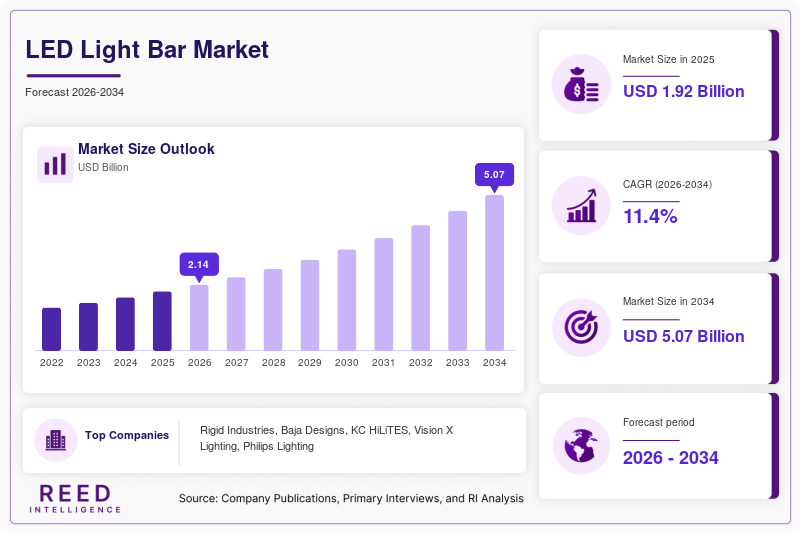
The global LED Light Bar Market size was valued at USD 1.92 billion in 2026 and is projected to reach USD 4.56 billion by 2034, expanding at a CAGR of 11.4% during 2026–2034. The market continues to gain momentum due to rising adoption of energy-efficient lighting systems across automotive, industrial, marine, agricultural, and recreational applications. LED light bars provide enhanced illumination, longer operational life, lower power consumption, and improved durability compared to conventional lighting technologies. These benefits have encouraged widespread deployment in commercial fleets, off-road vehicles, emergency response units, construction machinery, and outdoor equipment.
A major global factor supporting market growth is the increasing transition toward energy-efficient technologies and sustainable lighting infrastructure. Governments and industries worldwide are implementing energy conservation initiatives that encourage the replacement of traditional halogen and HID lighting solutions with LED-based alternatives. Furthermore, improvements in LED chip efficiency, thermal management systems, waterproof housing materials, and smart lighting controls have enhanced product performance and reliability. Manufacturers are also introducing compact, lightweight, and high-lumen LED light bars to meet evolving customer requirements.
Key Highlights
- North America dominated the market with a 35.1% share in 2025.
- Asia Pacific is expected to grow at the fastest CAGR of 12.8% during 2026–2034.
- By product type, Single-Row LED Light Bars accounted for the largest share of 42.6%.
- while Curved LED Light Bars are projected to grow at a CAGR of 13.6%.
- By application, Automotive & Off-Road Vehicles led with a 46.8% share.
- whereas Industrial Equipment is expected to expand at a CAGR of 12.9%.
- By distribution channel, Offline Sales held the largest share of 68.4%.
- while Online Sales are projected to grow at a CAGR of 14.2%.
- The United States remained the dominant country, with market values of USD 528 million in 2024 and USD 587 million in 2025.
Market Trends
Growing Integration of Smart Lighting Technologies
The LED Light Bar Market is witnessing increasing integration of smart lighting technologies across automotive, industrial, and commercial applications. Manufacturers are developing intelligent LED light bars equipped with wireless connectivity, adaptive brightness controls, remote monitoring systems, and programmable lighting patterns. These features improve operational efficiency while enhancing user convenience and safety. Fleet operators and industrial users are increasingly adopting connected lighting systems to monitor performance and reduce maintenance costs. Advancements in Internet of Things platforms are enabling seamless integration between lighting systems and vehicle management software. As digital transformation expands across industries, demand for smart LED light bars is expected to increase steadily, creating opportunities for innovation and product differentiation among manufacturers.
Rising Demand for High-Performance Off-Road Lighting
Growing participation in outdoor recreation, adventure tourism, and off-road driving activities is driving demand for high-performance LED light bars. Consumers increasingly seek lighting systems capable of delivering superior visibility under challenging environmental conditions, including rain, fog, dust, and rough terrain. Manufacturers are responding by introducing products with higher lumen output, wider beam coverage, enhanced waterproof ratings, and improved impact resistance. Recreational vehicle owners, utility vehicle operators, and off-road enthusiasts are investing in premium lighting solutions that improve safety and driving confidence. The trend is particularly evident in regions where outdoor sports and recreational vehicle ownership continue to expand, supporting long-term growth prospects for the LED light bar industry.
Market Drivers
Expansion of Commercial Vehicle and Fleet Operations
The rapid expansion of commercial transportation, logistics networks, and fleet operations is a major growth driver for the LED Light Bar Market. Delivery companies, utility service providers, emergency response organizations, and construction contractors increasingly require reliable illumination solutions for safe operations during nighttime and low-visibility conditions. LED light bars offer significant advantages, including low energy consumption, extended lifespan, reduced maintenance requirements, and high brightness levels. Fleet operators benefit from lower operating costs and improved vehicle productivity. As e-commerce activity continues to increase globally, transportation infrastructure and logistics fleets are expanding accordingly, generating substantial demand for advanced vehicle lighting solutions and supporting market growth throughout the forecast period.
Increasing Infrastructure and Construction Activities
Global investments in infrastructure development and construction projects are creating favorable conditions for LED light bar adoption. Construction machinery, mining equipment, utility vehicles, and heavy-duty industrial vehicles require dependable lighting systems for safe and efficient operation. LED light bars provide superior illumination while withstanding harsh operating environments characterized by vibration, dust, moisture, and extreme temperatures. Growing urbanization, industrial expansion, and government investments in transportation infrastructure are increasing demand for construction equipment worldwide. As project operators prioritize worker safety and operational efficiency, the deployment of durable LED lighting systems is expected to accelerate, strengthening market demand across both developed and emerging economies.
Market Restraint
Availability of Low-Cost Alternative Products
The availability of low-cost and unbranded lighting products remains a significant challenge for the LED Light Bar Market. Numerous regional suppliers offer inexpensive alternatives that compete primarily on price rather than performance, durability, or energy efficiency. These products often attract cost-sensitive consumers, particularly in developing markets where purchasing decisions are heavily influenced by upfront costs. The presence of counterfeit and low-quality products can also affect customer confidence and create pricing pressure across the industry. Manufacturers of premium LED light bars face challenges in communicating long-term value, reliability, and safety advantages compared with cheaper alternatives. Additionally, price competition can reduce profit margins and limit investment in research and development activities. Despite these challenges, established brands continue to focus on innovation, certification compliance, and product quality to maintain competitive positioning and differentiate themselves within the market.
Market Opportunities
Expansion of Agricultural Equipment Applications
Agricultural modernization is creating substantial opportunities for LED light bar manufacturers. Farmers increasingly utilize tractors, harvesters, sprayers, and utility vehicles during extended operating hours, requiring dependable illumination systems to improve productivity and safety. LED light bars provide enhanced visibility across large agricultural fields while consuming less power than traditional lighting technologies. The growing adoption of precision farming techniques and mechanized agricultural equipment is encouraging demand for advanced lighting solutions. Emerging economies are experiencing rising investments in agricultural productivity and rural infrastructure, further supporting market expansion. Manufacturers that develop specialized products tailored to agricultural operating conditions are expected to benefit from strong demand growth over the coming years.
Growth of E-Commerce and Direct-to-Consumer Sales Channels
The rapid growth of e-commerce platforms is creating new opportunities within the LED Light Bar Market. Online sales channels enable manufacturers to reach broader customer bases while reducing dependence on traditional distribution networks. Consumers can compare specifications, performance ratings, and pricing information more efficiently, facilitating informed purchasing decisions. Digital marketplaces also support product customization and targeted marketing strategies. Small and medium-sized manufacturers can expand their market presence without extensive physical retail infrastructure. Furthermore, improvements in logistics networks and cross-border trade are enhancing product accessibility in previously underserved markets. The continued expansion of online retail ecosystems is expected to accelerate LED light bar sales and strengthen market penetration globally.
Segmental Analysis
By Product Type
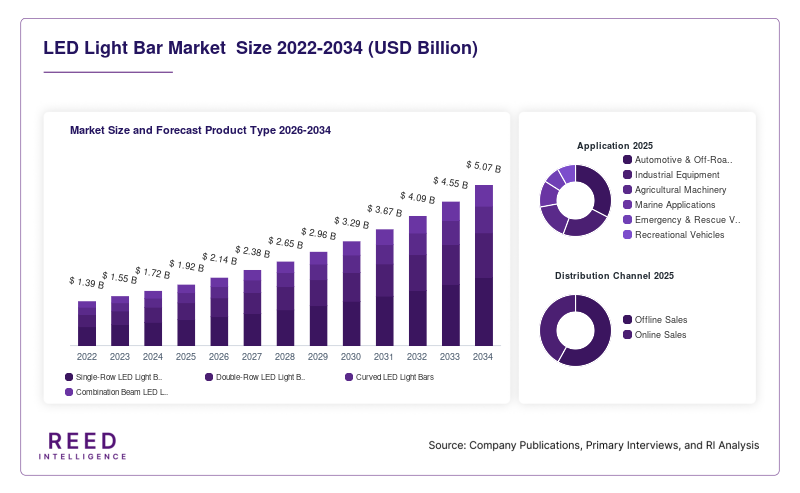
Single-Row LED Light Bars represented the dominant product category and accounted for approximately 42.6% market share in 2024. Their popularity is driven by compact design, cost-effectiveness, ease of installation, and versatility across multiple applications. Automotive users, commercial vehicle operators, and agricultural equipment owners frequently select single-row products because they provide sufficient illumination while maintaining lower energy consumption and reduced installation complexity. Manufacturers continue to introduce improved designs with enhanced brightness, durability, and waterproof performance. The segment also benefits from widespread availability through both retail and online distribution channels, supporting strong adoption across developed and emerging markets.
Curved LED Light Bars are anticipated to be the fastest-growing product category, expanding at a CAGR of 13.6% through 2034. Their growing popularity stems from wider beam coverage and improved field-of-view performance. These products are increasingly preferred by off-road enthusiasts, emergency service providers, and industrial vehicle operators seeking enhanced visibility. Technological advancements in optics design and housing materials have improved durability and lighting efficiency. Rising consumer interest in premium vehicle accessories and increasing demand for customized lighting solutions are expected to further accelerate segment growth throughout the forecast period.
By Application
Automotive and Off-Road Vehicles held the largest application share, accounting for approximately 46.8% of market revenue in 2024. The segment benefits from growing demand for enhanced driving visibility, vehicle customization, and safety improvements. Off-road vehicle owners, truck operators, and recreational users increasingly install LED light bars to improve performance under challenging environmental conditions. Product manufacturers continue to launch advanced lighting systems featuring multiple beam patterns, higher lumen output, and improved weather resistance. The combination of recreational demand and commercial vehicle adoption continues to strengthen the segment's market position.
Industrial Equipment is projected to be the fastest-growing application segment, registering a CAGR of 12.9% during the forecast period. Construction machinery, mining vehicles, warehouse equipment, and utility service vehicles increasingly require reliable illumination systems for extended operating hours. LED light bars provide durability, energy efficiency, and reduced maintenance requirements compared with conventional lighting technologies. Expanding industrial activity, infrastructure development projects, and workplace safety initiatives are encouraging greater adoption. As industries focus on productivity and operational reliability, demand for advanced industrial lighting solutions is expected to rise significantly.
By Distribution Channel
Offline Sales accounted for the largest market share of approximately 68.4% in 2024. Traditional distribution networks, including automotive retailers, specialty lighting stores, equipment dealerships, and industrial suppliers, remain important sales channels. Customers often prefer in-person purchasing experiences that allow product inspection and technical consultation. Professional installation services available through offline channels also contribute to segment dominance. Commercial fleet operators and industrial buyers frequently rely on established dealer relationships when procuring lighting equipment. These factors continue to support the strong market position of offline distribution channels.
Online Sales are expected to expand at the fastest CAGR of 14.2% through 2034. The rapid growth of e-commerce platforms, digital marketing, and direct-to-consumer business models is transforming purchasing behavior. Consumers gain access to broader product selections, competitive pricing, detailed specifications, and customer reviews. Manufacturers increasingly invest in digital sales strategies to reach new markets and improve customer engagement. Enhanced logistics networks, secure payment systems, and growing internet penetration are further accelerating online adoption, making this segment one of the most dynamic areas within the LED light bar industry.
Regional Analysis
North America
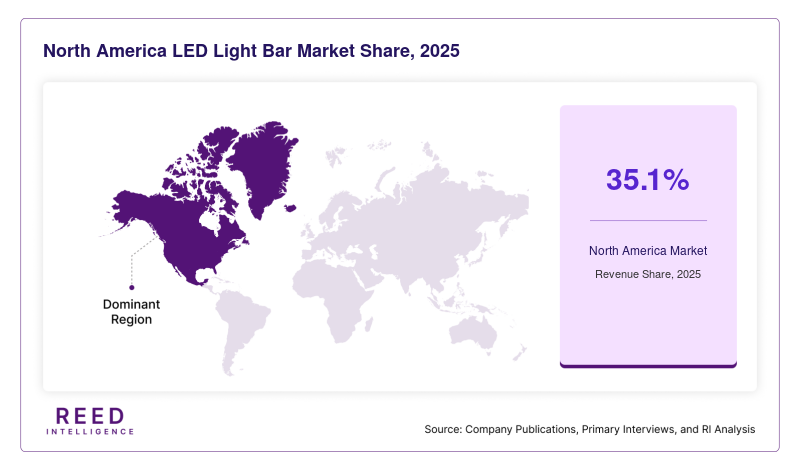
North America accounted for approximately 35.1% of global market share in 2025 and maintained its position as the largest regional market. The region benefits from widespread adoption of LED lighting technologies across automotive, industrial, and commercial sectors. Strong demand from off-road vehicle owners, commercial fleet operators, and construction companies continues to support market expansion. The regional market is forecast to register a CAGR of 10.6% through 2034, supported by technological innovation and increasing investments in energy-efficient equipment.
The United States remains the dominant country within the region. A key growth factor is the strong culture of recreational vehicle ownership and outdoor adventure activities. Demand for premium off-road lighting systems remains high among consumers seeking enhanced vehicle performance and safety. The presence of leading manufacturers, advanced distribution networks, and strong purchasing power further contributes to sustained market growth across the country.
Europe
Europe represented approximately 26.4% of global revenue in 2025 and is expected to record a CAGR of 10.2% during the forecast period. Market growth is supported by stringent energy efficiency regulations and increasing adoption of advanced vehicle technologies. Commercial transportation, industrial automation, and agricultural modernization continue to generate demand for high-performance LED light bars. Growing investments in sustainable infrastructure projects also support regional expansion.
Germany remains the leading country within Europe due to its strong automotive and industrial manufacturing base. A unique growth factor is the country's emphasis on engineering efficiency and vehicle safety standards. Businesses increasingly invest in advanced lighting solutions that improve operational performance and comply with regulatory requirements. This trend continues to create favorable opportunities for LED light bar suppliers.
Asia Pacific
Asia Pacific held approximately 23.8% market share in 2025 and is projected to expand at the fastest CAGR of 12.8% through 2034. Rapid industrialization, infrastructure development, and vehicle production are driving regional demand. Increasing adoption of LED technologies across transportation, agriculture, and construction sectors is further supporting growth. Rising disposable income and expanding recreational vehicle ownership also contribute to increasing product demand.
China dominates the Asia Pacific market due to its extensive manufacturing ecosystem and large domestic consumer base. A unique growth factor is the country's significant investment in industrial expansion and logistics infrastructure. Growing demand for commercial vehicles and heavy equipment creates strong requirements for reliable lighting systems. Local manufacturing capabilities also enable competitive pricing and broad product availability.
Middle East & Africa
The Middle East & Africa accounted for approximately 8.2% of global market revenue in 2025 and is expected to achieve a CAGR of 10.9% during the forecast period. Increasing investments in construction projects, mining activities, and transportation infrastructure are supporting market growth. Governments across the region are promoting modernization initiatives that encourage the adoption of energy-efficient technologies, including LED lighting systems.
Saudi Arabia represents the leading market within the region. A distinctive growth factor is the expansion of large-scale infrastructure and economic diversification projects. Construction companies and industrial operators increasingly require durable lighting equipment capable of operating in harsh environmental conditions. This demand continues to create opportunities for premium LED light bar manufacturers serving the regional market.
Latin America
Latin America captured approximately 6.5% of the global market in 2025 and is projected to grow at a CAGR of 10.4% through 2034. Increasing industrial activity, agricultural modernization, and commercial transportation development are supporting market expansion. The adoption of energy-efficient lighting systems is gradually increasing as businesses seek to reduce operational costs and improve equipment performance.
Brazil remains the dominant country in the region. A unique growth factor is the extensive use of agricultural machinery across large farming operations. Farmers increasingly adopt LED light bars to improve nighttime productivity and operational safety. Continued investments in agribusiness modernization and rural infrastructure development are expected to sustain long-term demand for advanced lighting products.
Competitive Landscape
The LED Light Bar Market is moderately fragmented, with competition centered on product innovation, durability, brightness performance, pricing strategies, and distribution capabilities. Leading companies continue investing in research and development to improve optical efficiency, thermal management, and smart lighting functionality. Strategic partnerships, product launches, and geographic expansion remain common growth strategies among market participants.
Rigid Industries is recognized as one of the leading companies in the market due to its strong product portfolio and presence across automotive, industrial, and recreational applications. The company recently introduced upgraded high-output LED light bars featuring improved beam control and enhanced weather resistance. Other major participants continue focusing on premium lighting solutions, digital sales expansion, and customized product offerings to strengthen market competitiveness.Growing demand from commercial fleets, industrial operators, and recreational users is encouraging manufacturers to expand production capacity and invest in advanced LED technologies. Competition is expected to intensify as new entrants target high-growth regional markets and specialized application segments.
Key Players
- Rigid Industries
- Baja Designs
- KC HiLiTES
- Vision X Lighting
- Nilight
- Philips Lighting
- Osram GmbH
- Hella GmbH
- Larson Electronics
- Putco Inc.
- Auxbeam Lighting
- Oracle Lighting
- Lazer Lamps
- OEDRO
- Black Oak LED
Recent Developments
- Rigid Industries launched a new high-lumen LED light bar series with enhanced thermal management and improved beam optimization for off-road applications.
- Osram expanded its automotive lighting portfolio through advanced LED solutions designed for commercial vehicles and heavy-duty equipment.
- Vision X Lighting introduced smart-enabled LED light bars featuring wireless control functionality and customizable lighting configurations.
- Baja Designs expanded manufacturing capacity to address growing demand from recreational vehicle and motorsport markets.
- Philips Lighting introduced next-generation ruggedized LED lighting products focused on industrial and construction equipment applications.
LED Light Bar Market Segments
Product Type
- Single-Row LED Light Bars
- Double-Row LED Light Bars
- Curved LED Light Bars
- Combination Beam LED Light Bars
Application
- Automotive & Off-Road Vehicles
- Industrial Equipment
- Agricultural Machinery
- Marine Applications
- Emergency & Rescue Vehicles
- Recreational Vehicles
Distribution Channel
- Offline Sales
- Online Sales
By Region
- North America
- Europe
- APAC
- Middle East and Africa
- LATAM