LED Stereo Microscope Market Size, Share & Demand Report By Type (Binocular Stereo Microscopes, Trinocular Stereo Microscopes, Digital Stereo Microscopes), By Application (Industrial Inspection, Biomedical Research, Education, Forensic Analysis), By End-Use (Research Laboratories, Educational Institutions, Industrial Manufacturing, Healthcare Facilities), By Region & Segment Forecasts, 2026–2034
USD 3950
Market Overview
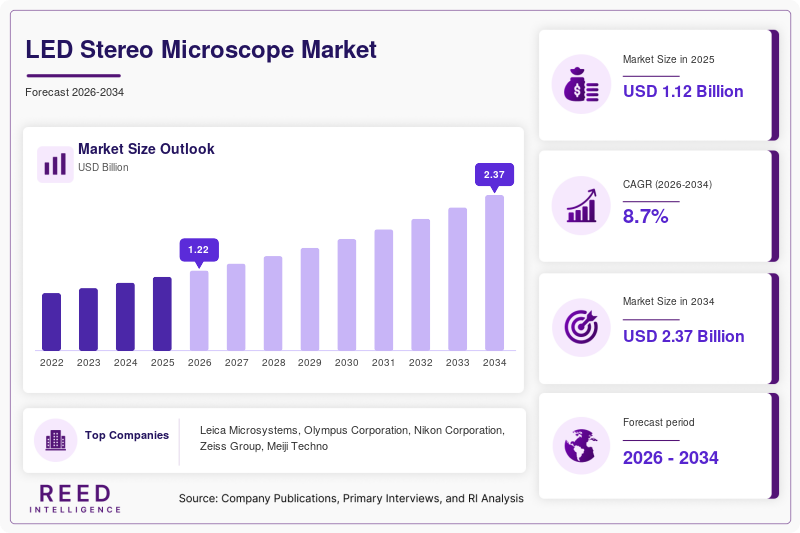
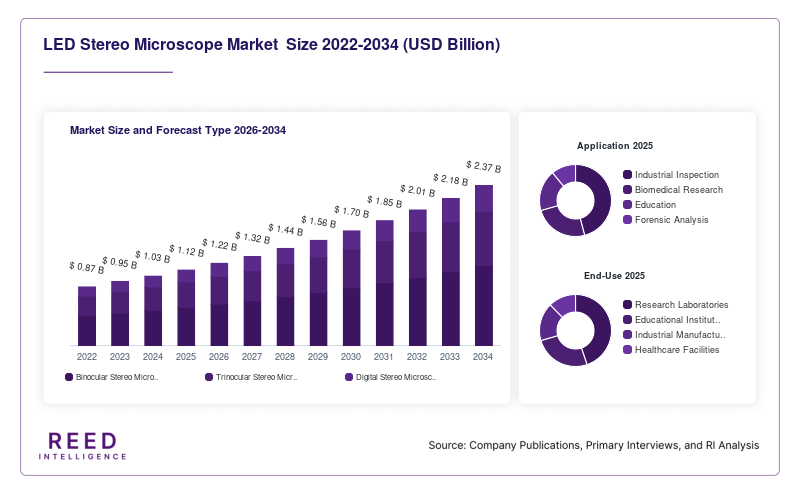
The global LED Stereo Microscope Market size was valued at approximately USD 1.12 billion in 2026 and is projected to reach USD 2.18 billion by 2034, expanding at a CAGR of 8.7% during the forecast period. The steady growth trajectory is supported by increasing adoption across life sciences, electronics manufacturing, and educational institutions. LED stereo microscopes are widely used for precision observation due to their energy efficiency, longer lifespan, and improved illumination quality compared to conventional halogen-based systems.
A major global factor driving market expansion is the rapid advancement in electronics manufacturing and miniaturization. As devices become smaller and more complex, manufacturers require high-resolution, stable illumination systems for inspection and assembly. LED stereo microscopes offer consistent lighting, low heat emission, and enhanced clarity, making them suitable for delicate components such as semiconductors and printed circuit boards. Additionally, rising investments in research laboratories and academic infrastructure are contributing to broader adoption worldwide.
Key Highlights
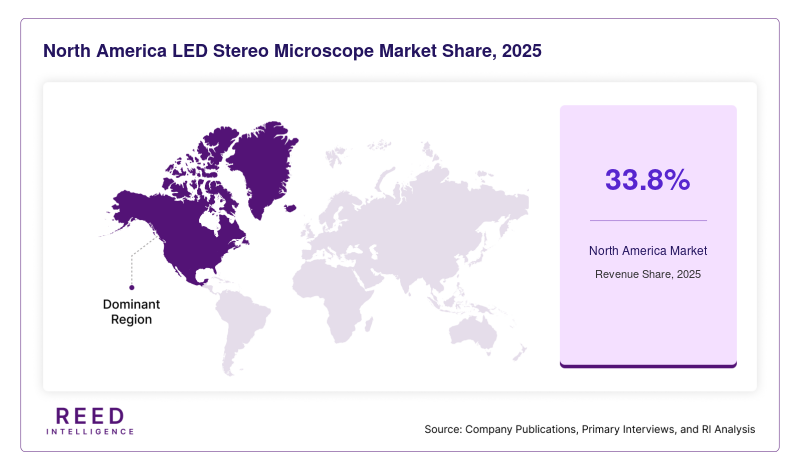
- North America dominated the market with a 33.8% share in 2025.
- Asia Pacific is expected to grow at the fastest CAGR of 10.9% during 2026–2034.
- By type, binocular stereo microscopes accounted for the largest share of 42.6%, while digital stereo microscopes are projected to grow at a CAGR of 11.6%.
- By application, industrial inspection led with a 39.4% share, whereas biomedical research is expected to expand at a CAGR of 10.8%.
- The United States remained the dominant country, with market values of USD 420 million in 2024 and USD 455 million in 2025.
Market Trends
Increasing integration of digital imaging and connectivity
The integration of digital imaging technologies with LED stereo microscopes is reshaping the market landscape. Manufacturers are incorporating high-resolution cameras, image analysis software, and connectivity features such as Wi-Fi and cloud storage into microscope systems. This enables real-time image sharing, remote collaboration, and data storage, which are particularly useful in research laboratories and educational settings. The trend supports the shift toward digital workflows and enhances productivity by allowing users to document and analyze samples efficiently. As laboratories adopt digital ecosystems, the demand for advanced LED stereo microscopes with integrated imaging capabilities continues to rise steadily.
Growing adoption in quality control and precision manufacturing
LED stereo microscopes are increasingly being used in quality control processes across industries such as automotive, aerospace, and electronics. Their ability to provide clear, shadow-free illumination makes them suitable for inspecting intricate components and detecting defects at early stages. Manufacturers are focusing on improving optical performance and ergonomics to meet the needs of continuous industrial use. This trend is further supported by automation and Industry 4.0 initiatives, where microscopes are integrated into inspection systems. The emphasis on maintaining high production standards and reducing waste is expected to sustain demand for these systems in industrial environments.
Market Drivers
Expansion of life sciences and biomedical research
The growth of life sciences research is a significant driver for the LED stereo microscope market. Increasing funding for biological studies, drug discovery, and clinical research has created a demand for reliable visualization tools. LED stereo microscopes are widely used for sample preparation, dissection, and observation of biological specimens. Their energy efficiency and stable illumination make them suitable for prolonged use in laboratories. Additionally, the rise in academic research programs and collaborations between institutions and pharmaceutical companies is contributing to increased equipment procurement. This sustained demand from research institutions is expected to drive long-term market growth.
Rising demand from electronics and semiconductor industries
The electronics and semiconductor sectors are key contributors to the expansion of the LED stereo microscope market. As electronic components become more compact and complex, precise inspection tools are essential to ensure quality and functionality. LED stereo microscopes provide high clarity and depth perception, enabling technicians to identify defects in micro-components. The increasing production of consumer electronics, coupled with advancements in semiconductor fabrication, is fueling the need for advanced inspection equipment. Moreover, the adoption of automated manufacturing processes further enhances the importance of reliable microscopy solutions in maintaining product quality.
Market Restraint
High initial cost and maintenance complexity
One of the primary challenges in the LED stereo microscope market is the relatively high initial cost of advanced systems. High-end models with digital imaging capabilities, ergonomic designs, and precision optics can be expensive, limiting adoption among small laboratories and educational institutions with constrained budgets. Additionally, maintenance and calibration requirements add to the overall cost of ownership. Users may need specialized training to operate and maintain these systems effectively, which can further increase operational expenses. This cost barrier may slow adoption in price-sensitive regions, despite the long-term benefits of LED-based technology.
Market Opportunities
Emerging demand in educational institutions and training centers
Educational institutions represent a growing opportunity for the LED stereo microscope market. Governments and private organizations are investing in upgrading laboratory infrastructure to support science education. LED stereo microscopes are preferred in classrooms due to their durability, low energy consumption, and ease of use. The increasing emphasis on hands-on learning and practical training in biology and engineering courses is driving demand. Additionally, the expansion of online and hybrid education models has created a need for microscopes that support digital imaging and remote instruction. This trend is expected to create sustained growth opportunities in the education sector.
Technological advancements in portable and compact designs
The development of portable and compact LED stereo microscopes presents a significant opportunity for market growth. Manufacturers are focusing on designing lightweight, user-friendly systems that can be used in fieldwork and on-site inspections. These portable devices are particularly useful in environmental studies, forensic investigations, and industrial maintenance. Advances in battery technology and wireless connectivity are further enhancing the functionality of these systems. As users seek flexible and mobile solutions, the demand for compact LED stereo microscopes is expected to increase, opening new avenues for market expansion.
Segmental Analysis
By Type
Binocular stereo microscopes dominated the market in 2024, accounting for approximately 42.6% of the total share. These microscopes are widely used due to their ability to provide a three-dimensional view of specimens, making them suitable for applications requiring depth perception. They are commonly used in industrial inspection, biological research, and educational settings. The ergonomic design and ease of use make them a preferred choice for prolonged usage. Additionally, their compatibility with LED illumination enhances image clarity and reduces eye strain, further supporting their widespread adoption across various sectors.
Digital stereo microscopes are the fastest-growing subsegment, expected to expand at a CAGR of 11.6% during the forecast period. The growth is driven by the increasing integration of imaging technologies and the need for digital documentation. These microscopes allow users to capture, store, and share images easily, making them ideal for collaborative research and remote analysis. The adoption of digital systems is also supported by advancements in software and connectivity, which enhance functionality and user experience.
By Application
Industrial inspection held the largest share of 39.4% in 2024, driven by the increasing need for quality control in manufacturing processes. LED stereo microscopes are widely used to inspect components, identify defects, and ensure product quality. The growing complexity of electronic devices and the demand for precision manufacturing are key factors supporting this segment. The use of microscopes in automated inspection systems further enhances efficiency and accuracy in industrial operations.
Biomedical research is the fastest-growing application segment, with a projected CAGR of 10.8%. The expansion of research activities in life sciences, including drug development and cellular studies, is driving demand. LED stereo microscopes are essential tools for sample preparation and analysis. The increasing focus on healthcare innovation and the rising number of research projects are expected to sustain growth in this segment.
By End-Use
Research laboratories accounted for the largest share in 2024, contributing significantly to market revenue. These laboratories require advanced microscopy solutions for various applications, including biological research, material analysis, and chemical studies. The availability of funding and the expansion of research programs are key factors driving demand. LED stereo microscopes are preferred due to their reliability and energy efficiency, which are essential for continuous laboratory operations.
Educational institutions are the fastest-growing end-use segment, with a CAGR of 10.5%. The increasing emphasis on practical learning and laboratory-based education is driving demand for microscopy equipment. Governments and private institutions are investing in upgrading educational infrastructure, which includes the procurement of advanced microscopes. The integration of digital features in LED stereo microscopes further enhances their suitability for modern teaching methods.
Regional Analysis
North America
North America held a significant share of the LED stereo microscope market in 2025, accounting for approximately 33.8% of global revenue. The region is expected to maintain steady growth with a CAGR of 7.9% during the forecast period. The presence of advanced research facilities, well-established healthcare infrastructure, and strong investment in technological innovation supports market expansion. Additionally, the adoption of digital microscopy solutions is increasing across laboratories and industrial sectors, contributing to sustained demand.
The United States remains the dominant country in this region due to its robust research ecosystem and high spending on scientific equipment. A unique growth factor is the strong collaboration between academic institutions and private companies, which drives continuous innovation and equipment upgrades. This collaborative environment encourages the adoption of advanced LED stereo microscopes in both research and industrial applications.
Europe
Europe accounted for around 27.6% of the global market share in 2025 and is projected to grow at a CAGR of 7.5% through 2034. The region benefits from strong regulatory frameworks and a focus on quality standards in manufacturing and research. Countries in Europe are investing in laboratory modernization, which is supporting the adoption of LED-based microscopy solutions.
Germany leads the European market due to its strong industrial base and emphasis on precision engineering. A key growth factor is the region’s focus on sustainability and energy-efficient technologies. LED stereo microscopes align with these goals, making them a preferred choice across industries and research institutions.
Asia Pacific
Asia Pacific is the fastest-growing region, with a projected CAGR of 10.9% during the forecast period and a market share of 24.3% in 2025. Rapid industrialization, expanding electronics manufacturing, and increasing research investments are driving demand. The region is witnessing significant growth in semiconductor production, which requires advanced inspection tools.
China dominates the Asia Pacific market due to its large manufacturing base and government support for technological advancement. A unique growth factor is the rapid expansion of educational institutions and research centers, which is increasing the demand for microscopy equipment across various applications.
Middle East & Africa
The Middle East & Africa region held a smaller share of approximately 7.1% in 2025 but is expected to grow at a CAGR of 6.8%. The market is driven by gradual improvements in healthcare infrastructure and increasing investments in research facilities. The adoption of LED stereo microscopes is growing steadily as awareness of advanced technologies increases.
Saudi Arabia is a leading country in this region, supported by government initiatives to diversify the economy and invest in scientific research. A unique growth factor is the development of new research hubs and educational institutions, which is boosting demand for laboratory equipment, including microscopes.
Latin America
Latin America accounted for around 7.2% of the market share in 2025 and is projected to grow at a CAGR of 7.2% during the forecast period. The region is experiencing gradual growth due to improvements in industrial and educational infrastructure. Increasing investments in healthcare and research are supporting market expansion.
Brazil leads the market in Latin America due to its large population and growing industrial sector. A unique growth factor is the expansion of vocational training programs, which require advanced laboratory equipment. This is driving demand for LED stereo microscopes in educational and training institutions.
Competitive Landscape
The LED stereo microscope market is moderately competitive, with several established players focusing on innovation and product development. Leading companies are investing in advanced imaging technologies and ergonomic designs to enhance user experience. The market is characterized by strategic collaborations, product launches, and geographic expansion.
One of the leading companies in the market is Leica Microsystems, known for its strong portfolio of high-performance microscopy solutions. The company has recently introduced advanced digital stereo microscopes with improved imaging capabilities and connectivity features. Other major players are focusing on expanding their distribution networks and strengthening their presence in emerging markets to capture new opportunities.
Key Players
- Leica Microsystems
- Olympus Corporation
- Nikon Corporation
- Zeiss Group
- Meiji Techno
- AmScope
- Vision Engineering
- Euromex Microscopen
- Labomed Inc.
- Celestron LLC
- Motic
- Dino-Lite
- Swift Optical Instruments
- Accu-Scope
- Bresser GmbH
Recent Developments
- Leica Microsystems launched a new range of digital LED stereo microscopes with enhanced imaging software for research applications.
- Olympus Corporation introduced compact and portable stereo microscopes designed for fieldwork and industrial inspections.
- Nikon Corporation expanded its product portfolio by integrating AI-based image analysis features into its microscopy systems.
LED Stereo Microscope Market Segments
Type
- Binocular Stereo Microscopes
- Trinocular Stereo Microscopes
- Digital Stereo Microscopes
Application
- Industrial Inspection
- Biomedical Research
- Education
- Forensic Analysis
End-Use
- Research Laboratories
- Educational Institutions
- Industrial Manufacturing
- Healthcare Facilities
By Region
- North America
- Europe
- APAC
- Middle East and Africa
- LATAM