Leisure Boat Marine Coating Market Size, Share, Demand Report by Resin Type (Epoxy, Polyurethane, Acrylic, Alkyd, Specialty Resins), By Application (Antifouling Coatings, Primer Coatings, Topcoat Finishes, Varnishes, Specialty Protective Coatings), By End Use (Motorboats, Sailboats, Yachts, Personal Watercraft) & Regional Forecasts, 2026–2034
USD 3950
Market Overview
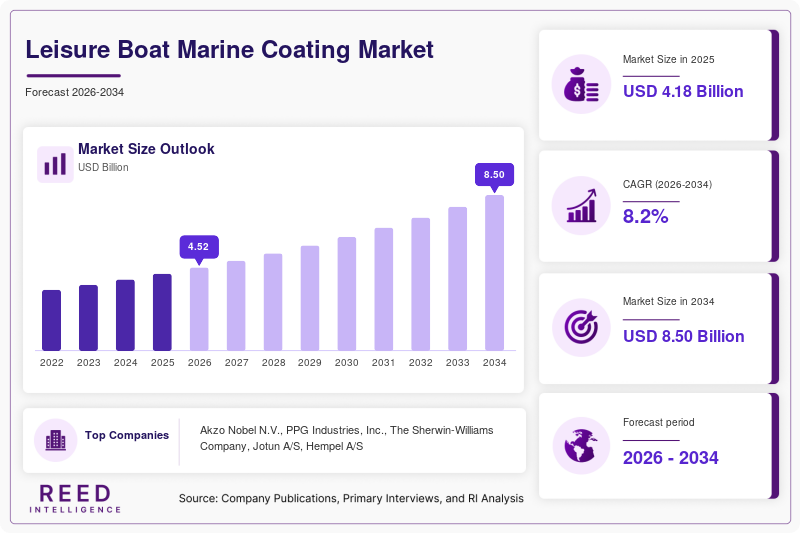
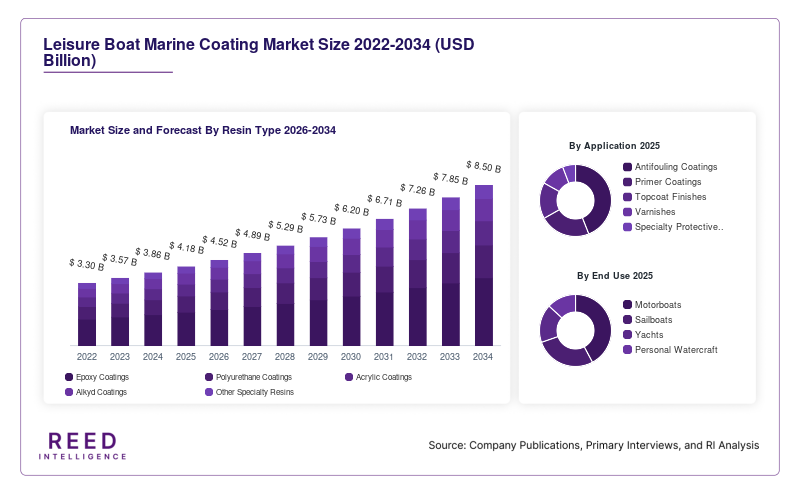
The global Leisure Boat Marine Coating Market size was valued at USD 4.18 billion in 2026 and is projected to reach USD 7.86 billion by 2034, expanding at a CAGR of 8.2% during 2026–2034. The market is gaining momentum due to the rising ownership of recreational watercraft, expanding marine tourism infrastructure, and increasing consumer demand for long-lasting vessel aesthetics and hull protection. Leisure boat marine coatings play a critical role in safeguarding yachts, sailboats, motorboats, and personal watercraft against corrosion, fouling, UV degradation, saltwater abrasion, and fuel exposure. A major global factor supporting growth is the continued rise in disposable income among upper-middle-income households, particularly in coastal economies, which has accelerated spending on private boating and marina activities. In addition, technological improvements in low-VOC coatings, self-polishing antifouling systems, and nanotechnology-enhanced protective layers are reshaping product innovation. Manufacturers are increasingly focusing on environmental compliance, especially in regions with stringent maritime sustainability regulations, creating broader demand for water-based and hybrid marine coatings. Premium boat owners are also investing more in maintenance cycles, refits, and aesthetic enhancements, further strengthening recurring coating demand. The market benefits from both OEM applications and aftermarket repainting services, with aftermarket demand accounting for a large recurring revenue stream due to regular maintenance requirements.
Key Highlights
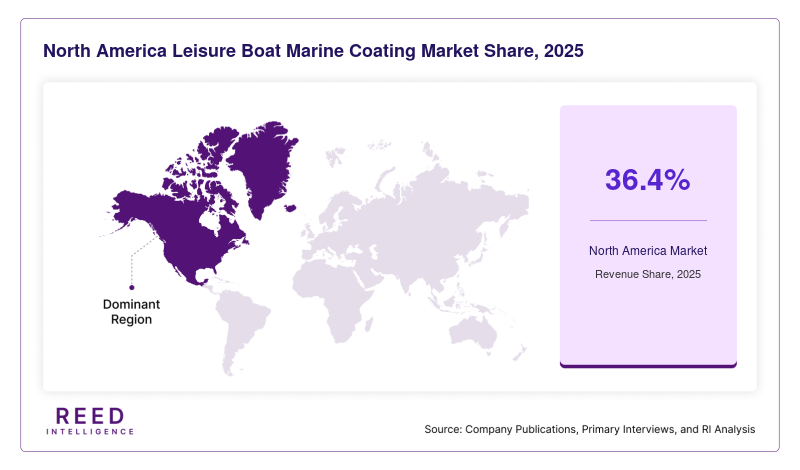
- North America dominated the market with a 36.4% share in 2025.
- Asia Pacific is expected to grow at the fastest CAGR of 10.8% during 2026–2034.
- By resin type, epoxy coatings accounted for the largest share of 39.1%, while polyurethane coatings are projected to grow at a CAGR of 9.8%.
- By application, antifouling coatings led with a 44.6% share, whereas topcoat finishes are expected to expand at a CAGR of 9.4%.
- The United States remained the dominant country, with market values of USD 780 million in 2024 and USD 845 million in 2025.
Market Trends
Rising Shift Toward Eco-Friendly and Low-Emission Marine Coatings
Environmental regulations are significantly influencing product development across the Leisure Boat Marine Coating Market. Regulatory bodies in North America and Europe are tightening restrictions on volatile organic compounds and toxic biocides traditionally used in marine paints. This shift has encouraged manufacturers to develop water-based coatings, copper-free antifouling solutions, and silicone-based foul-release systems. Boat owners are increasingly selecting coatings that align with sustainability goals without sacrificing durability. The trend is particularly visible in premium leisure boating markets where environmentally responsible marina certifications influence purchasing decisions. As sustainable boating gains broader consumer acceptance, coating producers are investing in green chemistry and bio-based resin technologies to improve compliance and market competitiveness.
Premiumization of Recreational Boats Driving High-Performance Coating Demand
The growing preference for luxury yachts, sport fishing boats, and custom leisure vessels is supporting increased demand for premium marine coatings. High-net-worth consumers are seeking coatings with enhanced gloss retention, UV stability, abrasion resistance, and superior finish quality. Advanced ceramic-infused coatings and nanocomposite topcoats are gaining traction for their ability to reduce maintenance frequency while preserving appearance. This premiumization trend is especially strong in developed boating markets where consumers prioritize aesthetics and resale value. As customization and luxury features become central to boat ownership, marine coating brands are expanding premium product portfolios tailored for long-term visual and structural performance.
Market Drivers
Expanding Recreational Boating Participation Across Coastal and Inland Regions
Increasing global participation in leisure boating activities is a primary growth driver for the Leisure Boat Marine Coating Market. Recreational boating has expanded beyond luxury consumers to include middle-income demographics through rental services, shared ownership, and financing options. Marina expansion, boating clubs, and tourism investments are also broadening accessibility. This increase in active vessel fleets directly raises demand for protective and decorative coatings during both manufacturing and maintenance cycles. In regions such as North America and Europe, aging leisure boats require periodic repainting, while Asia Pacific is witnessing fresh vessel demand. The broadening consumer base creates a consistent and expanding market for coating manufacturers.
Growth in Boat Maintenance, Refurbishment, and Aftermarket Services
The aftermarket segment continues to play a major role in supporting marine coating revenues due to the cyclical maintenance needs of leisure boats. Hull cleaning, corrosion control, repainting, and refinishing are essential to preserve vessel performance and compliance. As more consumers retain boats for longer periods, refurbishment spending is increasing. Boat owners increasingly recognize that quality coatings reduce drag, improve fuel efficiency, and extend vessel life. This awareness has strengthened demand for specialized maintenance coatings. Service yards and marine repair centers are also expanding globally, making professional coating services more accessible and reinforcing product sales through recurring maintenance schedules.
Market Restraint
Stringent Environmental Compliance and Raw Material Price Volatility
The Leisure Boat Marine Coating Market faces constraints from tightening environmental regulations and fluctuating raw material costs. Restrictions on copper biocides, solvent emissions, and hazardous additives require manufacturers to reformulate products, often increasing production expenses. Compliance testing, certification, and product redevelopment can extend commercialization timelines and reduce profit margins. Simultaneously, volatility in petrochemical-derived resin prices impacts epoxy, acrylic, and polyurethane production costs. Smaller manufacturers may struggle to absorb these expenses, creating pricing pressure across the supply chain. For example, sudden increases in specialty additives or titanium dioxide prices can elevate end-user costs, potentially delaying repainting cycles among price-sensitive boat owners and reducing short-term aftermarket demand.
Market Opportunities
Emerging Marine Tourism Infrastructure in Developing Economies
Developing coastal economies are investing heavily in marina development, recreational waterfront projects, and tourism diversification, creating new opportunities for the Leisure Boat Marine Coating Market. Countries in Southeast Asia, the Middle East, and Latin America are promoting yachting tourism, charter fleets, and water sports infrastructure. This expansion supports both new boat purchases and servicing ecosystems. As these markets mature, demand for antifouling, protective, and decorative coatings is expected to accelerate. Manufacturers entering these regions with localized distribution and climate-specific coating solutions can secure long-term growth as marine leisure ecosystems become more established.
Technological Innovation in Smart and Self-Cleaning Coatings
Innovation in self-cleaning, foul-release, and sensor-integrated coatings presents substantial market potential. New coating technologies that reduce drag, resist microorganism buildup, and minimize maintenance intervals are appealing to both private owners and rental fleet operators. Silicone elastomers, graphene-enhanced coatings, and hydrophobic nanolayers are attracting interest for performance advantages. Smart coatings capable of indicating wear or corrosion are also entering development pipelines. These innovations create differentiation opportunities for manufacturers while addressing operational efficiency concerns. As technology costs gradually decline, adoption may broaden from luxury boats to mainstream recreational vessels, expanding addressable market size.
Segmental Analysis
By Resin Type
Epoxy coatings held the dominant share of 39.1% in 2024 due to their strong adhesion, corrosion resistance, and underwater durability. These coatings are widely used as primers and barrier coats for leisure boats operating in harsh saltwater conditions. Boat owners favor epoxy systems for hull protection and osmosis prevention, particularly for fiberglass vessels. Their compatibility with multiple topcoats and long-term protective performance supports broad adoption across OEM and maintenance segments.
Polyurethane coatings are projected to grow at the fastest CAGR of 9.8% through 2034. Their superior gloss retention, color stability, and UV resistance make them increasingly preferred for premium topcoats and visible surfaces. Growth is supported by rising consumer demand for aesthetic appeal, luxury finishes, and lower maintenance intervals. As premiumization expands, polyurethane adoption is likely to strengthen.
By Application
Antifouling coatings accounted for 44.6% of market share in 2024 due to their critical role in preventing marine organism buildup. These coatings improve fuel efficiency, maintain vessel speed, and reduce hull cleaning frequency. They are essential for boats operating in coastal and warm-water environments, where barnacle and algae accumulation is common. Strong aftermarket demand supports this segment’s leadership.
Topcoat finishes are expected to record the fastest CAGR of 9.4% during the forecast period. Increased consumer preference for appearance enhancement, UV durability, and resale value is driving demand. Luxury and custom leisure boats particularly rely on advanced topcoat systems for premium aesthetics and weather resistance.
By End Use
Motorboats represented the largest share of 42.8% in 2024 due to their widespread use across recreation, fishing, and watersports. Their large global fleet size generates consistent OEM and aftermarket coating demand. Frequent exposure to varying marine environments also supports regular maintenance cycles.
Yachts are forecast to witness the fastest CAGR of 10.1% through 2034. Rising global wealth, charter expansion, and luxury tourism are supporting yacht ownership. These vessels demand specialized coatings with premium finish quality, advanced antifouling performance, and long lifecycle durability, creating higher-value opportunities for manufacturers.
Regional Analysis
North America
North America accounted for 36.4% of the global Leisure Boat Marine Coating Market in 2025 and is projected to maintain strong growth at a CAGR of 7.9% through 2034. The region benefits from a mature recreational boating culture, extensive marina networks, and high aftermarket repainting frequency. Large yacht ownership, sport fishing demand, and consumer preference for premium coatings support stable product consumption across OEM and aftermarket channels.
The United States leads the regional market due to its expansive boating population, coastal infrastructure, and strong maintenance spending. Florida, California, and the Great Lakes region contribute significantly to demand. A unique growth factor is the country’s large installed base of aging leisure boats, which creates recurring demand for refinishing, antifouling upgrades, and premium protective systems.
Europe
Europe represented 28.7% of the Leisure Boat Marine Coating Market in 2025 and is forecast to expand at a CAGR of 7.6% during the forecast period. Strong yacht manufacturing in Mediterranean countries and widespread sailing culture in Western Europe support market stability. Sustainability regulations are also accelerating adoption of environmentally compliant marine coatings.
Italy dominates the European market due to its yacht manufacturing base and luxury boating presence. A distinct regional driver is the concentration of premium yacht refit facilities in Mediterranean marinas, which sustain strong demand for high-performance finishes and aesthetic coatings tailored to luxury vessel standards.
Asia Pacific
Asia Pacific held 22.9% market share in 2025 and is expected to register the fastest CAGR of 10.8% through 2034. Rising wealth, tourism investments, and marina infrastructure development are accelerating recreational boating adoption. Countries across Southeast Asia and Oceania are also seeing stronger marine leisure participation.
Australia is the dominant market within Asia Pacific due to its boating culture, extensive coastline, and recreational fishing demand. A unique growth factor is the rapid expansion of boating tourism and charter services across island economies, which is increasing vessel fleet maintenance requirements and boosting coating demand.
Middle East & Africa
Middle East & Africa captured 6.3% of the market in 2025 and is anticipated to grow at a CAGR of 8.7%. Luxury waterfront developments, yacht tourism, and expanding marina investments are supporting regional growth. Gulf countries are particularly active in marine leisure diversification.
The United Arab Emirates leads due to strong yacht ownership, tourism investments, and luxury marina developments. A notable growth factor is government-backed coastal tourism projects that encourage private and charter marine vessel expansion, creating fresh demand for high-end marine coatings.
Latin America
Latin America accounted for 5.7% of the market in 2025 and is projected to grow at a CAGR of 8.1%. Coastal tourism, sport fishing, and recreational boating growth in select economies are supporting regional expansion. Brazil and Mexico are key contributors.
Brazil dominates due to its extensive coastline and increasing domestic tourism spending. A unique driver is the rise of recreational boating among affluent urban consumers, particularly in coastal resort regions where marina development and leisure watercraft ownership are increasing steadily.
Competitive Landscape
The Leisure Boat Marine Coating Market is moderately consolidated, with leading players competing through product innovation, sustainability strategies, and regional expansion. Akzo Nobel N.V. remains a leading participant due to its extensive International brand portfolio and broad marine coatings distribution. PPG Industries, Inc., The Sherwin-Williams Company, Jotun A/S, and Hempel A/S also maintain significant positions through advanced antifouling technologies and premium yacht coating solutions. Recent competitive activity includes increased investment in copper-free coatings, strategic marina partnerships, and expanded distribution in Asia Pacific. Companies are emphasizing regulatory compliance, self-cleaning technology, and durable aesthetic coatings to differentiate product portfolios. Innovation remains central as manufacturers address evolving environmental and performance expectations.
Key Players
- Akzo Nobel N.V.
- PPG Industries, Inc.
- The Sherwin-Williams Company
- Jotun A/S
- Hempel A/S
- Nippon Paint Holdings Co., Ltd.
- Kansai Paint Co., Ltd.
- RPM International Inc.
- BASF SE
- Chugoku Marine Paints, Ltd.
- Axalta Coating Systems
- Boero YachtCoatings
- Sea Hawk Paints
- Pettit Marine Paint
- CMP Group Ltd.
Recent Developments
- Akzo Nobel expanded its low-VOC yacht coating line in 2025 to strengthen sustainability compliance.
- PPG Industries introduced an advanced foul-release coating platform for premium leisure vessels in 2024.
- Hempel A/S expanded Asia Pacific marine coatings distribution through new marina partnerships in 2025.
Leisure Boat Marine Coating Market Segments
By Resin Type
- Epoxy Coatings
- Polyurethane Coatings
- Acrylic Coatings
- Alkyd Coatings
- Other Specialty Resins
By Application
- Antifouling Coatings
- Primer Coatings
- Topcoat Finishes
- Varnishes
- Specialty Protective Coatings
By End Use
- Motorboats
- Sailboats
- Yachts
- Personal Watercraft
By Region
- North America
- Europe
- APAC
- Middle East and Africa
- LATAM