Lemon Salt Market Size, Share & Demand Report By Product Type (Flavored Lemon Salt, Organic Lemon Salt, Regular Lemon Salt), By Application (Food Processing, Beverage Applications, Household Cooking, Foodservice Industry), By Distribution Channel (Supermarkets & Hypermarkets, Convenience Stores, Online Retail, Specialty Food Stores), By End User (Commercial Foodservice, Household Consumers, Industrial Food Manufacturers), By Region & Segment Forecasts, 2026–2034
USD 3950
Market Overview
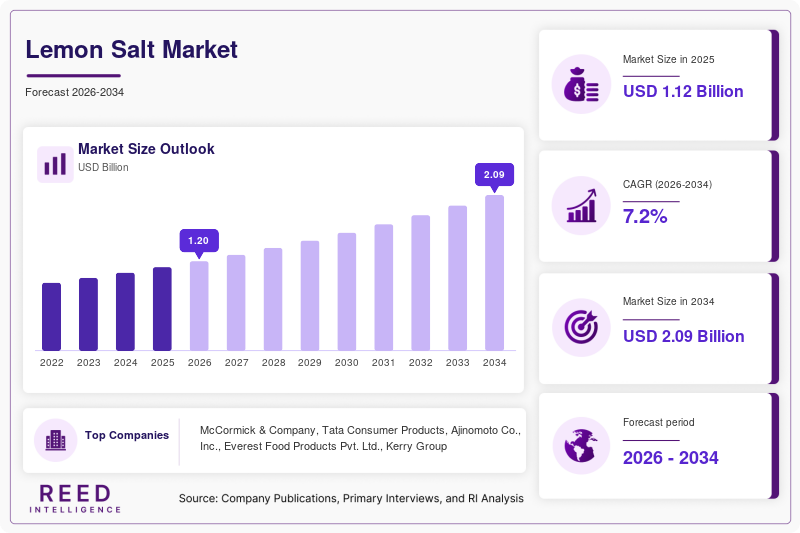
The Lemon Salt Market size was valued at USD 1.12 billion in 2026 and is projected to reach USD 1.96 billion by 2034, expanding at a CAGR of 7.2% during the forecast period from 2026 to 2034. The market growth has been supported by the rising global consumption of flavored seasonings and convenience food products. Consumers across developed and emerging economies have increasingly preferred citrus-infused seasoning ingredients that enhance flavor profiles in snacks, beverages, ready meals, and street food products.
Lemon salt, commonly formulated using salt, dehydrated lemon extracts, citric compounds, and natural flavoring agents, has gained broad popularity across household and industrial food applications. The increasing preference for tangy and savory flavor combinations has encouraged food manufacturers to incorporate lemon salt into processed snacks, instant noodles, seasoning blends, and beverage mixes. In addition, the expansion of quick-service restaurants and packaged food industries has strengthened product demand globally.
Key Highlights
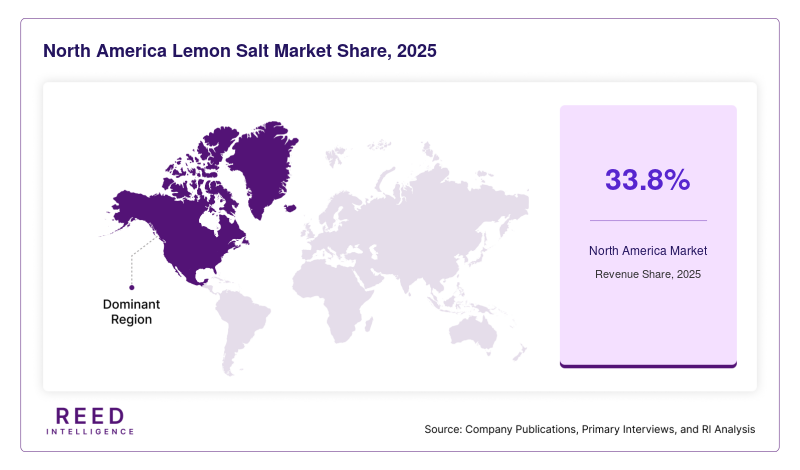
- North America accounted for 33.8% of the global Lemon Salt Market share in 2025, while Asia Pacific is projected to register the fastest CAGR of 8.5% during 2026–2034.
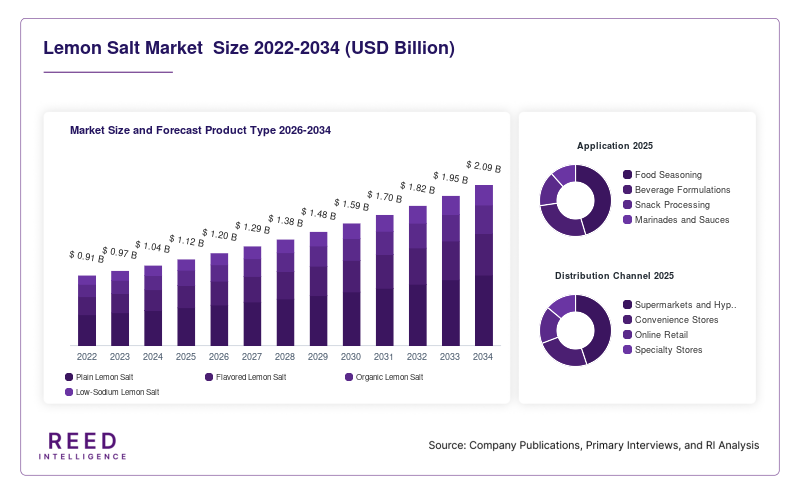
- By product type, flavored lemon salt held the dominant market share of 58.4% in 2025, whereas organic lemon salt is projected to witness the fastest CAGR of 9.1% through 2034.
- By application, food processing accounted for 46.7% share in 2025, while beverage applications are expected to expand at a CAGR of 8.3% during the forecast period.
- By distribution channel, supermarkets and hypermarkets represented 42.9% of the market share in 2025, while online retail is expected to grow at a CAGR of 10.4% through 2034.
- By end user, commercial foodservice held 55.1% market share in 2025, whereas household consumption is projected to expand at a CAGR of 7.9% during the forecast timeline.
- The U.S. Lemon Salt Market was valued at USD 238 million in 2024 and reached USD 256 million in 2025.
Market Trends
Rising Demand for Citrus-Flavored Seasonings
The increasing popularity of citrus-infused flavors has emerged as a major trend shaping the Lemon Salt Market. Consumers have shown greater interest in tangy seasoning combinations that enhance the taste of snacks, seafood, grilled foods, and beverages. This trend has encouraged seasoning manufacturers to expand flavored salt portfolios targeting retail and foodservice customers.
Packaged snack producers and ready-to-eat meal manufacturers have also incorporated lemon salt into seasoning blends to differentiate product offerings. The growing adoption of international cuisines and street-food-inspired flavors has further accelerated demand for lemon-based seasonings across urban markets.
Growth of Clean-Label and Reduced-Sodium Products
The expansion of clean-label food categories has significantly influenced Lemon Salt Market trends. Consumers increasingly prefer seasoning products containing natural ingredients, fruit-derived extracts, and lower sodium content. This shift has encouraged manufacturers to develop cleaner formulations using natural lemon oils, dehydrated citrus powders, and mineral salts.
Food companies have also introduced preservative-free lemon salt products to address health-conscious purchasing behavior. Premium retail brands are increasingly marketing organic and additive-free seasoning blends, contributing to product innovation within the global market.
Market Drivers
Expansion of Convenience Food Consumption
The growing consumption of convenience and packaged foods has remained a major driver for the Lemon Salt Market. Urban consumers continue to seek quick meal solutions with enhanced flavor profiles, increasing the use of seasoning blends in processed foods. Lemon salt has become widely utilized in instant noodles, chips, frozen meals, and snack products due to its versatile flavoring properties.
Food manufacturers have expanded product portfolios with flavored seasoning variants to address evolving consumer taste preferences. The rising popularity of savory snacks and ready-to-cook meals has further strengthened industrial demand for lemon salt ingredients.
Increasing Popularity of Foodservice and Street Food Culture
The rapid growth of foodservice chains and street-food-inspired dining trends has supported the expansion of the Lemon Salt Market. Restaurants, cafés, and quick-service outlets increasingly use flavored salts in appetizers, beverages, grilled dishes, and fusion cuisine preparations.
The demand for distinctive seasoning combinations among younger consumers has also encouraged chefs and commercial kitchens to incorporate lemon salt into menu innovations. This growing culinary experimentation has strengthened commercial demand across urban foodservice sectors.
Market Restraint
Fluctuation in Raw Material Prices
Volatility in salt pricing, citrus crop yields, and lemon extract availability has remained a major restraint for the Lemon Salt Market. Seasonal agricultural fluctuations and changing climatic conditions have affected lemon production across key sourcing countries. Such variations have increased manufacturing costs and reduced pricing consistency for seasoning manufacturers.
Market Opportunities
Expansion of Premium Gourmet Seasoning Categories
The increasing consumer preference for gourmet food products presents a strong opportunity for the Lemon Salt Market. Premium seasoning brands are introducing infused salts with unique flavor combinations targeting high-income consumers and specialty food retailers.
Manufacturers focusing on artisanal production methods and small-batch seasoning blends are expected to strengthen brand positioning within premium culinary markets.
Growth of Digital Grocery and Direct-to-Consumer Sales
The rapid expansion of e-commerce grocery platforms is creating new opportunities for Lemon Salt Market participants. Online channels allow seasoning brands to improve product visibility and reach consumers across multiple geographies.
Direct-to-consumer sales strategies and subscription-based spice delivery services are expected to enhance customer engagement and accelerate market penetration during the forecast period.
Segmental Analysis
By Product Type
Flavored Lemon Salt Dominated the Market
Flavored lemon salt accounted for 58.4% of the global Lemon Salt Market share in 2025. The segment maintained dominance due to strong consumer preference for blended seasoning products incorporating herbs, spices, and citrus flavoring agents.
Organic Lemon Salt Will Witness the Fastest Growth
Organic lemon salt is projected to expand at a CAGR of 9.1% during the forecast period. The segment growth will be driven by increasing demand for preservative-free and naturally sourced seasoning products.
By Application
Food Processing Held the Largest Share
Food processing represented 46.7% of the global Lemon Salt Market share in 2025. The segment’s dominance was attributed to widespread use of lemon salt in snack foods, instant meals, sauces, and seasoning blends.
Beverage Applications Will Grow Rapidly
Beverage applications are projected to register a CAGR of 8.3% during 2026–2034. The segment growth will be supported by rising demand for flavored drink mixes, cocktail seasonings, and citrus-infused beverages.
By Distribution Channel
Supermarkets and Hypermarkets Led the Market
Supermarkets and hypermarkets accounted for 42.9% of the global Lemon Salt Market share in 2025. The segment maintained dominance due to broad product availability and organized retail expansion.
Online Retail Will Record the Fastest Growth
Online retail is projected to grow at a CAGR of 10.4% during the forecast period. Increasing digital grocery adoption and expanding e-commerce penetration will continue to strengthen online seasoning product sales.
By End User
Commercial Foodservice Dominated
Commercial foodservice held 55.1% of the market share in 2025. Restaurants, cafés, catering services, and quick-service food chains extensively utilized lemon salt in menu preparations due to its flavor versatility.
Household Consumption Will Expand Steadily
Household consumption is expected to expand at a CAGR of 7.9% through 2034. Growing home cooking trends and rising consumer experimentation with seasoning blends will continue to support segment growth.
Regional Analysis
North America
North America accounted for 33.8% of the global Lemon Salt Market share in 2025 and will likely expand at a CAGR of 6.8% during 2026–2034. The region’s market growth will be supported by strong demand for flavored snacks, convenience foods, and seasoning blends.
The United States remained the dominant country within the region. The expansion of premium snack manufacturing and growing consumption of restaurant-style packaged foods contributed to increasing lemon salt usage across industrial food applications.
Europe
Europe held 26.9% of the global Lemon Salt Market share in 2025 and is projected to register a CAGR of 6.5% through 2034. The region’s market expansion will be driven by rising demand for clean-label seasoning products and natural culinary ingredients.
Germany emerged as the dominant country due to increasing consumer interest in gourmet seasonings and premium packaged foods. The country’s strong retail infrastructure supported higher adoption of specialty flavored salts.
Asia Pacific
Asia Pacific represented 25.7% of the global Lemon Salt Market share in 2025 and is anticipated to witness the fastest CAGR of 8.5% during the forecast period. Rapid urbanization, changing food habits, and rising disposable income levels will continue to strengthen regional market demand.
China dominated the regional market due to the expansion of processed food manufacturing and increasing popularity of flavored snack products. Growing online food retail activity has also improved seasoning product accessibility across the country.
Middle East & Africa
The Middle East & Africa accounted for 7.4% of the global Lemon Salt Market share in 2025 and is expected to grow at a CAGR of 6.1% from 2026 to 2034. Rising consumption of spice-rich cuisines and flavored seasoning products will support regional market expansion.
Saudi Arabia remained the dominant country in the region. The growing hospitality sector and increasing demand for convenience food products contributed to greater adoption of lemon salt in commercial food preparation.
Latin America
Latin America captured 6.2% of the global Lemon Salt Market share in 2025 and is projected to expand at a CAGR of 6.4% during the forecast timeline. Increasing consumer demand for savory snacks and seasoning innovations will continue to support market development.
Brazil emerged as the leading country due to rising consumption of flavored beverages and processed snack products. Expanding supermarket penetration also improved retail availability of lemon salt products across urban areas.
Competitive Landscape
The global Lemon Salt Market remains moderately fragmented, with seasoning manufacturers, spice processors, and packaged food ingredient suppliers competing across retail and industrial applications. Companies have increasingly focused on flavor innovation, natural ingredient sourcing, and premium packaging solutions to strengthen market positioning.
Key Players List
- McCormick & Company
- Tata Consumer Products
- Ajinomoto Co., Inc.
- Everest Food Products Pvt. Ltd.
- Kerry Group
- Nestlé S.A.
- Unilever PLC
- Olam Group
- Döhler Group
- Sensient Technologies Corporation
- Fuchs Gruppe
- The Kraft Heinz Company
- Givaudan
- Symrise AG
- MDH Spices
Recent Developments
- In 2025, McCormick & Company introduced a new low-sodium lemon seasoning blend targeting health-conscious consumers in North America.
- In 2025, Kerry Group expanded its citrus flavor manufacturing capabilities to support industrial food customers.
- In 2024, Ajinomoto Co., Inc. launched new seasoning formulations tailored for snack manufacturers in Asia Pacific.
- In 2025, Tata Consumer Products expanded its flavored salt product distribution across modern retail outlets in India.
- In 2024, Sensient Technologies Corporation invested in citrus extraction technologies aimed at improving flavor retention and shelf stability in seasoning applications.
Lemon Salt Market Segments
Product Type
- Plain Lemon Salt
- Flavored Lemon Salt
- Organic Lemon Salt
- Low-Sodium Lemon Salt
Application
- Food Seasoning
- Beverage Formulations
- Snack Processing
- Marinades and Sauces
Distribution Channel
- Supermarkets and Hypermarkets
- Convenience Stores
- Online Retail
- Specialty Stores
End User
- Household Consumers
- Commercial Foodservice
- Food Processing Companies
By Region
- North America
- Europe
- APAC
- Middle East and Africa
- LATAM