Leuco Dye Market Size, Share & Demand Report By Type (Fluoran Leuco Dyes, Spiropyran Dyes, Phthalide Leuco Dyes, Triarylmethane Leuco Dyes), By Application (Thermal Paper, Carbonless Copy Paper, Smart Packaging, Security Printing, Smart Textiles, Diagnostic Applications), By End-Use (Retail and Logistics, Healthcare Diagnostics, Packaging Industry, Textile Industry, Consumer Electronics, Banking and Financial Services), By Region & Segment Forecasts, 2026–2034
USD 3950
Market Overview
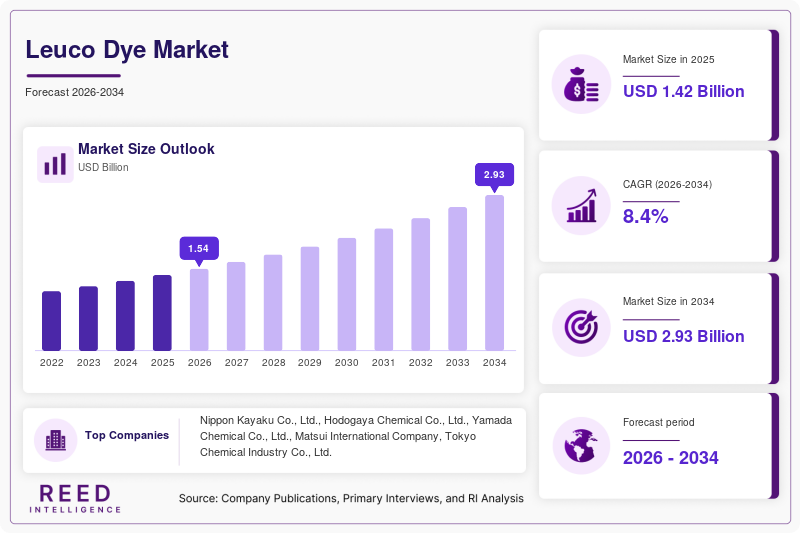
The global Leuco Dye Market size was valued at USD 1.42 billion in 2026 and is projected to reach USD 2.71 billion by 2034, expanding at a CAGR of 8.4% during the forecast period from 2026 to 2034. The market continues to gain momentum due to increasing adoption of thermochromic and pressure-sensitive materials across packaging, printing, smart labeling, medical diagnostics, and textile applications. Leuco dyes are widely used in carbonless copy paper, thermal printing paper, temperature-sensitive packaging, and color-changing products because of their reversible color transformation characteristics. Rising industrial automation and the growing demand for intelligent packaging solutions have further accelerated product demand across developed and emerging economies.
The expansion of the e-commerce and logistics sectors has created favorable conditions for thermal printing technologies, which rely heavily on leuco dye formulations. Increased use of barcode labels, shipping tags, and receipt printing in retail chains has contributed to sustained market growth. In addition, manufacturers are investing in low-toxicity and BPA-free thermal paper coatings to comply with environmental standards and consumer safety regulations. Growing research activities in smart textiles and healthcare diagnostics are also supporting long-term market development.
Key Highlights
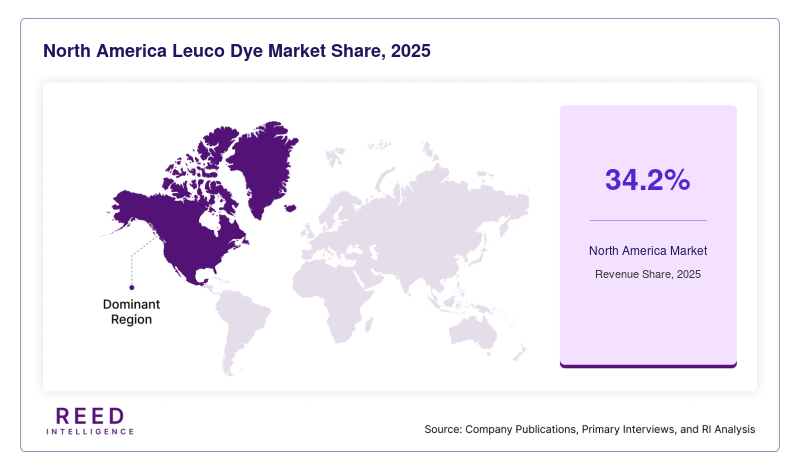
- North America dominated the market with a 34.2% share in 2025.
- Asia Pacific is expected to grow at the fastest CAGR of 10.9% during 2026–2034.
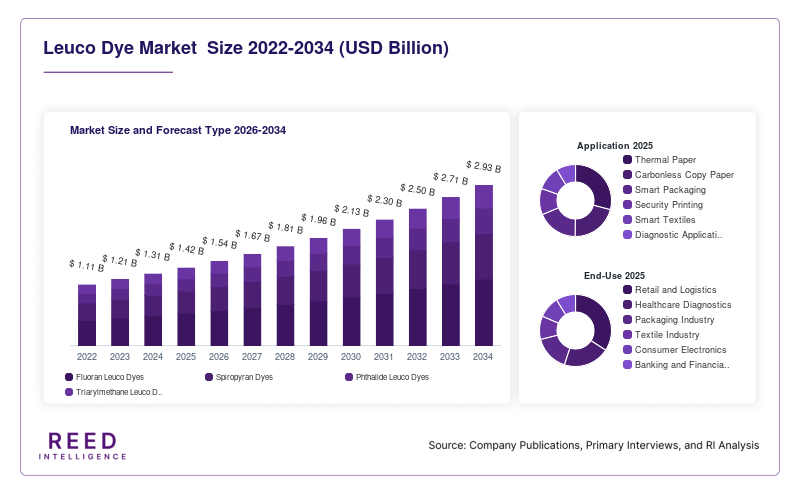
- By type, fluoran leuco dyes accounted for the largest share of 39.6%.
- while spiropyran dyes are projected to grow at a CAGR of 11.7%.
- By application, thermal paper led with a 44.8% share, whereas smart packaging is expected to expand at a CAGR of 12.1%.
- By end-use, retail and logistics accounted for the highest share of 36.9%.
- while healthcare diagnostics is projected to grow at a CAGR of 11.4%.
- The United States remained the dominant country, with market values of USD 472 million in 2024 and USD 515 million in 2025.
Market Trends
Growing Integration of Smart Packaging Technologies
The increasing adoption of smart packaging solutions across food, pharmaceutical, and consumer goods industries is emerging as a significant trend in the Leuco Dye Market. Manufacturers are incorporating temperature-sensitive and color-changing indicators into labels and packaging systems to improve product monitoring and consumer engagement. Leuco dyes are being used in freshness indicators, tamper-evident labels, and cold-chain monitoring systems due to their ability to respond to environmental changes. The expansion of e-commerce grocery delivery and temperature-sensitive pharmaceutical distribution has accelerated demand for intelligent packaging technologies. Companies are also integrating QR-enabled packaging and interactive color-changing graphics to strengthen brand visibility and customer experience. This trend is expected to support market growth as businesses continue investing in advanced packaging materials that improve supply chain transparency and product safety.
Expansion of Sustainable and BPA-Free Thermal Paper Solutions
Sustainability initiatives and stricter environmental regulations are influencing purchasing decisions across the thermal printing industry. As a result, manufacturers are increasingly developing BPA-free and low-toxicity leuco dye formulations to address regulatory concerns related to conventional thermal paper coatings. Retail chains, transportation companies, and banking institutions are transitioning toward safer receipt paper and labeling materials to comply with evolving environmental standards. This transition is encouraging chemical manufacturers to invest in alternative dye technologies with improved recyclability and reduced chemical migration risks. In addition, advancements in water-based coatings and biodegradable substrates are strengthening the appeal of sustainable thermal printing products. The growing awareness regarding occupational exposure to harmful chemicals among workers and consumers is further supporting the shift toward environmentally responsible leuco dye products.
Market Drivers
Rising Demand for Thermal Printing Across Retail and Logistics Industries
The rapid expansion of retail automation and global logistics networks is driving demand for thermal printing solutions, which directly supports the growth of the Leuco Dye Market. Thermal paper remains widely used for barcode labels, shipping tags, point-of-sale receipts, and warehouse tracking systems. The rise of online shopping platforms and omnichannel retail operations has increased the need for efficient labeling and order management systems. Leuco dyes play an essential role in thermal printing because they provide reliable image development and heat-sensitive color changes. Warehousing and transportation companies are also investing in advanced inventory tracking technologies to improve operational efficiency. As cross-border trade and parcel shipment volumes continue to rise, thermal printing applications are expected to maintain stable growth throughout the forecast period.
Increasing Adoption in Healthcare and Diagnostic Applications
Healthcare and medical diagnostics industries are creating additional growth opportunities for leuco dye manufacturers. These dyes are increasingly used in diagnostic strips, biosensors, sterilization indicators, and temperature-sensitive medical labels. The growing demand for rapid diagnostic testing and point-of-care healthcare solutions has encouraged manufacturers to develop highly responsive dye formulations with improved accuracy and stability. Hospitals and pharmaceutical companies are also adopting color-changing indicators for monitoring storage conditions and sterilization procedures. In addition, rising investments in healthcare infrastructure across developing economies are contributing to the demand for advanced medical consumables. Research institutions are further exploring the use of leuco dyes in wearable biosensors and smart medical packaging, supporting innovation and long-term market expansion.
Market Restraint
Volatility in Raw Material Prices and Environmental Compliance Challenges
Fluctuating raw material costs and increasing environmental compliance requirements continue to restrain the growth of the Leuco Dye Market. The production of leuco dyes depends on specialty chemical intermediates that are often subject to price instability due to supply chain disruptions, geopolitical tensions, and changing energy costs. Manufacturers operating with limited production capacity face challenges in maintaining profit margins when raw material prices rise unexpectedly. In addition, environmental regulations concerning chemical handling, disposal, and worker safety are becoming more stringent across North America and Europe. Several thermal paper formulations containing traditional developers have faced scrutiny because of potential health concerns. As a result, manufacturers are required to invest heavily in research and reformulation activities to develop safer alternatives. Smaller companies may struggle to meet these compliance standards, limiting market entry and increasing operational complexity. Delays in regulatory approvals for new chemical formulations can also affect product commercialization timelines and increase overall development expenses.
Market Opportunities
Advancements in Smart Textiles and Wearable Technology
The growing development of smart textiles and wearable electronics is creating promising opportunities for the Leuco Dye Market. Leuco dyes are increasingly integrated into fabrics and wearable materials that can change color in response to temperature, light, or pressure variations. Fashion brands and sportswear manufacturers are exploring interactive garments that improve user engagement and visual appeal. In healthcare, wearable devices equipped with color-changing indicators are being developed to monitor body temperature and physical conditions in real time. These innovations are encouraging chemical companies to produce highly durable and flexible dye systems compatible with textile manufacturing processes. Rising consumer interest in functional clothing and connected wearable products is expected to support additional research and commercialization activities during the forecast period.
Growing Use in Security Printing and Anti-Counterfeiting Solutions
The increasing focus on document security and product authentication is generating new opportunities for leuco dye manufacturers. Governments, financial institutions, and consumer goods companies are investing in anti-counterfeiting technologies to reduce fraud and protect brand integrity. Leuco dyes are widely used in security printing because they can create hidden, reversible, or temperature-sensitive marks that are difficult to replicate. These dyes are being applied in banknotes, identification cards, tax stamps, pharmaceutical packaging, and luxury product labels. The expansion of global trade and digital commerce has increased concerns regarding counterfeit products, particularly in pharmaceutical and electronics industries. As a result, manufacturers are developing customized dye formulations with enhanced durability and security features. The growing demand for advanced authentication technologies is expected to create stable revenue opportunities for market participants.
Segmental Analysis
By Type
Fluoran leuco dyes accounted for the largest market share of 39.6% in 2024 due to their extensive use in thermal paper, carbonless copy paper, and pressure-sensitive applications. These dyes are preferred because they offer high color density, stable image formation, and reliable heat sensitivity. Retail, banking, and logistics industries continue to use fluoran-based formulations for receipt printing and barcode labeling applications. Manufacturers are also focusing on improving the durability and environmental performance of these dyes to comply with evolving safety standards. Strong demand for point-of-sale systems and automated inventory tracking solutions has further strengthened the adoption of fluoran dyes. In addition, ongoing innovation in encapsulation technologies has improved print stability and shelf life, making these dyes suitable for high-volume commercial applications across developed and emerging markets.
Spiropyran dyes are expected to register the fastest CAGR of 11.7% during the forecast period due to increasing adoption in smart materials and interactive products. These dyes are widely used in photochromic and thermochromic applications because they can reversibly change color when exposed to light or temperature variations. Growing interest in smart textiles, wearable electronics, and advanced sensors is supporting demand for spiropyran-based technologies. Research institutions and specialty chemical companies are investing in new formulations with improved UV stability and enhanced responsiveness. In addition, the increasing use of color-changing coatings in automotive interiors, packaging, and consumer electronics is expected to drive commercial adoption. Expanding research activities in flexible electronics and smart medical devices are also contributing to long-term growth opportunities for this segment.
By Application
Thermal paper represented the dominant application segment with a 44.8% market share in 2024. The segment continues to benefit from extensive use in retail receipts, transportation tickets, banking transactions, and logistics labels. Rapid growth in e-commerce and organized retail has significantly increased the demand for thermal printing systems worldwide. Leuco dyes remain essential components in thermal paper because they enable clear image development through heat activation. Supermarkets, pharmacies, and transportation networks rely heavily on thermal printing technologies for efficient transaction processing and inventory management. In addition, growing adoption of automated checkout systems and digital logistics operations is supporting continued demand for high-performance thermal paper products. Manufacturers are also introducing BPA-free thermal coatings and recyclable substrates to address environmental concerns and strengthen product adoption across regulated markets.
Smart packaging is projected to grow at the fastest CAGR of 12.1% during the forecast period due to increasing demand for intelligent monitoring and product authentication solutions. Leuco dyes are widely used in temperature-sensitive labels, freshness indicators, and tamper-evident packaging systems. Food and pharmaceutical companies are increasingly adopting these technologies to improve product quality assurance and supply chain transparency. Growing consumer awareness regarding food safety and product authenticity is encouraging businesses to invest in advanced packaging materials. In addition, e-commerce expansion and cold-chain logistics development are creating strong demand for interactive and traceable packaging solutions. Manufacturers are introducing customizable dye systems with enhanced responsiveness and durability to meet evolving industry requirements. The integration of digital tracking technologies with smart packaging platforms is expected to further support segment growth during the forecast period.
By End-Use
Retail and logistics accounted for the largest share of 36.9% in 2024 due to widespread use of thermal printing and barcode labeling systems. Retail stores, warehouses, courier companies, and transportation providers rely on leuco dye-based thermal paper for efficient order processing and inventory management. The expansion of e-commerce platforms and same-day delivery services has increased the demand for shipping labels, tracking tags, and printed receipts. Businesses are investing in automated warehouse systems and digital supply chain solutions to improve operational efficiency and reduce processing errors. In addition, rising international trade activities and cross-border parcel shipments continue to support demand for thermal printing applications. Large retail chains are also adopting sustainable receipt paper and advanced labeling technologies to improve customer experience and comply with environmental regulations.
Healthcare diagnostics is anticipated to witness the fastest CAGR of 11.4% from 2026 to 2034 owing to growing demand for rapid testing and temperature-sensitive medical solutions. Leuco dyes are increasingly used in diagnostic strips, sterilization indicators, biosensors, and smart medical labels because of their responsive color-changing properties. Hospitals and laboratories are adopting advanced monitoring systems to improve patient safety and storage condition tracking. Rising investments in healthcare infrastructure across Asia Pacific and Latin America are supporting the adoption of diagnostic consumables and smart packaging technologies. Research organizations are also exploring wearable biosensors and colorimetric detection systems that utilize advanced leuco dye chemistry. In addition, increasing focus on personalized medicine and home-based healthcare monitoring is expected to create sustained growth opportunities for this end-use segment.
Regional Analysis
North America
North America accounted for 34.2% of the global Leuco Dye Market share in 2025 and is expected to maintain steady growth at a CAGR of 7.6% during the forecast period. The region benefits from a highly developed retail infrastructure and widespread adoption of thermal printing technologies across logistics, healthcare, and banking sectors. Strong demand for point-of-sale receipts, barcode labels, and smart packaging applications continues to support market expansion. In addition, increasing investments in sustainable thermal paper solutions and BPA-free coatings are encouraging manufacturers to introduce environmentally compliant products.
The United States remained the dominant country within North America due to its large thermal paper consumption base and strong specialty chemicals industry. The country recorded market values of USD 472 million in 2024 and USD 515 million in 2025. One unique growth factor is the rapid integration of smart packaging technologies within food delivery and pharmaceutical distribution networks. Major retail chains and healthcare companies are investing in temperature-sensitive packaging and traceability systems, creating consistent demand for advanced leuco dye formulations across domestic supply chains.
Europe
Europe represented 27.5% of the global market share in 2025 and is projected to expand at a CAGR of 7.9% from 2026 to 2034. The region is characterized by strong environmental regulations and growing adoption of sustainable chemical solutions. Demand for BPA-free thermal paper and recyclable packaging materials has increased significantly across Germany, France, and the Nordic countries. In addition, expanding investments in industrial automation and labeling technologies are supporting the demand for high-performance leuco dyes. The presence of established printing and specialty chemical manufacturers further contributes to regional market development.
Germany emerged as the dominant country in the European market due to its advanced manufacturing capabilities and strong industrial base. The country benefits from high demand for precision labeling systems in automotive, pharmaceutical, and logistics industries. A unique growth factor in Germany is the increasing focus on Industry 4.0 and smart factory operations. Automated inventory tracking, digital warehouse systems, and intelligent labeling technologies are creating favorable conditions for thermal printing solutions and specialized leuco dye applications.
Asia Pacific
Asia Pacific held 24.8% of the global Leuco Dye Market share in 2025 and is anticipated to register the fastest CAGR of 10.9% during the forecast period. Rapid industrialization, expanding retail networks, and large-scale manufacturing activities are major factors supporting regional growth. China, Japan, South Korea, and India remain significant consumers and producers of thermal paper and specialty chemicals. The increasing use of barcode labels, transportation tags, and smart packaging in e-commerce logistics is accelerating product demand. In addition, the region benefits from lower production costs and strong supply chain integration.
China dominated the Asia Pacific market due to its extensive thermal paper manufacturing capacity and large consumer electronics industry. The country continues to invest heavily in packaging automation and smart retail infrastructure. One distinctive growth factor is the rapid expansion of e-commerce platforms and cross-border logistics operations. Growing parcel shipment volumes and digital payment systems are increasing the demand for thermal receipts and shipping labels, which directly supports leuco dye consumption across domestic and export-oriented industries.
Middle East & Africa
The Middle East & Africa accounted for 6.1% of the global market share in 2025 and is expected to grow at a CAGR of 7.1% through 2034. The market is gradually expanding due to improving retail infrastructure, increasing healthcare investments, and rising adoption of thermal printing solutions in transportation and banking sectors. Countries across the Gulf region are investing in smart city projects and digital commerce platforms, which are creating demand for advanced labeling technologies. The growth of organized retail and pharmaceutical distribution systems is also contributing to market expansion.
Saudi Arabia emerged as the leading country within the region because of its ongoing economic diversification initiatives and investments in industrial development. A unique growth factor is the increasing deployment of smart logistics and warehousing systems under national infrastructure modernization programs. The country is expanding digital payment ecosystems and retail automation technologies, leading to greater use of thermal paper products and related leuco dye applications. Rising healthcare expenditure is also supporting demand for diagnostic labels and temperature-sensitive packaging materials.
Latin America
Latin America captured 7.4% of the global market share in 2025 and is projected to grow at a CAGR of 7.4% during the forecast period. The market is benefiting from expanding retail chains, rising urbanization, and increasing use of barcode-based inventory systems. Countries such as Brazil and Mexico are witnessing growing demand for thermal paper in banking, transportation, and supermarket applications. In addition, packaging manufacturers are adopting smart labeling technologies to improve supply chain visibility and customer engagement. Economic recovery in several countries is also encouraging investments in logistics and commercial infrastructure.
Brazil remained the dominant country in the Latin American market due to its large retail sector and growing manufacturing activities. One important growth factor is the expansion of food export industries that require temperature-sensitive packaging and traceability systems. Brazilian companies are increasingly adopting intelligent labeling solutions to comply with export regulations and maintain product quality during transportation. This trend is expected to support the adoption of advanced leuco dye formulations in packaging and logistics applications across the country.
Competitive Landscape
The Leuco Dye Market is moderately consolidated, with global and regional manufacturers competing through product innovation, sustainability initiatives, and strategic partnerships. Companies are increasingly focusing on BPA-free formulations, advanced encapsulation technologies, and smart packaging applications to strengthen their market positions. Expansion of thermal paper production capacity and investment in research activities remain common competitive strategies across the industry.
Nippon Kayaku Co., Ltd. remains one of the leading companies in the market due to its diversified specialty chemical portfolio and strong presence in thermal paper applications. The company recently expanded its research efforts related to environmentally compliant dye technologies and high-stability thermal coatings. Other major participants, including Hodogaya Chemical Co., Ltd., Yamada Chemical Co., Ltd., and Matsui International Company, continue to focus on product customization and advanced color-changing materials for industrial and consumer applications.
Several manufacturers are also entering partnerships with packaging and printing companies to develop intelligent labeling solutions. Market participants are increasing investments in Asia Pacific production facilities to improve supply chain efficiency and meet rising regional demand. Product differentiation based on heat sensitivity, durability, and environmental compliance is expected to remain a key competitive factor during the forecast period.
Key Players
- Nippon Kayaku Co., Ltd.
- Hodogaya Chemical Co., Ltd.
- Yamada Chemical Co., Ltd.
- Matsui International Company
- Tokyo Chemical Industry Co., Ltd.
- Connect Chemicals GmbH
- DIC Corporation
- H.W. Sands Corp.
- 3M Company
- BASF SE
- Sensient Technologies Corporation
- OliKrom
- Kolortek Co., Ltd.
- LCR Hallcrest LLC
Recent Developments
- In February 2026, Nippon Kayaku Co., Ltd. introduced a new BPA-free thermal dye formulation designed for sustainable retail receipt applications.
- In August 2025, Hodogaya Chemical Co., Ltd. expanded its specialty dye production facility in Asia Pacific to strengthen supply chain efficiency and address growing regional demand.
- In November 2025, OliKrom announced the development of advanced thermochromic leuco dye systems for smart packaging and temperature-monitoring labels in pharmaceutical logistics.
- In March 2026, Sensient Technologies Corporation partnered with a packaging technology company to develop intelligent color-changing labels for cold-chain food distribution.
Leuco Dye Market Segments
Type
- Fluoran Leuco Dyes
- Spiropyran Dyes
- Phthalide Leuco Dyes
- Triarylmethane Leuco Dyes
Application
- Thermal Paper
- Carbonless Copy Paper
- Smart Packaging
- Security Printing
- Smart Textiles
- Diagnostic Applications
End-Use
- Retail and Logistics
- Healthcare Diagnostics
- Packaging Industry
- Textile Industry
- Consumer Electronics
- Banking and Financial Services
By Region
- North America
- Europe
- APAC
- Middle East and Africa
- LATAM