Levant Power Cable Market Size, Share Demand Report By Voltage (Low Voltage Cables, Medium Voltage Cables, High Voltage Cables), By Application (Utilities, Industrial, Commercial, Renewable Energy), By Installation Type (Overhead Cables, Underground Cables, Submarine Cables), By Conductor Material (Copper, Aluminum) By Region & Segment Forecasts, 2026–2034
USD 3950
Market Overview
The Levant Power Cable Market size was valued at USD 3.42 billion in 2026 and is projected to reach USD 5.96 billion by 2034, expanding at a CAGR of 7.2% during the forecast period (2026–2034). The market is witnessing steady growth due to increasing investments in power transmission and distribution infrastructure across Levant countries, including Saudi Arabia, UAE, Qatar, Kuwait, and Oman. Power cables play a crucial role in ensuring efficient electricity flow across residential, commercial, and industrial sectors.
A key global factor supporting the growth of the Levant Power Cable Market is the rising demand for electricity driven by urbanization and industrial expansion. The integration of renewable energy sources into national grids is also contributing to increased deployment of advanced power cable systems.
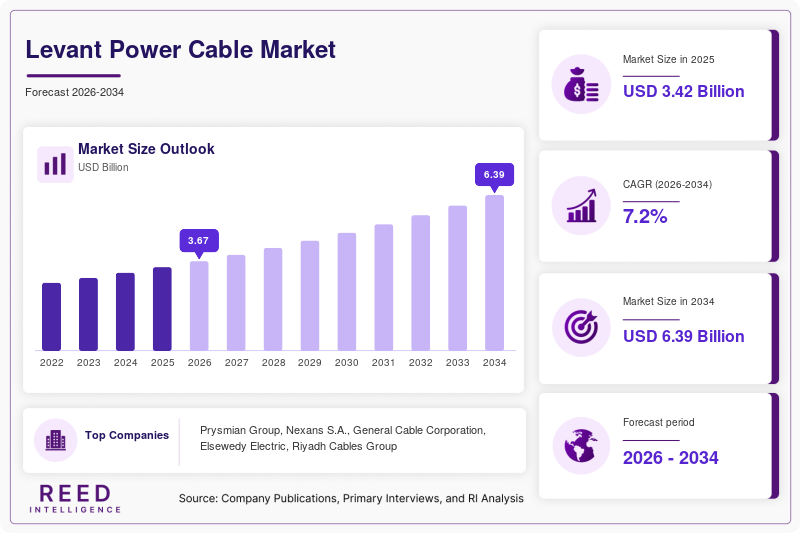
Key Highlights
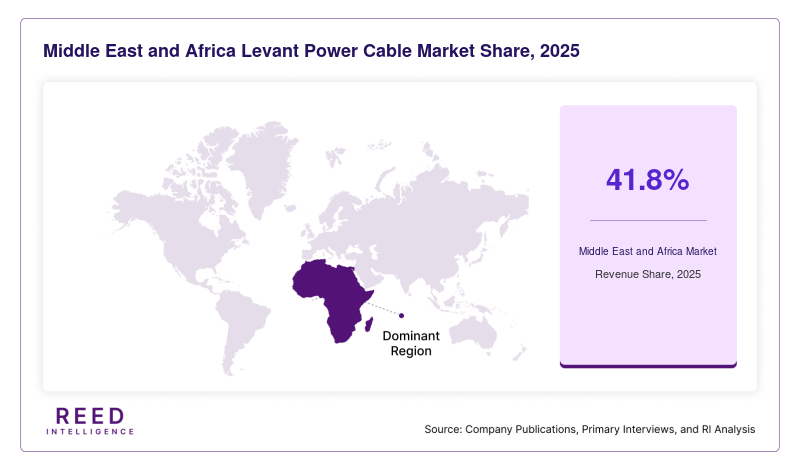
- Dominant region: Middle East & Africa held 41.8% market share in 2025, while Asia Pacific is projected to grow fastest at a CAGR of 7.8% (2026–2034).
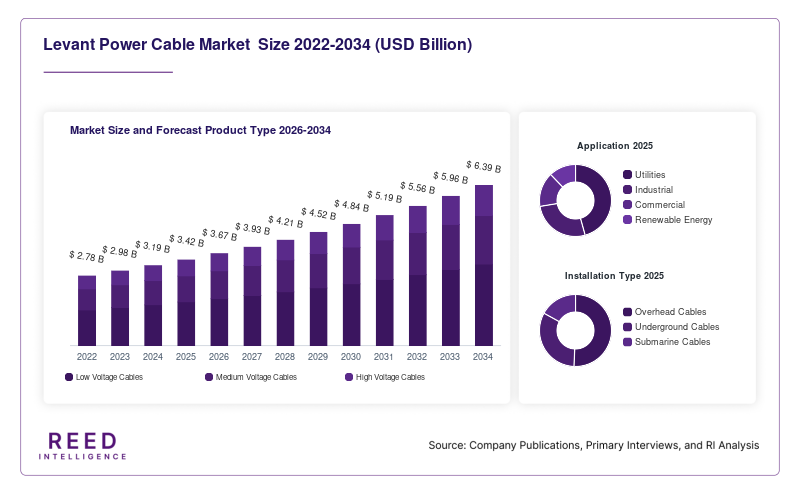
- Leading subsegments: Low voltage cables dominated the voltage segment with 45.6% share in 2025, while high voltage cables are expected to grow fastest at a CAGR of 7.9%.
- Installation insights: Underground cables accounted for 52.3% share in 2025, while submarine cables are projected to grow at a CAGR of 8.1%.
- End-use insights: Utilities sector held 48.7% share in 2025, while renewable energy projects are expected to grow at a CAGR of 8.4%.
- Dominant country: Saudi Arabia market was valued at USD 812 million in 2024 and USD 865 million in 2025.
Market Trends
Expansion of Renewable Energy Grid Integration
The increasing adoption of solar and wind energy projects is driving demand for advanced power cable systems. These projects require efficient transmission infrastructure, boosting the need for high-performance cables.
Shift Toward Underground and Submarine Cabling
Governments and utilities are increasingly adopting underground and submarine cable systems to enhance reliability and reduce transmission losses. This trend is gaining traction in urban and coastal regions.
Market Drivers
Increasing Investments in Power Infrastructure
Large-scale investments in power generation, transmission, and distribution projects are supporting the demand for power cables across the Levant region.
Rapid Urbanization and Industrial Growth
The expansion of cities and industrial zones is increasing electricity demand, driving the deployment of new cable networks.
Market Restraint
High Installation and Maintenance Costs
Power cable systems, especially underground and submarine cables, involve significant installation and maintenance expenses, which can limit adoption.
Market Opportunities
Growth in Smart Grid Development
The adoption of smart grid technologies presents opportunities for advanced cable solutions that support efficient energy management.
Expansion of Cross-Border Power Projects
Regional collaborations for cross-border electricity transmission are expected to drive demand for high-capacity cable systems.
Segmental Analysis
By Voltage
The Levant Power Cable Market is segmented into low voltage, medium voltage, and high voltage cables.
- Dominant Subsegment: Low voltage cables held 45.6% share in 2025 due to widespread use in residential and commercial applications.
- Fastest-Growing Subsegment: High voltage cables are expected to grow at a CAGR of 7.9%, driven by large-scale transmission projects.
By Installation Type
The market includes overhead, underground, and submarine cables.
- Dominant Subsegment: Underground cables accounted for 52.3% share in 2025 due to increasing urban infrastructure projects.
- Fastest-Growing Subsegment: Submarine cables are projected to grow at a CAGR of 8.1%, supported by cross-border energy projects.
By End-Use
Segments include utilities, industrial, commercial, and renewable energy.
- Dominant Subsegment: Utilities sector held 48.7% share in 2025 due to extensive grid infrastructure.
- Fastest-Growing Subsegment: Renewable energy projects are expected to grow at a CAGR of 8.4%, driven by solar and wind installations.
By Conductor Material
The market is segmented into copper and aluminum.
- Dominant Subsegment: Copper cables held 58.2% share in 2025 due to superior conductivity and durability.
- Fastest-Growing Subsegment: Aluminum cables are projected to grow at a CAGR of 7.5%, supported by cost advantages.
Regional Analysis
Middle East & Africa
Middle East & Africa accounted for 41.8% of the Levant Power Cable Market share in 2025. The region is expected to grow at a CAGR of 7.4% during 2026–2034. Saudi Arabia dominated the region due to extensive infrastructure development and renewable energy investments.
Asia Pacific
Asia Pacific held 23.6% market share in 2025 and is projected to grow at the fastest CAGR of 7.8%. China dominated the region due to large-scale power transmission projects.
North America
North America represented 14.2% share in 2025 and is anticipated to grow at a CAGR of 6.9%. The United States led the region due to grid modernization initiatives.
Europe
Europe captured 12.8% market share in 2025 and is expected to grow at a CAGR of 6.7%. Germany dominated due to strong renewable energy integration.
Latin America
Latin America accounted for 7.6% share in 2025 and is forecast to grow at a CAGR of 6.8%. Brazil led the region due to infrastructure expansion.
Competitive Landscape
The Levant Power Cable Market is moderately competitive, with several global and regional players competing based on product quality, technological innovation, and project execution capabilities. Prysmian Group is recognized as a leading player, supported by its extensive product portfolio and strong presence in power transmission projects. The company recently expanded its high-voltage cable production capacity to address increasing demand in renewable energy projects.
Other key players include Nexans S.A., General Cable Corporation, Elsewedy Electric, and Riyadh Cables Group. These companies are focusing on expanding manufacturing capabilities and strengthening regional partnerships to enhance market presence. Investments in research and development are enabling the introduction of advanced cable solutions with improved efficiency and durability.
Competitive strategies also include securing long-term contracts, participating in infrastructure projects, and expanding distribution networks to maintain market position.
Key Players List
- Prysmian Group
- Nexans S.A.
- General Cable Corporation
- Elsewedy Electric
- Riyadh Cables Group
- Dubai Cable Company (Ducab)
- Saudi Cable Company
- Oman Cables Industry
- Bahra Electric
- LS Cable & System
- Sumitomo Electric Industries
- Southwire Company
- Finolex Cables Ltd.
- KEI Industries Ltd.
- Polycab India Limited
Recent Developments
- In 2025, Prysmian Group expanded its high-voltage cable manufacturing capacity.
- Nexans S.A. secured contracts for renewable energy transmission projects in the Middle East.
- Elsewedy Electric invested in new production facilities to enhance output capacity.
- Riyadh Cables Group introduced advanced cable solutions for smart grid applications.
- Ducab expanded its export operations across regional markets.
Levant Power Cable Market Segments
Product Type
- Low Voltage Cables
- Medium Voltage Cables
- High Voltage Cables
Application
- Utilities
- Industrial
- Commercial
- Renewable Energy
Installation Type
- Overhead Cables
- Underground Cables
- Submarine Cables
Conductor Material
- Copper
- Aluminum
By Region
- North America
- Europe
- APAC
- Middle East and Africa
- LATAM