Library Management Software Market Size, Share & Demand Report By Deployment (Cloud-Based, On-Premise, Hybrid), By Component (Software, Services), By Application (Academic Libraries, Public Libraries, Special Libraries, Digital Libraries), By End-User (Educational Institutions, Corporate & Research Organizations, Government Libraries), By Region & Segment Forecasts, 2025–2034
USD 3950
Market Overview
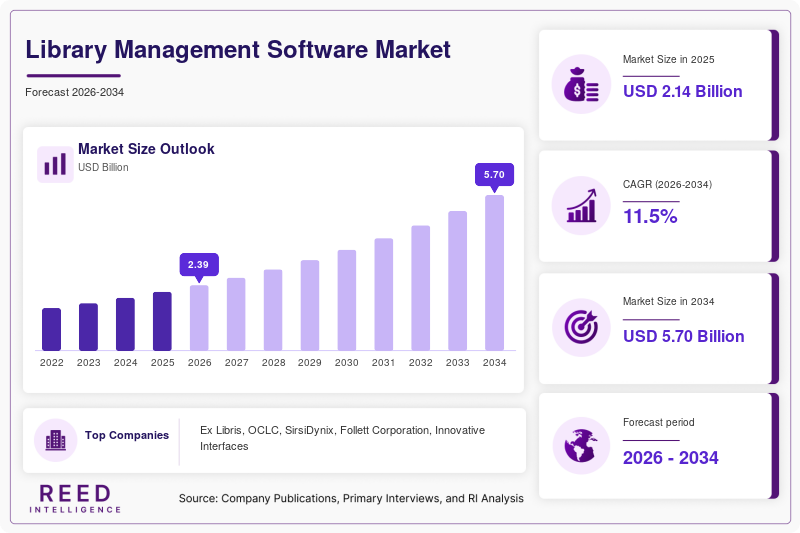
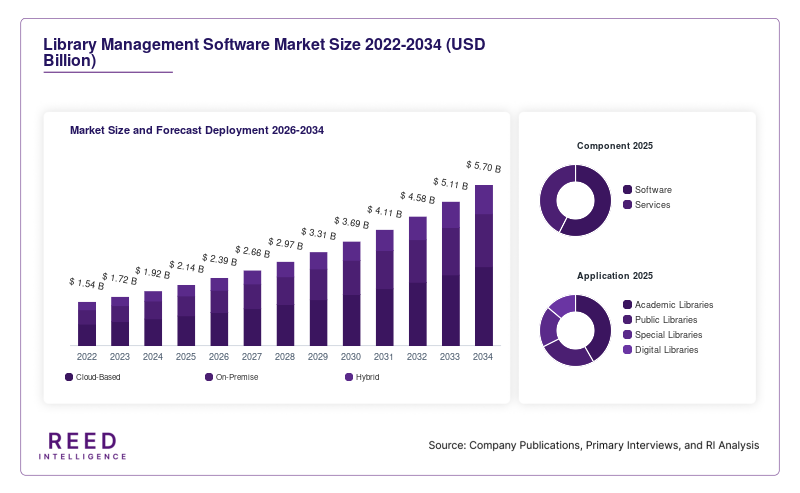
The Library Management Software Market size was valued at USD 2.14 billion in 2025 and is projected to reach USD 5.68 billion by 2034, expanding at a CAGR of 11.5% during 2025–2034. The market size growth reflects the rising need for efficient cataloging, circulation management, and digital resource tracking across academic, public, and enterprise libraries. Library management platforms integrate catalog databases, digital archives, user access systems, and analytics dashboards to streamline administrative processes and improve resource utilization.
One global factor supporting market expansion is the rapid digitization of educational infrastructure. Educational institutions, research organizations, and public libraries are increasingly adopting integrated software systems to manage both physical and digital collections. Government investments in digital learning ecosystems, combined with the rise of hybrid libraries offering e-books, digital journals, and multimedia resources, have strengthened demand for scalable software solutions.
Key Highlights
- North America held the dominant regional share of 36.8% in 2025, while Asia Pacific is projected to grow fastest at a CAGR of 13.4% through 2034.
- Cloud-based deployment accounted for the leading share of 57.2% in 2025, while AI-enabled library analytics is expected to grow fastest with a CAGR of 14.6%.
- By application, academic libraries dominated with 48.9% share, whereas digital libraries will expand fastest at a CAGR of 13.9%.
- The United States market was valued at USD 640 million in 2025 and is estimated to reach USD 705 million in 2026.
Market Trends
AI-Enabled Discovery and Metadata Automation
Artificial intelligence is transforming the Library Management Software Market by enabling automated metadata tagging, intelligent catalog indexing, and semantic search capabilities. AI-driven recommendation engines help users discover relevant books, journals, and multimedia resources more efficiently. Machine learning algorithms can also analyze borrowing patterns and usage behavior to optimize collection management. As academic institutions expand digital repositories, AI-powered classification and search tools are becoming essential for managing large volumes of digital resources.
Libraries are also integrating natural language processing to enhance user search experiences. Instead of keyword-only searches, systems can interpret contextual queries and return more relevant results. This trend is expected to improve resource accessibility and operational efficiency in digital libraries.
Shift Toward Cloud-Based Library Infrastructure
Cloud computing has emerged as a major trend shaping the Library Management Software Market. Institutions are increasingly shifting from on-premise systems to cloud-hosted platforms that provide scalable storage, remote access, and simplified maintenance. Cloud deployments allow libraries to integrate digital collections, subscription databases, and analytics tools within a unified environment.
The adoption of cloud systems also supports remote learning and distributed academic networks. Libraries can offer web-based access to resources for students and researchers worldwide. Vendors are expanding Software-as-a-Service (SaaS) offerings with subscription-based pricing, which reduces initial investment and supports smaller institutions adopting digital library technologies.
Market Drivers
Expansion of Digital Libraries and E-Learning Ecosystems
The rapid expansion of digital libraries and online education platforms has significantly accelerated growth in the Library Management Software Market. Universities, research institutes, and public libraries are digitizing archives, journals, and historical collections to improve accessibility. Library management systems enable efficient indexing, access control, and circulation management for digital resources.
E-learning platforms are also integrating library systems to support remote access to course materials, research databases, and academic publications. This integration allows students and faculty to access resources from mobile devices or online portals, increasing the demand for advanced library management platforms.
Automation of Library Operations
Automation has become a major driver in the Library Management Software Market as institutions aim to reduce administrative workload and improve operational efficiency. Library software automates cataloging, book circulation, inventory tracking, and user registration processes. Automated barcode and RFID integration further improves resource tracking and reduces manual errors.
Libraries also benefit from analytics tools that monitor borrowing trends, user activity, and collection performance. These insights help institutions optimize acquisition strategies and allocate budgets effectively. As libraries handle growing digital and physical collections, automated management solutions are becoming essential.
Market Restraint
High Implementation and Migration Costs
Despite strong growth prospects, high implementation and migration costs remain a significant challenge for the Library Management Software Market. Many traditional libraries still rely on legacy systems or manual cataloging methods. Transitioning to modern software platforms requires significant investment in infrastructure upgrades, system integration, and staff training.
Migration of large databases, including bibliographic records and digital archives, can be technically complex and time-consuming. Libraries must ensure data integrity and compatibility when transferring information from legacy systems to modern platforms. Additionally, small institutions and community libraries often face budget constraints that limit their ability to adopt advanced library management software.
Maintenance costs and subscription fees associated with cloud-based systems may also discourage adoption among resource-constrained institutions. Addressing these cost-related barriers will be critical for expanding adoption in developing regions and smaller library networks.
Market Opportunities
Integration with Educational Technology Platforms
Integration with educational technology platforms presents a major opportunity for the Library Management Software Market. Universities are increasingly connecting library systems with learning management systems, academic databases, and digital classrooms. This integration allows seamless access to reading materials, research journals, and multimedia resources within educational platforms.
Library software vendors are developing APIs and interoperability tools that support integration with academic infrastructure. Such capabilities enhance learning experiences and create a unified digital environment for students and educators.
Growth of Smart Libraries and IoT Integration
The emergence of smart libraries is creating new opportunities within the Library Management Software Market. Internet of Things (IoT) technologies enable automated inventory tracking, smart shelves, and digital access management. RFID-enabled book tracking and automated check-in/check-out systems improve operational efficiency and reduce manual workload.
IoT-enabled systems also provide real-time data on resource usage, enabling libraries to optimize collection management. As libraries adopt smart infrastructure to improve service delivery and user experience, demand for advanced library management platforms is expected to increase.
Segmental Analysis
By Deployment
Cloud-based solutions dominated the Library Management Software Market in 2025 with a 57.2% share. Libraries increasingly adopted cloud platforms due to their scalability, remote accessibility, and lower infrastructure requirements. Cloud-based systems allowed institutions to store large digital collections, integrate analytics tools, and manage multiple library branches through centralized platforms.
The hybrid deployment segment will expand fastest at a CAGR of 13.1% through 2034. Hybrid systems combine on-premise data control with cloud-based resource access. This approach allows libraries to maintain sensitive institutional data locally while leveraging cloud infrastructure for digital content distribution. Institutions seeking flexibility and security are expected to drive growth in this segment.
By Application
Academic libraries held the dominant share in the Library Management Software Market, accounting for 48.9% in 2025. Universities and colleges manage large collections of books, journals, research papers, and digital learning materials. Library management software enables centralized cataloging, automated borrowing systems, and integration with academic databases.
The digital libraries segment will grow fastest with a CAGR of 13.9% during the forecast period. Digital libraries allow users to access e-books, journals, and multimedia resources remotely. Growth will be driven by increasing adoption of digital education platforms and online research databases.
By Component
Software solutions accounted for the largest share of the Library Management Software Market, representing 68.4% in 2025. These platforms provide catalog management, circulation tracking, user authentication, and analytics capabilities. Software modules enable libraries to manage physical and digital resources within a unified platform.
The services segment will expand fastest with a CAGR of 12.8% through 2034. Services include system integration, technical support, and training programs that help institutions deploy and manage library software effectively. As libraries adopt advanced digital systems, demand for professional services will increase.
By End-User
Educational institutions dominated the Library Management Software Market, holding 63.7% share in 2025. Schools, colleges, and universities maintain extensive libraries that require automated cataloging and digital resource management. Library software enables efficient administration of large collections and supports academic research activities.
The corporate and research organizations segment will grow fastest at a CAGR of 12.6% during the forecast period. Corporate knowledge centers and research institutions maintain specialized databases and technical documents. Advanced library management platforms allow organizations to organize proprietary knowledge resources efficiently.
Regional Analysis
North America
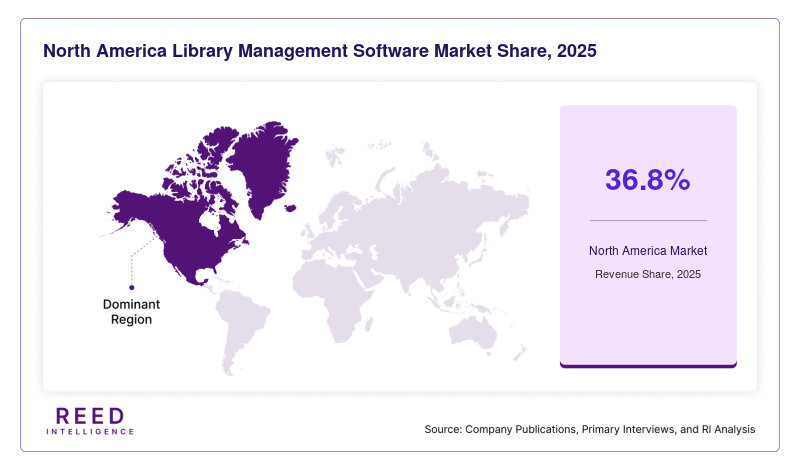
North America accounted for 36.8% of the Library Management Software Market in 2025, reflecting widespread adoption of digital library systems across academic institutions, research organizations, and public libraries. The region’s growth was supported by advanced IT infrastructure and strong investments in digital education. The regional market will expand at a CAGR of 10.6% during 2025–2034, driven by increasing integration of digital resources and cloud-based library systems.
The United States remained the dominant country in the regional market. A major growth factor in the country has been the expansion of digital research repositories in universities and national libraries. Higher education institutions have been investing in advanced software platforms to manage large volumes of digital journals, research papers, and multimedia content. The demand for integrated analytics and resource discovery tools has further strengthened software adoption across academic networks.
Europe
Europe represented 27.1% of the Library Management Software Market in 2025, supported by the presence of extensive public library networks and strong digitization initiatives across cultural institutions. Governments across the region have been investing in digital archiving and knowledge preservation programs, encouraging adoption of advanced library systems. The regional market will grow at a CAGR of 10.9% through 2034.
The United Kingdom led the regional market. A key growth factor has been the modernization of national library infrastructure and university research systems. Libraries across the country are implementing centralized software platforms to connect academic libraries and digital archives. These platforms enable standardized cataloging, improved search capabilities, and remote access to research materials.
Asia Pacific
Asia Pacific held 22.4% of the Library Management Software Market share in 2025. Rapid digital transformation in education systems and expanding university networks contributed to market expansion. Government initiatives aimed at strengthening digital education infrastructure have supported adoption of advanced library management platforms. The regional market will expand at the fastest CAGR of 13.4% from 2025 to 2034.
China dominated the regional market due to large-scale investments in digital education and academic research infrastructure. Universities and research institutes across the country have been implementing centralized library management systems to support digital resource sharing. The expansion of digital libraries and online academic platforms has further accelerated adoption of modern software solutions.
Middle East & Africa
The Middle East & Africa accounted for 7.5% of the Library Management Software Market in 2025. Market growth in the region was supported by educational modernization programs and the establishment of new academic institutions. Governments have been investing in digital knowledge infrastructure to improve access to research resources. The regional market will grow at a CAGR of 11.8% during the forecast period.
The United Arab Emirates emerged as the dominant country in the region. A key growth factor has been the development of smart education ecosystems and technology-driven university campuses. Libraries within these institutions are implementing advanced software platforms to manage digital collections, research databases, and multimedia learning resources.
Latin America
Latin America captured 6.2% of the Library Management Software Market share in 2025. The regional market has been gradually expanding as universities and public libraries adopt digital cataloging and resource management systems. Growing internet penetration and digital literacy initiatives have supported market adoption. The regional market will expand at a CAGR of 11.1% through 2034.
Brazil remained the leading country in the region. A key growth factor has been the expansion of academic research networks and university libraries. Institutions are increasingly implementing software platforms to manage digital repositories and improve access to scholarly publications.
Competitive Landscape
The Library Management Software Market is moderately fragmented, with several technology providers offering cloud-based and integrated library platforms. Companies are focusing on product innovation, interoperability with educational platforms, and AI-driven search capabilities to strengthen their competitive position.
One prominent market leader is Ex Libris, known for its integrated library services platform and digital resource management tools used by academic institutions worldwide. The company recently introduced advanced analytics and AI-powered discovery capabilities to improve research accessibility.
Other major players are expanding cloud-based solutions and subscription models to attract small and medium-sized libraries. Strategic partnerships with universities and digital content providers are also becoming a common strategy for expanding market presence.
Key Players
- Ex Libris
- OCLC
- SirsiDynix
- Follett Corporation
- Innovative Interfaces
- Capita plc
- Civica
- Mandarin Library Automation
- LIBSYS Ltd.
- Insignia Software
- Soutron Global
- Axiell Group
- Book Systems
- Infor Library and Information Solutions
- TLC – The Library Corporation
- Koha Community Developers
- Evergreen Project
Recent Developments
- 2024: Ex Libris launched enhanced AI-driven discovery tools to improve search and content recommendations in academic libraries.
- 2024: OCLC expanded its cloud-based library services platform with integrated analytics dashboards for collection management.
- 2023: SirsiDynix introduced mobile-enabled library management features supporting remote access to digital resources.
- 2023: Axiell Group developed new digital archive management capabilities for museums and cultural institutions.
- 2023: Follett Corporation enhanced integration between its library software and educational technology platforms.
Library Management Software Market Segments
Deployment
- Cloud-Based
- On-Premise
- Hybrid
Component
- Software
- Services
Application
- Academic Libraries
- Public Libraries
- Special Libraries
- Digital Libraries
End-User
- Educational Institutions
- Corporate & Research Organizations
- Government Libraries
By Region
- North America
- Europe
- APAC
- Middle East and Africa
- LATAM