Licorice Candy Market Size, Share & Demand Report By Product Type (Soft Licorice Candy, Hard Licorice Candy, Filled Licorice Candy), By Flavor Type (Traditional Black Licorice, Fruit-flavored Licorice), By Distribution Channel (Supermarkets & Hypermarkets, Convenience Stores, Online Retail, Specialty Candy Stores, Vending Channels), By End User (Children, Teenagers, Adults, Geriatric Consumers), By Region & Segment Forecasts, 2026–2034
USD 3950
Market Overview
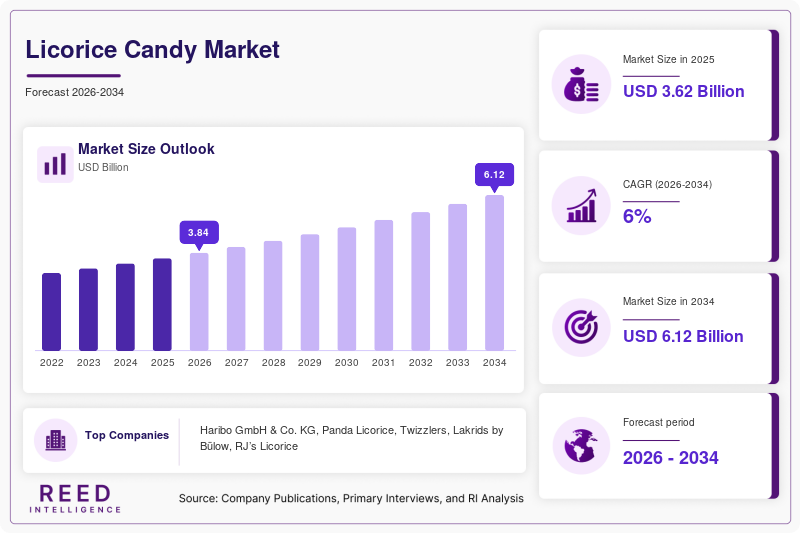
The Licorice Candy Market size is estimated at USD 3.84 billion, and it is projected to reach USD 6.12 billion by 2034, registering a CAGR of 6.0% during 2026–2034. A major global factor supporting the growth of the Licorice Candy Market is the increasing demand for specialty confectionery products with natural flavor ingredients and low-sugar formulations. Manufacturers are introducing innovative product variants with fruit extracts, herbal ingredients, and reduced artificial additives to align with evolving consumer preferences.
The market is also benefiting from expansion in online confectionery retailing, rising gifting demand, and increasing product availability through supermarkets and convenience stores. Consumer interest in retro candy products and premium international confectionery brands is further supporting market development.
Key Highlights
- Highest share region (2025): Europe – 38.6%
- Fastest-growing region CAGR (2026–2034): Asia Pacific – 7.1%
- Leading subsegment (Product Type): Soft Licorice Candy – 2025 share 54.2%
- Fastest-growing subsegment (Distribution Channel): Online Retail – CAGR 7.8%
- Dominant country (2024): Germany – USD 0.52 billion
- Dominant country (2025): United States – USD 0.57 billion
Market Trends
Rising Demand for Natural and Low-Sugar Confectionery
One major trend shaping the Licorice Candy Market is the growing demand for natural ingredient-based confectionery products. Consumers are increasingly preferring candies made with plant-based sweeteners, organic extracts, and reduced sugar formulations, encouraging manufacturers to diversify their product portfolios.
Expansion of Premium and Gourmet Candy Offerings
Another notable trend in the Licorice Candy Market is the increasing popularity of premium and gourmet licorice products. Manufacturers are introducing artisanal flavors, exotic ingredient blends, and high-quality packaging formats targeting adult consumers and gifting applications.
Market Drivers
Growth in Impulse Snacking Consumption
The increasing popularity of impulse snacking and on-the-go confectionery products is driving the Licorice Candy Market. Consumers are purchasing packaged candy products through supermarkets, convenience stores, and vending channels, supporting continuous demand growth across urban markets.
Expanding Retail and E-commerce Distribution
The rapid growth of e-commerce platforms and organized retail infrastructure is contributing significantly to market expansion. Wider product availability, promotional pricing, and direct-to-consumer sales strategies are improving accessibility for premium and imported licorice candy brands.
Market Restraint
Health Concerns Related to Excess Sugar Consumption
One key restraint affecting the Licorice Candy Market is increasing consumer awareness regarding sugar consumption and calorie intake. Health-conscious consumers are reducing confectionery purchases, particularly in developed markets with strong wellness trends.
Market Opportunities
Development of Functional Licorice Candy Products
Manufacturers are increasingly exploring functional confectionery products infused with herbal extracts, vitamins, and digestive-support ingredients. This trend is creating new opportunities for the Licorice Candy Market, particularly among wellness-focused consumers.
Expansion in Emerging Consumer Markets
Growing disposable incomes and increasing exposure to international confectionery brands in emerging economies are creating strong opportunities for market participants. Expanding urban retail infrastructure is further supporting premium candy product penetration.
Segmental Analysis
By Product Type
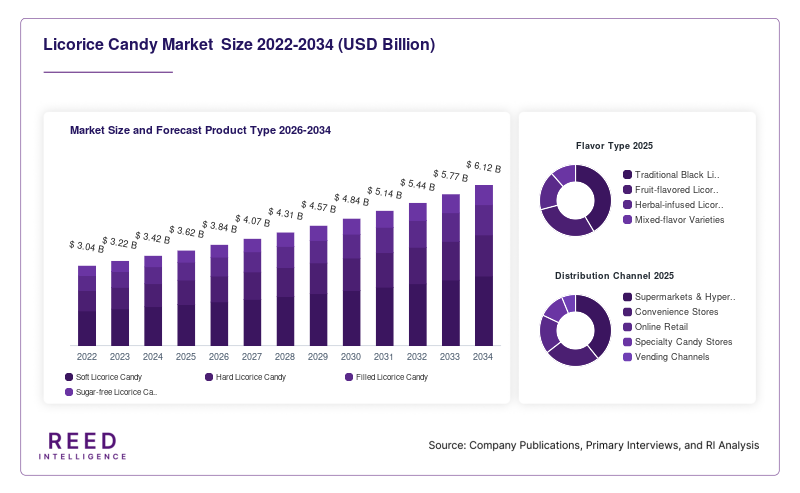
The Licorice Candy Market is segmented into soft licorice candy, hard licorice candy, filled licorice candy, and sugar-free licorice candy. Soft licorice candy dominated with a 54.2% share in 2025 due to its chewy texture, broad flavor availability, and high consumer preference across both children and adult demographics.
Sugar-free licorice candy is projected to grow at the fastest CAGR of 7.5% (2026–2034) due to increasing health awareness and rising demand for reduced-calorie confectionery alternatives.
By Flavor Type
Flavor segmentation includes traditional black licorice, fruit-flavored licorice, herbal-infused licorice, and mixed-flavor varieties. Fruit-flavored licorice held 41.6% share in 2025 due to strong consumer demand for strawberry, cherry, apple, and berry-based confectionery products.
Herbal-infused licorice is expected to grow at the fastest CAGR of 7.3%, supported by rising consumer interest in botanical and functional confectionery products.
By Distribution Channel
Distribution channels include supermarkets & hypermarkets, convenience stores, online retail, specialty candy stores, and vending channels. Supermarkets & hypermarkets accounted for 46.9% share in 2025 due to high product visibility and broad retail accessibility.
Online retail is projected to grow at the fastest CAGR of 7.8% during the forecast period due to increasing direct-to-consumer sales and expanding international confectionery e-commerce platforms.
By End User
End users include children, teenagers, adults, and geriatric consumers. Adults dominated with 44.5% share in 2025 due to rising preference for nostalgic and premium confectionery products.
Teenagers are projected to grow at the fastest CAGR of 7.0% during 2026–2034, driven by increasing demand for flavored chewy candies and social media-driven confectionery trends.
Regional Analysis
North America
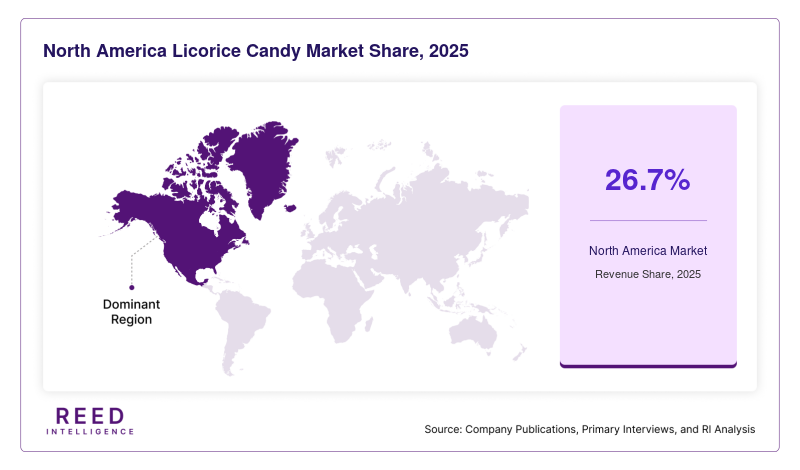
North America accounted for 26.7% share of the Licorice Candy Market in 2025, supported by strong demand for packaged confectionery products and growing premium candy consumption. The region is expected to grow at a CAGR of 5.8% (2026–2034). The United States dominates due to high retail penetration and increasing demand for flavored chewy candy products.
Europe
Europe held 38.6% share in 2025, driven by long-standing consumer preference for licorice confectionery and strong regional manufacturing presence. The region is projected to grow at a CAGR of 5.7% (2026–2034). Germany leads the regional market due to high per capita confectionery consumption and established premium candy brands.
Asia Pacific
Asia Pacific captured 20.8% share in 2025 and is projected to grow at the fastest CAGR of 7.1% (2026–2034) in the Licorice Candy Market. China remains the dominant country due to expanding modern retail networks, rising youth consumption, and growing popularity of imported confectionery products.
Middle East & Africa
Middle East & Africa accounted for 7.2% share in 2025, with a projected CAGR of 6.1% (2026–2034). Growth is supported by increasing supermarket expansion and rising demand for packaged snack products. Saudi Arabia dominates the regional market due to growing premium confectionery imports and expanding urban consumer spending.
Latin America
Latin America represented 6.7% share in 2025 and is projected to grow at a CAGR of 5.9% during 2026–2034. Brazil leads the regional market due to expanding confectionery retail channels and increasing demand for affordable candy products among younger consumers.
Competitive Landscape
The Licorice Candy Market is moderately fragmented, with global confectionery companies and regional candy manufacturers competing through flavor innovation, premium packaging, and product diversification. Market participants are increasingly introducing sugar-free, vegan, and natural ingredient-based licorice products to align with changing consumer preferences.
Major companies operating in the market include Haribo GmbH & Co. KG, Panda Licorice, Twizzlers, Lakrids by Bülow, and RJ’s Licorice. Haribo GmbH & Co. KG remains one of the leading participants in the market due to its strong global confectionery distribution network and diversified licorice product portfolio. Manufacturers are also investing in limited-edition flavors, sustainable packaging materials, and digital retail expansion strategies to strengthen market visibility and consumer engagement.
Key Players List
- Haribo GmbH & Co. KG
- Panda Licorice
- Twizzlers
- Lakrids by Bülow
- RJ’s Licorice
- Kenny’s Candy Company
- Wiley Wallaby
- Australian Licorice Company
- Gerrit J. Verburg Co.
- Red Vines
- Katjes Fassin GmbH
- Darrell Lea
- Halva Candy
- Cloetta AB
- Toms Group
Recent Developments
- 2025: Several confectionery companies introduced reduced-sugar and plant-based licorice candy variants.
- 2025: Haribo expanded premium licorice product offerings across North American retail channels.
- 2024: Lakrids by Bülow launched gourmet flavor collections targeting premium gifting applications.
- 2024: Multiple manufacturers adopted recyclable packaging solutions for confectionery products.
- 2024: Online confectionery retailers expanded international distribution for imported licorice brands.
- 2024: RJ’s Licorice introduced fruit-infused chewy candy products for younger consumer groups.
- 2024: Candy producers increased investment in natural flavor extracts and botanical ingredient formulations.
Licorice Candy Market Segments
Product Type
- Soft Licorice Candy
- Hard Licorice Candy
- Filled Licorice Candy
- Sugar-free Licorice Candy
Flavor Type
- Traditional Black Licorice
- Fruit-flavored Licorice
- Herbal-infused Licorice
- Mixed-flavor Varieties
Distribution Channel
- Supermarkets & Hypermarkets
- Convenience Stores
- Online Retail
- Specialty Candy Stores
- Vending Channels
End User
- Children
- Teenagers
- Adults
- Geriatric Consumers
By Region
- North America
- Europe
- APAC
- Middle East and Africa
- LATAM