Ligases Enzyme Market Size, Share & Demand Report By Type (DNA Ligases, RNA Ligases, Thermostable Ligases), By Source (Microbial, Plant, Animal, Recombinant), By Application (Molecular Diagnostics, Genetic Engineering, Synthetic Biology, Drug Discovery), By End-Use (Biopharmaceutical Companies, Academic & Research Institutes, Diagnostic Laboratories), By Region & Segment Forecasts, 2026–2034
USD 3950
Market Overview
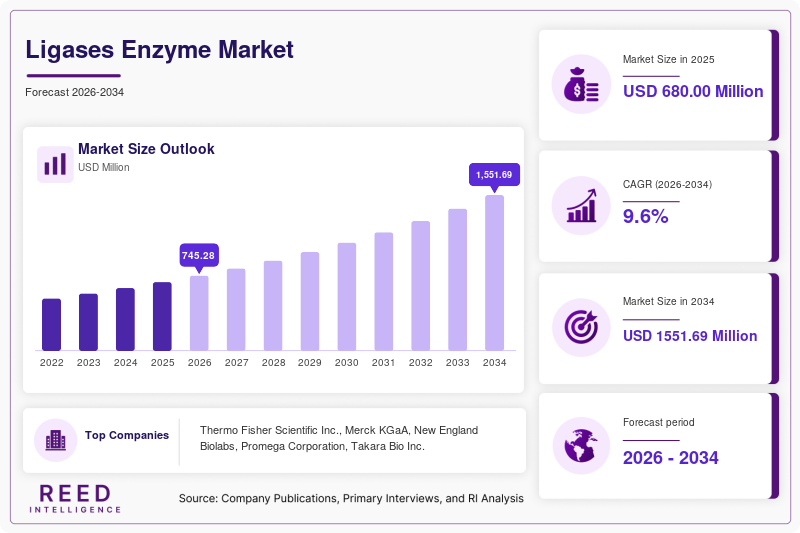
The Ligases Enzyme Market size was valued at approximately USD 680 million in 2026 and is projected to reach USD 1.42 billion by 2034, expanding at a CAGR of 9.6% during 2026–2034. Ligases, which catalyze the joining of two DNA or RNA strands, play a critical role in molecular biology, genetic engineering, and diagnostics. The increasing application of ligases in next-generation sequencing (NGS), synthetic biology, and gene editing technologies has significantly contributed to the expansion of the market.
A key global factor supporting market growth is the rapid advancement in genomic research and precision medicine. Governments and private organizations worldwide are investing heavily in genomics initiatives, enabling widespread adoption of enzyme-based technologies in diagnostics and therapeutics. This trend has strengthened the demand for high-performance ligases across research laboratories and biopharmaceutical companies.
Key Highlights:
- North America dominated the market with a 38% share in 2025, while Asia Pacific is expected to register the fastest growth at a CAGR of 11.2%.
- By type, DNA ligases emerged as the leading subsegment, whereas thermostable ligases are anticipated to be the fastest-growing with a CAGR of 10.4%.
- By application, molecular diagnostics led the market, while synthetic biology is projected to grow at a CAGR of 11.8%.
- The United States remained the dominant country, with market values of USD 210 million in 2024 and USD 230 million in 2025.
Market Trends
Increasing Integration of Ligases in Next-Generation Sequencing (NGS)
The growing adoption of next-generation sequencing technologies has transformed genomic research and clinical diagnostics. Ligases are essential components in library preparation workflows, enabling accurate DNA fragment joining and sequencing. The rising use of NGS in oncology, infectious disease diagnostics, and personalized medicine has elevated the demand for high-fidelity ligases. Moreover, advancements in sequencing platforms have necessitated enzymes with enhanced stability and efficiency, encouraging manufacturers to innovate specialized ligase formulations. This trend is expected to continue as sequencing becomes more cost-effective and accessible globally.
Expansion of Synthetic Biology and Gene Editing Applications
Synthetic biology and gene editing technologies, such as CRISPR-based systems, are increasingly relying on ligases for DNA assembly and repair processes. Ligases facilitate seamless DNA construction, making them indispensable for synthetic pathway engineering and genome modification. The rise of bioengineering applications in agriculture, healthcare, and industrial biotechnology has further accelerated the adoption of ligases. Additionally, the development of thermostable and high-specificity ligases is supporting complex genetic manipulations, enabling researchers to achieve precise outcomes. This trend is driving innovation and creating new growth avenues within the Ligases Enzyme Market.
Market Drivers
Growing Demand for Molecular Diagnostics
The increasing prevalence of chronic and infectious diseases has driven the demand for advanced diagnostic solutions. Ligases play a critical role in molecular diagnostic assays, including ligase chain reaction (LCR) and nucleic acid amplification techniques. These assays offer high sensitivity and specificity, making them suitable for early disease detection. As healthcare systems prioritize rapid and accurate diagnostics, the adoption of ligase-based technologies is expanding across clinical laboratories and diagnostic centers.
Rising Investments in Biotechnology Research
Significant investments in biotechnology and life sciences research are fueling the growth of the Ligases Enzyme Market. Academic institutions, research organizations, and biopharmaceutical companies are increasingly focusing on genetic engineering, drug discovery, and cell-based therapies. Ligases are essential tools in these applications, enabling DNA cloning, recombination, and repair processes. Government funding initiatives and private sector investments are further accelerating research activities, thereby increasing the demand for high-quality ligase enzymes.
Market Restraint
High Cost of Advanced Enzyme Technologies
One of the major challenges in the Ligases Enzyme Market is the high cost associated with advanced enzyme formulations. High-fidelity and thermostable ligases, which offer superior performance, often require complex manufacturing processes and stringent quality control measures. These factors contribute to elevated product costs, limiting their accessibility for small research laboratories and institutions with budget constraints.
Additionally, the need for specialized storage and handling conditions adds to the overall operational expenses. Enzymes are sensitive to temperature fluctuations and require cold-chain logistics, which can increase costs, particularly in emerging economies. This limitation may hinder widespread adoption in cost-sensitive markets, thereby affecting overall market growth.
Market Opportunities
Emerging Applications in Personalized Medicine
The growing focus on personalized medicine presents a significant opportunity for the Ligases Enzyme Market. Ligases are integral to genomic sequencing and biomarker identification, which are essential for developing tailored treatment strategies. As healthcare systems shift towards precision medicine, the demand for enzyme-based technologies is expected to increase. This trend is particularly prominent in oncology, where personalized therapies rely on accurate genetic analysis.
Expansion in Emerging Markets
Emerging economies in Asia Pacific, Latin America, and the Middle East are witnessing rapid growth in healthcare infrastructure and research capabilities. Governments in these regions are investing in biotechnology and life sciences, creating a favorable environment for market expansion. The increasing establishment of research laboratories and diagnostic centers is driving the demand for ligases. Additionally, the growing awareness of advanced diagnostic techniques is expected to further support market growth in these regions.
Segmental Analysis
By Type
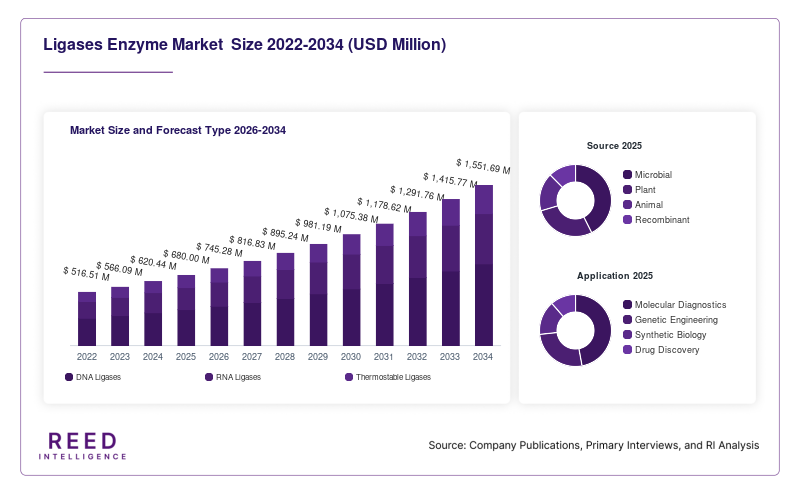
DNA ligases dominated the Ligases Enzyme Market, accounting for 62% share in 2025. Their widespread use in DNA replication, repair, and recombination processes has made them essential in molecular biology applications. DNA ligases are extensively utilized in cloning, sequencing, and diagnostic assays, contributing to their leading position.
Thermostable ligases are expected to be the fastest-growing subsegment, with a CAGR of 10.4%. Their ability to function at high temperatures makes them suitable for advanced applications such as PCR-based techniques. Increasing demand for robust enzymes in high-throughput workflows will drive their growth.
By Source
Microbial-derived ligases held the largest share of 55% in 2025, owing to their ease of production and cost-effectiveness. These enzymes are widely used in research and industrial applications due to their consistent performance.
Recombinant ligases are projected to grow at a CAGR of 10.1%. Advances in genetic engineering have enabled the development of customized enzymes with enhanced properties, supporting their adoption in specialized applications.
By Application
Molecular diagnostics dominated the market with a 40% share in 2025, driven by the increasing demand for accurate diagnostic tools. Ligases are widely used in nucleic acid amplification and detection techniques.
Synthetic biology is anticipated to be the fastest-growing application, with a CAGR of 11.8%. The expanding use of genetic engineering in various industries will support the demand for ligases in DNA assembly processes.
By End-Use
Biopharmaceutical companies accounted for 45% of the market share in 2025, as they extensively use ligases in drug discovery and development processes. The growing focus on biologics and gene therapies has further increased demand.
Academic and research institutes are expected to grow at a CAGR of 10.6%, driven by increasing research activities and funding support. The rising number of research projects in genomics and biotechnology will contribute to this growth.
Regional Analysis
North America
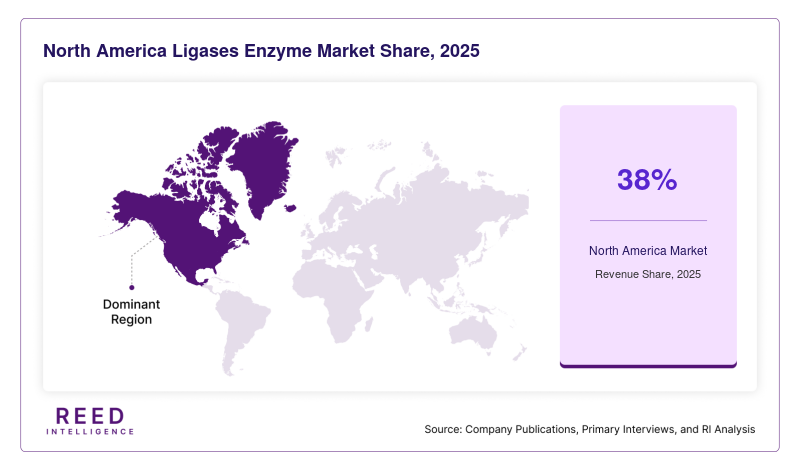
North America accounted for 38% of the Ligases Enzyme Market share in 2025 and will continue to grow at a CAGR of 9.1% during 2026–2034. The region’s strong presence of biotechnology companies and advanced research infrastructure has supported consistent demand for ligases. High adoption of molecular diagnostics and sequencing technologies has further strengthened market growth.
The United States dominated the regional market due to its well-established life sciences ecosystem. The presence of leading research institutions and funding programs has enabled extensive use of ligases in genomic studies. Additionally, the country’s focus on innovation and early adoption of advanced technologies has driven the demand for specialized enzymes.
Europe
Europe held approximately 27% market share in 2025 and is expected to grow at a CAGR of 8.7%. The region’s emphasis on research and development in biotechnology has contributed to steady market expansion. Increasing collaborations between academic institutions and industry players have supported the adoption of ligases.
Germany emerged as the dominant country in Europe, supported by its strong pharmaceutical and biotechnology sectors. The country’s focus on research excellence and innovation has facilitated the widespread use of ligases in molecular biology applications.
Asia Pacific
Asia Pacific represented 22% of the market share in 2025 and is projected to grow at the fastest CAGR of 11.2%. The region’s expanding biotechnology sector and increasing investments in research infrastructure have driven market growth.
China dominated the region due to its rapid advancements in genomics and biotechnology. Government initiatives promoting life sciences research and increasing funding for innovation have accelerated the adoption of ligases. Additionally, the growing number of research institutions has supported market expansion.
Middle East & Africa
The Middle East & Africa accounted for 7% of the market share in 2025 and is expected to grow at a CAGR of 8.3%. The region is gradually developing its healthcare and research infrastructure, creating opportunities for market growth.
Saudi Arabia emerged as a key country, driven by government initiatives to enhance healthcare and biotechnology capabilities. Investments in research facilities and increasing awareness of advanced diagnostic technologies have supported the adoption of ligases.
Latin America
Latin America held around 6% market share in 2025 and is projected to grow at a CAGR of 8.5%. The region’s improving healthcare infrastructure and growing focus on research have contributed to market development.
Brazil dominated the regional market due to its expanding biotechnology sector. Government support for research and increasing investments in healthcare have facilitated the adoption of ligases in various applications.
Competitive Landscape
The Ligases Enzyme Market is moderately consolidated, with several global and regional players competing based on product quality, innovation, and pricing. Leading companies are focusing on developing high-performance enzymes to cater to evolving research needs.
A key market leader, Thermo Fisher Scientific Inc., has strengthened its position through continuous product innovation and strategic acquisitions. The company recently introduced advanced ligase formulations designed for high-throughput sequencing applications, enhancing efficiency and accuracy.
Other major players are investing in research and development to expand their product portfolios and gain a competitive edge. Collaborations with research institutions and biotechnology firms are also common strategies to enhance market presence.
Key Players List
- Thermo Fisher Scientific Inc.
- Merck KGaA
- New England Biolabs
- Promega Corporation
- Takara Bio Inc.
- QIAGEN N.V.
- Agilent Technologies Inc.
- Bio-Rad Laboratories Inc.
- F. Hoffmann-La Roche Ltd
- Illumina Inc.
- LGC Biosearch Technologies
- Jena Bioscience GmbH
- Enzo Life Sciences Inc.
- GenScript Biotech Corporation
- Creative Enzymes
Recent Developments
- 2025: Thermo Fisher Scientific launched a new high-efficiency DNA ligase for NGS workflows.
- 2024: New England Biolabs introduced an enhanced thermostable ligase for PCR applications.
- 2024: QIAGEN expanded its enzyme portfolio with advanced ligase kits for diagnostics.
- 2023: Promega Corporation developed ligase-based solutions for synthetic biology research.
- 2023: Takara Bio Inc. strengthened its presence through strategic collaborations in Asia Pacific.
Ligases Enzyme Market Segments
Type
- DNA Ligases
- RNA Ligases
- Thermostable Ligases
Source
- Microbial
- Plant
- Animal
- Recombinant
Application
- Molecular Diagnostics
- Genetic Engineering
- Synthetic Biology
- Drug Discovery
End-Use
- Biopharmaceutical Companies
- Academic & Research Institutes
- Diagnostic Laboratories
By Region
- North America
- Europe
- APAC
- Middle East and Africa
- LATAM