Light Meter Market Size, Share, Demand Report By Type (Analog Light Meters, Digital Light Meters, Smart IoT-Enabled Light Meters, Handheld Portable Light Meters), By Application (Construction & Building Inspection, Photography & Cinematography, Agriculture & Greenhouse Farming, Industrial Safety & Manufacturing, Healthcare & Laboratories), By End-Use (Industrial, Commercial, Residential, Government & Infrastructure, Media & Entertainment) & Regional Forecasts, 2026–2034
USD 3950
Market Overview
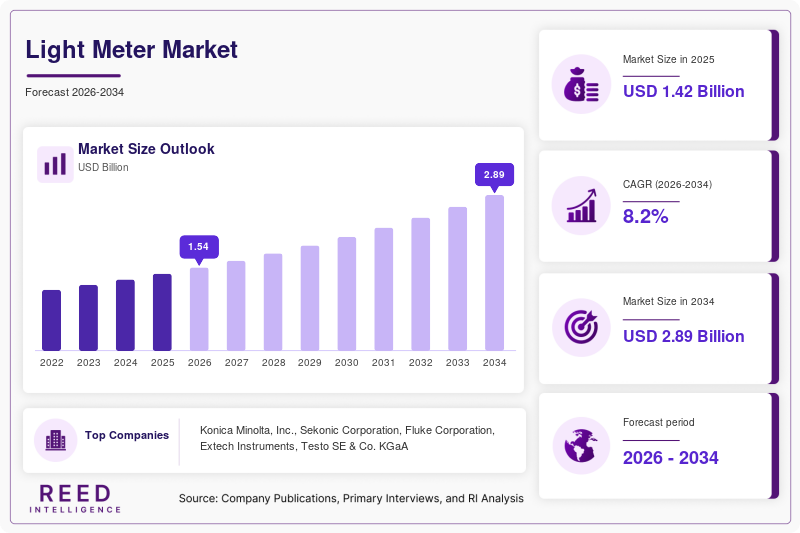
The global Light Meter Market is valued at approximately USD 1.42 billion in 2026 and is projected to reach nearly USD 2.68 billion by 2034, registering a CAGR of 8.2% (2026–2034). The market growth is primarily driven by increasing demand for precise light measurement across photography, cinematography, construction safety compliance, agricultural lighting optimization, and industrial inspection processes. Expansion of smart building technologies and energy-efficient lighting systems has further strengthened adoption of advanced light meters across commercial and residential sectors. Additionally, rising awareness regarding occupational safety standards in workplace lighting environments continues to support steady market penetration.
A key global factor supporting market growth is the rapid integration of IoT-enabled sensing devices in smart infrastructure projects. These systems increasingly rely on real-time illumination monitoring to optimize energy consumption and ensure regulatory compliance with workplace lighting standards. The evolution of digital light meters with enhanced sensitivity, data logging capabilities, and wireless connectivity is further improving adoption across end-use industries.
Key Highlights
- North America dominated the market with a 34.2% share in 2025.
- Asia Pacific is expected to grow at the fastest CAGR of 11.2% during 2026–2034.
- By equipment type, sensors accounted for the largest share of 38.5%.
- while software solutions are projected to grow at a CAGR of 12.4%.
- By application, structural health monitoring led with a 41.7% share, whereas corrosion detection is expected to expand at a CAGR of 11.8%.
- The United States remained the dominant country, with market values of USD 510 million in 2024 and USD 560 million in 2025.
Market Trends
Integration of Smart and Wireless Light Metering Systems
The Light Meter Market is experiencing a strong shift toward smart and wireless-enabled devices that support real-time data monitoring and remote accessibility. These advanced systems are increasingly integrated with IoT platforms, enabling users to track illumination levels across multiple sites simultaneously. Industries such as architecture, film production, and industrial maintenance are adopting smart meters to improve operational efficiency and ensure compliance with lighting standards. The use of Bluetooth and cloud-based analytics is further enhancing usability, allowing professionals to store, analyze, and share data seamlessly. This trend is also driven by the growing demand for automated building management systems that optimize lighting conditions while reducing energy consumption.
Rising Adoption in Precision Agriculture and Controlled Environment Farming
Another major trend is the increasing use of light meters in precision agriculture and indoor farming systems. Controlled environment agriculture relies heavily on accurate light measurement to optimize plant growth cycles and maximize yield efficiency. Light meters help farmers regulate artificial lighting conditions in greenhouses and vertical farming setups. This trend is gaining momentum due to global food security concerns and the rapid expansion of urban farming practices. Governments and private agritech companies are investing in smart agricultural infrastructure, further driving the demand for precise illumination monitoring tools across developed and emerging economies.
Market Drivers
Growing Demand for Energy-Efficient Lighting Systems
One of the primary drivers of the Light Meter Market is the increasing global focus on energy efficiency and sustainable lighting solutions. Governments across multiple regions are implementing strict regulations to reduce electricity consumption in commercial and residential buildings. Light meters play a crucial role in ensuring optimal lighting levels while minimizing energy waste. Industries are increasingly using these devices to evaluate lighting performance and comply with green building certifications. The shift toward LED lighting systems has further increased the need for precise measurement tools, as LED performance varies based on installation conditions and usage patterns. This has created sustained demand across construction, manufacturing, and facility management sectors.
Expansion of Photography, Film, and Content Creation Industries
The rapid growth of digital content creation, photography, and cinematography industries has significantly boosted demand for advanced light meters. Professionals in these sectors rely on accurate exposure measurement to achieve high-quality visual outputs. The rise of social media platforms and streaming services has further expanded the creator economy, increasing adoption of portable and digital light meters. Modern devices offer enhanced accuracy, compact design, and integration with camera systems, making them essential tools for both professional and amateur users. This growing creative economy continues to be a strong contributor to market expansion globally.
Market Restraint
Despite strong growth potential, the Light Meter Market faces certain limitations that could restrict its expansion. A major restraint is the increasing availability of multifunctional smart devices such as smartphones equipped with built-in light sensing applications. These devices provide basic illumination measurement capabilities, reducing dependency on standalone light meters for non-professional users. As a result, entry-level demand is gradually shifting toward mobile-based solutions, especially in price-sensitive markets.
Additionally, high-precision professional light meters remain relatively expensive, limiting adoption among small-scale users and independent professionals. In developing regions, budget constraints and lack of awareness about advanced measurement standards further hinder market penetration. Moreover, technological complexity associated with calibration and maintenance of high-end devices can discourage adoption in certain industrial applications. The market also faces competition from alternative environmental monitoring systems that integrate multiple sensing functions, including temperature, humidity, and light intensity, within a single platform. This convergence reduces the need for dedicated light measurement instruments in some applications, thereby restraining overall market growth potential.
Market Opportunities
Expansion of Smart City and Smart Building Projects
The growing development of smart cities presents a significant opportunity for the Light Meter Market. Modern urban infrastructure requires continuous monitoring of lighting conditions to ensure energy efficiency, safety, and regulatory compliance. Light meters integrated with building automation systems can help optimize street lighting, indoor illumination, and public infrastructure lighting. Governments worldwide are investing heavily in smart infrastructure projects, particularly in emerging economies. This creates strong demand for advanced sensing devices capable of supporting large-scale urban planning and energy optimization initiatives. Manufacturers focusing on IoT-enabled and AI-integrated light meters are likely to benefit significantly from this trend.
Increasing Demand in Healthcare and Laboratory Applications
Healthcare facilities and research laboratories require controlled lighting environments to ensure accuracy in medical procedures and experiments. Light meters are increasingly being used to maintain standardized illumination levels in operating rooms, diagnostic labs, and pharmaceutical production facilities. The growing emphasis on precision healthcare and regulatory compliance is driving adoption in this sector. Additionally, advancements in biotechnology and pharmaceutical research are further expanding the need for controlled lighting conditions. This creates a stable and long-term opportunity for manufacturers offering high-precision, calibration-stable light measurement devices tailored for sensitive environments.
Segmental Analysis
By Type
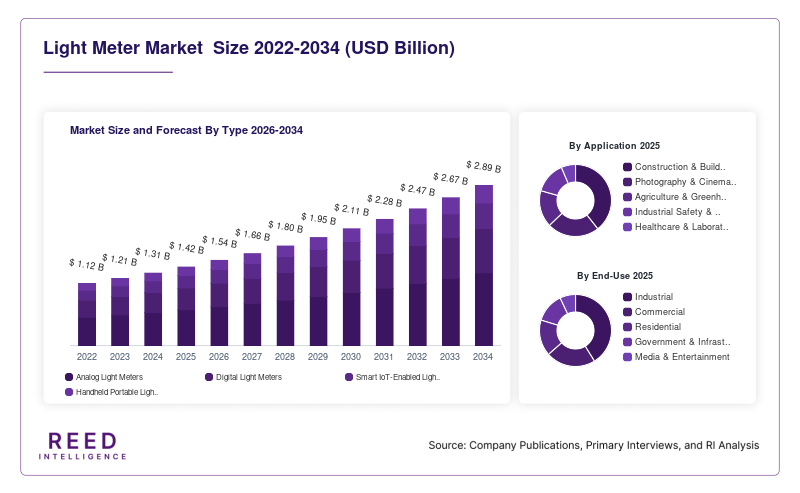
The equipment type segment shows that digital light meters held the dominant share of 44.3% in 2024, driven by their accuracy, portability, and compatibility with modern digital systems. These devices are widely used in photography, construction, and industrial inspection applications where precision is critical. Their ability to provide instant readings and integrate with software platforms makes them highly preferred across professional environments.
The fastest-growing subsegment is smart IoT-enabled light meters, expected to expand at a CAGR of 12.1%. Growth is driven by increasing adoption of connected devices in smart buildings and industrial automation systems. These meters offer remote monitoring, cloud storage, and predictive analytics capabilities, making them ideal for modern infrastructure applications.
By Application
In application segmentation, construction and building inspection accounted for the largest share of 40.6% in 2024, as regulatory compliance for workplace lighting remains a key requirement. Light meters are widely used to ensure safe illumination levels in commercial and industrial environments.
The fastest-growing subsegment is precision agriculture, projected to grow at a CAGR of 11.9%, driven by indoor farming expansion and controlled environment agriculture systems requiring optimized light exposure for crop productivity.
By End-Use
The industrial sector dominated with a 42.1% share in 2024, due to widespread use in manufacturing plants, warehouses, and quality control environments. Industrial facilities rely on light meters for safety compliance and operational efficiency.
The fastest-growing subsegment is the media and entertainment industry, expected to grow at a CAGR of 10.8%, supported by rising content production, film-making, and digital streaming demand requiring precise lighting calibration tools.
Regional Analysis
North America
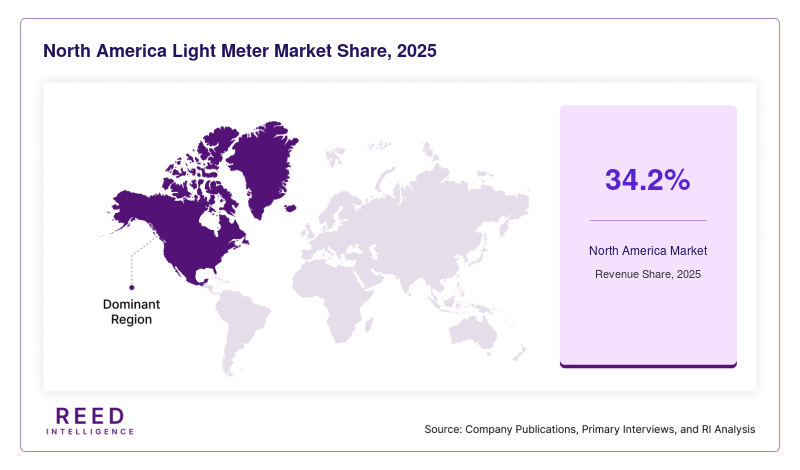
North America accounted for a significant share of the global Light Meter Market in 2025, holding approximately 34.2%, and is expected to grow at a CAGR of around 7.8% during 2026–2034. The region’s dominance is supported by strong adoption of advanced measurement instruments across industrial, commercial, and research applications. High penetration of smart building technologies and strict occupational safety regulations regarding lighting standards further support consistent demand for light meters across multiple end-use sectors.
The United States leads the regional market due to its strong presence in construction, media production, and aerospace industries. A key growth factor is the rapid expansion of energy-efficient building initiatives and widespread integration of IoT-based facility management systems, which require continuous light intensity monitoring for optimized performance and regulatory compliance.
Europe
Europe held around 27.6% market share in 2025, with an expected CAGR of approximately 7.5% through 2034. Growth in this region is driven by stringent environmental regulations and strong emphasis on energy-efficient infrastructure development. Countries across Europe are actively investing in smart city projects and green building certifications, which significantly increase the need for accurate light measurement solutions in both public and private infrastructure projects.
Germany dominates the European market due to its advanced industrial manufacturing base and strong focus on workplace safety standards. A major growth factor is the increasing deployment of automated lighting control systems in factories and commercial buildings, which rely on precision light meters for calibration and efficiency optimization.
Asia Pacific
Asia Pacific accounted for approximately 23.8% share in 2025 and is projected to grow at the fastest CAGR of 11.2% during 2026–2034. Rapid urbanization, industrial expansion, and large-scale infrastructure development are key factors fueling market growth in this region. Rising adoption of smart agriculture systems and expanding construction activities further strengthen demand for advanced light measurement devices.
China leads the Asia Pacific market due to massive investments in smart city development and industrial automation. A key growth factor is the rapid expansion of controlled environment agriculture and vertical farming projects, which require precise light monitoring systems to optimize crop productivity and energy usage.
Middle East & Africa
Middle East & Africa held nearly 7.2% share in 2025, with a projected CAGR of 8.4% through 2034. The market is driven by growing infrastructure development, smart city initiatives, and increasing adoption of modern construction practices across Gulf countries. Demand for advanced lighting control systems in commercial and hospitality projects is also rising steadily.
The United Arab Emirates dominates the region, supported by large-scale urban development and tourism infrastructure expansion. A key growth factor is the implementation of smart building technologies in high-rise commercial and residential projects, which require continuous lighting optimization and compliance monitoring using light meters.
Latin America
Latin America accounted for approximately 7.2% share in 2025 and is expected to grow at a CAGR of around 7.9% during 2026–2034. Growth is primarily supported by increasing industrial modernization and agricultural development across key economies. Expanding use of greenhouse farming techniques and industrial safety regulations are also boosting market demand.
Brazil leads the regional market due to its strong agricultural sector and growing adoption of precision farming technologies. A major growth factor is the rising implementation of controlled lighting systems in agriculture and manufacturing facilities to improve productivity and operational efficiency.
Competitive Landscape
The Light Meter Market is moderately competitive, with key players focusing on product innovation, digital integration, and expansion into smart sensing technologies. Leading companies include Konica Minolta, Sekonic Corporation, Extech Instruments, Testo SE & Co. KGaA, and Fluke Corporation. These firms dominate through advanced product portfolios and strong global distribution networks. Konica Minolta remains a leading player due to its strong imaging and optical measurement expertise, continuously expanding its digital light meter offerings with enhanced precision and connectivity features. Recent developments include the introduction of IoT-enabled portable light meters designed for industrial automation applications. Companies are increasingly investing in wireless connectivity, cloud-based analytics, and miniaturized sensor technologies to enhance usability and accuracy across diverse applications.
Key Players List
- Konica Minolta
- Sekonic Corporation
- Fluke Corporation
- Extech Instruments
- Testo SE & Co. KGaA
- Amprobe
- Dranetz Technologies
- Hanna Instruments
- TES Electrical Electronic Corp.
- Kyoritsu Electrical Instruments
- Gigahertz-Optik
- Delta OHM
- Reed Instruments
- PCE Instruments
- Omega Engineering
Recent Developments
- Konica Minolta launched an upgraded digital lux meter series with cloud connectivity and enhanced calibration accuracy for industrial use cases.
- Fluke Corporation introduced a compact handheld light meter designed for HVAC and building inspection professionals with improved battery efficiency.
- Testo SE & Co. expanded its smart sensor portfolio by integrating wireless data logging features for real-time environmental monitoring applications.
Light Meter Market Segments
By Type
- Analog Light Meters
- Digital Light Meters
- Smart IoT-Enabled Light Meters
- Handheld Portable Light Meters
By Application
- Construction & Building Inspection
- Photography & Cinematography
- Agriculture & Greenhouse Farming
- Industrial Safety & Manufacturing
- Healthcare & Laboratories
By End-Use
- Industrial
- Commercial
- Residential
- Government & Infrastructure
- Media & Entertainment
By Region
- North America
- Europe
- APAC
- Middle East and Africa
- LATAM