Lighter Market Size, Share & Trends Analysis Report By Product Type, By Fuel Type, By Distribution Channel, By End Use, and By Region (North America, Europe, Asia Pacific, Latin America, Middle East & Africa) Forecasts, 2026–2034
USD 3950
Lighter Market Size
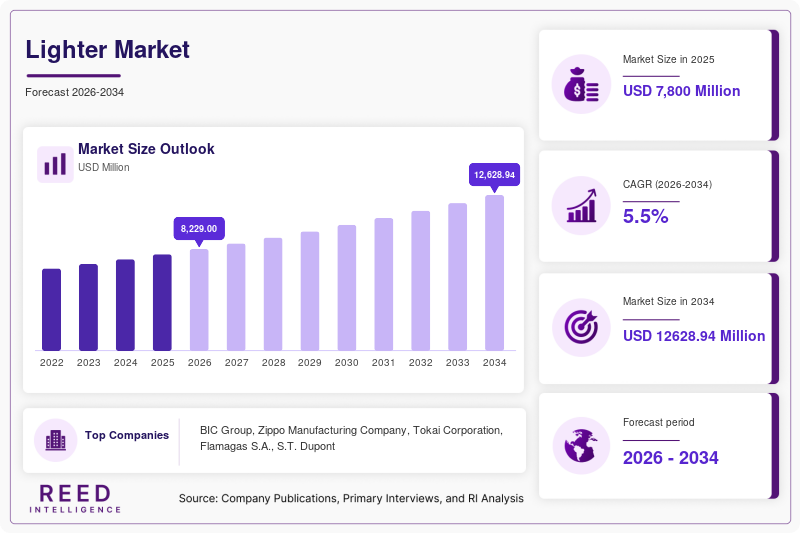
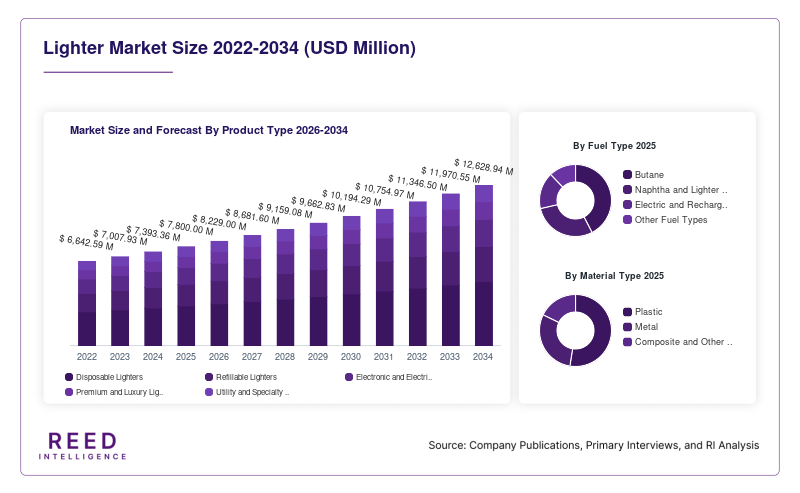
The global lighter market size was valued at USD 7,800 million in 2025 and is projected to grow from USD 8,229 million in 2026 to USD 12,628.94 million by 2034, registering a CAGR of 5.5% during the forecast period from 2026 to 2034.
The lighter market comprises portable devices used to generate a flame for lighting cigarettes, cigars, candles, cooking equipment, outdoor fires, and other applications. Products range from disposable and refillable pocket lighters to premium windproof lighters, utility lighters, and rechargeable electric arc lighters. The market serves consumer, hospitality, outdoor recreation, household, and selected industrial applications. Product demand is influenced by convenience, price, design, reliability, fuel availability, safety requirements, and consumer preferences.
Lighter Market Drivers
Sustained Demand for Portable Ignition Products
Lighters remain widely used for lighting cigarettes, cigars, candles, incense, fireplaces, grills, and other items requiring a flame. This variety of applications supports demand beyond tobacco-related use. Disposable products benefit from low purchase prices and broad retail distribution, while refillable models appeal to users seeking extended product life. The combination of personal, household, recreational, and selected commercial uses supports recurring demand across consumer segments.
Expansion of Retail and E-Commerce Distribution
Convenience stores, supermarkets, tobacco retailers, department stores, gift shops, and online platforms help manufacturers reach customers across different price points. High-volume retail channels support mass-market disposable products, while specialist and online channels provide access to premium, refillable, novelty, and electronic designs. Wider distribution improves product availability and gives consumers greater choice in features, appearance, and price.
Product Innovation and Premiumization
Manufacturers differentiate products through casing materials, finish, ignition mechanisms, refillability, portability, and brand design. Premium lighters can serve as personal accessories, gifts, or collectible items, while utility and electric lighters address particular household requirements. Improvements in ignition reliability, ergonomics, and child-resistant design can strengthen product appeal. Premiumization also gives manufacturers opportunities to serve consumers whose purchasing decisions are not based solely on price.
Lighter Market Restraints
Safety Regulations and Product Liability
Lighters contain ignition mechanisms and, in many cases, flammable fuel. Product design, manufacturing, packaging, labelling, and distribution must therefore address applicable safety standards and regulatory requirements. Child-resistance provisions and testing requirements can add development and compliance costs. Product failures, fuel leakage, unintended ignition, or inadequate safety features can create liability exposure and damage brand reputation.
Environmental Concerns and Competition from Alternatives
Disposable lighters can contribute to plastic waste and discarded mixed-material products, particularly where collection and recycling options are limited. Refillable products may reduce the frequency of replacement, but their overall environmental impact depends on product lifespan, material composition, fuel use, and disposal practices. Matches, built-in ignition systems, and rechargeable electric lighters also compete in selected applications. These alternatives may influence demand depending on price, convenience, and intended use.
Lighter Market Opportunities
Growth in Refillable and Premium Lighters
Refillable lighters offer opportunities for manufacturers serving consumers who value durability, design, brand identity, and repairability. Premium metal casings, gift sets, personalization, limited-edition designs, and collectible models can create differentiation beyond basic ignition performance. Manufacturers can also develop accessories and servicing options to support longer product life. Commercial potential depends on consumer willingness to pay, product quality, brand recognition, and after-sales availability.
Development of Electric and Specialized Utility Lighters
Rechargeable arc lighters and specialized utility lighters provide opportunities in candle lighting, kitchen use, fireplaces, grills, and selected outdoor activities. Product differentiation can focus on charging convenience, ignition reliability, ergonomics, safety features, and suitability for specific tasks. Manufacturers can expand through household-goods retailers, online marketplaces, and specialist channels. Battery life, charging time, moisture resistance, and purchase cost remain important factors affecting consumer acceptance.
Lighter Market Segmental Analysis
By Product Type
Disposable lighters serve consumers seeking affordable, portable ignition products that do not require refilling. They are widely distributed through convenience stores, supermarkets, tobacco retailers, and other high-frequency retail channels. Their commercial appeal is linked to low purchase prices, ease of use, and established manufacturing and distribution networks. Flint-based products are an important part of this category, while piezoelectric ignition designs offer an alternative mechanism. Disposable products face scrutiny related to product safety, material waste, and end-of-life disposal.
Refillable lighters are designed to be used repeatedly by replenishing the fuel supply or replacing relevant consumable components. They include everyday refillable models and premium products with metal casings and distinctive finishes. Their appeal depends on durability, ignition reliability, availability of compatible fuel, and the cost of continued use. Premium refillable lighters may also be purchased as gifts or collectible accessories. Exact global share and CAGR figures for refillable lighters under the market definition used here are not verifiable from the available sources.
Electronic and electric lighters include devices that use piezoelectric ignition, electrical heating, or an electric arc, depending on the design. Rechargeable arc models generate a plasma arc rather than a conventional fuel flame and are commonly marketed for household or outdoor applications. Their performance depends on battery capacity, charging time, ignition reliability, and resistance to environmental conditions. Some electronic ignition systems still use conventional fuel, so electronic lighters should not automatically be classified as flameless or fuel-free products.
Premium and luxury lighters emphasize materials, finishing, brand identity, craftsmanship, and product design. Metal construction, decorative finishes, personalization, limited editions, and branded gift packaging can differentiate these products from mass-market alternatives. Demand is influenced by discretionary consumer spending, brand recognition, gifting occasions, and collector interest. This category can command higher unit prices, but it serves a narrower customer base than affordable disposable products and is sensitive to economic conditions.
Utility and specialty lighters are designed for specific ignition tasks, including lighting candles, grills, fireplaces, and selected outdoor equipment. Long-reach designs can help users maintain distance from the ignition point, while wind-resistant and task-specific models serve particular operating environments. Product requirements vary according to the intended use, flame control, ergonomics, safety mechanisms, and fuel system. This category competes on task suitability and reliability rather than on portability alone.
By Fuel Type
Butane is commonly used in disposable and refillable flame lighters because it can be stored in compact fuel reservoirs and released through controlled mechanisms. Butane-powered products serve personal, household, and utility applications. Their performance depends on ignition design, fuel quality, valve reliability, and environmental conditions. Manufacturers must address leakage prevention, flame stability, product durability, and safe fuel handling throughout production and distribution.
Naphtha and other lighter fluids are used in selected refillable and traditional wick-style lighters. These products appeal to consumers who prefer established designs, reusable metal casings, or particular ignition characteristics. Their performance depends on fuel compatibility, wick and flint condition, sealing, and appropriate maintenance. Continued demand is influenced by product familiarity, availability of lighter fluid, and the presence of established brands in specialist and gift-oriented retail channels.
Electric and rechargeable systems use a battery-powered ignition mechanism, an electrically heated element, or an arc, depending on product construction. These devices may reduce reliance on disposable fuel reservoirs but require electricity for charging and may still include replaceable components. Market development depends on battery life, charging convenience, reliability, safety, and product suitability for the intended task. The segment should be distinguished from conventional butane lighters that use electronic ignition but still burn fuel.
By Material Type
Plastic is widely used in mass-market lighter casings because it supports lightweight construction, design flexibility, and high-volume manufacturing. Plastic-bodied products can be produced in varied colours, shapes, and finishes and are commonly associated with affordable disposable models. Material selection must account for heat exposure, mechanical strength, fuel-system compatibility, and applicable product safety requirements. Waste management and the difficulty of separating mixed materials can also influence design and disposal considerations.
Metal is used in refillable, premium, and some utility lighter designs. Metal casings can support durability, distinctive finishes, and a more substantial product feel. Stainless steel, brass, and other metals may be selected according to product requirements and price positioning. Metal construction generally involves different manufacturing and finishing processes from plastic designs, and costs depend on material prices, component complexity, and production scale.
Composite and other materials cover specialized casing materials and combinations of materials used to balance weight, durability, appearance, and cost. Their use varies across manufacturers and product types. Material decisions are influenced by mechanical performance, manufacturing methods, fuel compatibility, product safety, and consumer preferences. Exact share and CAGR data for this category are not verifiable from the available sources.
By Distribution Channel
Convenience stores provide readily accessible lighter products for consumers making frequent, low-value purchases. Their proximity, extended operating hours, and placement near checkout areas can support impulse and replacement purchases. Disposable and affordable lighters are particularly suited to this channel, although product selection varies by retailer and local regulations. Distribution success depends on shelf availability, wholesale pricing, brand recognition, and consistent supply.
Supermarkets and hypermarkets offer lighters alongside household goods, personal-use products, and other general merchandise. These retailers can provide a range of price points and product types, including utility lighters for household applications. Purchasing decisions are influenced by visibility, packaging, price promotions, and availability. Retailer requirements for safety compliance, product documentation, and supplier reliability affect manufacturer access to this channel.
Tobacco shops serve consumers purchasing lighters alongside cigarettes, cigars, tobacco accessories, and related products. These stores may offer both economical disposable lighters and higher-priced refillable or specialty models. Product familiarity, availability, and convenience support this channel, while brand preferences can influence repeat purchasing. Regulations affecting tobacco retailing may indirectly affect lighter distribution in some markets.
Lighter Market Regional Analysis
North America Lighter Market
North America is an established market for pocket, disposable, refillable, and premium lighters, supported by broad retail distribution and demand from personal, household, outdoor, and utility applications. The United States is a significant consumer market, while Canada and Mexico contribute through retail sales, household use, and regional distribution networks. Established brands compete with lower-priced products and specialized designs. However, published estimates of North America's global market share vary according to whether the analysis covers pocket lighters, disposable lighters, or the wider lighter category. An exact share for the global market definition used in this report is not verifiable from the available evidence.
Market development is influenced by consumer spending, retail access, smoking-related demand, household purchasing patterns, and interest in outdoor activities. Premium refillable products and utility lighters provide additional demand beyond basic disposable models. Manufacturers must also comply with applicable product-safety requirements and retailer standards. The region's growth rate depends on product mix, replacement demand, price positioning, and changes in consumer behaviour; a matching regional CAGR is not independently verified.
Europe Lighter Market
Europe has demand for disposable, refillable, premium, and utility lighters through convenience stores, supermarkets, tobacco retailers, specialist shops, and online channels. The region includes established brands and consumers across a broad range of product price points. Premium metal lighters, refillable designs, and branded products serve particular consumer and gifting markets, while disposable lighters remain relevant for everyday use. The exact European share of the wider global lighter market is not verifiable from a single consistent market definition.
European market conditions are shaped by product-safety standards, consumer preferences, retail distribution, environmental considerations, and purchasing power. Manufacturers must account for child-resistance requirements and applicable product standards, while material selection and end-of-life disposal remain relevant to product design. Premiumization can support value growth even when unit demand is relatively mature. However, a reliable Europe-specific CAGR matching the supplied global forecast is not available from the evidence reviewed.
Asia Pacific Lighter Market
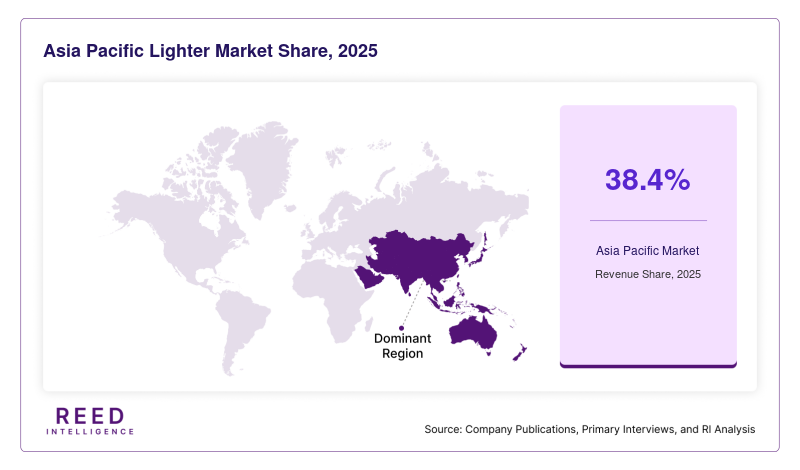
Asia Pacific is an important production and consumption centre for lighter products, supported by manufacturing capacity, established component supply chains, and extensive domestic and export distribution. China is particularly relevant to manufacturing, while India, Japan, South Korea, and Southeast Asian markets provide varied consumer demand. The region serves both low-priced disposable products and differentiated designs, with demand influenced by retail penetration, household use, smoking-related consumption, and product affordability. Available reports identify Asia Pacific as the largest region for several narrower lighter-market categories, but the precise share for the broader lighter market in this report is not verifiable.
Regional demand depends on manufacturing costs, domestic consumption, export activity, retail networks, product quality, and safety compliance. Manufacturers compete through production scale, unit costs, product variety, and relationships with global distributors. Premium and refillable products also provide opportunities in selected markets, while rechargeable electric designs serve consumers seeking alternative ignition systems. Growth rates differ substantially by country and product type, so an exact Asia Pacific CAGR for the supplied global market definition cannot be confirmed.
Latin America Lighter Market
Latin America has demand for affordable disposable lighters, refillable products, and utility lighters across household, personal, and outdoor applications. Brazil and Mexico are significant consumer markets within the region, supported by large retail systems and diverse consumer populations. Traditional retail outlets and convenience-focused channels remain important for low-cost products, while specialist retailers can serve customers seeking premium or decorative designs. An exact Latin American share of the broader global lighter market is not verifiable from the available evidence.
Market development is affected by household purchasing power, import costs, currency movements, retail coverage, and product availability. Lower-priced products can remain important where consumers prioritize affordability, while premium products depend on discretionary spending and brand awareness. Distributors and wholesalers influence market reach, particularly where smaller retailers dominate sales. The region's CAGR for the exact market scope and forecast period used here is not independently verified.
Middle East & Africa Lighter Market
The Middle East & Africa market includes demand for disposable and refillable lighters, utility products, and selected premium designs. Retailers serve consumers through convenience stores, general merchandise outlets, tobacco retailers, and specialist shops. Gulf markets have established modern retail infrastructure, while demand in African markets varies according to household purchasing power, urbanization, product availability, and distribution networks. The precise regional share of the global lighter market is not verifiable from the available evidence.
Lighter Market Competitive Landscape
The lighter market includes global consumer-product companies, specialist lighter manufacturers, premium brands, and regional producers supplying disposable, refillable, electric, and utility products. Competition is shaped by production scale, manufacturing cost, brand recognition, product reliability, safety compliance, design, distribution reach, and after-sales support. Mass-market manufacturers focus on consistent quality and high-volume retail availability, while premium brands differentiate through materials, finishes, craftsmanship, and brand identity.
Product development covers ignition reliability, child-resistant mechanisms, fuel containment, ergonomic design, refillability, and rechargeable electric systems. Manufacturers must balance product functionality with cost, safety, packaging, and distribution requirements. Retail relationships are important because convenience stores and supermarkets serve mass-market demand, while specialist shops and online channels provide access to premium and niche products.
Key Market Players
- BIC Group
- Zippo Manufacturing Company
- Tokai Corporation
- Flamagas S.A.
- S.T. Dupont
- Calico Brands, Inc.
- Zhuoye Lighter Manufacturing Co., Ltd.
- NingBo Xinhai Electric Co., Ltd.
- Colibri
- Dunhill
Lighter Market Recent Developments
- April 28, 2026 - BIC reported first-quarter performance for its Flame for Life division. BIC reported organic net sales growth of 1.7% in the division, supported by performance in Latin America and improvement in the United States. In North America, pocket lighters contributed to growth, with the company also reporting stronger convenience-channel performance. The update provides evidence of trading conditions in the lighter business, rather than a new product launch.
- March 26, 2026 - BIC published its 2025 Universal Registration Document. The document described the company's lighter safety and quality priorities, product-development approach, and existing product portfolio. It highlighted the BIC Maxi Ecolutions lighter, which uses bio-attributed plastic and recycled metals, and discussed the company's previously introduced EZ Load refillable utility lighter. The document provides a recent view of product strategy and material innovation, although it does not announce a new lighter launch in 2026.
Lighter Market Segments
By Product Type
- Disposable Lighters
- Refillable Lighters
- Electronic and Electric Lighters
- Premium and Luxury Lighters
- Utility and Specialty Lighters
By Fuel Type
- Butane
- Naphtha and Lighter Fluid
- Electric and Rechargeable Systems
- Other Fuel Types
By Material Type
- Plastic
- Metal
- Composite and Other Materials
By Distribution Channel
- Convenience Stores
- Supermarkets and Hypermarkets
- Tobacco Shops
- Specialty and Gift Stores
- Online Retail
- Other Distribution Channels
By Region
- North America
- Europe
- APAC
- Middle East and Africa
- LATAM