Lignin based Graphene Market Size, Share & Demand Report By Product Type (Graphene Nanoplatelets, Graphene Oxide, Reduced Graphene Oxide), By Application (Energy Storage, Composites, Coatings, Electronics, Others), By End-Use Industry (Electronics, Automotive, Construction, Energy, Others), By Production Method (Pyrolysis, Chemical Activation, Hydrothermal Processing), By Region & Segment Forecasts, 2025–2034
USD 3950
Market Overview
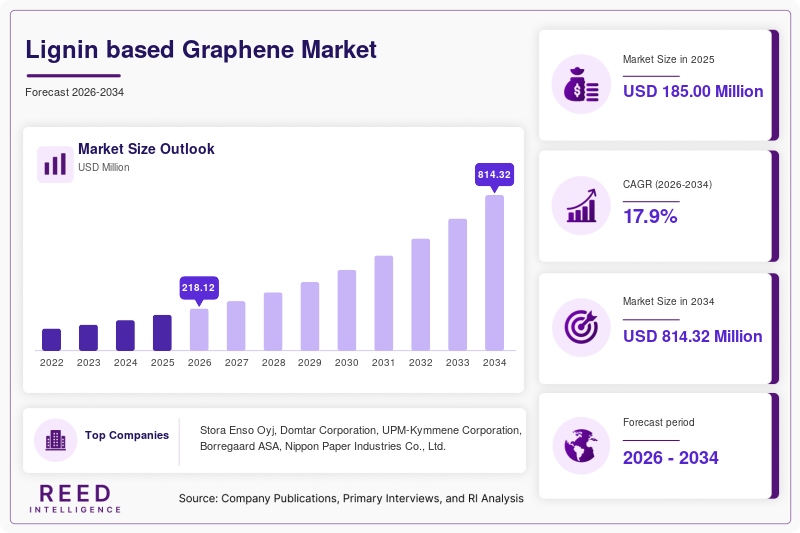
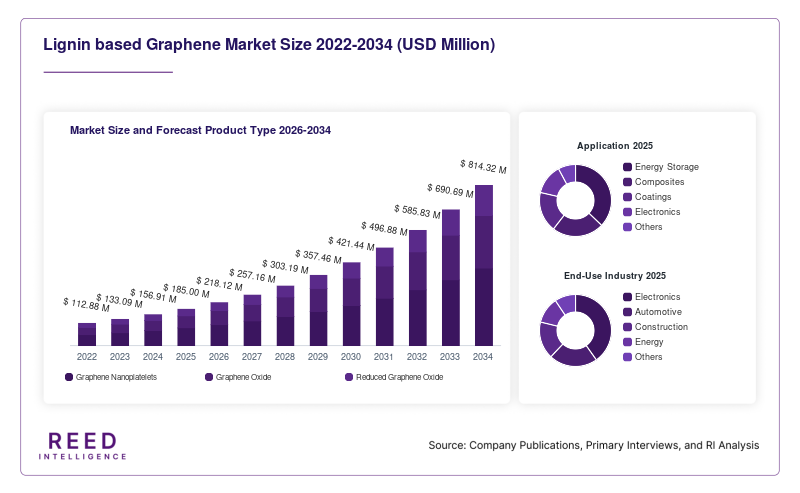
The global Lignin based Graphene Market size was valued at approximately USD 185 million in 2025 and is projected to reach USD 812 million by 2034, expanding at a CAGR of 17.9% during the forecast period (2025–2034). The market is gaining traction due to increasing demand for sustainable and bio-based alternatives to conventional graphene production methods. Lignin, a byproduct of the pulp and paper industry, offers a renewable and cost-effective precursor for graphene synthesis, making it an attractive material across multiple industrial applications.
A major global factor supporting market growth is the rising emphasis on carbon neutrality and circular economy initiatives. Governments and industries are increasingly focusing on reducing carbon footprints, which has accelerated the adoption of bio-derived advanced materials such as lignin-based graphene in sectors like energy storage, construction, and automotive.
Key Highlights:
- North America dominated the market with a 36.4% share in 2025, while Asia Pacific is expected to grow at the fastest CAGR of 19.8% through 2034.
- By application, energy storage was the leading subsegment with a 31.2% share in 2024, while composites is projected to grow at the fastest CAGR of 20.5%.
- The United States remained the dominant country, with market values of USD 58 million in 2024 and USD 66 million in 2025.
Market Trends
Increasing Integration in Energy Storage Systems
The integration of lignin-based graphene into advanced energy storage technologies has emerged as a prominent trend in the Lignin based Graphene Market. Manufacturers are leveraging its high conductivity, surface area, and eco-friendly profile to develop next-generation batteries and supercapacitors. This trend is particularly visible in lithium-ion battery innovation, where lignin-derived graphene is being explored to improve charge capacity and cycle life. As renewable energy adoption rises, the need for efficient storage solutions continues to drive this trend forward.
Expansion of Green Nanomaterials in Industrial Applications
Another notable trend is the growing demand for environmentally sustainable nanomaterials. Industries such as construction, coatings, and electronics are increasingly incorporating lignin-based graphene as a substitute for petroleum-derived materials. This shift is supported by regulatory pressure and consumer preference for green products. Companies are also investing in scalable production technologies to commercialize lignin-based graphene for large-scale industrial use, further shaping the market landscape.
Market Drivers
Growing Demand for Sustainable Advanced Materials
The global push toward sustainable manufacturing has significantly driven the Lignin based Graphene Market. Industries are actively seeking alternatives to fossil-based materials, and lignin-derived graphene offers a renewable, biodegradable, and cost-efficient solution. Its compatibility with green chemistry principles has made it a preferred material in research and industrial applications.
Advancements in Graphene Production Technologies
Technological advancements in graphene synthesis have enabled efficient conversion of lignin into high-quality graphene. Innovations such as pyrolysis and chemical activation have improved yield, scalability, and material performance. These advancements have lowered production costs and increased accessibility, encouraging wider adoption across various sectors.
Market Restraint
Limited Commercial Scalability and Standardization
One of the key challenges in the Lignin based Graphene Market is the limited scalability of production processes and lack of standardized quality parameters. While lignin is abundantly available, converting it into graphene with consistent properties remains technically complex. Variations in lignin composition based on source and extraction method can affect the quality of the final product.
Additionally, the absence of globally accepted standards for lignin-based graphene hinders its widespread commercialization. End-use industries often require precise material specifications, and inconsistencies can limit adoption. These factors collectively slow down the market’s growth potential despite strong demand for sustainable materials.
Market Opportunities
Emerging Applications in Flexible Electronics
The rising demand for flexible and wearable electronics presents a significant opportunity for the Lignin based Graphene Market. Due to its lightweight and conductive properties, lignin-based graphene is being explored for use in flexible circuits, sensors, and smart textiles. As the electronics industry continues to evolve toward miniaturization and flexibility, this application area is expected to expand rapidly.
Increasing Investments in Bio-based Material Research
Governments and private organizations are investing heavily in bio-based material research, creating new growth avenues for lignin-based graphene. Research institutions are focusing on enhancing material properties and discovering new applications, particularly in high-performance composites and environmental remediation. These investments are expected to accelerate innovation and open new commercial pathways in the coming years.
Segmental Analysis
By Application
The energy storage segment dominated the Lignin based Graphene Market, accounting for 31.2% of the market share in 2024. This dominance was attributed to the increasing use of lignin-based graphene in batteries and supercapacitors due to its excellent conductivity and environmental benefits.
The composites segment is projected to grow at the fastest CAGR of 20.5% through 2034, driven by rising demand for lightweight and high-strength materials. Lignin-based graphene enhances mechanical properties and durability, making it suitable for automotive and aerospace applications.
By Product Type
Graphene nanoplatelets derived from lignin held the largest share of 34.6% in 2024. Their widespread use in coatings and conductive materials contributed to their dominance.
Graphene oxide is expected to witness the fastest growth with a CAGR of 19.6%, owing to its versatility and ease of functionalization. It is increasingly used in water treatment and biomedical applications.
By End-Use Industry
The electronics industry dominated the market with a 28.9% share in 2024, driven by the material’s application in conductive films and components.
The automotive sector is anticipated to grow at the fastest CAGR of 20.1%, fueled by the need for lightweight and energy-efficient materials in electric vehicles.
By Production Method
The pyrolysis method accounted for the largest share of 39.3% in 2024, as it offers efficient conversion of lignin into graphene with desirable properties.
Chemical activation is expected to grow at a CAGR of 18.7%, driven by its ability to produce high-purity graphene suitable for specialized applications.
Regional Analysis
North America
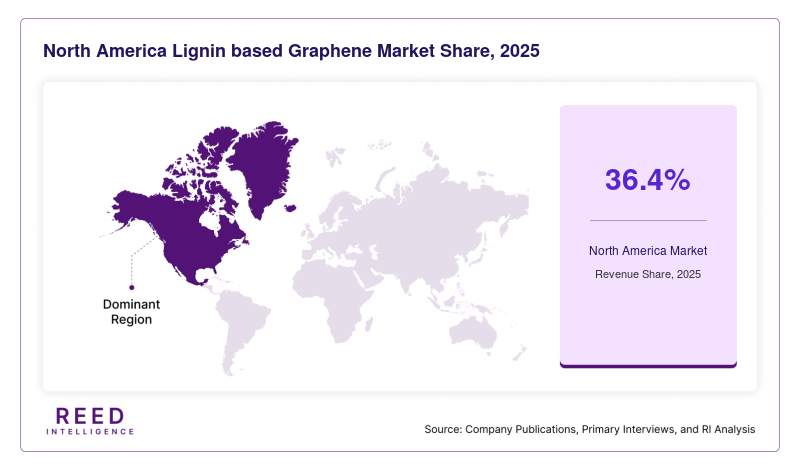
North America accounted for a 36.4% share of the Lignin based Graphene Market in 2025 and is projected to grow at a CAGR of 16.8% through 2034. The region’s growth trajectory will be supported by strong research infrastructure and the presence of advanced material manufacturers.
The United States dominated the regional market due to its well-established pulp and paper industry, which ensures a steady supply of lignin. Additionally, collaborations between research institutions and private companies have accelerated the development of lignin-based graphene technologies, strengthening the country’s market position.
Europe
Europe held approximately 27.1% of the market share in 2025 and is expected to expand at a CAGR of 17.2% during the forecast period. The region’s growth will be driven by stringent environmental regulations promoting the use of sustainable materials.
Germany emerged as the leading country, supported by its strong industrial base and emphasis on green innovation. The country’s focus on reducing carbon emissions has encouraged the adoption of lignin-based graphene in automotive and construction applications.
Asia Pacific
Asia Pacific represented 22.6% of the market in 2025 and is anticipated to grow at the fastest CAGR of 19.8% through 2034. Rapid industrialization and increasing investments in advanced materials will drive regional growth.
China dominated the region due to its large-scale manufacturing capabilities and growing focus on renewable materials. The country’s expanding electronics and energy sectors have created significant demand for lignin-based graphene.
Middle East & Africa
The Middle East & Africa accounted for 7.2% of the market share in 2025 and is projected to grow at a CAGR of 15.9%. The region’s growth will be supported by increasing diversification efforts away from oil-based economies.
The United Arab Emirates led the market, driven by investments in sustainable technologies and infrastructure development. The country’s focus on innovation has facilitated the adoption of advanced materials, including lignin-based graphene.
Latin America
Latin America held 6.7% of the market share in 2025 and is expected to grow at a CAGR of 16.3% during the forecast period. The region’s growth will be influenced by expanding industrial activities and availability of biomass resources.
Brazil dominated the regional market due to its strong pulp and paper industry, which provides a consistent supply of lignin. The country’s focus on sustainable material development has further boosted market growth.
Competitive Landscape
The Lignin based Graphene Market is characterized by the presence of several emerging and established players focusing on innovation and strategic collaborations. Companies are investing in research and development to improve production efficiency and material performance.
The market leader, Stora Enso Oyj, has strengthened its position through continuous advancements in lignin-based materials and partnerships with technology firms. The company recently introduced a new lignin-derived graphene product aimed at energy storage applications, enhancing its competitive edge.
Other key players are focusing on expanding their product portfolios and geographic presence to capture market opportunities. The competitive environment remains dynamic, with innovation and sustainability acting as key differentiators.
Key Players
- Stora Enso Oyj
- Domtar Corporation
- UPM-Kymmene Corporation
- Borregaard ASA
- Nippon Paper Industries Co., Ltd.
- Sappi Limited
- American Process Inc.
- Ingevity Corporation
- WestRock Company
- Suzano S.A.
Recent Developments
- In 2024, Stora Enso Oyj launched a new lignin-based graphene solution targeting battery manufacturers.
- In 2023, UPM-Kymmene Corporation expanded its bio-material research facility to enhance graphene production capabilities.
- In 2024, Borregaard ASA partnered with a technology firm to develop scalable lignin-to-graphene conversion processes.
- In 2025, Sappi Limited announced investments in sustainable nanomaterial production technologies.
- In 2023, Domtar Corporation initiated pilot projects for lignin-based graphene applications in composites.
Lignin based Graphene Market Segments
Product Type
- Graphene Nanoplatelets
- Graphene Oxide
- Reduced Graphene Oxide
Application
- Energy Storage
- Composites
- Coatings
- Electronics
- Others
End-Use Industry
- Electronics
- Automotive
- Construction
- Energy
- Others
Production Method
- Pyrolysis
- Chemical Activation
- Hydrothermal Processing
By Region
- North America
- Europe
- APAC
- Middle East and Africa
- LATAM