Lignosulfonate Market Size, Share Demand Report By Type (Calcium Lignosulfonate, Sodium Lignosulfonate, Magnesium Lignosulfonate, Others), By Application (Concrete Admixtures, Animal Feed Binders, Oil Well Additives, Agriculture Chemicals, Others), By End-Use Industry (Construction, Agriculture, Oil & Gas, Ceramics, Others), By Region & Segment Forecasts, 2026–2034
USD 3950
Market Overview
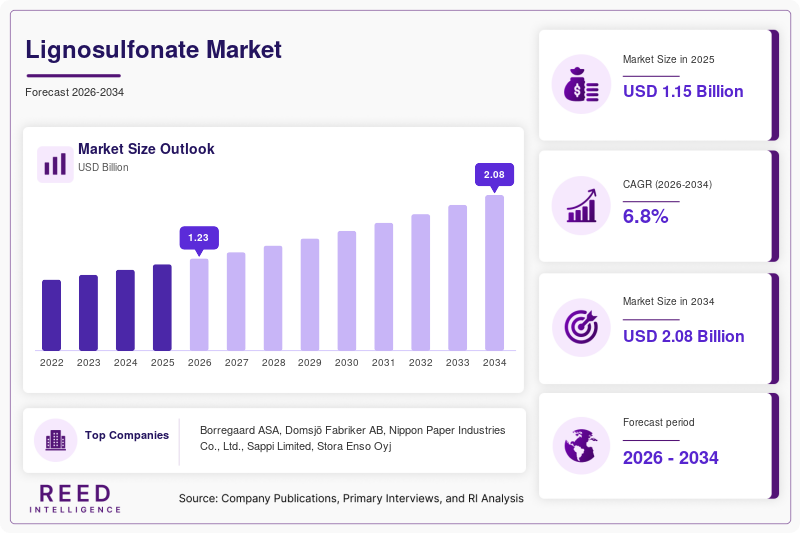
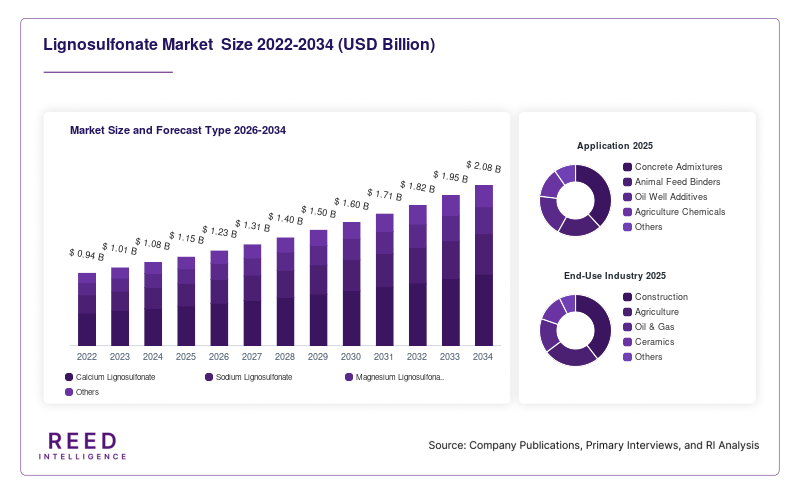
The global Lignosulfonate Market was valued at approximately USD 1.15 billion in 2026 and is projected to reach USD 1.95 billion by 2034, expanding at a CAGR of 6.8% during the forecast period (2026–2034). Lignosulfonates, derived from sulfite pulping processes, are widely used as dispersants, binders, and emulsifiers across multiple industries such as construction, agriculture, oil & gas, and animal feed. Their cost-effectiveness and biodegradable nature have positioned them as a viable alternative to synthetic chemicals, especially in sustainability-driven applications.
One of the major global factors supporting market growth is the rising emphasis on eco-friendly and renewable materials across industries. Regulatory pressure on reducing chemical emissions and carbon footprints has encouraged manufacturers to adopt lignin-based derivatives such as lignosulfonates. This shift is particularly evident in construction admixtures and agricultural formulations, where performance efficiency aligns with environmental goals.
Key Highlights
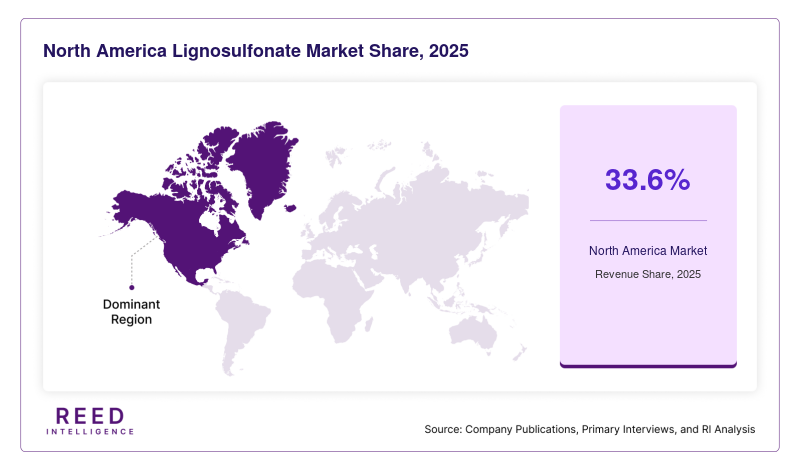
- North America dominated the market with a 33.6% share in 2025.
- Asia Pacific is expected to grow at the fastest CAGR of 7.9% during 2026–2034.
- By type, calcium lignosulfonate accounted for the largest share of 42.3%, while sodium lignosulfonate is projected to grow at a CAGR of 7.5%.
- By application, concrete admixtures led with a 39.8% share, whereas animal feed binders are expected to expand at a CAGR of 7.2%.
- China remained the dominant country, with market values of USD 210 million in 2024 and USD 235 million in 2025.
Market Trends
Rising Adoption in Sustainable Construction Materials
The increasing adoption of lignosulfonates in sustainable construction materials is shaping the market trajectory. These compounds act as effective plasticizers and water reducers in concrete, improving workability while lowering cement consumption. With construction companies focusing on reducing carbon emissions, lignosulfonates are gaining traction as a natural alternative to synthetic additives. Infrastructure expansion across emerging economies has further supported this trend, particularly in green building projects. Governments are promoting sustainable construction through incentives and regulations, driving the inclusion of lignosulfonate-based admixtures. Additionally, advancements in formulation technologies have improved performance consistency, making these materials suitable for high-performance concrete applications. This trend is expected to remain strong as environmental compliance becomes a core requirement in construction practices.
Expansion in Agricultural and Animal Feed Applications
Another key trend is the expanding use of lignosulfonates in agriculture and animal nutrition. In agriculture, lignosulfonates function as dispersants in pesticide formulations and micronutrient carriers, enhancing product stability and effectiveness. In animal feed, they act as binding agents that improve pellet durability and reduce feed wastage. The growing global demand for high-quality feed and efficient farming practices has increased reliance on such additives. Furthermore, the push for sustainable farming methods has encouraged the use of biodegradable and non-toxic ingredients. Technological innovations in feed processing and crop protection formulations are also enhancing the applicability of lignosulfonates. This trend is particularly noticeable in regions with large agricultural bases, where productivity and sustainability are key priorities.
Market Drivers
Growing Demand for Cost-Effective Industrial Additives
The increasing need for cost-effective additives across industries is a major driver of the lignosulfonate market. Industries such as construction, oil & gas, and ceramics rely on additives that can enhance performance without significantly increasing costs. Lignosulfonates offer a balance between efficiency and affordability, making them an attractive option. Their ability to function as dispersants and binders reduces material consumption and improves operational efficiency. For instance, in drilling fluids, lignosulfonates help stabilize mud systems while minimizing environmental impact. The growing focus on operational cost optimization has further accelerated their adoption. Additionally, their compatibility with various formulations allows manufacturers to use them in multiple applications, increasing their commercial appeal.
Increasing Focus on Renewable and Bio-Based Materials
The shift toward renewable and bio-based materials is another significant driver for the market. As industries move away from petroleum-based chemicals, lignosulfonates provide a sustainable alternative derived from wood processing. Environmental regulations aimed at reducing emissions and promoting circular economy practices have encouraged manufacturers to adopt such materials. The pulp and paper industry, which generates lignosulfonates as a by-product, benefits from this trend by creating additional revenue streams. Moreover, consumer awareness regarding environmentally friendly products has influenced purchasing decisions across sectors. This has led to increased demand for eco-friendly additives in construction, agriculture, and manufacturing. The alignment of lignosulfonates with sustainability goals is expected to drive consistent market growth.
Market Restraints
Variability in Raw Material Quality and Performance Limitations
A key restraint affecting the lignosulfonate market is the variability in raw material quality, which impacts product performance. Since lignosulfonates are derived from different wood sources and pulping processes, their chemical composition can vary significantly. This inconsistency can affect their efficiency as dispersants or binders, making it challenging for manufacturers to maintain uniform product standards. In high-performance applications, such as advanced construction materials or specialized industrial formulations, this variability can limit adoption. For example, inconsistent performance in concrete admixtures may lead to reduced strength or workability, affecting project outcomes. Additionally, competition from synthetic alternatives with more predictable properties further restricts market growth. Addressing these challenges requires advanced processing technologies and stringent quality control measures, which may increase production costs and limit scalability.
Market Opportunities
Growth in Emerging Economies and Infrastructure Development
Emerging economies present significant growth opportunities for the lignosulfonate market, particularly due to rapid infrastructure development. Countries in Asia Pacific, Latin America, and parts of Africa are investing heavily in construction projects, including roads, bridges, and urban infrastructure. This has increased demand for concrete admixtures, where lignosulfonates play a crucial role. The affordability and availability of these materials make them suitable for large-scale projects in cost-sensitive markets. Additionally, government initiatives aimed at improving infrastructure quality have encouraged the use of advanced additives. The expansion of construction activities in these regions is expected to create sustained demand for lignosulfonates. Furthermore, local production capabilities are improving, reducing dependency on imports and enhancing market accessibility.
Advancements in Product Customization and High-Performance Applications
Technological advancements in product customization are opening new avenues for lignosulfonate applications. Manufacturers are developing modified lignosulfonates with improved properties such as enhanced dispersion, thermal stability, and compatibility with complex formulations. These innovations enable their use in high-performance applications, including specialty chemicals, advanced ceramics, and oilfield services. The ability to tailor products according to specific industry requirements increases their value proposition. Additionally, research and development efforts are focused on improving consistency and efficiency, addressing existing limitations. The growing demand for customized solutions across industries is expected to drive innovation and expand the application scope of lignosulfonates. This presents a strong opportunity for market players to differentiate their offerings and capture new segments.
Segmental Analysis
By Type
Calcium lignosulfonate dominated the market in 2024, accounting for approximately 42.3% of the total share. This dominance is attributed to its widespread use in construction and industrial applications due to its cost-effectiveness and reliable performance. It is commonly used as a plasticizer in concrete and as a binder in various industrial processes. Its availability and compatibility with different formulations have made it a preferred choice among manufacturers.
Sodium lignosulfonate is expected to be the fastest-growing subsegment, with a projected CAGR of 7.5%. Its superior dispersing properties and higher solubility make it suitable for applications such as dyes, ceramics, and oil drilling fluids. The increasing demand for high-performance additives is driving the growth of this subsegment.
By Application
Concrete admixtures accounted for the largest share of 39.8% in 2024. The use of lignosulfonates in construction improves workability and reduces water content, enhancing the overall quality of concrete. This has made them a key component in infrastructure projects.
Animal feed binders are projected to grow at a CAGR of 7.2%. The rising demand for high-quality feed and efficient livestock production is driving this growth. Lignosulfonates improve pellet durability, reducing feed wastage and increasing efficiency.
By End-Use Industry
The construction industry held the largest share in 2024, driven by extensive infrastructure development activities worldwide. Lignosulfonates are widely used in cement and concrete formulations, supporting their dominance in this segment.
The agriculture industry is expected to grow at the fastest CAGR of 7.4%. The increasing adoption of sustainable farming practices and the need for efficient crop protection solutions are key factors driving growth in this segment.
Regional Analysis
North America
North America accounted for approximately 33.6% of the lignosulfonate market share in 2025 and is projected to grow at a CAGR of 6.1% during the forecast period. The region benefits from a well-established construction industry and increasing adoption of sustainable materials. Demand for lignosulfonates in oilfield applications also contributes to market growth, supported by ongoing exploration activities.
The United States remains the dominant country in this region, driven by strong demand for eco-friendly construction additives. A key growth factor is the increasing adoption of green building standards, which encourage the use of biodegradable materials in construction processes.
Europe
Europe held around 27.4% of the market share in 2025 and is expected to grow at a CAGR of 6.3%. The region’s strict environmental regulations have accelerated the shift toward bio-based chemicals, including lignosulfonates. Industries are focusing on reducing carbon emissions, which supports market expansion.
Germany leads the European market, supported by advanced manufacturing capabilities and strong environmental policies. A unique growth factor is the integration of lignosulfonates in industrial applications aimed at achieving sustainability targets set by regulatory authorities.
Asia Pacific
Asia Pacific accounted for 25.8% of the market share in 2025 and is projected to register the fastest CAGR of 7.9%. Rapid urbanization and infrastructure development in countries such as China and India are driving demand for construction additives.
China dominates the regional market, with significant investments in infrastructure projects. A key growth factor is the large-scale production of pulp and paper, which ensures a steady supply of lignosulfonates for various applications.
Middle East & Africa
The Middle East & Africa region held a 7.2% market share in 2025 and is expected to grow at a CAGR of 6.5%. The region’s construction and oil & gas industries are major consumers of lignosulfonates, particularly in drilling fluids and cement additives.
Saudi Arabia is the leading country, supported by ongoing infrastructure projects and energy sector investments. A unique growth factor is the increasing focus on diversifying economies, which includes adopting sustainable industrial materials.
Latin America
Latin America accounted for 6.0% of the market share in 2025 and is projected to grow at a CAGR of 6.7%. The region’s agricultural sector drives demand for lignosulfonates in fertilizers and pesticides.
Brazil leads the market, supported by its large agricultural base. A key growth factor is the rising adoption of advanced farming techniques that require efficient and eco-friendly additives.
Competitive Landscape
The lignosulfonate market is moderately fragmented, with several global and regional players competing based on product quality, pricing, and innovation. Companies are focusing on expanding their product portfolios and enhancing production capacities to meet growing demand. Strategic partnerships and acquisitions are also common, aimed at strengthening market presence.
Borregaard ASA is considered a leading player in the market, known for its extensive range of lignin-based products. A recent development includes the expansion of its production facility to increase capacity and improve product quality. Other companies are investing in research and development to create customized solutions for specific applications, further intensifying competition.
Key Players List
- Borregaard ASA
- Domsjö Fabriker AB
- Nippon Paper Industries Co., Ltd.
- Sappi Limited
- Stora Enso Oyj
- WestRock Company
- Rayonier Advanced Materials Inc.
- Green Agrochem
- LignoTech Florida LLC
- Tembec Inc.
- Shenyang Xingzhenghe Chemical Co., Ltd.
- Hubei Aging Chemical Co., Ltd.
- Wuhan Eastin Chemical Co., Ltd.
- American International Forest Products LLC
- MudKing Products Inc.
Recent Developments
- Borregaard ASA expanded its lignosulfonate production capacity to meet rising global demand.
- Sappi Limited introduced a new range of high-performance lignosulfonates for industrial applications.
- Stora Enso Oyj invested in research to enhance the consistency and quality of lignin-based products.
Lignosulfonate Market Segments
Type
- Calcium Lignosulfonate
- Sodium Lignosulfonate
- Magnesium Lignosulfonate
- Others
Application
- Concrete Admixtures
- Animal Feed Binders
- Oil Well Additives
- Agriculture Chemicals
- Others
End-Use Industry
- Construction
- Agriculture
- Oil & Gas
- Ceramics
- Others
By Region
- North America
- Europe
- APAC
- Middle East and Africa
- LATAM