Liquid Foundation Market Size, Share, Demand Report By Product Type (Matte Liquid Foundation, Dewy Liquid Foundation, Serum-Based Liquid Foundation, Full-Coverage Liquid Foundation, Lightweight Liquid Foundation), By Skin Type (Oily Skin, Dry Skin, Combination Skin, Sensitive Skin, Normal Skin), By Distribution Channel (Offline Retail, Online Retail), By Region & Segment Forecasts, 2026–2034
USD 3950
Market Overview
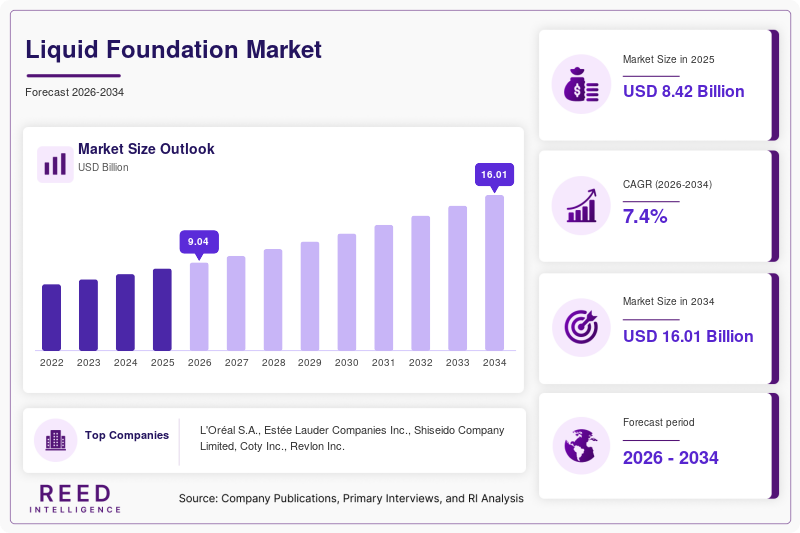
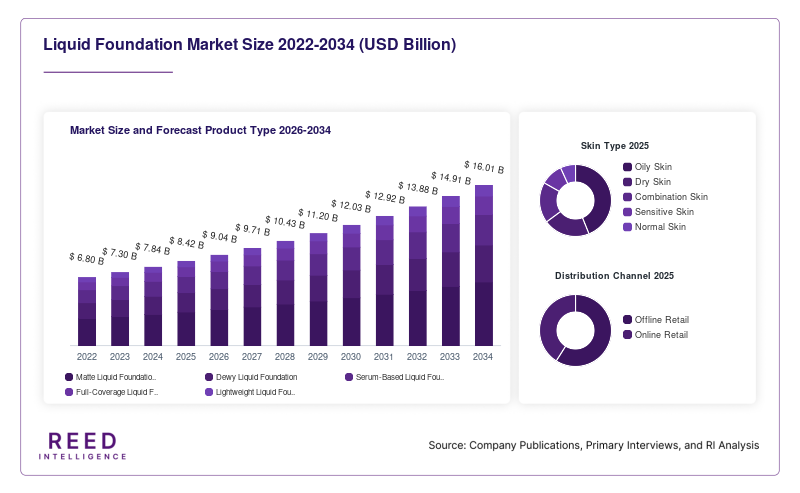
The global Liquid Foundation Market size was valued at USD 8.42 billion in 2026 and is projected to reach USD 14.96 billion by 2034, expanding at a CAGR of 7.4% during the forecast period from 2026 to 2034. The market continues to witness steady expansion due to rising consumer spending on premium beauty products, increasing product personalization, and wider adoption of skincare-infused cosmetic formulations. Consumers across developed and emerging economies are increasingly preferring multifunctional beauty products that combine coverage, hydration, sun protection, and anti-aging properties within a single formulation. This shift has encouraged manufacturers to invest in lightweight, long-lasting, and dermatologically tested liquid foundations that cater to varying skin tones and climatic conditions.
The growing influence of digital beauty campaigns and social media-driven purchasing behavior has also contributed to the expansion of the Liquid Foundation Market. Beauty influencers, virtual try-on applications, and online product reviews have accelerated consumer awareness and encouraged experimentation with premium cosmetic products. In addition, expanding e-commerce penetration and direct-to-consumer beauty brands have improved product accessibility in urban as well as semi-urban markets. Increasing disposable income among working women and younger consumers further supports long-term market growth.
Key Highlights
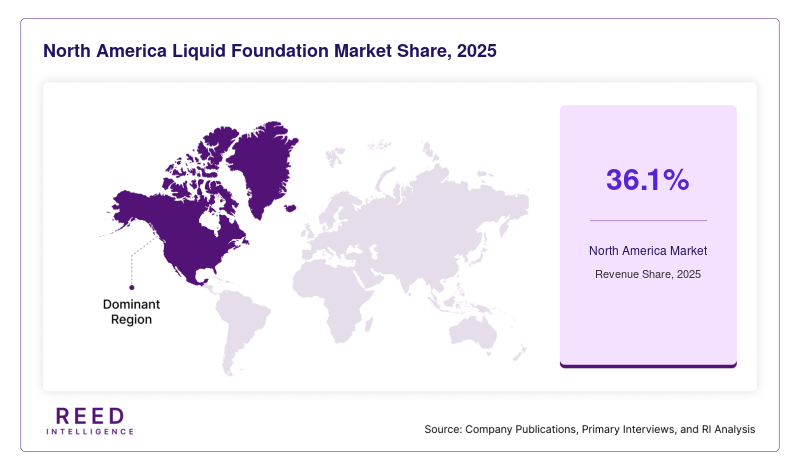
- North America dominated the market with a 36.1% share in 2025.
- Asia Pacific is expected to grow at the fastest CAGR of 9.6% during 2026–2034.
- By product type, matte liquid foundation accounted for the largest share of 39.4%, while serum-based liquid foundation is projected to grow at a CAGR of 10.3%.
- By skin type, combination skin applications led with a 34.8% share, whereas sensitive skin formulations are expected to expand at a CAGR of 9.8%.
- The United States remained the dominant country, with market values of USD 1.84 billion in 2024 and USD 1.97 billion in 2025.
Market Trends
Rise of Skincare-Infused Cosmetic Formulations
The Liquid Foundation Market is witnessing a growing preference for hybrid beauty products that combine skincare ingredients with makeup functionality. Consumers increasingly seek products containing hyaluronic acid, niacinamide, vitamin C, and SPF protection, as these formulations provide cosmetic coverage while supporting long-term skin health. Beauty brands are focusing on lightweight and breathable textures that reduce pore blockage and improve hydration retention. This trend is particularly visible among millennials and Gen Z consumers who prioritize clean-label and skin-friendly cosmetic products. As dermatological awareness increases globally, companies are introducing foundations free from parabens, fragrances, and alcohol-based irritants. The integration of skincare benefits into liquid foundations has strengthened premium product demand and increased average product value across online and offline retail channels.
Expansion of Inclusive Shade Ranges and Personalized Beauty
Beauty companies are increasingly expanding shade diversity and customization capabilities to address broader consumer demographics. The demand for inclusive beauty products has encouraged manufacturers to launch liquid foundations in wider shade spectrums that match varying undertones and skin textures. Artificial intelligence-based shade matching tools and virtual makeup try-on technologies are improving customer engagement and reducing product return rates in e-commerce channels. Several cosmetic brands are also launching region-specific product formulations to suit humidity levels, temperature variations, and local skin concerns. This personalization trend has become a major differentiating factor within the Liquid Foundation Market. Companies that provide customized beauty experiences are gaining stronger customer loyalty, particularly in rapidly developing markets across Asia Pacific and Latin America.
Market Drivers
Growth in Global Beauty and Personal Care Spending
Rising global expenditure on beauty and personal care products continues to support the expansion of the Liquid Foundation Market. Increasing urbanization, higher disposable income, and changing grooming habits have significantly influenced cosmetic purchasing patterns among consumers. Working professionals and younger demographics are spending more on appearance-enhancing products that offer convenience and long-lasting performance. Liquid foundation products have gained popularity because they provide smoother application, improved skin blending, and extended wear compared to traditional powder formulations. Additionally, premium beauty brands are strengthening their global presence through digital commerce and influencer partnerships. The increasing availability of mid-range and luxury liquid foundation products across supermarkets, specialty stores, and online platforms has widened consumer access and improved overall market penetration.
Increasing Demand for Long-Wear and Climate-Resistant Products
Consumer preference for durable and weather-resistant cosmetic products is another important growth driver for the Liquid Foundation Market. Rising temperatures, humidity fluctuations, and busy lifestyles have increased demand for sweat-resistant and transfer-proof makeup products. Manufacturers are responding by introducing advanced formulations with oil-control technology, hydration-lock ingredients, and lightweight textures suitable for extended daily use. Consumers in tropical and high-humidity regions particularly favor foundations that maintain coverage without frequent reapplication. Product innovation related to waterproof formulations and non-comedogenic ingredients is also contributing to higher sales volumes. Moreover, beauty brands are investing in research activities to create foundations compatible with diverse skin conditions, helping improve customer satisfaction and repeat purchasing behavior.
Market Restraint
Concerns Related to Skin Sensitivity and Chemical Ingredients
Despite strong demand growth, the Liquid Foundation Market faces challenges associated with increasing consumer concerns regarding chemical-based cosmetic formulations. Many conventional liquid foundations contain synthetic preservatives, silicones, artificial fragrances, and oil-based ingredients that may trigger skin irritation, acne, or allergic reactions among sensitive users. As consumers become more informed about ingredient safety through digital platforms and dermatological content, scrutiny surrounding cosmetic transparency has intensified. Regulatory authorities across Europe and North America are also implementing stricter labeling and ingredient compliance standards, increasing manufacturing and testing costs for cosmetic companies. Smaller brands often face difficulties in reformulating products while maintaining affordability and product performance. In addition, negative social media reviews regarding skin reactions can significantly impact brand reputation and consumer trust. These concerns are encouraging a gradual shift toward organic, vegan, and clean-label cosmetic alternatives, creating competitive pressure for traditional liquid foundation manufacturers.
Market Opportunities
Expansion of Vegan and Clean Beauty Product Lines
The growing consumer preference for sustainable and ethical beauty products presents substantial opportunities within the Liquid Foundation Market. Demand for vegan, cruelty-free, and environmentally responsible cosmetic products is increasing rapidly among younger consumers. Beauty brands are investing in plant-based ingredients, biodegradable packaging, and refillable product formats to align with sustainability expectations. Clean beauty positioning has become an important purchasing factor, particularly in developed economies where ingredient transparency strongly influences consumer decisions. Companies that successfully combine sustainable practices with high-performance formulations are expected to strengthen their market position. The expansion of certified organic liquid foundations and eco-friendly production methods is likely to create long-term growth opportunities across premium and mid-tier cosmetic segments.
Rapid Growth of Digital and Direct-to-Consumer Retail Channels
The increasing adoption of digital commerce platforms offers major opportunities for companies operating in the Liquid Foundation Market. Online beauty retailing enables brands to reach broader audiences while reducing dependency on physical distribution networks. Direct-to-consumer business models allow cosmetic manufacturers to collect customer insights, personalize product recommendations, and launch targeted promotional campaigns. Virtual makeup applications, augmented reality beauty tools, and AI-driven shade selection systems are improving customer confidence during online purchases. Social commerce integration through short-video platforms and influencer marketing is also accelerating product visibility among younger consumers. Emerging markets with expanding smartphone penetration and internet accessibility are expected to create strong future demand for online liquid foundation sales, supporting market expansion during the forecast period.
Segmental Analysis
By Product Type
Matte liquid foundation emerged as the dominant subsegment within the Liquid Foundation Market, accounting for 39.4% of the market share in 2024. Consumers widely prefer matte formulations because they provide oil control, long-lasting coverage, and a smooth finish suitable for daily wear. Demand is particularly strong among consumers with oily and combination skin types who seek transfer-resistant and shine-free cosmetic products. Beauty brands continue introducing lightweight matte formulations that prevent dryness while maintaining durability under varying climatic conditions. The growing popularity of professional makeup tutorials and social media beauty trends has further increased consumer interest in matte foundations. In addition, the availability of matte products across luxury and affordable price categories supports strong sales performance globally.
Serum-based liquid foundation is projected to register the fastest CAGR of 10.3% during the forecast period. This subsegment is gaining traction because consumers increasingly prefer skincare-oriented cosmetic products that offer hydration and skin nourishment alongside coverage. Serum foundations typically contain vitamins, antioxidants, and moisturizing ingredients that support healthier skin appearance while providing lightweight texture and natural finish. Demand is rising among mature consumers and individuals with dry or sensitive skin conditions. Cosmetic manufacturers are focusing on advanced formulations with anti-aging and SPF properties to differentiate products within competitive retail environments. The integration of clean-label ingredients and non-comedogenic formulations is expected to further strengthen growth opportunities for serum-based foundations during the coming years.
By Skin Type
Combination skin applications accounted for the largest share of the Liquid Foundation Market in 2024, representing approximately 34.8% of global revenue. Consumers with combination skin require products that effectively balance oil control in specific facial areas while maintaining hydration across dry regions. Cosmetic manufacturers are responding by developing adaptable formulations with breathable textures and balanced moisture technology. Products designed for combination skin often include lightweight ingredients that minimize cakiness while supporting longer wear duration. The increasing prevalence of climate-related skin concerns and changing skincare routines has further boosted demand for foundations suitable for mixed skin conditions. Additionally, beauty brands are expanding shade availability and finish options within this category to improve customer satisfaction and repeat purchasing behavior.
Sensitive skin formulations are anticipated to witness the fastest CAGR of 9.8% during the forecast period due to increasing consumer awareness regarding ingredient safety and skin health. Consumers with reactive or allergy-prone skin increasingly seek fragrance-free, hypoallergenic, and dermatologist-tested liquid foundations. Beauty companies are investing heavily in research and development activities to create formulations free from common irritants such as parabens, sulfates, and artificial fragrances. The expansion of clean beauty trends and rising dermatologist recommendations have significantly contributed to demand growth within this subsegment. In addition, increasing social media discussions related to skin sensitivity and cosmetic safety continue influencing purchasing decisions among health-conscious consumers globally.
By Distribution Channel
Offline retail channels dominated the Liquid Foundation Market in 2024 and accounted for the largest revenue share globally. Supermarkets, specialty beauty stores, department stores, and cosmetic retail chains remain important purchasing destinations because consumers prefer physically testing product texture, finish, and shade compatibility before purchase. Beauty advisors and in-store consultation services continue to influence customer purchasing decisions, particularly for premium cosmetic products. Offline retail outlets also support impulse purchases and provide promotional bundles that improve product visibility. Several cosmetic brands are investing in experiential retail environments and beauty kiosks to strengthen customer engagement. The expansion of organized retail infrastructure across developing economies has further supported growth in offline liquid foundation sales.
Online distribution channels are expected to register the fastest CAGR of 11.1% during the forecast period. E-commerce growth is driven by increasing smartphone usage, digital payment adoption, and expanding social commerce platforms. Consumers increasingly purchase liquid foundations online because of convenience, broader product availability, and competitive pricing strategies. Virtual try-on technologies and artificial intelligence-based shade recommendations are reducing uncertainty associated with online cosmetic shopping. Beauty influencers and social media campaigns are also contributing significantly to online product visibility and customer acquisition. In emerging economies, rapid internet penetration and improved logistics infrastructure are expected to accelerate online sales growth. Direct-to-consumer cosmetic brands are particularly benefiting from digital retail expansion and personalized marketing capabilities.
Regional Analysis
North America
North America accounted for 36.1% of the global Liquid Foundation Market share in 2025 and is expected to maintain a stable growth trajectory during the forecast period. The regional market is projected to expand at a CAGR of 6.8% from 2026 to 2034 due to strong consumer spending on premium cosmetics and increasing adoption of multifunctional beauty products. The presence of established beauty brands, extensive retail infrastructure, and advanced e-commerce penetration continues to support market growth. Consumers in the region increasingly prefer long-lasting and dermatologist-tested formulations with skincare benefits.
The United States represents the dominant country within the North American Liquid Foundation Market. One significant growth factor is the rising consumer preference for personalized beauty products supported by artificial intelligence and virtual shade-matching technologies. Cosmetic companies in the country are heavily investing in product innovation and influencer-driven digital campaigns. The growing demand for vegan and cruelty-free makeup products has also encouraged manufacturers to launch cleaner formulations targeting environmentally conscious consumers across urban markets.
Europe
Europe held a significant share of the Liquid Foundation Market in 2025 and is anticipated to grow at a CAGR of 6.5% during the forecast period. The market benefits from high consumer awareness regarding premium beauty products and ingredient transparency. European consumers increasingly seek organic and skin-friendly cosmetic formulations that comply with stringent regional safety regulations. Beauty brands operating in the region are focusing on sustainable packaging and eco-conscious production practices to strengthen their market presence. The expansion of specialty cosmetic retail chains has further improved product accessibility.
Germany remains the leading country in the European Liquid Foundation Market due to strong purchasing power and rising demand for dermatologically tested cosmetics. A major growth factor supporting the market is the increasing popularity of clean beauty products formulated without harsh synthetic ingredients. Consumers in Germany actively prefer products with certified organic ingredients and environmentally responsible packaging. In addition, local and international beauty brands continue expanding their online retail presence to attract younger demographics seeking personalized cosmetic solutions.
Asia Pacific
Asia Pacific is projected to register the fastest CAGR of 9.6% in the global Liquid Foundation Market from 2026 to 2034. The region benefits from rapid urbanization, rising disposable income, and increasing beauty consciousness among younger consumers. Countries across the region are witnessing strong growth in digital beauty commerce and influencer-driven cosmetic marketing. The growing popularity of K-beauty and J-beauty trends has encouraged demand for lightweight and hydration-focused liquid foundations. Expanding middle-class populations and improving retail infrastructure continue to strengthen regional market growth.
China dominates the Asia Pacific Liquid Foundation Market due to its large consumer base and rapidly growing online beauty sector. One unique growth factor is the increasing use of livestream commerce and social media beauty platforms that directly influence purchasing behavior. Domestic and international cosmetic brands are leveraging digital channels to introduce innovative products and customized shade ranges. In addition, increasing demand for sun-protection and skincare-integrated cosmetics among urban consumers is contributing to sustained market expansion in the country.
Middle East & Africa
The Middle East & Africa region is experiencing moderate growth within the Liquid Foundation Market and is expected to expand at a CAGR of 6.9% during the forecast period. Rising beauty awareness, increasing female workforce participation, and growing retail modernization are supporting cosmetic product demand across the region. Consumers increasingly prefer premium and long-lasting makeup products suitable for warm climatic conditions. International beauty brands are expanding their regional distribution networks through partnerships with specialty cosmetic retailers and online platforms to improve product availability.
Saudi Arabia remains the dominant country within the regional market due to rising beauty expenditure and growing social media influence on cosmetic trends. A major growth factor is the increasing demand for high-coverage and humidity-resistant liquid foundations designed for extreme weather conditions. Beauty retailers in the country are expanding luxury cosmetic portfolios and strengthening omnichannel sales strategies. The growing popularity of beauty influencers and online tutorials is also encouraging product experimentation among younger consumers.
Latin America
Latin America accounted for a notable share of the global Liquid Foundation Market in 2025 and is forecast to grow at a CAGR of 7.1% during 2026–2034. The market is supported by increasing urbanization and expanding awareness regarding premium beauty products. Consumers across the region are increasingly investing in cosmetics that offer long-lasting coverage and hydration benefits. The growing influence of social media beauty content and celebrity endorsements has further accelerated product demand. Retail expansion by international cosmetic companies is improving product accessibility across metropolitan areas.
Brazil represents the leading country in the Latin American Liquid Foundation Market. One important growth factor is the strong regional preference for beauty and personal care products among younger consumers. The country has a highly active beauty retail environment supported by direct selling networks and expanding e-commerce penetration. Cosmetic companies are increasingly launching tropical climate-friendly formulations with oil-control and sweat-resistant properties to address local consumer requirements and climatic conditions.
Regional Analysis
North America
North America accounted for 36.1% of the global Liquid Foundation Market share in 2025 and is expected to maintain a stable growth trajectory during the forecast period. The regional market is projected to expand at a CAGR of 6.8% from 2026 to 2034 due to strong consumer spending on premium cosmetics and increasing adoption of multifunctional beauty products. The presence of established beauty brands, extensive retail infrastructure, and advanced e-commerce penetration continues to support market growth. Consumers in the region increasingly prefer long-lasting and dermatologist-tested formulations with skincare benefits.
The United States represents the dominant country within the North American Liquid Foundation Market. One significant growth factor is the rising consumer preference for personalized beauty products supported by artificial intelligence and virtual shade-matching technologies. Cosmetic companies in the country are heavily investing in product innovation and influencer-driven digital campaigns. The growing demand for vegan and cruelty-free makeup products has also encouraged manufacturers to launch cleaner formulations targeting environmentally conscious consumers across urban markets.
Europe
Europe held a significant share of the Liquid Foundation Market in 2025 and is anticipated to grow at a CAGR of 6.5% during the forecast period. The market benefits from high consumer awareness regarding premium beauty products and ingredient transparency. European consumers increasingly seek organic and skin-friendly cosmetic formulations that comply with stringent regional safety regulations. Beauty brands operating in the region are focusing on sustainable packaging and eco-conscious production practices to strengthen their market presence. The expansion of specialty cosmetic retail chains has further improved product accessibility.
Germany remains the leading country in the European Liquid Foundation Market due to strong purchasing power and rising demand for dermatologically tested cosmetics. A major growth factor supporting the market is the increasing popularity of clean beauty products formulated without harsh synthetic ingredients. Consumers in Germany actively prefer products with certified organic ingredients and environmentally responsible packaging. In addition, local and international beauty brands continue expanding their online retail presence to attract younger demographics seeking personalized cosmetic solutions.
Asia Pacific
Asia Pacific is projected to register the fastest CAGR of 9.6% in the global Liquid Foundation Market from 2026 to 2034. The region benefits from rapid urbanization, rising disposable income, and increasing beauty consciousness among younger consumers. Countries across the region are witnessing strong growth in digital beauty commerce and influencer-driven cosmetic marketing. The growing popularity of K-beauty and J-beauty trends has encouraged demand for lightweight and hydration-focused liquid foundations. Expanding middle-class populations and improving retail infrastructure continue to strengthen regional market growth.
China dominates the Asia Pacific Liquid Foundation Market due to its large consumer base and rapidly growing online beauty sector. One unique growth factor is the increasing use of livestream commerce and social media beauty platforms that directly influence purchasing behavior. Domestic and international cosmetic brands are leveraging digital channels to introduce innovative products and customized shade ranges. In addition, increasing demand for sun-protection and skincare-integrated cosmetics among urban consumers is contributing to sustained market expansion in the country.
Middle East & Africa
The Middle East & Africa region is experiencing moderate growth within the Liquid Foundation Market and is expected to expand at a CAGR of 6.9% during the forecast period. Rising beauty awareness, increasing female workforce participation, and growing retail modernization are supporting cosmetic product demand across the region. Consumers increasingly prefer premium and long-lasting makeup products suitable for warm climatic conditions. International beauty brands are expanding their regional distribution networks through partnerships with specialty cosmetic retailers and online platforms to improve product availability.
Saudi Arabia remains the dominant country within the regional market due to rising beauty expenditure and growing social media influence on cosmetic trends. A major growth factor is the increasing demand for high-coverage and humidity-resistant liquid foundations designed for extreme weather conditions. Beauty retailers in the country are expanding luxury cosmetic portfolios and strengthening omnichannel sales strategies. The growing popularity of beauty influencers and online tutorials is also encouraging product experimentation among younger consumers.
Latin America
Latin America accounted for a notable share of the global Liquid Foundation Market in 2025 and is forecast to grow at a CAGR of 7.1% during 2026–2034. The market is supported by increasing urbanization and expanding awareness regarding premium beauty products. Consumers across the region are increasingly investing in cosmetics that offer long-lasting coverage and hydration benefits. The growing influence of social media beauty content and celebrity endorsements has further accelerated product demand. Retail expansion by international cosmetic companies is improving product accessibility across metropolitan areas.
Brazil represents the leading country in the Latin American Liquid Foundation Market. One important growth factor is the strong regional preference for beauty and personal care products among younger consumers. The country has a highly active beauty retail environment supported by direct selling networks and expanding e-commerce penetration. Cosmetic companies are increasingly launching tropical climate-friendly formulations with oil-control and sweat-resistant properties to address local consumer requirements and climatic conditions.
Competitive Landscape
The Liquid Foundation Market is characterized by intense competition among multinational cosmetic companies and emerging independent beauty brands. Market participants focus on product innovation, shade inclusivity, sustainability initiatives, and digital marketing strategies to strengthen competitive positioning. Leading companies continue investing in skincare-integrated formulations and environmentally responsible packaging to address evolving consumer expectations. Product launches featuring long-lasting wear, hydration benefits, and clean-label ingredients remain key competitive strategies across premium and mass-market segments.
L'Oréal S.A. remains one of the leading participants in the global Liquid Foundation Market due to its extensive product portfolio and strong global retail presence. The company recently expanded its AI-powered beauty technology platform to improve virtual shade matching and online customer engagement. Other prominent players including Estée Lauder Companies Inc., Shiseido Company Limited, Coty Inc., and Revlon Inc. are also increasing investments in influencer partnerships and direct-to-consumer channels. Competitive intensity is expected to increase further as regional brands expand internationally and consumers demand more personalized cosmetic solutions.
Key Players
- L'Oréal S.A.
- Estée Lauder Companies Inc.
- Shiseido Company Limited
- Coty Inc.
- Revlon Inc.
- Unilever PLC
- Chanel Limited
- Dior Beauty
- e.l.f. Beauty Inc.
- Kao Corporation
- Amorepacific Corporation
- Natura & Co.
- Oriflame Cosmetics AG
- Avon Products Inc.
- Huda Beauty
Recent Developments
- In March 2026, L'Oréal S.A. introduced an AI-powered personalized shade recommendation system for its premium liquid foundation portfolio across North America and Europe.
- In September 2025, Estée Lauder Companies Inc. launched a vegan liquid foundation range featuring skincare-infused ingredients and refillable packaging formats.
- In January 2026, Shiseido Company Limited expanded its lightweight humidity-resistant liquid foundation collection targeting consumers in Southeast Asian markets.
- In November 2025, Coty Inc. partnered with digital beauty influencers to strengthen direct-to-consumer liquid foundation sales through social commerce campaigns.
- In February 2026, e.l.f. Beauty Inc. introduced affordable serum-based liquid foundations with niacinamide and SPF protection for younger consumer demographics.
Liquid Foundation Market Segments
Product Type
- Matte Liquid Foundation
- Dewy Liquid Foundation
- Serum-Based Liquid Foundation
- Full-Coverage Liquid Foundation
- Lightweight Liquid Foundation
Skin Type
- Oily Skin
- Dry Skin
- Combination Skin
- Sensitive Skin
- Normal Skin
Distribution Channel
- Offline Retail
- Online Retail
By Region
- North America
- Europe
- APAC
- Middle East and Africa
- LATAM