Liquid Lens Module Market Size, Share, Demand Report By Type (Autofocus Liquid Lens Modules, Tunable Focus Liquid Lens Modules, Zoom Liquid Lens Modules), By Application (Consumer Electronics, Industrial Machine Vision), By End-Use Industry (Electronics & Semiconductor, Industrial Automation, Healthcare & Life Sciences), By Distribution Channel (Direct OEM Supply, Distributors & Component Suppliers, Online Sales Platforms), By Region & Segment Forecasts, 2026–2034
USD 3950
Market Overview
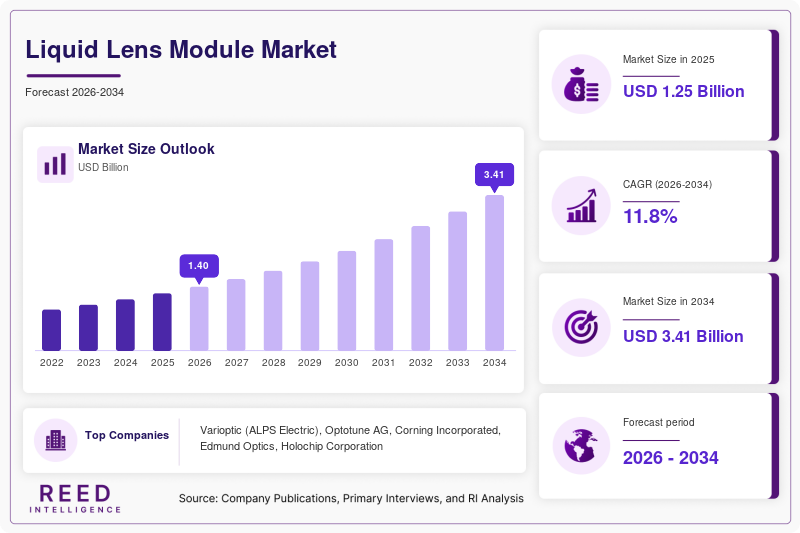
The Liquid Lens Module Market was valued at approximately USD 1.25 billion in 2026 and is projected to reach USD 3.05 billion by 2034, registering a compound annual growth rate (CAGR) of 11.8% during 2026–2034. The market growth is primarily driven by the rapid integration of adaptive optical technologies in imaging systems, where liquid lens modules enable fast autofocus, compact design, and high precision without mechanical movement.
One of the key global factors supporting the expansion of the Liquid Lens Module Market is the accelerating demand for miniaturized and high-performance optical components in consumer electronics and industrial automation systems. As imaging devices become more compact and multifunctional, liquid lens technology is increasingly preferred for its low power consumption, high-speed focus adjustment, and durability under high usage cycles.
Key Highlights:
- Dominant region share: Asia Pacific held 38% share in 2025
- Fastest-growing region CAGR: Middle East & Africa at 13.2% (2026–2034)
- Leading subsegment (Type): Autofocus liquid lens modules dominated in 2025
- Fastest-growing subsegment (Application): AR/VR devices at 14.6% CAGR
- Dominant country: China recorded USD 310 million (2024) and USD 345 million (2025) market size
The Liquid Lens Module Market continues to evolve as industries prioritize optical efficiency and system miniaturization across imaging ecosystems.
Market Trends
Integration of Liquid Lens Modules in AR/VR Devices
The adoption of AR/VR technologies has significantly increased the relevance of the Liquid Lens Module Market. Liquid lens modules are being integrated into head-mounted displays and smart glasses to enable rapid focal adjustments, enhancing visual clarity and reducing eye strain. Manufacturers are focusing on lightweight optical systems that improve user immersion while maintaining energy efficiency. This trend is expected to strengthen as metaverse applications and spatial computing platforms expand across industrial and consumer segments.
Expansion in Industrial Machine Vision Systems
Another key trend in the Liquid Lens Module Market is the increasing deployment in industrial machine vision systems. Liquid lenses offer high-speed focus adjustment, which is essential for quality inspection, defect detection, and robotic guidance systems. Industries such as electronics manufacturing, automotive assembly, and semiconductor production are integrating liquid lens modules into automated inspection equipment. This shift is driven by the need for precision imaging in real-time production environments, where traditional mechanical lenses are less efficient.
The combination of immersive technologies and industrial automation is reshaping demand dynamics in the Liquid Lens Module Market, encouraging continuous innovation in optical performance and system integration.
Market Drivers
Rising Demand for Compact Imaging Systems
The Liquid Lens Module Market is strongly driven by increasing demand for compact imaging systems in smartphones, surveillance devices, and industrial cameras. As electronic devices become smaller, traditional mechanical focusing systems are being replaced by liquid lens modules, which allow rapid autofocus without moving parts. This enhances device reliability, reduces wear and tear, and improves energy efficiency, making them highly suitable for modern portable electronics.
Growth in Automation and Smart Manufacturing
Another major driver in the Liquid Lens Module Market is the rapid adoption of automation and smart manufacturing technologies. Machine vision systems integrated with liquid lens modules enable faster inspection cycles and improved accuracy in production lines. Industries are investing in advanced optical solutions to improve operational efficiency, reduce defects, and support real-time decision-making. This has significantly increased the deployment of liquid lens technology in industrial robotics and AI-based inspection systems.
Together, these drivers are accelerating adoption across multiple industries, reinforcing the long-term expansion of the Liquid Lens Module Market.
Market Restraint
High Manufacturing Complexity and Cost Constraints
A major restraint impacting the Liquid Lens Module Market is the high complexity associated with manufacturing and integration. Liquid lens systems require precise control of optical fluids, micro-actuators, and sealing technologies, which increases production difficulty. This results in higher costs compared to conventional optical lens systems, limiting adoption in price-sensitive applications.
Additionally, supply chain dependencies for specialized materials and components further increase overall production expenses. Smaller manufacturers often face challenges in scaling production while maintaining consistent optical performance. These factors collectively restrict widespread adoption in low-cost consumer electronics and emerging markets.
Furthermore, performance limitations under extreme environmental conditions, such as high temperature fluctuations or mechanical stress, can affect long-term reliability. This creates hesitation among end-users in highly demanding industrial and automotive environments. As a result, cost and complexity remain key barriers for the broader expansion of the Liquid Lens Module Market.
Market Opportunities
Expansion in Healthcare Imaging Applications
The Liquid Lens Module Market presents strong opportunities in healthcare imaging systems, including endoscopy, microscopy, and diagnostic imaging devices. Liquid lens modules enable rapid focus adjustment in confined spaces, improving diagnostic accuracy and reducing procedure time. Increasing demand for minimally invasive medical procedures is expected to further support adoption in this sector.
Rising Adoption in Autonomous Vehicles and ADAS Systems
Another emerging opportunity in the Liquid Lens Module Market is the integration of liquid lens modules in autonomous vehicles and advanced driver-assistance systems (ADAS). These modules enhance real-time object detection and environmental scanning capabilities, improving vehicle safety and navigation accuracy. As automotive manufacturers continue to invest in smart sensing technologies, liquid lens modules are expected to become an integral part of next-generation vision systems.
Both opportunities highlight the expanding scope of the Liquid Lens Module Market across high-growth technology sectors.
Segmental Analysis
By Type Segment
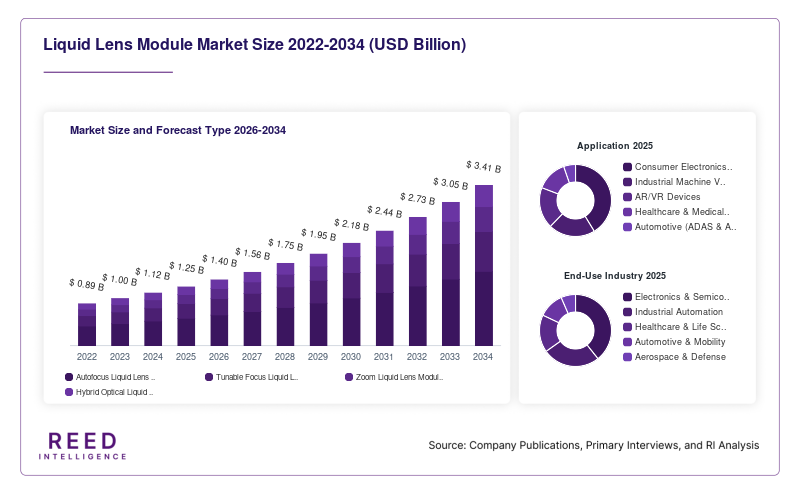
In the Liquid Lens Module Market, autofocus liquid lens modules dominated the type segment with a 2025 share of 44%, driven by widespread use in smartphones, cameras, and industrial imaging systems. These modules are preferred for their rapid focus adjustment and durability in high-cycle operations.
The fastest-growing subsegment is tunable focus liquid lens modules, projected to register a CAGR of 13.8% during 2026–2034, driven by demand in AR/VR and advanced optical systems requiring dynamic focal adjustments.
By Application Segment
The consumer electronics segment dominated with a 2025 share of 41% in the Liquid Lens Module Market. Smartphones and wearable devices continue to be the primary contributors due to compact imaging requirements.
The fastest-growing application is AR/VR systems, expected to grow at a CAGR of 14.6%, driven by rising adoption of immersive technologies and spatial computing platforms.
By End-Use Segment
Industrial automation held a 36% share in 2025, supported by machine vision systems used in inspection and robotics. High-speed production lines rely on liquid lens modules for accurate imaging.
The fastest-growing end-use segment is healthcare and medical devices, projected to grow at a CAGR of 13.1%, driven by demand for minimally invasive imaging tools and diagnostic precision.
By Distribution Channel Segment
Direct OEM supply dominated the Liquid Lens Module Market with a 52% share in 2025, as most modules are integrated directly into imaging systems during manufacturing.
The fastest-growing channel is online distribution platforms, expected to grow at a CAGR of 12.2%, supported by increased digital procurement and component sourcing efficiency.
Regional Analysis
North America
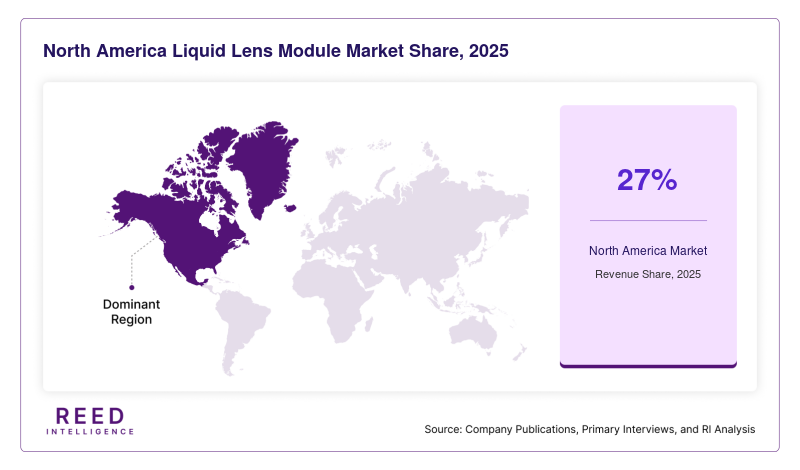
North America accounted for approximately 27% share of the Liquid Lens Module Market in 2025, and it is expected to register a CAGR of 10.9% during 2026–2034. The region benefits from strong adoption of advanced imaging technologies across industrial automation, defense, and consumer electronics sectors.
The United States dominated the regional Liquid Lens Module Market, driven by strong investment in AR/VR development and machine vision technologies. Growth is further supported by increasing demand for smart manufacturing systems, where liquid lens modules are integrated into high-speed inspection and robotics platforms.
Europe
Europe held around 22% share in 2025 of the Liquid Lens Module Market and is projected to grow at a CAGR of 10.5% from 2026 to 2034. The region’s growth is driven by strong automotive innovation and industrial automation adoption.
Germany emerged as the dominant country due to its advanced automotive manufacturing base and integration of optical sensing technologies in production systems. Increasing demand for precision engineering and quality inspection systems continues to support Liquid Lens Module Market growth across Europe.
Asia Pacific
Asia Pacific led the Liquid Lens Module Market with a 38% share in 2025, and is expected to grow at a CAGR of 12.4% during 2026–2034. The region benefits from large-scale electronics manufacturing and rapid adoption of imaging technologies.
China remained the dominant country, supported by strong production capabilities in smartphones, cameras, and industrial electronics. Expansion of semiconductor manufacturing and AI-driven automation further strengthens regional dominance in the Liquid Lens Module Market.
Middle East & Africa
The Middle East & Africa accounted for a 7% share in 2025, and is projected to grow at the fastest CAGR of 13.2% during 2026–2034. Growth is supported by increasing investments in smart city infrastructure and security surveillance systems.
The United Arab Emirates led the regional Liquid Lens Module Market, driven by adoption of advanced surveillance and smart infrastructure technologies. Government-led digital transformation initiatives are also contributing to rising demand for optical imaging systems.
Latin America
Latin America held approximately 6% share in 2025 of the Liquid Lens Module Market and is expected to grow at a CAGR of 10.8% during 2026–2034. Growth is driven by expanding industrial automation and consumer electronics penetration.
Brazil dominated the regional market due to increasing adoption of smart manufacturing technologies and surveillance systems. Gradual improvements in technological infrastructure are supporting steady growth in the Liquid Lens Module Market across the region.
Competitive Landscape
The Liquid Lens Module Market is moderately consolidated, with key players focusing on innovation in optical performance, miniaturization, and integration capabilities. Leading companies include Varioptic (an ALPS Electric subsidiary), Corning Incorporated, Optotune AG, Edmund Optics, and Holochip Corporation.
Varioptic (ALPS Electric) remains a leading player due to its strong portfolio of adaptive liquid lens technologies and extensive integration in consumer electronics and industrial systems. Recently, the company expanded its product line to support high-speed autofocus modules for compact imaging devices.
Other players are investing in R&D to improve response time, thermal stability, and optical precision. Strategic collaborations with OEM manufacturers and semiconductor companies are also shaping competitive dynamics in the Liquid Lens Module Market.
Key Players List
- Varioptic (ALPS Electric)
- Optotune AG
- Corning Incorporated
- Edmund Optics
- Holochip Corporation
- Qioptiq (Excelitas Technologies)
- Canon Inc.
- Sony Corporation
- Panasonic Holdings Corporation
- Samsung Electro-Mechanics
- Edmund Optics Asia
- Focuslight Technologies
- Leica Microsystems
- Nanonics Imaging
- Teledyne Technologies
Recent Developments
- Expansion of AR/VR-focused optical modules integrated with liquid lens systems in wearable devices.
- Increasing deployment of liquid lens-based machine vision systems in semiconductor manufacturing.
- Strategic collaborations between optical component manufacturers and consumer electronics OEMs to enhance autofocus performance.
- Advancements in tunable liquid lens technologies for high-speed industrial imaging applications.
Liquid Lens Module Market Segments
Type
- Autofocus Liquid Lens Modules
- Tunable Focus Liquid Lens Modules
- Zoom Liquid Lens Modules
- Hybrid Optical Liquid Lens Systems
Application
- Consumer Electronics (Smartphones, Cameras, Wearables)
- Industrial Machine Vision
- AR/VR Devices
- Healthcare & Medical Imaging
- Automotive (ADAS & Autonomous Systems)
End-Use Industry
- Electronics & Semiconductor
- Industrial Automation
- Healthcare & Life Sciences
- Automotive & Mobility
- Aerospace & Defense
Distribution Channel
- Direct OEM Supply
- Distributors & Component Suppliers
- Online Sales Platforms
- Specialty Optical Retailers
By Region
- North America
- Europe
- APAC
- Middle East and Africa
- LATAM