Liquid Ring Compressor Market Size, Share & Demand Report By Type (Single-Stage Liquid Ring Compressors), By Material (Cast Iron, Stainless Steel), By Application (Chemical Processing, Power Generation, Oil & Gas, Pharmaceuticals, Others), By End-Use Industry (Oil & Gas, Food & Beverage, Chemical Industry), By Sales Channel (Direct Sales, Distributors), By Region & Segment Forecasts, 2026–2034
USD 3950
Market Overview
The Liquid Ring Compressor Market size was valued at approximately USD 2.3 billion in 2026 and is projected to reach USD 3.7 billion by 2034, expanding at a CAGR of 6.1% during the forecast period (2026–2034). The market growth is primarily supported by the rising adoption of vacuum and compression systems across process industries, particularly in chemical processing and power generation sectors, where reliability and low-maintenance equipment are essential.
A key global factor supporting market expansion is the increasing demand for energy-efficient and environmentally compatible compression technologies. Liquid ring compressors offer advantages such as oil-free operation, minimal wear, and the ability to handle wet gases, making them suitable for industries focused on reducing emissions and operational risks.
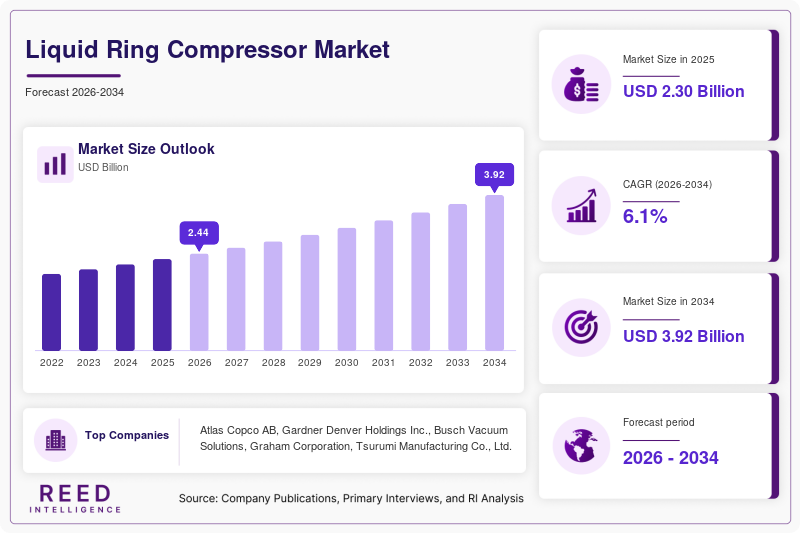
Key Highlights
- Asia Pacific dominated the market with a 38% share in 2025, while the Middle East & Africa is expected to grow at the fastest CAGR of 7.4% (2026–2034).
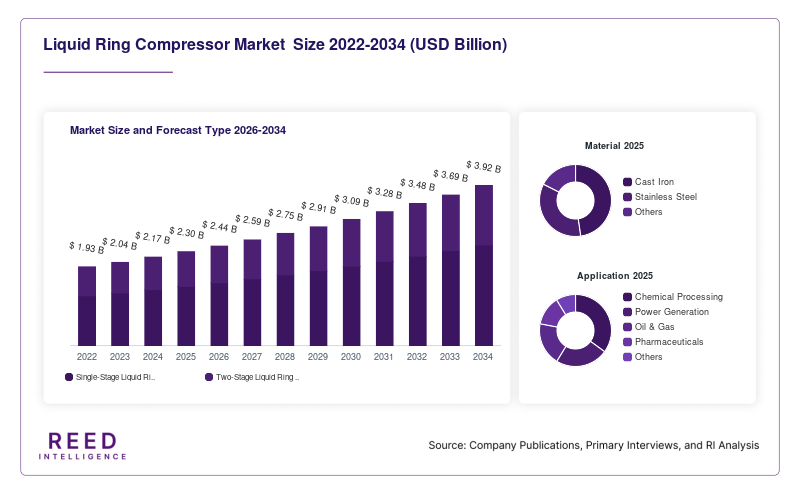
- Single-stage compressors led the type segment with a 54% share in 2025, while two-stage compressors are projected to grow at a CAGR of 6.8%.
- Cast iron materials accounted for the largest share at 47% in 2025, while stainless steel is forecast to grow at a CAGR of 6.9%.
- Chemical processing emerged as the leading application segment with a 31% share in 2025, while power generation is expected to expand at a CAGR of 6.7%.
- China remained the dominant country, with market values estimated at USD 410 million in 2024 and USD 435 million in 2025.
Market Trends
Integration of Smart Monitoring Systems
Manufacturers are increasingly integrating IoT-enabled monitoring systems into liquid ring compressors. These systems enable predictive maintenance, real-time performance tracking, and reduced downtime, improving operational efficiency across industries.
Shift Toward Corrosion-Resistant Materials
There is a noticeable shift toward advanced materials such as stainless steel and composite alloys to enhance durability in harsh operating environments, especially in chemical and petrochemical applications.
Market Drivers
Rising Demand in Chemical and Petrochemical Industries
The expanding chemical and petrochemical sectors are driving demand for reliable vacuum and compression systems. Liquid ring compressors are widely used for handling corrosive and explosive gases, making them a preferred choice for safety-critical operations.
Growth in Power Generation Infrastructure
The increasing need for efficient power generation systems has led to higher adoption of liquid ring compressors in condenser vacuum applications. Their ability to operate efficiently under variable loads supports their use in thermal and nuclear power plants.
Market Restraint
High Initial Installation Costs
Liquid ring compressors involve higher upfront costs compared to alternative technologies. This cost factor may limit adoption among small and medium enterprises, particularly in developing economies with budget constraints.
Market Opportunities
Expansion in Wastewater Treatment Applications
Growing investments in wastewater treatment infrastructure present opportunities for liquid ring compressors. Their capability to handle saturated gases and vapors makes them suitable for aeration and sludge processing systems.
Increasing Adoption in Food and Beverage Processing
The food and beverage industry is adopting hygienic and oil-free compression systems. Liquid ring compressors offer contamination-free operation, creating growth opportunities in packaging and processing applications.
Segmental Analysis
By Type
Single-stage compressors dominated the segment with a 54% share in 2025, driven by their cost-effectiveness and suitability for moderate vacuum applications. Two-stage compressors are expected to grow at a CAGR of 6.8%, supported by their ability to achieve deeper vacuum levels for specialized industrial processes.
By Material
Cast iron accounted for the largest share at 47% in 2025, owing to its durability and cost efficiency. Stainless steel is projected to grow at a CAGR of 6.9%, driven by its corrosion resistance and suitability for harsh chemical environments.
By Application
Chemical processing led with a 31% share in 2025, due to high demand for safe gas handling solutions. Power generation is anticipated to grow at a CAGR of 6.7%, supported by increasing energy demand and infrastructure expansion.
By End-Use Industry
The oil & gas sector dominated with a 28% share in 2025, driven by extensive use in refining and gas recovery processes. The food & beverage industry is expected to grow at a CAGR of 6.6%, supported by increasing demand for hygienic processing systems.
By Sales Channel
Direct sales accounted for 62% share in 2025, as industrial buyers prefer customized solutions. Online and distributor-based channels are expected to grow at a CAGR of 6.3%, driven by digitalization and ease of procurement.
Regional Analysis
North America
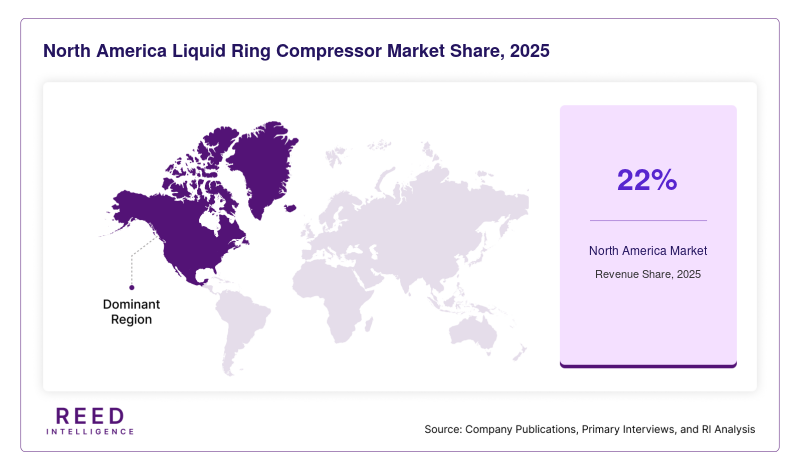
North America accounted for 22% of the market share in 2025 and is expected to grow at a CAGR of 5.6% during 2026–2034. The United States led the region due to increasing investments in industrial automation. The presence of advanced manufacturing facilities supported steady demand.
Europe
Europe held 20% market share in 2025 and is projected to expand at a CAGR of 5.4%. Germany dominated the region, supported by strong chemical manufacturing capabilities and emphasis on energy-efficient industrial equipment.
Asia Pacific
Asia Pacific captured 38% of the market share in 2025 and is forecast to grow at a CAGR of 6.5%. China led the region due to rapid industrialization and infrastructure development, particularly in process industries.
Middle East & Africa
The Middle East & Africa region accounted for 10% share in 2025 and is expected to grow at a CAGR of 7.4%. Saudi Arabia dominated due to expanding oil & gas activities and investments in industrial processing facilities.
Latin America
Latin America held 10% share in 2025 and is projected to grow at a CAGR of 5.8%. Brazil led the region, supported by increasing investments in energy and wastewater management projects.
Competitive Landscape
The Liquid Ring Compressor Market is moderately consolidated, with key players focusing on product innovation and geographic expansion. Leading companies include Atlas Copco AB, Gardner Denver Holdings Inc., Busch Vacuum Solutions, Graham Corporation, and Tsurumi Manufacturing Co., Ltd. Atlas Copco AB is recognized as a market leader due to its extensive product portfolio and strong global presence.
The company recently introduced advanced liquid ring compressors with integrated digital monitoring capabilities, enhancing operational efficiency. Gardner Denver emphasizes energy-efficient solutions, while Busch Vacuum Solutions focuses on customized vacuum systems. Graham Corporation specializes in engineered solutions for power and chemical industries, and Tsurumi Manufacturing strengthens its position through durable and cost-effective products. Strategic collaborations, product launches, and investments in R&D remain key strategies adopted by market participants to maintain competitiveness and expand market share.
Key Players List
- Atlas Copco AB
- Gardner Denver Holdings Inc.
- Busch Vacuum Solutions
- Graham Corporation
- Tsurumi Manufacturing Co., Ltd.
- Siemens Energy AG
- Ebara Corporation
- PPI Pumps Pvt. Ltd.
- Dekker Vacuum Technologies Inc.
- Samson Pumps A/S
- Shandong Zhangqiu Blower Co., Ltd.
- Osaka Vacuum Ltd.
- Premier Fluid Systems Inc.
- Hibon Inc.
- Sterling SIHI GmbH
Recent Developments
- 2025: Atlas Copco launched a new series of energy-efficient liquid ring compressors with IoT-enabled diagnostics.
- 2024: Busch Vacuum Solutions expanded its production facility in Asia to meet rising regional demand.
- 2025: Gardner Denver introduced upgraded compressor models designed for chemical processing applications.
- 2024: Ebara Corporation enhanced its corrosion-resistant compressor line for petrochemical use.
- 2025: Siemens Energy invested in digital integration technologies for industrial compression systems.
Liquid Ring Compressor Market Segments
Type
- Single-Stage Liquid Ring Compressors
- Two-Stage Liquid Ring Compressors
Material
- Cast Iron
- Stainless Steel
- Others
Application
- Chemical Processing
- Power Generation
- Oil & Gas
- Pharmaceuticals
- Others
End-Use Industry
- Oil & Gas
- Food & Beverage
- Chemical Industry
- Energy & Utilities
- Others
Sales Channel
- Direct Sales
- Distributors
- Online Channels
By Region
- North America
- Europe
- APAC
- Middle East and Africa
- LATAM