Liquid Smoke Market Size, Share Demand Report By Type (Hickory, Mesquite, Applewood, Oak, Others), By Application (Food, Beverages), By Form (Liquid, Powder), By Distribution Channel (Direct Sales, Retail Stores, Online), By End-Use (Food Processing Industry, Foodservice Sector, Household) By Region & Segment Forecasts, 2026–2034
USD 3950
Market Overview
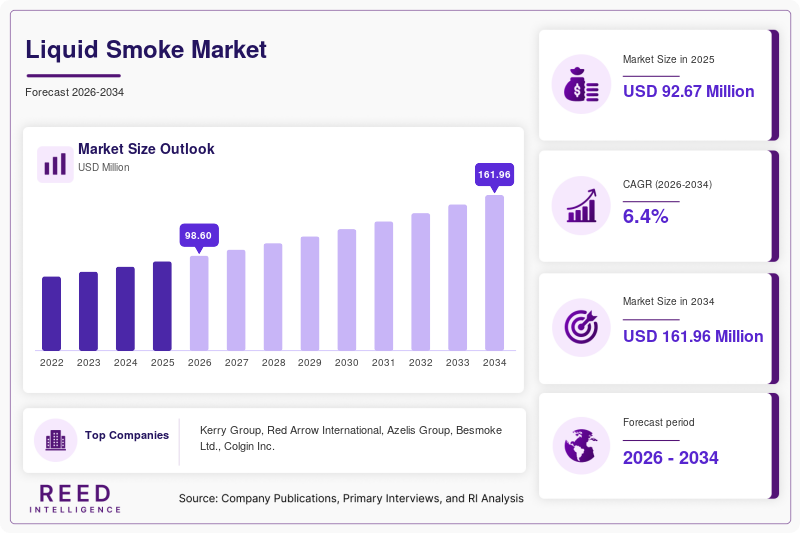
The Liquid Smoke Market size was estimated at USD 98.6 million in 2026 and is projected to reach USD 162.4 million by 2034, expanding at a CAGR of 6.4% during 2026–2034. The market has demonstrated steady expansion driven by the rising global demand for convenient flavoring solutions in processed and ready-to-eat foods. A key global factor supporting market growth has been the increasing preference for clean-label and natural flavor enhancers, as liquid smoke is derived from the condensation of wood smoke and is perceived as a natural alternative to artificial additives.
Food manufacturers across regions have increasingly adopted liquid smoke to enhance taste profiles while maintaining consistency in large-scale production. Additionally, its antimicrobial properties have contributed to its application in food preservation, particularly in meat and seafood products. The growing popularity of plant-based diets has further encouraged the use of liquid smoke in vegan and vegetarian products to replicate traditional smoky flavors.
Key Highlights:
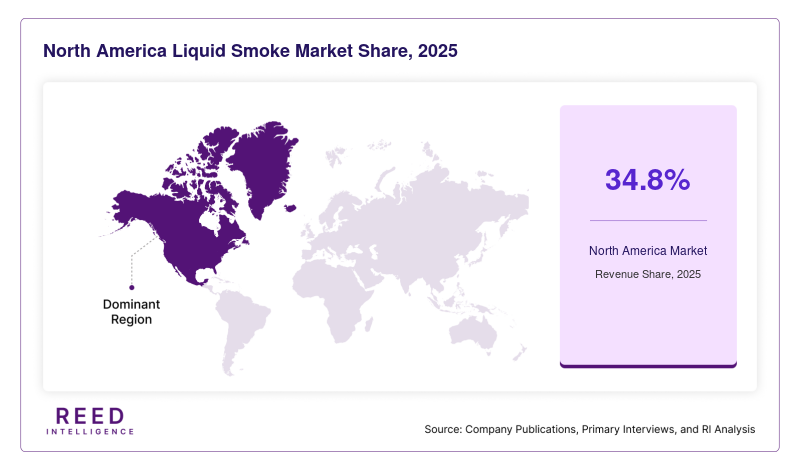
- North America dominated the market with a 34.8% share in 2025, while Asia Pacific is expected to grow at a CAGR of 7.6% through 2034.
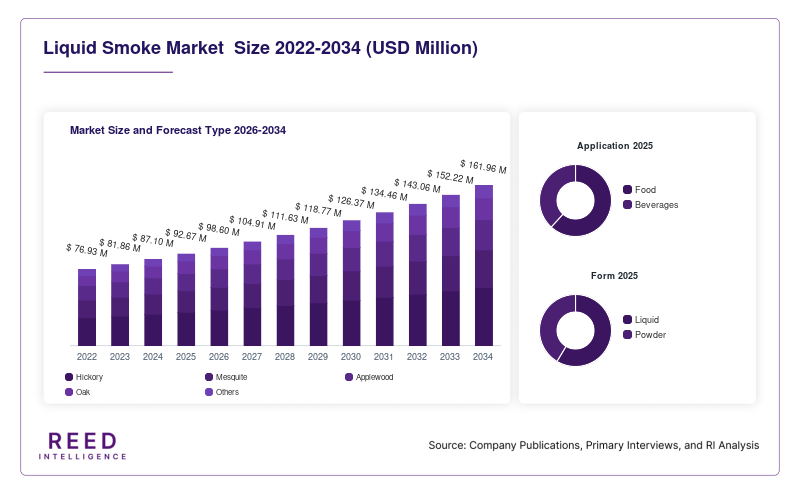
- Hickory-based liquid smoke led the type segment with 38.5% share in 2025, while mesquite is projected to grow at a CAGR of 7.2%.
- The food application segment dominated with 68.9% share, while beverages are expected to expand at a CAGR of 6.8%.
- The U.S. remained the dominant country with market values of USD 28.4 million in 2024 and USD 30.1 million in 2025.
Market Trends
Rising Demand for Clean-Label Ingredients
Consumers are increasingly seeking transparency in food ingredients, which has led to the adoption of natural flavoring agents. Liquid smoke aligns with clean-label trends due to its natural extraction process, making it suitable for food producers aiming to replace synthetic additives.
Expansion into Plant-Based Food Applications
The growing plant-based food industry has influenced the Liquid Smoke Market trends. Manufacturers are using liquid smoke to replicate grilled and smoked flavors in vegan meat alternatives, enhancing product appeal without compromising dietary preferences.
Market Drivers
Increasing Demand for Processed and Convenience Foods
The rapid urbanization and changing consumer lifestyles have driven the demand for processed and ready-to-eat foods. Liquid smoke plays a crucial role in providing consistent flavor profiles in packaged foods such as sauces, snacks, and ready meals. Its ease of use and ability to deliver authentic smoky taste without traditional smoking processes make it an efficient solution for food manufacturers.
Growth of Foodservice and Quick-Service Restaurants
The expansion of global foodservice chains and quick-service restaurants has significantly contributed to the Liquid Smoke Market growth. Restaurants increasingly use liquid smoke to standardize taste across locations while reducing preparation time and operational costs. This trend is particularly evident in grilled meat products, barbecue sauces, and marinades.
Market Restraint
Regulatory Constraints and Health Concerns
Stringent food safety regulations and concerns regarding the presence of certain compounds in liquid smoke may limit market growth. Regulatory approvals and compliance requirements vary across regions, posing challenges for manufacturers in terms of product formulation and distribution.
Market Opportunities
Expansion in Emerging Markets
Developing economies in Asia Pacific and Latin America present significant opportunities for the Liquid Smoke Market. Increasing disposable incomes and evolving dietary habits are driving the demand for flavored and processed foods, creating favorable conditions for market expansion.
Innovation in Flavor Profiles
Manufacturers are focusing on developing new flavor variants such as fruitwood-based liquid smoke and customized blends. These innovations cater to diverse culinary preferences and offer opportunities to penetrate niche markets, including gourmet and specialty food segments.
Segmental Analysis
By Type
Hickory liquid smoke dominated the segment with a 38.5% share in 2025, owing to its strong and versatile flavor profile widely used in meat and barbecue applications.
Mesquite liquid smoke is expected to grow at a CAGR of 7.2%, driven by its increasing use in premium and gourmet food products due to its distinctive earthy flavor.
By Application
The food segment held the largest share of 68.9% in 2025, supported by its extensive use in meat, sauces, and snacks.
The beverage segment will expand at a CAGR of 6.8%, driven by the introduction of smoked cocktails and specialty drinks offering unique taste experiences.
By Form
Liquid form dominated with a 72.4% share in 2025, as it is easy to blend and widely used in industrial food processing.
Powdered liquid smoke is projected to grow at a CAGR of 6.9%, supported by its longer shelf life and ease of storage in dry food applications.
By Distribution Channel
Direct sales accounted for 55.6% share in 2025, driven by bulk purchasing by food manufacturers and processors.
Online retail is expected to grow at a CAGR of 8.1%, fueled by increasing digital adoption and demand from small-scale food businesses and home users.
By End-Use
The food processing industry dominated with a 61.2% share in 2025, as liquid smoke is widely used in large-scale production.
The foodservice sector is anticipated to grow at a CAGR of 7.0%, driven by expanding restaurant chains and demand for consistent flavoring solutions.
Regional Analysis
North America
North America accounted for 34.8% of the Liquid Smoke Market share in 2025 and will grow at a CAGR of 5.9% during the forecast period. The region’s growth was supported by high consumption of processed meat products and strong demand for barbecue flavors. The U.S. dominated the regional market due to its established food processing industry and widespread adoption of liquid smoke in sauces and marinades.
Europe
Europe held 26.3% market share in 2025 and is projected to grow at a CAGR of 5.7% through 2034. The region’s demand was driven by increasing preference for natural food additives and stringent regulations favoring clean-label products. Germany emerged as the dominant country, supported by its advanced food manufacturing sector and growing interest in smoked flavor applications.
Asia Pacific
Asia Pacific represented 21.7% share in 2025 and will register the fastest growth with a CAGR of 7.6%. Rapid urbanization and rising demand for processed foods contributed to regional expansion. China led the market due to its large consumer base and increasing adoption of Western food flavors in domestic cuisine.
Middle East & Africa
The Middle East & Africa held 9.4% share in 2025 and is expected to grow at a CAGR of 6.1%. Growth in the region was driven by expanding foodservice industries and increasing demand for flavored meat products. The UAE dominated due to its strong hospitality sector and high consumption of international cuisines.
Latin America
Latin America accounted for 7.8% share in 2025 and will grow at a CAGR of 6.3%. The region’s growth was influenced by rising consumption of processed foods and sauces. Brazil led the market, supported by its large meat processing industry and increasing adoption of flavor-enhancing ingredients.
Competitive Landscape
The Liquid Smoke Market is moderately fragmented, with several global and regional players competing based on product quality, innovation, and distribution reach. Leading companies focus on expanding their product portfolios and enhancing flavor customization to cater to diverse consumer preferences. Among these, Kerry Group has established a strong market presence due to its extensive flavor solutions portfolio and global distribution network.
The company recently introduced new clean-label liquid smoke variants to meet evolving consumer demands. Other players such as Red Arrow International and Azelis Group emphasize technological advancements and strategic partnerships to strengthen their market position. Manufacturers are also investing in research and development to improve product safety and compliance with international regulations. The competitive environment is characterized by continuous innovation, mergers, and collaborations aimed at expanding market share and addressing the growing demand for natural flavoring solutions.
Key Players List
- Kerry Group
- Red Arrow International
- Azelis Group
- Besmoke Ltd.
- Colgin Inc.
- Baumer Foods
- MSK Ingredients
- B&G Foods Inc.
- Frutarom Industries Ltd.
- Firmenich SA
- Archer Daniels Midland Company
- McCormick & Company
- International Flavors & Fragrances Inc.
- Symrise AG
- Bell Flavors & Fragrances
Recent Developments
- In 2025, leading manufacturers introduced new clean-label liquid smoke products with reduced impurities to comply with evolving food safety regulations.
- Several companies expanded production facilities in Asia Pacific to meet rising regional demand.
- Strategic collaborations between flavor companies and food processors increased to develop customized smoky flavor solutions.
- Product innovations focused on fruitwood-based variants to cater to premium and gourmet food segments.
- Digital sales channels gained traction, with companies strengthening their online presence to reach a broader customer base.
Liquid Smoke Market Segments
Type
- Hickory
- Mesquite
- Applewood
- Oak
- Others
Application
- Food
- Beverages
Form
- Liquid
- Powder
Distribution Channel
- Direct Sales
- Retail Stores
- Online
End-Use
- Food Processing Industry
- Foodservice Sector
- Household
By Region
- North America
- Europe
- APAC
- Middle East and Africa
- LATAM