Liquid Waste Management Market Size, Share & Trends Analysis Report By Waste Source (Municipal Wastewater, Industrial Wastewater, Commercial Wastewater, Agricultural & Other Liquid Waste), By Treatment Type (Biological Treatment, Physical Treatment, Chemical Treatment, Advanced Treatment), By Service (Collection & Transportation, Treatment & Processing, Disposal, Recycling & Reuse), By End Use (Municipal, Industrial, Commercial, Agriculture & Other End Uses) and By Region (North America, Europe,
USD 3950
Liquid Waste Management Market Size
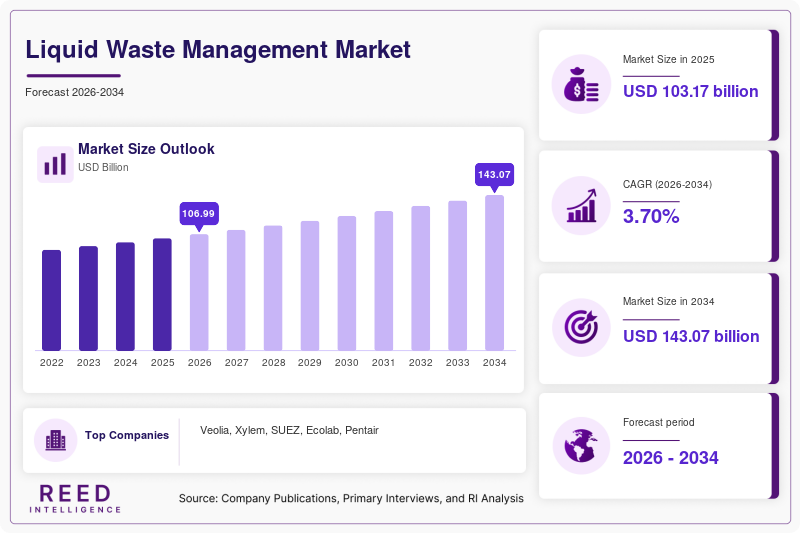
The global liquid waste management market size was valued at USD 103.17 billion in 2025 and is projected to grow from USD 106.99 billion in 2026 to USD 143.08 billion by 2034, registering a CAGR of 3.70% during the forecast period from 2026 to 2034.
The market is supported by mandatory wastewater collection and treatment, aging sewer and treatment infrastructure, industrial discharge controls, water scarcity, and the growing use of treated wastewater as an alternative water source. UN-Water reports that among 107 countries providing wastewater data for 2022, 76% of total wastewater received some treatment, while only 60% was safely treated among the smaller set of countries with sufficient data for that indicator. This treatment gap creates continuing infrastructure and service demand, particularly in developing urban areas.
Liquid waste management covers the collection, transportation, treatment, processing, disposal, recycling, and reuse of wastewater and other liquid waste streams generated by households, municipalities, commercial facilities, industries, agriculture, and institutional users. The market is shifting from a disposal-oriented model toward integrated treatment, resource recovery, and water reuse.
The strongest structural signal is the continued gap between wastewater generation and safe treatment. UN-Water's latest assessment shows that global progress toward SDG 6.3 remains uneven, with substantial differences between countries and treatment levels.
Liquid Waste Management Market Drivers
Increasing wastewater treatment requirements and infrastructure renewal
Wastewater treatment remains a compliance requirement for municipalities and industrial facilities, making the market relatively less discretionary than many environmental-service categories. Aging sewer networks, overloaded treatment plants, population growth, and stricter discharge standards create recurring demand for pumps, biological treatment systems, filtration, disinfection, sludge handling, monitoring equipment, and plant rehabilitation. UN-Water's 2024 assessment identified a major global gap between wastewater receiving some treatment and wastewater receiving safe treatment, demonstrating that additional treatment capacity and process upgrades remain necessary.
Government financing reinforces this mechanism. In the U.S., EPA's FY2026 Clean Water State Revolving Fund allocations provide financing for wastewater infrastructure, while individual projects include treatment plant upgrades, sewer extensions, disinfection systems, and collection-system rehabilitation. In India, AMRUT 2.0 continues to support sewerage, septage management, treatment-plant expansion, and rehabilitation projects. The commercial effect is sustained equipment replacement and long-duration treatment-service demand rather than purely new-project demand.
Water scarcity is turning wastewater into a usable resource
Water stress is changing the economic value of treated wastewater. Instead of treating effluent only to meet discharge standards, utilities and industrial users increasingly evaluate wastewater as a source of process water, irrigation water, cooling water, and other non-potable supplies. EPA's WRAP 2.0, launched in April 2026, specifically emphasizes reuse for industry, technology, and energy applications.
The same mechanism is visible internationally. Japan's infrastructure ministry promotes treated sewage reuse for landscaping, agriculture, and industrial applications, while India's NITI Aayog identifies reuse as a way to reduce freshwater demand in agriculture and urban areas. This increases demand for tertiary treatment, membranes, ultraviolet disinfection, reverse osmosis, monitoring, and distribution infrastructure. However, reuse economics still depend on local freshwater prices, regulation, public acceptance, and the energy cost of advanced treatment.
Industrial contaminants and tighter environmental controls
Industrial liquid waste contains more complex contaminant profiles than conventional municipal wastewater, creating demand for specialized treatment and monitoring. PFAS is one example: the U.S. EPA states that sewage sludge can contain PFAS originating from industrial facilities, landfills, households, and other upstream sources and released draft guidance in July 2026 addressing PFOA and PFOS risks in biosolids.
The EU's revised wastewater directive similarly expands attention toward pollutants, resource recovery, and treatment performance. These changes increase demand for advanced oxidation, adsorption, membrane treatment, biological processes, filtration, monitoring, and specialized sludge management. The counterbalance is that advanced treatment increases capital and operating costs, which can delay upgrades for smaller municipalities and price-sensitive industrial customers.
Liquid Waste Management Market Restraints
High capital and operating costs
Liquid waste management requires substantial physical infrastructure, including sewer networks, pumping stations, treatment plants, sludge-handling systems, storage, monitoring equipment, and increasingly sophisticated tertiary treatment. Energy consumption is another important operating cost, particularly for aeration, pumping, membrane filtration, ultraviolet treatment, and reverse osmosis.
The cost challenge becomes more pronounced when wastewater must meet reuse-quality specifications or remove emerging contaminants. SUEZ's 2026 Hybrid Batch Reverse Osmosis pilot in France illustrates the direction of technology development: the system targets 90–95% treated-water recovery while reducing brine, chemical use, and energy consumption. Such innovations can improve economics, but initial technology and integration costs remain barriers for smaller utilities and industrial facilities.
Fragmented regulation and uneven infrastructure capacity
Liquid waste management is highly dependent on local discharge permits, environmental standards, sewerage systems, water pricing, land availability, and municipal financing. Treatment requirements therefore differ substantially between countries and even between jurisdictions within the same country.
UN-Water's reporting highlights major differences in wastewater collection and safe treatment across regions and income groups. India provides another example: NITI Aayog has identified substantial gaps between urban wastewater generation, installed treatment capacity, and actual treatment, while noting that reuse remains relatively limited. This fragmentation raises project-development costs and makes standardized deployment more difficult.
Liquid Waste Management Market Opportunities
Water reuse and resource recovery
Water reuse is becoming a distinct commercial layer within liquid waste management. Utilities can recover treated water for irrigation, industrial processes, municipal cleaning, cooling, and other non-potable applications, while treatment plants can recover biogas, nutrients, and other resources from wastewater and sludge.
The European Commission's revised wastewater directive explicitly promotes circularity through water reuse and recovery of valuable resources. In France, SUEZ's 2026 Hérault Méditerranée agreement includes up to 600,000 cubic meters of annual recycled-water reuse across municipal applications, while anaerobic digestion is being added to recover energy from sludge. These projects demonstrate how wastewater infrastructure can shift from a cost center toward an asset that supplies water and energy.
Industrial wastewater and high-value water treatment
Industrial wastewater represents an expanding opportunity because manufacturers need both environmental compliance and reliable water availability. Semiconductor, pharmaceutical, food and beverage, energy, mining, and chemical facilities can require customized treatment systems with high-quality process-water recovery.
EPA's 2026 reuse program specifically highlights industry, technology, and energy as target areas for expanded water reuse. Veolia has also identified semiconductors, pharmaceuticals, and data centers as industries increasing demand for innovative water-treatment technologies. This creates opportunities for membrane systems, advanced biological treatment, digital monitoring, water-quality analytics, and outsourced treatment services.
Segmental Analysis
By Waste Source
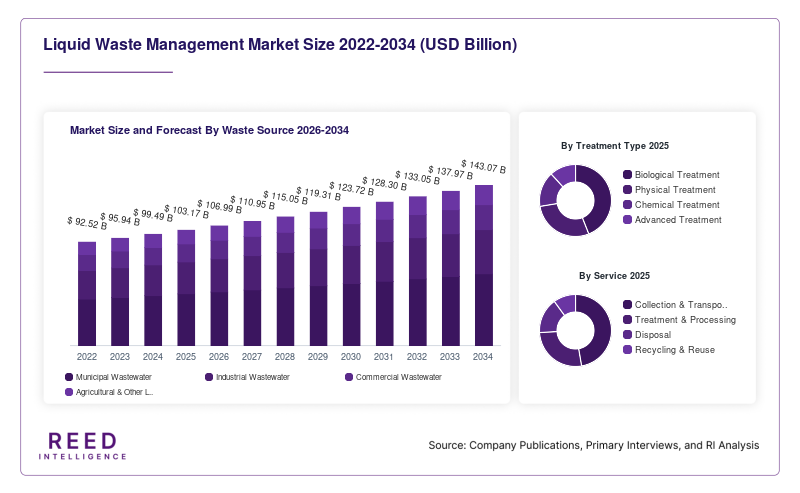
Municipal Wastewater represents approximately 55% of the global market in 2025, supported by population concentration in cities, sewer-network requirements, public-health standards, and municipal treatment obligations. The segment remains service-intensive because collection, pumping, treatment, sludge handling, and plant maintenance continue after initial infrastructure construction.
Industrial Wastewater represents approximately 30%, while it is the fastest-growing waste-source segment at about 4.8% CAGR. Industrial users face more complex contaminant loads and increasingly need treatment systems that combine compliance with water recovery. EPA's emphasis on industrial reuse and Veolia's focus on strategic industrial customers indicate increasing commercial attention to industrial water and wastewater systems.
Commercial Wastewater accounts for approximately 10%, supported by hospitality, healthcare, retail, foodservice, offices, and institutional properties. Demand is generally linked to urban development and compliance requirements.
Agricultural & Other Liquid Waste accounts for approximately 5%, with demand influenced by livestock operations, food processing, agricultural runoff, and localized liquid-waste treatment requirements.
By Treatment Type
Biological Treatment accounts for approximately 46% of the global market in 2025, reflecting its broad use in municipal and industrial wastewater treatment. Biological processes remain central to removal of organic pollutants and nutrients and can be integrated with secondary and tertiary treatment.
Advanced Treatment represents approximately 18% and is the fastest-growing treatment category at about 5.4% CAGR. Membranes, advanced oxidation, UV, activated carbon, nutrient removal, and other technologies are gaining relevance as water reuse and emerging-contaminant requirements increase. SUEZ's 2026 reverse-osmosis reuse pilot demonstrates the commercial push toward higher water recovery with lower energy and chemical requirements.
Physical Treatment holds approximately 22%, covering screening, clarification, filtration, sedimentation, and related processes.
Chemical Treatment represents approximately 14%, mainly used where specific contaminants, disinfection requirements, pH control, coagulation, or industrial effluent characteristics require chemical processes.
By Service
Treatment & Processing represents approximately 42% of the global market in 2025, reflecting the high technical and operating requirements of wastewater treatment plants.
Recycling & Reuse represents approximately 18% and is the fastest-growing service at about 6.1% CAGR. The expansion is linked to water scarcity, industrial water requirements, and government efforts to establish wastewater as an alternative source of water. EPA's WRAP 2.0 places reuse directly within its 2026 water strategy.
Collection & Transportation accounts for approximately 24%, supported by sewer extensions, pumping systems, septic and septage services, and urban infrastructure expansion.
Disposal represents approximately 16%, including treated-effluent discharge and residual liquid-waste management.
By End Use
Municipal End Use accounts for approximately 50% of the market in 2025, reflecting the essential nature of public sewerage and wastewater treatment. Municipalities remain major purchasers of long-term treatment, pumping, network monitoring, and operation and maintenance services.
Industrial End Use accounts for approximately 30% and is the fastest-growing end-use category at about 5.0% CAGR, supported by stricter discharge requirements and increasing interest in closed-loop water systems.
Commercial End Use represents approximately 12%, driven by hotels, hospitals, restaurants, offices, retail centers, and institutional properties.
Agriculture & Other End Uses account for approximately 8%, with treated-water reuse becoming more relevant in water-stressed agricultural areas. NITI Aayog has identified treated wastewater as a potential resource for agricultural and peri-urban applications.
Regional Analysis
North America Liquid Waste Management Market
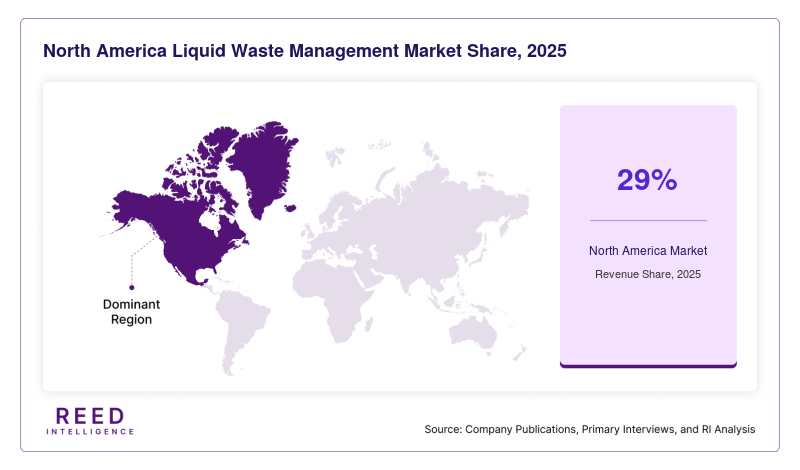
North America represents approximately 29% of the global market in 2025 and is growing at about 3.1% CAGR. The region benefits from mature sewerage infrastructure, large municipal treatment systems, industrial wastewater requirements, and established public financing mechanisms. In the U.S., EPA's Clean Water State Revolving Fund provides continuing financial support for wastewater infrastructure, including treatment upgrades, sewer improvements, and disinfection projects.
The region is also shifting toward water reuse. EPA launched WRAP 2.0 in April 2026 with an explicit focus on industrial, technology, and energy-sector reuse, responding to increasing water requirements from manufacturing, data centers, and other water-intensive activities.
The U.S. market has strong demand for pumping, biological treatment, advanced filtration, monitoring, digital water management, and outsourced services. Xylem reported 2025 revenue of USD 9.0 billion and serves wastewater customers across approximately 150 countries.
The principal constraint is the cost of renewing aging infrastructure while maintaining affordability for municipal customers. Emerging-contaminant requirements can also require additional treatment stages and monitoring.
Europe Liquid Waste Management Market
Europe accounts for approximately 25% of the global market in 2025 and is growing at about 2.9% CAGR. The region has a mature wastewater-treatment base, but regulatory tightening is increasing spending on advanced treatment, pollutant removal, energy efficiency, and resource recovery.
The revised EU Urban Wastewater Treatment Directive entered into force on January 1, 2025 and requires stronger treatment performance while introducing requirements related to additional pollutants, circularity, water reuse, and climate impacts. The European Commission estimates the revised framework could produce €6.6 billion in annual economic benefits by 2045.
France is an important example of the market's transition toward resource recovery. SUEZ is developing wastewater reuse and energy-recovery projects, including a 2026 agreement in southern France involving recycled water and anaerobic digestion. Veolia is also developing treated-wastewater reuse projects in France and Brazil.
High compliance standards support advanced treatment demand, while mature infrastructure and relatively slow population growth moderate volume expansion.
APAC Liquid Waste Management Market
APAC represents approximately 28% of the global market in 2025 and is the fastest-growing region at about 5.2% CAGR. Population growth, urbanization, industrialization, uneven wastewater-treatment coverage, and water scarcity create a broad infrastructure requirement across China, India, Southeast Asia, Japan, South Korea, and Australia.
India illustrates the scale of the opportunity. NITI Aayog has identified major gaps between urban wastewater generation and treatment and has promoted treated-water reuse for agriculture, construction, horticulture, and industrial applications. AMRUT 2.0 continues to include sewerage, septage, treatment-plant expansion, and rehabilitation projects.
Japan is further along the infrastructure cycle and actively promotes treated sewage reuse for agricultural, landscaping, and industrial applications as climate-related water risks increase.
The region's commercial mechanism is therefore two-sided: developing markets need basic collection and treatment capacity, while advanced economies increasingly require efficiency, reuse, automation, and asset renewal. The key constraint is financing and the uneven technical capacity of smaller municipalities.
Middle East and Africa Liquid Waste Management Market
The Middle East and Africa account for approximately 10% of the market in 2025 and are growing at about 4.5% CAGR. Water scarcity is the central market mechanism, particularly in Gulf countries where wastewater reuse can reduce dependence on freshwater and desalinated water for non-potable applications.
Oman provides a recent example. In June 2026, SUEZ and partners secured a 15-year, €2 billion performance-based water and wastewater contract covering 2.3 million people, including operation of 22 wastewater treatment plants with total treatment capacity of 280,000 cubic meters per day and treated-effluent networks for reuse.
Africa has a different infrastructure profile, with major opportunities in collection networks, basic treatment, sanitation, sludge management, and decentralized systems. The commercial challenge is project financing and affordability, especially where municipal revenue collection is weak. Long-term public-private partnerships, development-bank financing, and performance-based contracts can help bridge this gap.
LATAM Liquid Waste Management Market
LATAM represents approximately 8% of the global market in 2025 and is growing at about 4.2% CAGR. Demand is linked to urban sanitation, water pollution control, industrial activity, water security, and modernization of treatment infrastructure.
The World Bank approved a USD 200 million multi-phase program for Peru in 2025 focused on wastewater management, water and sanitation infrastructure, water reuse, aquifer recharge, pollution reduction, energy cogeneration, and nutrient recovery. The Inter-American Development Bank also lists wastewater treatment and storm-drainage projects across countries including Peru, Colombia, Brazil, and other Latin American markets.
The region therefore has opportunities in municipal treatment, wastewater reuse, industrial treatment, and climate-resilient infrastructure. Project financing, regulatory enforcement, and differences in municipal capacity remain important constraints.
Competitive Landscape
The liquid waste management market has a mix of global water-technology companies, environmental-service providers, engineering companies, equipment manufacturers, and regional operators. Competition increasingly extends beyond individual pumps or treatment components toward integrated plant design, digital monitoring, long-term operation and maintenance, water reuse, energy recovery, and performance-based contracts.
Veolia has expanded its water-technology position through full ownership of Water Technologies and Solutions after acquiring CDPQ's 30% stake in May 2025. Veolia said the transaction would simplify the structure and strengthen its position in water technologies and the U.S. market. Its 2025 results reported Water Technologies revenue of €4.954 billion, while the company served 97 million people with sanitation services globally.
Key Market Players
- Veolia
- Xylem
- SUEZ
- Ecolab
- Pentair
- Kurita Water Industries
- Evoqua/Xylem
- Aquatech International
- Pentair Flow
- DuPont Water Solutions
- Sulzer
- Alfa Laval
Recent Market Developments
- August 2026 – Xylem announced a USD 1.46 billion acquisition of Cornell Pump and Roper Pump. The transaction expands Xylem's engineered pumping portfolio for industrial and municipal applications and strengthens its exposure to infrastructure investment and resource-demand markets.
- June 2026 – SUEZ signed its largest Middle East contract in Oman. The €2 billion, 15-year performance-based agreement covers water and wastewater services for 2.3 million people and includes 22 wastewater treatment plants, sewer networks, and treated-effluent reuse infrastructure.
Liquid Waste Management Market Segments
By Waste Source
- Municipal Wastewater
- Industrial Wastewater
- Commercial Wastewater
- Agricultural & Other Liquid Waste
By Treatment Type
- Biological Treatment
- Physical Treatment
- Chemical Treatment
- Advanced Treatment
By Service
- Collection & Transportation
- Treatment & Processing
- Disposal
- Recycling & Reuse
By End Use
- Municipal
- Industrial
- Commercial
- Agriculture & Other End Uses
By Region
- North America
- Europe
- APAC
- Middle East and Africa
- LATAM