Lithium Sulfur Battery Market Size, Share Demand Report By Type (High-Energy Density Lithium Sulfur Batteries, Solid-State Lithium Sulfur Batteries), By Application (Electric Vehicles, Aerospace, Consumer Electronics), By End-Use (Automotive, Energy Storage, Industrial), By Region & Segment Forecasts, 2026–2034
USD 3950
Market Overview
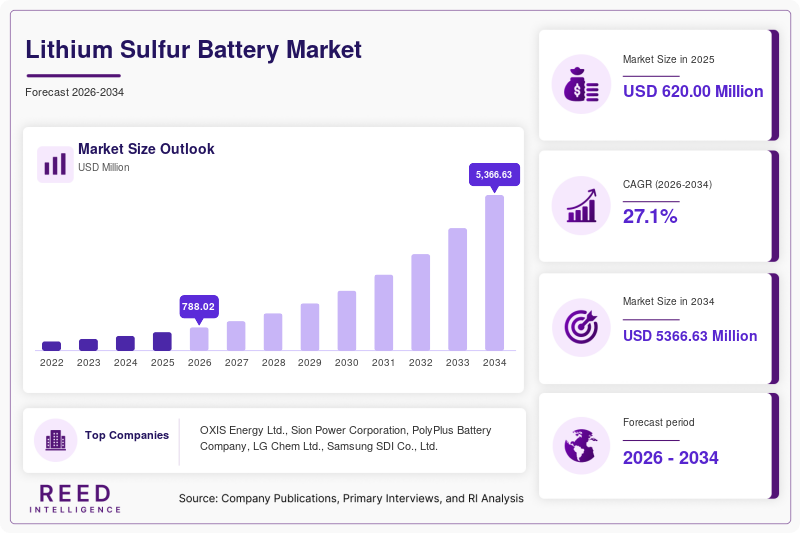
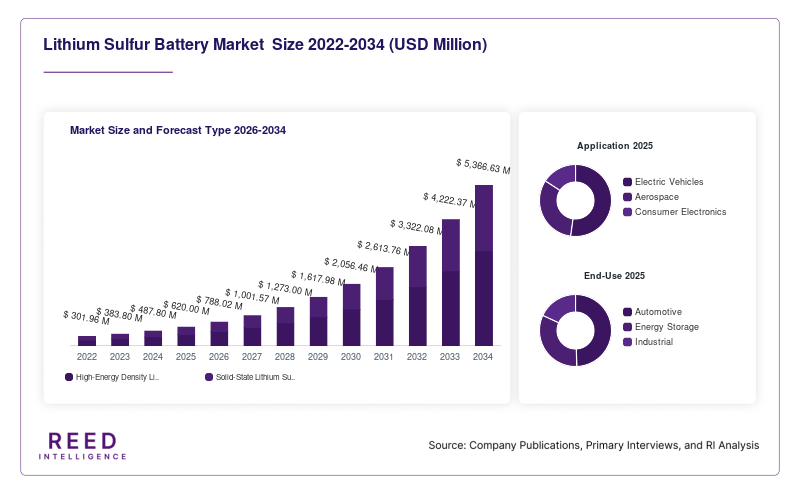
The global Lithium Sulfur Battery Market size was valued at approximately USD 620 million in 2026 and is projected to reach USD 4200 million by 2034, expanding at a CAGR of 27.1% during 2026–2034. The market is gaining traction due to its potential to deliver higher energy density compared to conventional lithium-ion batteries, along with lower material costs driven by the abundance of sulfur. These characteristics make lithium sulfur batteries particularly attractive for next-generation energy storage systems, electric vehicles, and aerospace applications.
A major global factor supporting market growth is the increasing push toward decarbonization and electrification across transportation and energy sectors. Governments and industries worldwide are investing in advanced battery technologies that offer longer range, reduced weight, and improved sustainability. Lithium sulfur batteries, with their ability to provide higher specific energy and reduced environmental impact, align well with these global energy transition goals.
Key Highlights
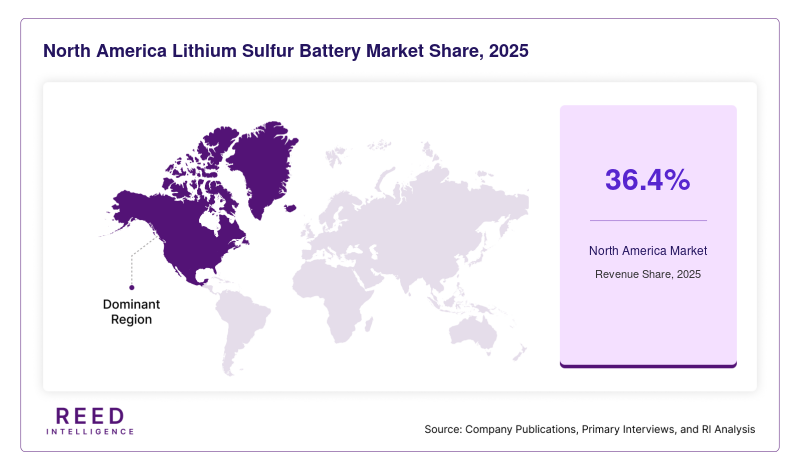
- North America dominated the market with a 36.4% share in 2025.
- Asia Pacific is expected to grow at the fastest CAGR of 29.3% during 2026–2034.
- By type, high-energy density lithium sulfur batteries accounted for the largest share of 44.8%, while solid-state lithium sulfur batteries are projected to grow at a CAGR of 31.6%.
- By application, electric vehicles led with a 39.2% share, whereas aerospace is expected to expand at a CAGR of 30.8%.
- The United States remained the dominant country, with market values of USD 180 million in 2024 and USD 220 million in 2025.
Market Trends
Increasing Focus on Lightweight Energy Storage Solutions
One of the most notable trends in the Lithium Sulfur Battery Market is the rising demand for lightweight energy storage solutions, particularly in transportation and aerospace sectors. Lithium sulfur batteries offer significantly higher energy density compared to lithium-ion batteries, enabling reduced battery weight without compromising performance. This advantage is critical for electric vehicles and aircraft, where weight reduction directly impacts efficiency and range. Manufacturers are focusing on optimizing sulfur cathodes and advanced electrolytes to enhance cycle stability while maintaining lightweight characteristics. As industries prioritize efficiency and emissions reduction, this trend is expected to drive continuous innovation and investment in lithium sulfur technologies.
Expansion of Pilot-Scale Manufacturing Facilities
Another emerging trend is the expansion of pilot-scale and pre-commercial manufacturing facilities by key players. Companies are transitioning from laboratory-scale research to industrial-scale production, aiming to validate performance and cost efficiency. These pilot plants are enabling the testing of new materials, production processes, and battery architectures. Additionally, partnerships between battery startups and established automotive or aerospace companies are accelerating commercialization timelines. This trend is strengthening supply chain readiness and building confidence among end users, ultimately contributing to the gradual integration of lithium sulfur batteries into mainstream applications.
Market Drivers
Rising Demand for High Energy Density Batteries
The growing demand for high energy density batteries is a primary driver for the Lithium Sulfur Battery Market. Compared to traditional lithium-ion batteries, lithium sulfur technology can deliver up to two to three times higher energy density, making it highly suitable for applications requiring extended operational time and reduced weight. Electric vehicles, drones, and portable electronics are key sectors benefiting from this capability. As consumers and industries demand longer battery life and improved efficiency, manufacturers are increasingly investing in lithium sulfur battery development. This shift is further supported by advancements in material science that are addressing performance challenges such as polysulfide shuttle effects.
Increasing Investments in Sustainable Energy Technologies
Another significant driver is the rising global investment in sustainable and environmentally friendly energy technologies. Lithium sulfur batteries utilize sulfur, which is abundant and less environmentally harmful compared to cobalt and nickel used in lithium-ion batteries. This reduces both cost and environmental impact, aligning with global sustainability goals. Governments and private organizations are funding research initiatives and pilot projects to accelerate the development of next-generation batteries. Additionally, regulatory policies promoting clean energy and reducing carbon emissions are encouraging the adoption of advanced battery technologies, further driving market growth.
Market Restraint
Limited Cycle Life and Stability Challenges
A major restraint in the Lithium Sulfur Battery Market is the limited cycle life and stability issues associated with the technology. Lithium sulfur batteries tend to suffer from rapid capacity degradation due to the dissolution of intermediate polysulfides during charge-discharge cycles. This phenomenon leads to reduced efficiency and shorter battery lifespan, posing a significant challenge for commercial applications. While ongoing research is addressing these issues through advanced materials and electrolyte formulations, achieving consistent long-term performance remains a critical hurdle.
The impact of this restraint is particularly evident in applications such as electric vehicles, where battery longevity is a key requirement. Manufacturers must ensure that lithium sulfur batteries can withstand thousands of charge cycles without significant degradation. For instance, automotive OEMs are hesitant to adopt the technology at scale until reliability benchmarks comparable to lithium-ion batteries are achieved. Additionally, higher initial development costs and the need for specialized manufacturing processes further limit widespread adoption. Overcoming these challenges will require sustained investment in research and collaborative efforts across the industry.
Market Opportunities
Growing Adoption in Aerospace and Defense Applications
The aerospace and defense sectors present a significant opportunity for the Lithium Sulfur Battery Market. These industries require lightweight and high-performance energy storage systems for applications such as unmanned aerial vehicles, satellites, and advanced aircraft. Lithium sulfur batteries, with their superior energy density and reduced weight, are well-suited to meet these requirements. As governments increase defense budgets and invest in advanced technologies, the demand for innovative battery solutions is expected to rise. This creates a favorable environment for lithium sulfur battery manufacturers to expand their presence in high-value applications.
Integration with Renewable Energy Storage Systems
Another promising opportunity lies in the integration of lithium sulfur batteries with renewable energy storage systems. As solar and wind energy installations grow globally, the need for efficient and cost-effective energy storage solutions is increasing. Lithium sulfur batteries offer the potential to store large amounts of energy at a lower cost compared to conventional technologies. Their scalability and environmental benefits make them an attractive option for grid storage and off-grid applications. Companies focusing on energy storage solutions are exploring lithium sulfur technology to enhance system efficiency and reduce overall costs, creating new growth avenues for the market.
Segmental Analysis
By Type
The high-energy density lithium sulfur batteries segment dominated the market, accounting for 44.8% share in 2024. This dominance is attributed to the growing demand for batteries that offer extended runtime and improved performance. These batteries are widely used in applications such as electric vehicles and aerospace, where energy density is a critical factor. Manufacturers are focusing on enhancing cathode materials and optimizing battery design to improve efficiency and reliability. The segment’s growth is further supported by ongoing research and development efforts aimed at addressing performance challenges.
Solid-state lithium sulfur batteries are emerging as the fastest-growing subsegment, with a projected CAGR of 31.6% during the forecast period. This growth is driven by their potential to offer improved safety and stability compared to conventional lithium sulfur batteries. Solid-state technology eliminates the need for liquid electrolytes, reducing the risk of leakage and thermal runaway. Additionally, advancements in solid electrolyte materials are enhancing battery performance and lifespan, making them an attractive option for next-generation applications.
By Application
The electric vehicles segment held the largest share of 39.2% in 2024, driven by the increasing adoption of electric mobility solutions. Lithium sulfur batteries offer higher energy density, enabling longer driving ranges and reduced battery weight. This makes them an ideal choice for electric vehicles, where performance and efficiency are key considerations. Automotive manufacturers are investing in research and partnerships to integrate lithium sulfur technology into their product offerings.
The aerospace segment is expected to grow at the fastest CAGR of 30.8%, driven by the demand for lightweight and high-performance energy storage systems. Lithium sulfur batteries are well-suited for aerospace applications due to their superior energy density and reduced weight. This enables improved fuel efficiency and extended flight range. Ongoing advancements in battery technology are further enhancing their suitability for aerospace applications, supporting segment growth.
By End-Use
The automotive sector dominated the market, accounting for 41.5% share in 2024. This dominance is driven by the rapid adoption of electric vehicles and the need for advanced battery technologies. Lithium sulfur batteries offer significant advantages in terms of energy density and cost, making them an attractive option for automotive applications. Manufacturers are focusing on improving battery performance and reducing costs to support large-scale adoption.
The energy storage sector is projected to grow at the fastest CAGR of 28.9%, driven by the increasing demand for renewable energy integration. Lithium sulfur batteries provide a cost-effective solution for storing energy generated from solar and wind sources. Their scalability and environmental benefits make them suitable for grid and off-grid applications. As renewable energy adoption continues to rise, the demand for advanced energy storage solutions is expected to drive segment growth.
Regional Analysis
North America
North America accounted for approximately 36.4% market share in 2025 and is projected to grow at a CAGR of 26.5% during 2026–2034. The region’s dominance is driven by strong investments in advanced battery technologies and a well-established research ecosystem. Government funding and supportive policies aimed at promoting clean energy and electric mobility have accelerated the adoption of lithium sulfur batteries. Additionally, the presence of leading battery manufacturers and technology firms is contributing to the region’s growth.
The United States remains the dominant country in North America, supported by extensive research initiatives and collaborations between industry and academia. A unique growth factor in the country is the increasing investment in defense and aerospace technologies, where lightweight and high-performance batteries are critical. This has led to significant demand for lithium sulfur batteries in military and space applications, further strengthening market growth.
Europe
Europe held a 24.1% share in 2025 and is expected to grow at a CAGR of 25.8% during the forecast period. The region’s growth is driven by stringent environmental regulations and a strong focus on reducing carbon emissions. European countries are actively promoting the adoption of electric vehicles and renewable energy systems, creating demand for advanced battery technologies. The region’s emphasis on sustainability and circular economy practices also supports the development of lithium sulfur batteries.
Germany is the leading country in the European market, benefiting from its robust automotive industry and strong commitment to innovation. A unique growth factor is the region’s focus on reducing dependency on critical raw materials such as cobalt. Lithium sulfur batteries, which rely on abundant sulfur, align with this objective, making them an attractive alternative for European manufacturers.
Asia Pacific
Asia Pacific is expected to be the fastest-growing region, with a CAGR of 29.3% during 2026–2034, and held a 21.8% share in 2025. The region’s growth is fueled by rapid industrialization, increasing demand for electric vehicles, and significant investments in battery manufacturing. Countries such as China, Japan, and South Korea are leading the development and commercialization of advanced battery technologies.
China dominates the Asia Pacific market, supported by its large-scale manufacturing capabilities and strong government support for clean energy initiatives. A unique growth factor in the country is the expansion of domestic battery production facilities, which is driving down costs and improving accessibility. This has positioned China as a key player in the global lithium sulfur battery market.
Middle East & Africa
The Middle East & Africa region accounted for a 9.6% share in 2025 and is projected to grow at a CAGR of 23.7% during the forecast period. Growth in this region is driven by increasing investments in renewable energy projects and the need for efficient energy storage solutions. Governments are focusing on diversifying their energy mix and reducing dependence on fossil fuels.
Saudi Arabia is the dominant country in this region, with significant investments in renewable energy infrastructure. A unique growth factor is the development of large-scale solar energy projects, which require advanced battery storage systems. Lithium sulfur batteries offer a cost-effective and sustainable solution, supporting their adoption in the region.
Latin America
Latin America held a 8.1% share in 2025 and is expected to grow at a CAGR of 22.9% during 2026–2034. The region’s growth is supported by increasing adoption of renewable energy and growing awareness of sustainable technologies. Governments are implementing policies to promote clean energy and reduce carbon emissions, creating opportunities for advanced battery solutions.
Brazil is the leading country in Latin America, driven by its expanding renewable energy sector and growing demand for energy storage systems. A unique growth factor is the increasing use of off-grid energy solutions in remote areas. Lithium sulfur batteries provide an efficient and cost-effective option for such applications, contributing to market growth.
Competitive Landscape
The Lithium Sulfur Battery Market is characterized by intense competition and ongoing innovation. Key players are focusing on research and development to improve battery performance and address technical challenges. Strategic partnerships, mergers, and acquisitions are common strategies adopted by companies to strengthen their market position.
OXIS Energy is considered a leading player in the market, known for its advancements in lithium sulfur battery technology. The company has been actively collaborating with aerospace and defense organizations to develop high-performance batteries. A recent development includes the expansion of its pilot manufacturing facility to support commercial-scale production. Other companies are also investing in advanced materials and manufacturing processes to enhance battery performance and reduce costs. The competitive landscape is expected to remain dynamic, with new entrants and technological advancements shaping the market.
Key Players List
- OXIS Energy Ltd.
- Sion Power Corporation
- PolyPlus Battery Company
- LG Chem Ltd.
- Samsung SDI Co., Ltd.
- Panasonic Corporation
- Tesla Inc.
- Johnson Matthey Plc
- GS Yuasa Corporation
- Hitachi Chemical Co., Ltd.
- Saft Groupe S.A.
- Amprius Technologies
- SolidEnergy Systems
- CALB (China Aviation Lithium Battery)
- Contemporary Amperex Technology Co., Limited (CATL)
Recent Developments
- A leading battery manufacturer announced the successful testing of a new lithium sulfur battery prototype with enhanced cycle life.
- A major automotive company partnered with a battery startup to develop lithium sulfur batteries for electric vehicles.
- A research institute introduced a novel cathode material that improves battery stability and performance.
Lithium Sulfur Battery Market Segments
Type
- High-Energy Density Lithium Sulfur Batteries
- Solid-State Lithium Sulfur Batteries
Application
- Electric Vehicles
- Aerospace
- Consumer Electronics
End-Use
- Automotive
- Energy Storage
- Industrial
By Region
- North America
- Europe
- APAC
- Middle East and Africa
- LATAM