LNG Marine Genset Market Size, Share & Demand Report By Power Rating (Up to 1 MW, 1–5 MW, Above 5 MW), By Vessel Type (Container Ships, Tankers, LNG Carriers, Cruise Ships, Ferries), By Fuel Type (Pure LNG, Dual Fuel), By Application (Auxiliary Power, Propulsion Support), By Region & Segment Forecasts, 2025–2034
USD 3950
Market Overview
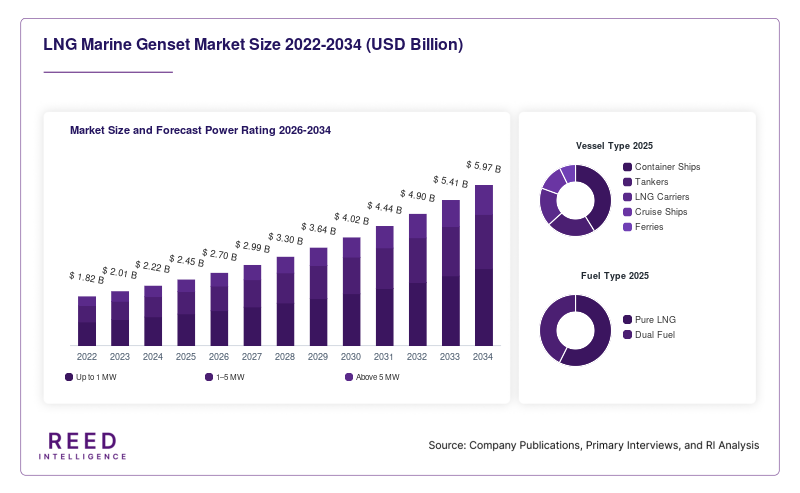
The LNG Marine Genset Market size was valued at USD 2.45 billion in 2025 and is projected to reach approximately USD 5.98 billion by 2034, expanding at a compound annual growth rate (CAGR) of 10.4% from 2025 to 2034. The increasing adoption of cleaner marine propulsion systems and auxiliary power solutions has been a significant contributor to market expansion. The global shift toward decarbonization in maritime operations has encouraged shipbuilders and fleet operators to integrate LNG-based gensets as a compliant and efficient alternative to conventional diesel-powered systems.
One of the major global factors supporting market growth is the implementation of stringent emission regulations across international waters, particularly those governed by maritime regulatory frameworks aimed at reducing sulfur oxide (SOx) and nitrogen oxide (NOx) emissions. LNG marine gensets provide a viable pathway for compliance while also improving operational efficiency and reducing fuel costs over time.
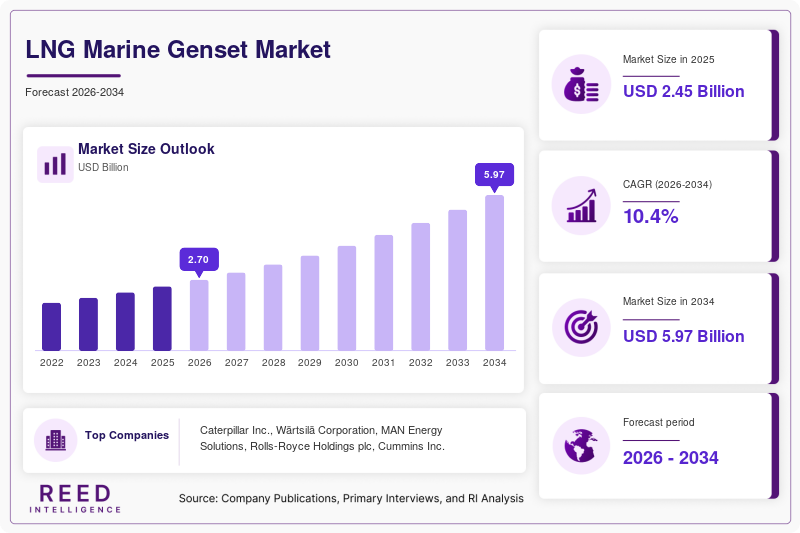
Key Highlights:
- Europe dominated the market with a share of 34.8% in 2025, while Asia Pacific is projected to register the fastest CAGR of 11.8% during the forecast period.
- By power rating, the 1–5 MW segment led with a 41.2% share in 2024, whereas the above 5 MW segment is expected to grow at a CAGR of 11.2%.
- By vessel type, container ships dominated with a 38.5% share, while LNG carriers are anticipated to witness the fastest growth at 12.1% CAGR.
- Norway remained the dominant country in 2024 with a market size of USD 312 million, reaching USD 335 million in 2025 due to strong LNG adoption policies.
Market Trends
Integration of Hybrid Power Systems in Marine Applications
The LNG Marine Genset Market is experiencing a growing trend toward hybridization, where LNG gensets are integrated with battery energy storage systems. This approach allows vessels to optimize fuel consumption by switching between LNG and stored electrical energy based on operational requirements. Hybrid configurations enhance fuel efficiency, reduce emissions during port operations, and improve overall system reliability. Shipowners are increasingly investing in such technologies to meet emission targets while maintaining operational flexibility.
Expansion of LNG Bunkering Infrastructure
The development of LNG bunkering facilities across major ports is significantly shaping the market landscape. Governments and private stakeholders are investing in infrastructure to support LNG fueling, thereby reducing logistical barriers for ship operators. This expansion is enabling wider adoption of LNG marine gensets across various vessel categories, including ferries, cruise ships, and cargo vessels. Improved fuel accessibility is expected to accelerate market penetration and strengthen the long-term outlook.
Market Drivers
Stringent Environmental Regulations in Maritime Industry
The enforcement of stricter emission norms has been a major driver for the LNG Marine Genset Market. Regulatory bodies have introduced limits on sulfur content in marine fuels, compelling ship operators to transition toward cleaner alternatives. LNG gensets significantly reduce harmful emissions compared to traditional diesel systems, making them an attractive solution for compliance. This regulatory push has led to increased retrofitting of existing vessels and incorporation of LNG gensets in new ship designs.
Rising Demand for Fuel-Efficient Marine Power Solutions
Operational cost optimization remains a priority for fleet operators, driving the demand for fuel-efficient technologies. LNG offers higher energy efficiency and lower fuel costs over time compared to conventional fuels. LNG marine gensets provide stable power output with reduced maintenance requirements, making them a preferred choice for long-haul and high-capacity vessels. This growing emphasis on cost efficiency is expected to sustain market growth during the forecast period.
Market Restraint
High Initial Investment and Infrastructure Costs
Despite the advantages of LNG marine gensets, the high upfront costs associated with system installation and supporting infrastructure pose a significant challenge. Shipowners must invest in specialized storage tanks, fuel handling systems, and safety mechanisms to accommodate LNG fuel. Additionally, limited availability of LNG bunkering facilities in certain regions increases operational complexities and discourages adoption. These financial and logistical barriers can slow down market growth, particularly among small and medium-sized fleet operators with limited capital resources.
Market Opportunities
Growth in LNG-Powered Vessel Fleet Expansion
The increasing number of LNG-powered vessels presents a substantial opportunity for the LNG Marine Genset Market. Shipbuilders are incorporating LNG-compatible systems into new vessel designs to meet future emission standards. This trend is expected to create sustained demand for advanced genset technologies, particularly in cargo shipping and passenger transport sectors.
Technological Advancements in Dual-Fuel Engines
Innovations in dual-fuel engine technology are opening new avenues for market growth. Modern LNG marine gensets are capable of operating on both LNG and conventional fuels, offering flexibility and reliability. These advancements reduce dependency on a single fuel source and enhance operational efficiency, making them attractive for diverse maritime applications. Continued research and development in this area are expected to drive adoption across emerging markets.
Segmental Analysis
By Power Rating
The 1–5 MW segment dominated the LNG Marine Genset Market with a 41.2% share in 2024. This segment’s leadership was attributed to its suitability for a wide range of vessels, including medium-sized cargo ships and ferries. Its balance between power output and fuel efficiency made it a preferred choice among operators.
The above 5 MW segment is projected to grow at the fastest CAGR of 11.2% during the forecast period. Increasing deployment in large vessels such as cruise ships and LNG carriers will drive growth. The demand for high-capacity power systems capable of supporting advanced onboard operations will further support this segment.
By Vessel Type
Container ships accounted for the largest share of 38.5% in 2024, driven by high demand for efficient and reliable auxiliary power systems. The growing global trade volume has increased the need for robust genset solutions in this segment.
The LNG carriers segment is expected to grow at a CAGR of 12.1%, supported by rising LNG transportation activities. These vessels require specialized gensets compatible with LNG fuel systems, creating strong demand for advanced technologies.
By Fuel Type
The pure LNG segment dominated the market with a 57.6% share in 2024, reflecting the increasing preference for dedicated LNG systems. These gensets offer maximum emission reduction benefits and improved efficiency.
The dual-fuel segment is projected to grow at a CAGR of 11.5%, driven by its operational flexibility. The ability to switch between LNG and conventional fuels ensures reliability in regions with limited LNG infrastructure.
By Application
The auxiliary power segment held the largest share of 63.4% in 2024, as LNG gensets are widely used for onboard electricity generation. This application is critical for supporting navigation systems, lighting, and other onboard operations.
The propulsion support segment is expected to grow at a CAGR of 10.9%, driven by increasing adoption of LNG-based propulsion systems. Integration of gensets into propulsion systems enhances overall vessel efficiency.
Regional Analysis
North America
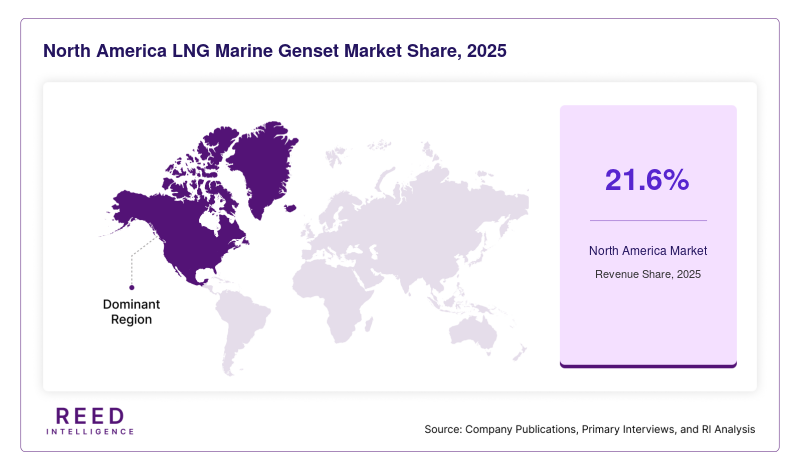
North America accounted for 21.6% of the LNG Marine Genset Market share in 2025 and is projected to grow at a CAGR of 9.6% during the forecast period. The region benefited from early adoption of clean fuel technologies and increasing investments in LNG infrastructure. The presence of advanced shipbuilding facilities and strong regulatory enforcement supported market expansion.
The United States dominated the regional market due to increasing adoption of LNG-powered ferries and inland waterway vessels. Government incentives promoting cleaner marine fuels and infrastructure development have played a key role in supporting market growth.
Europe
Europe held the largest share of 34.8% in 2025 and is expected to grow at a CAGR of 10.1% through 2034. The region’s leadership was attributed to strict environmental regulations and widespread adoption of LNG as a marine fuel. Established LNG bunkering networks further supported market penetration.
Norway emerged as the dominant country, driven by strong government support and early adoption of LNG-powered vessels. The country’s focus on sustainable maritime operations has significantly boosted demand for LNG marine gensets.
Asia Pacific
Asia Pacific represented 27.9% of the market in 2025 and is anticipated to register the fastest CAGR of 11.8% during the forecast period. Rapid industrialization, expanding shipping activities, and increasing investments in port infrastructure contributed to market growth.
China led the region due to large-scale shipbuilding activities and growing emphasis on emission reduction. Government initiatives promoting LNG adoption in maritime transport have accelerated market expansion.
Middle East & Africa
The Middle East & Africa accounted for 8.3% of the market share in 2025 and is projected to grow at a CAGR of 9.2%. The region benefited from abundant natural gas reserves and increasing focus on diversifying energy applications.
United Arab Emirates dominated the region, supported by investments in LNG infrastructure and growing maritime trade activities. Strategic initiatives to enhance port capabilities have also contributed to market growth.
Latin America
Latin America held a 7.4% share in 2025 and is expected to grow at a CAGR of 8.9% during the forecast period. The region’s growth was driven by increasing trade activities and gradual adoption of cleaner fuel technologies.
Brazil emerged as the leading country, supported by expanding offshore exploration activities and rising demand for efficient marine power solutions. Government policies promoting sustainable energy have further strengthened market prospects.
Competitive Landscape
The LNG Marine Genset Market is moderately consolidated, with key players focusing on technological innovation and strategic partnerships. Leading companies are investing in advanced dual-fuel technologies and expanding their product portfolios to meet evolving industry requirements.
A prominent market leader is Caterpillar Inc., which has strengthened its position through the development of high-efficiency LNG gensets designed for large marine vessels. The company recently introduced an upgraded dual-fuel genset platform with enhanced emission control capabilities, supporting compliance with global maritime regulations.
Other major players are actively pursuing collaborations with shipbuilders and LNG infrastructure providers to expand their market presence and improve product accessibility.
Key Players List
- Caterpillar Inc.
- Wärtsilä Corporation
- MAN Energy Solutions
- Rolls-Royce Holdings plc
- Cummins Inc.
- Mitsubishi Heavy Industries Ltd.
- Yanmar Co., Ltd.
- Hyundai Heavy Industries Co., Ltd.
- Siemens Energy AG
- ABB Ltd.
- Kawasaki Heavy Industries Ltd.
- Volvo Penta
- Doosan Infracore
- Bergen Engines AS
- Scania AB
Recent Developments
- Wärtsilä launched a next-generation LNG marine genset with improved fuel efficiency and reduced emissions.
- MAN Energy Solutions partnered with shipbuilders to develop integrated LNG propulsion and genset systems.
- Cummins introduced advanced dual-fuel marine generators targeting mid-sized vessels.
- Rolls-Royce expanded its LNG genset portfolio for hybrid marine applications.
- Mitsubishi Heavy Industries invested in R&D for high-capacity LNG marine power solutions.
LNG Marine Genset Market Segments
Power Rating
- Up to 1 MW
- 1–5 MW
- Above 5 MW
Vessel Type
- Container Ships
- Tankers
- LNG Carriers
- Cruise Ships
- Ferries
Fuel Type
- Pure LNG
- Dual Fuel
Application
- Auxiliary Power
- Propulsion Support
By Region
- North America
- Europe
- APAC
- Middle East and Africa
- LATAM