Loan Servicing Market Size, Share & Trends Analysis Report By Loan Type (Mortgage Loans, Consumer Loans, Auto Loans, Student Loans), By Servicing Type (Primary Servicing, Subservicing), By Component (Software, Services), By Deployment (Cloud-Based, On-Premise), By End User (Banks, Non-Bank Lenders, Credit Unions) and By Region (North America, Europe, APAC, Middle East and Africa, LATAM) Forecasts, 2026–2034
USD 3950
Loan Servicing Market Size
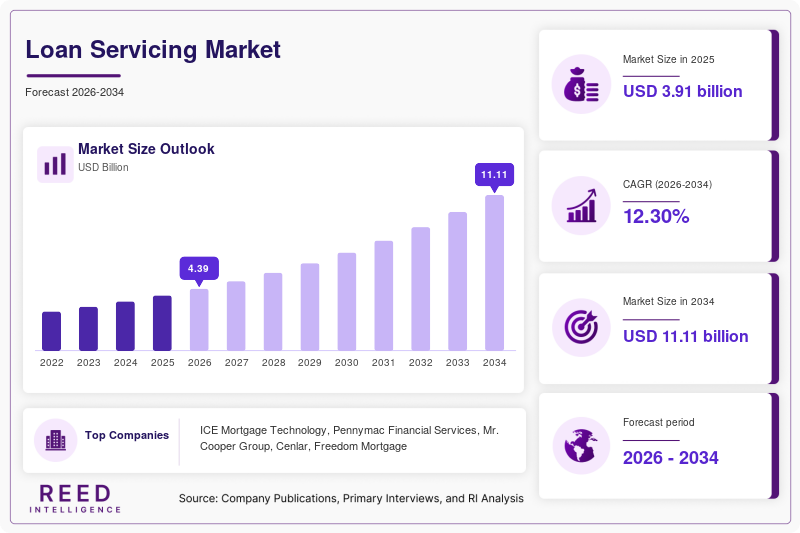
The global Loan Servicing Market size was valued at USD 3.91 billion in 2025 and is projected to grow from USD 4.39 billion in 2026 to USD 11.11 billion by 2034, registering a CAGR of 12.30% during the forecast period from 2026 to 2034.
The Loan Servicing Market covers the operational activities performed after a loan is originated, including payment processing, account maintenance, escrow administration, borrower communication, collections, delinquency management, reporting, document management, loan boarding, payoff processing and loss mitigation. Mortgage servicing is the most technology-intensive portion of the market, but servicing platforms are also used for consumer, auto, student and commercial lending.
The market is moving from transaction processing toward digitally managed, data-intensive servicing. ICE Mortgage Technology's servicing platform covers loan boarding, escrow, cash processing, payoff, default, collections, loss mitigation, APIs and borrower-facing digital engagement. ICE is also adding AI-powered conversational and voice tools to servicing workflows.
Regulation remains a major source of technology demand. U.S. mortgage servicers must maintain procedures for payment processing, error resolution, information requests, early intervention and loss mitigation under Regulation X and Regulation Z.
Servicing portfolios are also becoming larger and more specialized. Pennymac reported USD 720.3 billion of total loans serviced at March 31, 2026, while its second-quarter 2026 portfolio reached USD 731 billion, demonstrating the scale at which servicing operations are increasingly managed.
Loan Servicing Market Drivers
Growing Loan Portfolios Are Increasing the Recurring Servicing Workload
Loan servicing generates revenue and operational requirements for the entire duration of a loan. As lenders originate more mortgages, auto loans, consumer loans and commercial credit, the installed servicing portfolio becomes a recurring source of payment-processing, customer-service, collections and compliance activity.
Mortgage portfolios illustrate the mechanism particularly clearly. Pennymac's servicing portfolio increased from USD 665.8 billion at the end of 2024 to USD 733.6 billion at the end of 2025, a 10% increase. Its first-quarter 2026 servicing portfolio remained above USD 720 billion.
The servicing requirement continues even when loan origination slows because existing borrowers still require statements, payment processing, escrow management, customer support and payoff services.
For technology providers, a larger portfolio increases the value of scalable servicing systems because the cost of manually processing each account rises with portfolio size. ICE's MSP platform is designed to support servicers ranging from smaller operators to companies servicing millions of loans.
Digital Servicing and AI Are Reducing Manual Processing
Servicers are moving routine interactions from call centers and paper-based workflows toward digital self-service and automation. ICE Servicing Digital gives borrowers online access to loan and property information, while its servicing platform supports automated loan boarding, collections, loss mitigation, APIs and event-driven workflows.
AI is extending this automation. ICE introduced conversational chat and voice agents for borrowers and call-prediction capabilities for servicing employees in 2026. The company is positioning AI around repetitive inquiries, workflow automation and faster resolution rather than replacing all human servicing activity.
Pennymac is pursuing a similar direction. In June 2026, it expanded its strategic relationship with AWS to deploy generative AI across lending and servicing and developed conversational AI capabilities using Amazon Nova Sonic.
The commercial mechanism is lower cost per serviced account, faster response times and greater capacity without proportional growth in servicing personnel.
Compliance and Loss-Mitigation Requirements Increase Technology Spending
Loan servicing is highly regulated, particularly for residential mortgages. CFPB rules require servicers to maintain policies and procedures for payment processing, error resolution, requests for information, early intervention and loss mitigation.
Servicers must also provide accurate periodic information to borrowers and promptly credit payments. CFPB guidance specifies requirements covering payment application, statements and payoff information.
This creates demand for systems that maintain audit trails, automate notices, document borrower interactions and route exceptions to employees. Regulatory complexity therefore acts as a direct technology-demand mechanism.
Fannie Mae's servicing-process changes also illustrate the operational impact. Its 2026 changes include new escrow reporting requirements and broader process modernization, requiring servicers to update systems and workflows.
Loan Servicing Market Restraints
Legacy Systems and Data Fragmentation Increase Modernization Costs
Many loan-servicing operations depend on legacy systems that were built around batch processing, mainframes and fragmented data architectures. ICE itself describes mortgage servicing as an environment where disconnected systems and manual tasks remain common.
Modernization therefore requires data migration, API integration, testing, regulatory validation and employee training. Servicers cannot simply replace a core platform without considering payment histories, escrow balances, borrower records, investor reporting and servicing-transfer requirements.
ICE's ongoing data-center migration illustrates the scale of this infrastructure challenge. Its migration includes MSP and other servicing applications and requires staged implementation with customer and partner participation.
AI Adoption Is Constrained by Governance, Privacy and Regulatory Risk
AI can reduce servicing costs, but financial institutions must control how automated systems interact with borrowers and make servicing-related decisions. ICE notes that servicers are increasingly concerned about accountability, auditability, data security and regulatory oversight when deploying AI.
Fannie Mae and Freddie Mac have introduced AI-governance expectations for sellers and servicers, including policies governing AI use and the ability to disclose information about AI systems and safeguards.
This creates additional implementation costs. Servicers need model governance, human oversight, monitoring, documentation and controls before highly automated servicing workflows can be deployed at scale.
Loan Servicing Market Opportunities
AI-Powered Borrower Servicing
Conversational AI, voice agents and automated case routing provide a significant opportunity to reduce repetitive servicing interactions. ICE is already integrating AI into borrower-facing chat and voice functions, while Pennymac is deploying generative AI through AWS.
The largest opportunity is not simply chatbot deployment. AI can connect borrower intent with account data, payment history, loan terms and servicing workflows, allowing routine questions to be resolved without transferring the borrower between departments.
Servicing-as-a-Service and Subservicing Expansion
Financial institutions increasingly have the option to retain servicing rights while outsourcing operational servicing to specialist providers. This creates demand for subservicing platforms and specialist operators.
Pennymac's February 2026 agreement to acquire Cenlar's subservicing business provides a major industry example. The transaction was expected to add up to USD 740 billion of unpaid principal balance and 2 million loans to Pennymac's servicing portfolio, potentially taking the company's total portfolio above USD 1 trillion.
This creates opportunities for technology providers, specialized subservicers and firms offering servicing infrastructure to financial institutions that do not want to build every servicing function internally.
Cloud-Based Servicing Platforms
Cloud deployment can help servicers scale infrastructure, integrate APIs and deploy new digital capabilities without maintaining the entire technology stack themselves.
Pennymac selected AWS as its preferred cloud provider in June 2026, linking cloud infrastructure with generative AI deployment and commercialization of its servicing platform.
The opportunity is particularly relevant for smaller banks, credit unions, fintech lenders and non-bank originators that need enterprise-grade servicing capabilities without building large technology organizations.
Segmental Analysis
By Loan Type
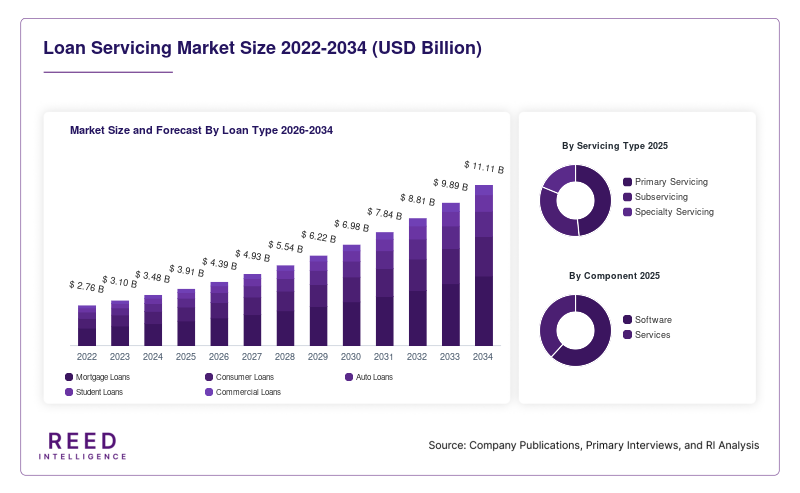
Mortgage Loans represent approximately 52% of the global market in 2025, making them the largest loan-servicing segment. Mortgage servicing requires payment processing, escrow management, tax and insurance administration, borrower communication, loss mitigation, foreclosure workflows and extensive regulatory reporting. CFPB Regulation X and Regulation Z contain specific servicing requirements covering these activities.
Consumer Loans account for approximately 18%, followed by Auto Loans at 14%, Student Loans at 9% and Commercial Loans at 7%.
Consumer Loans are the fastest-growing loan type, with approximately 14.2% CAGR. Digital lending and automated account management are increasing the number of borrowers managed through online servicing environments.
By Servicing Type
Primary Servicing represents approximately 56% of the market in 2025 because banks, mortgage companies and specialist lenders continue to retain direct responsibility for significant loan portfolios.
Subservicing accounts for approximately 29%, while Specialty Servicing represents approximately 15%.
Subservicing is the fastest-growing category, with approximately 15.1% CAGR. The Pennymac-Cenlar transaction demonstrates the scale of consolidation and outsourcing occurring in mortgage servicing. Pennymac expected the acquisition to add up to USD 740 billion in subservicing UPB and 2 million loans.
By Component
Software represents approximately 43% of the market in 2025. Core servicing platforms, borrower portals, workflow systems, analytics, APIs and automation tools form the technology layer supporting servicing operations.
Services account for approximately 57%, reflecting the labor-intensive nature of payment processing, customer service, collections, default management, compliance and specialized servicing.
Software is the fastest-growing component, with approximately 16.0% CAGR, as servicing providers migrate toward automated workflows, cloud systems and AI-assisted operations.
ICE's servicing platform illustrates the breadth of software functionality, including loan boarding, escrow, collections, loss mitigation, APIs, servicing events and borrower engagement.
By Deployment
Cloud-Based deployment represents approximately 62% of the market and is the fastest-growing deployment category, with approximately 16.3% CAGR.
Cloud platforms provide scalable computing, API integration and faster deployment of analytics and AI capabilities. Pennymac's 2026 AWS expansion illustrates the connection between cloud infrastructure and generative AI deployment in servicing.
On-Premise systems account for approximately 38%. They remain important among institutions with legacy servicing infrastructure, complex internal integrations or specific data-control requirements.
By End User
Banks represent approximately 29% of the market in 2025, reflecting their large loan portfolios and established servicing operations.
Mortgage Companies & Servicers account for approximately 27%, followed by Non-Bank Lenders at 19%, Credit Unions at 14% and Government & Institutional Lenders at 11%.
Non-Bank Lenders are the fastest-growing end-user segment, with approximately 15.0% CAGR. Their growth increases demand for scalable third-party servicing, subservicing and technology because many non-bank lenders prioritize origination and capital-market activities while outsourcing portions of servicing operations.
Regional Analysis
North America Loan Servicing Market
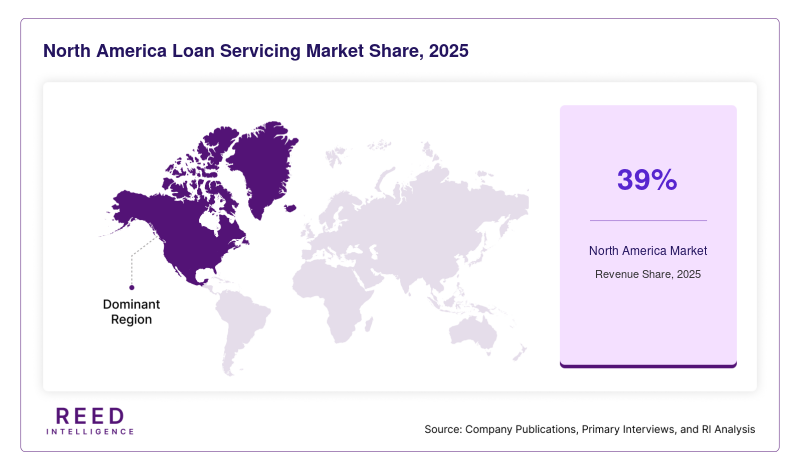
North America represents approximately 39% of the global Loan Servicing Market in 2025, making it the largest regional market. The region benefits from a large mortgage-servicing ecosystem, extensive consumer lending, mature financial infrastructure and strong regulatory requirements.
The U.S. mortgage market is particularly important because servicing involves payment processing, escrow, borrower communication, loss mitigation and extensive compliance obligations. CFPB rules require servicers to maintain procedures covering these functions, creating continuing demand for specialized servicing technology.
Large servicing portfolios also support specialist providers. Pennymac reported USD 731 billion in total servicing portfolio UPB at June 30, 2026, while its February 2026 Cenlar acquisition announcement indicated that its total portfolio could exceed USD 1 trillion after the transaction.
North America is projected to grow at approximately 10.8% CAGR through 2034. AI-based customer service, cloud migration, servicing-rights transactions and loss-mitigation automation will remain important technology mechanisms.
Europe Loan Servicing Market
Europe accounts for approximately 25% of the global market in 2025 and is projected to grow at approximately 11.4% CAGR.
The European market is influenced by bank modernization, digital banking adoption, consumer-credit regulation and growing use of cloud-based financial infrastructure. Loan servicing is increasingly connected to digital payment systems, automated communications and centralized customer platforms.
European lenders also operate in multiple regulatory jurisdictions, increasing the value of standardized workflows and automated compliance. Data quality and auditability are important because servicing platforms must maintain accurate records across long loan lifecycles.
Mortgage and consumer lending remain the principal demand centers, while fintech lenders add demand for API-based servicing infrastructure. Cloud adoption is expected to remain a key modernization mechanism, although data-residency, cybersecurity and legacy-bank integration requirements can slow migration.
APAC Loan Servicing Market
APAC represents approximately 20% of the global market in 2025 and is the fastest-growing region, with approximately 16.2% CAGR.
The region combines large banking populations, growing consumer-credit penetration, expanding digital lending and rapid adoption of mobile financial services. China, India, Japan, Australia, South Korea and Southeast Asia represent distinct servicing markets with different regulatory and lending structures.
The strongest expansion is occurring where digital lenders and banks use cloud-based infrastructure to manage rapidly expanding portfolios. Automated repayment notifications, digital borrower onboarding, collections analytics and self-service portals can reduce the cost of servicing large consumer-loan populations.
The region also provides opportunities for third-party servicing providers because many fintech lenders prioritize customer acquisition and loan origination rather than building complete servicing operations internally.
APAC's main constraints are regulatory fragmentation, differences in credit infrastructure, data-localization requirements and uneven maturity among national lending markets.
Middle East and Africa Loan Servicing Market
Middle East and Africa represents approximately 7% of the global market in 2025 and is projected to grow at approximately 13.6% CAGR.
Digital banking expansion, mobile lending and increasing consumer-finance penetration are supporting demand for automated loan account management. The region also has opportunities for cloud-based servicing because newer financial institutions can adopt modern platforms without maintaining extensive legacy infrastructure.
The servicing opportunity is strongest in markets with rapidly expanding consumer and SME lending. Automated collections and borrower communication are particularly relevant because lenders need to manage larger portfolios without proportionally increasing branch and servicing staff.
The principal constraints are fragmented regulatory environments, differences in credit reporting infrastructure and varying levels of digital-payment penetration.
LATAM Loan Servicing Market
LATAM accounts for approximately 9% of the global market in 2025 and is projected to grow at approximately 14.5% CAGR.
Brazil and Mexico represent major lending markets, while fintech expansion is increasing the number of digital consumer-credit accounts requiring automated servicing. Digital payments and mobile banking adoption create a foundation for online repayment, borrower notifications and automated collections.
The region's commercial opportunity is particularly strong for cloud-based servicing platforms that integrate loan records with payment gateways, credit data, customer communication and collections systems.
The principal constraints include currency volatility, regulatory differences between countries and credit-quality variation across borrower groups. Servicing providers with localized compliance and collections capabilities can therefore gain an advantage over standardized cross-border systems.
Competitive Landscape
The Loan Servicing Market is divided between large servicing operators, mortgage subservicers, banks with internal servicing infrastructure and technology providers supplying core servicing platforms.
ICE Mortgage Technology has a broad servicing technology footprint through MSP, Servicing Digital, Customer Service, Loss Mitigation, Collections, APIs and Servicing Events. Its platform is designed to support the entire servicing lifecycle from loan boarding through payoff or default.
ICE is also positioning AI as a core competitive layer. In 2026 it introduced conversational chat and voice agents, call prediction and AI capabilities through ICE Aurora. The company's emphasis on governance, auditability and human oversight is particularly relevant because mortgage servicing is highly regulated.
Pennymac is expanding both its servicing portfolio and its technology capabilities. Its servicing portfolio reached USD 731 billion in June 2026, while its acquisition of Cenlar's subservicing business could add up to USD 740 billion of UPB and 2 million loans.
Key Market Players
- ICE Mortgage Technology
- Pennymac Financial Services
- Mr. Cooper Group
- Cenlar
- Freedom Mortgage
- Lakeview Loan Servicing
- RoundPoint Mortgage Servicing
- LoanCare
- ServiceMac
- SLS
- Black Knight / ICE
- Fiserv
- Finastra
- Temenos
- Jack Henry
- Sagent
Recent Market Developments
- June 2026 – Pennymac expanded its AWS partnership. The company selected AWS as its preferred cloud provider and announced plans to use generative AI across lending and servicing, including conversational AI powered by Amazon Nova Sonic. This links cloud infrastructure directly with servicing automation and borrower engagement.
- July 2026 – ICE detailed its AI governance approach for servicing. ICE said its servicing AI is being designed around governance, auditability and explainability, with human oversight and configurable controls. The development addresses the need to automate servicing while maintaining regulatory defensibility.
Loan Servicing Market Segments
By Loan Type
- Mortgage Loans
- Consumer Loans
- Auto Loans
- Student Loans
- Commercial Loans
By Servicing Type
- Primary Servicing
- Subservicing
- Specialty Servicing
By Component
- Software
- Services
By Deployment
- Cloud-Based
- On-Premise
By End User
- Banks
- Non-Bank Lenders
- Credit Unions
- Mortgage Companies & Servicers
- Government & Institutional Lenders
By Region
- North America
- Europe
- APAC
- Middle East and Africa
- LATAM