Log Splitter Market Size, Share & Demand Report By Product Type (Hydraulic Log Splitters, Electric Log Splitters, Gas-Powered Log Splitters, Manual Log Splitters), By Application (Residential Firewood Processing, Commercial Forestry, Landscaping and Land Clearing), By End Use (Residential, Commercial, Industrial), By Distribution Channel (Online Retail, Specialty Equipment Stores, Home Improvement Retailers) By Region & Segment Forecasts, 2026–2034
USD 3950
Market Overview
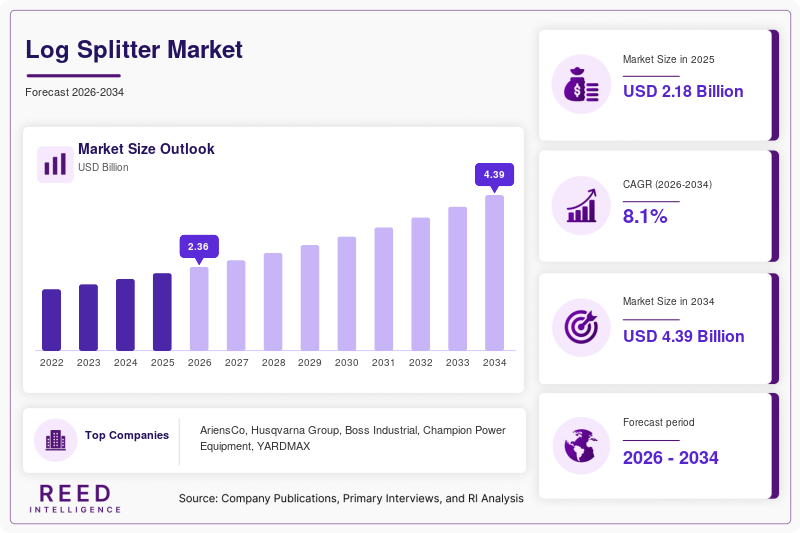
The global Log Splitter Market size was valued at USD 2.18 billion in 2026 and is projected to reach USD 4.06 billion by 2034, expanding at a CAGR of 8.1% during the forecast period. Rising demand for efficient wood processing equipment across residential, commercial, and forestry applications continues to support long-term market growth. Log splitters are increasingly used by homeowners, firewood suppliers, landscaping contractors, and agricultural operators due to their ability to reduce manual labor and improve operational efficiency. Expanding adoption of biomass heating systems and wood-burning stoves in colder regions has also created favorable demand conditions for advanced hydraulic and electric log splitting systems.
The growing emphasis on productivity and workplace safety in forestry and agricultural operations has encouraged manufacturers to introduce equipment with enhanced splitting force, automated controls, and compact mobility features. Demand for electric-powered log splitters has increased steadily as consumers seek quieter and low-maintenance alternatives to conventional gasoline-powered systems. Manufacturers are also integrating ergonomic designs, towable configurations, and energy-efficient hydraulic technologies to improve usability for both professional and residential customers.
Key Highlights
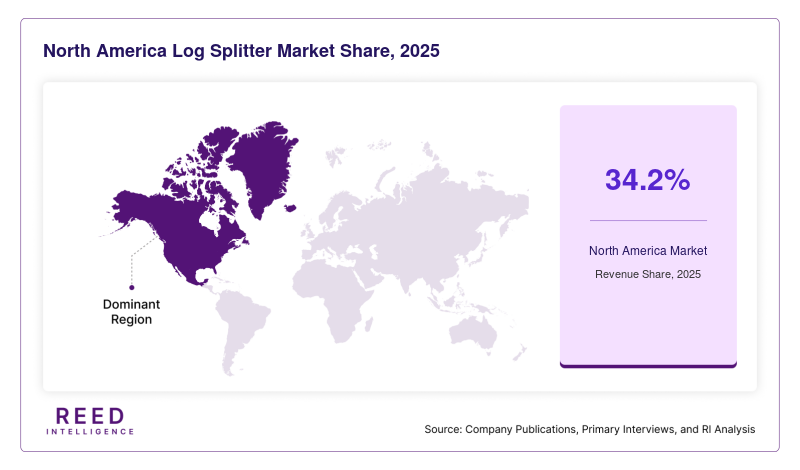
- North America dominated the market with a 34.2% share in 2025.
- Asia Pacific is expected to grow at the fastest CAGR of 10.8% during 2026–2034.
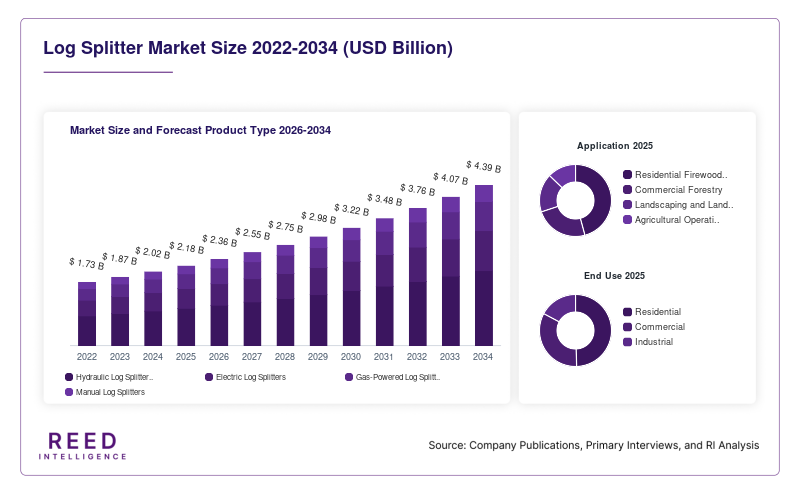
- By product type, hydraulic log splitters accounted for the largest share of 46.8%.
- while electric log splitters are projected to grow at a CAGR of 11.6%.
- By application, residential firewood processing led with a 39.7% share, whereas commercial forestry applications are expected to expand at a CAGR of 10.9%.
- The United States remained the dominant country, with market values of USD 620 million in 2024 and USD 685 million in 2025.
Market Trends
Expansion of Electric and Battery-Powered Equipment
The market is witnessing increased adoption of electric and battery-powered log splitters due to rising consumer preference for environmentally responsible equipment with lower operating noise and reduced maintenance requirements. Residential users and small commercial operators are increasingly replacing gasoline-powered systems with electric alternatives that offer easier startup mechanisms, compact designs, and lower fuel dependency. Improvements in lithium-ion battery technology have also enabled manufacturers to introduce cordless log splitters capable of supporting moderate-duty applications without significant performance loss. Retail distribution channels are promoting electric models aggressively because of their affordability and suitability for suburban and semi-urban consumers. As emission regulations become more stringent in developed economies, demand for energy-efficient log splitting equipment is expected to accelerate further.
Rising Integration of Smart Hydraulic Systems
Manufacturers are increasingly integrating smart hydraulic systems and automated control features into modern log splitters to improve productivity and user safety. Advanced pressure control mechanisms, automatic cycle return functions, and variable splitting force settings are becoming common across premium product categories. These technologies help operators process large volumes of wood with reduced physical effort and improved operational consistency. Commercial forestry operators are particularly investing in equipment with real-time performance monitoring and enhanced hydraulic durability to reduce downtime during peak seasonal demand. Compact towable systems equipped with improved mobility features are also gaining popularity among contractors and rural landowners. The growing use of durable steel frames and corrosion-resistant materials is further supporting product longevity and improving customer replacement cycles.
Market Drivers
Growing Demand for Firewood and Biomass Heating Solutions
The increasing use of firewood and biomass-based heating systems across residential and commercial sectors is a major factor supporting growth in the Log Splitter Market. Consumers in colder climates continue to rely on wood-burning stoves, furnaces, and biomass boilers as cost-effective alternatives to conventional heating systems. This trend has increased demand for efficient wood processing equipment capable of handling large quantities of logs in shorter periods. Rural households and small-scale firewood businesses are investing in hydraulic and electric log splitters to improve productivity and reduce labor-intensive operations. Rising energy costs in several developed economies have further encouraged consumers to adopt wood-based heating solutions, thereby strengthening long-term market demand for durable and efficient log splitting equipment.
Expansion of Forestry and Landscaping Activities
The steady expansion of forestry management, landscaping, and agricultural land maintenance activities has increased the need for advanced wood processing machinery. Commercial operators require reliable equipment for handling tree maintenance, land clearing, and firewood preparation tasks efficiently. Government initiatives supporting sustainable forest management and wildfire prevention programs have also contributed to the growing adoption of heavy-duty log splitters. Landscaping contractors increasingly prefer portable and towable systems that can operate across diverse terrain conditions. The market is additionally benefiting from the rising number of residential property owners investing in outdoor maintenance equipment for seasonal wood processing. Improved product availability through online retail platforms and regional dealer networks has further accelerated equipment adoption among first-time buyers.
Market Restraint
High Initial Equipment Cost and Seasonal Demand Variability
The relatively high purchase cost of advanced hydraulic and commercial-grade log splitters remains a key restraint for the market, particularly among small-scale users and cost-sensitive consumers. Heavy-duty equipment with high splitting force, towable functionality, and automated hydraulic systems often requires significant upfront investment, which can discourage adoption among residential customers. In addition, maintenance expenses associated with hydraulic systems, engine servicing, and replacement components can increase long-term ownership costs. Seasonal demand variability also creates revenue instability for manufacturers and distributors because equipment sales are concentrated heavily during colder months in North America and Europe. During periods of weak winter demand or fluctuating firewood prices, purchasing activity can decline noticeably. Smaller manufacturers may also face operational challenges related to inventory management and production planning, especially in regions where climate conditions limit year-round equipment usage.
Market Opportunities
Increasing Adoption in Emerging Rural Economies
Emerging economies across Asia Pacific and Latin America present substantial growth opportunities for the Log Splitter Market due to expanding rural infrastructure and rising mechanization in agricultural operations. Farmers and rural landowners are increasingly investing in compact wood processing equipment to improve labor efficiency and reduce dependence on manual splitting methods. Governments in developing regions are supporting agricultural modernization programs that encourage the adoption of mechanized equipment for forestry and land maintenance activities. Local distributors are also expanding product availability through regional retail partnerships and digital commerce platforms. Affordable electric and entry-level hydraulic models are expected to gain traction among price-sensitive customers seeking practical solutions for household and small-scale commercial applications.
Product Innovation Focused on Safety and Portability
Manufacturers have significant opportunities to strengthen market presence through innovations focused on operator safety, portability, and energy efficiency. Consumers increasingly prefer equipment with enhanced ergonomic controls, automatic shutoff systems, and compact storage capabilities. Demand for lightweight and towable log splitters is rising among landscaping contractors and mobile forestry operators who require flexible equipment for remote job sites. Companies are also investing in hybrid hydraulic systems and battery-powered models to address tightening environmental standards and fuel efficiency concerns. Integration of modular designs and quick-maintenance features can further improve product adoption by reducing servicing complexity for end users. Continuous innovation in safety-focused equipment is expected to create favorable opportunities across both residential and commercial segments.
Segmental Analysis
By Product Type
Hydraulic log splitters accounted for the largest market share in 2024 due to their high splitting force, durability, and suitability for heavy-duty applications. These systems are widely used across commercial forestry, agricultural operations, and large-scale firewood production because they can process dense hardwood materials efficiently. Professional operators prefer hydraulic models for their operational reliability and ability to handle continuous workloads during peak seasonal demand. Manufacturers are increasingly introducing advanced hydraulic pressure systems, reinforced steel frames, and towable configurations to improve product performance and mobility. The segment also benefits from strong demand among rural homeowners who require powerful equipment for long-term residential wood processing needs. Expanding dealer networks and improved financing options have further contributed to the dominance of hydraulic log splitters across developed markets.
Electric log splitters are expected to witness the fastest CAGR of 11.6% during the forecast period due to rising demand for low-maintenance and environmentally efficient equipment. Residential users increasingly prefer electric systems because of their quieter operation, easy startup mechanisms, and reduced fuel dependency. Advancements in battery technology and motor efficiency are enabling manufacturers to introduce portable cordless models capable of supporting moderate-duty operations. Urban and suburban consumers are particularly attracted to compact electric systems that require limited storage space and minimal servicing requirements. Regulatory pressure related to emissions and fuel consumption is also encouraging the transition toward electric-powered equipment in several developed economies. Continuous innovation in lightweight construction materials and user-friendly safety features is expected to strengthen growth across this segment.
By Application
Residential firewood processing represented the dominant application segment in 2024, accounting for a substantial share of global revenue generation. Consumers in colder climates continue to use firewood for home heating, recreational outdoor activities, and supplemental energy needs. This has created steady demand for compact and mid-sized log splitters capable of supporting seasonal household wood processing requirements. Homeowners increasingly prefer equipment with enhanced safety controls, ergonomic handles, and transport wheels to improve operational convenience. Manufacturers are also targeting residential buyers through e-commerce platforms and retail distribution channels offering affordable entry-level products. Rising interest in self-sufficient heating solutions and outdoor living activities has further strengthened the adoption of residential log splitting equipment.
Commercial forestry applications are projected to expand at the fastest CAGR of 10.9% through 2034 due to increasing mechanization within timber harvesting and land management operations. Forestry contractors require high-capacity equipment capable of processing large wood volumes efficiently while minimizing operational downtime. Advanced hydraulic log splitters with automated cycle functions and reinforced components are gaining popularity among commercial operators seeking higher productivity levels. Governments and private forestry organizations are also investing in wildfire prevention and sustainable forest management programs, which support demand for industrial-grade wood processing equipment. Growing infrastructure development and land clearing activities across emerging economies are expected to create additional growth opportunities for this segment over the coming years.
By End Use
The residential end-use segment held the largest share of the Log Splitter Market in 2024 due to increasing household demand for firewood preparation equipment. Rural and semi-urban homeowners continue to invest in portable log splitters to reduce manual labor and improve wood processing efficiency during winter seasons. Consumers prefer equipment that combines affordability, ease of operation, and compact storage capability. Electric and low-capacity hydraulic models are widely adopted within this segment because they provide sufficient performance for moderate residential use. Manufacturers are increasingly focusing on user-friendly controls, enhanced safety systems, and lightweight product designs to attract first-time buyers. Seasonal promotional campaigns and online retail availability have also contributed significantly to expanding residential equipment sales.
The commercial end-use segment is anticipated to register the fastest growth rate during the forecast period, supported by increasing investments in forestry operations, landscaping services, and agricultural maintenance projects. Commercial operators require durable and high-performance log splitters capable of handling intensive workloads over extended operational periods. Demand for towable hydraulic systems and automated splitting technologies is increasing among contractors seeking greater productivity and reduced labor dependency. The segment is also benefiting from rising biomass fuel production and industrial firewood supply activities across North America and Europe. Expanding adoption of preventive land management programs and vegetation control initiatives in wildfire-prone regions is expected to strengthen long-term demand for commercial-grade equipment.
Regional Analysis
North America
North America accounted for 34.2% of the global Log Splitter Market in 2025 and continues to maintain a strong position due to high firewood consumption and extensive forestry activities. The regional market is projected to expand at a CAGR of 7.9% during the forecast period. Strong seasonal demand for residential heating equipment and growing adoption of biomass fuel systems are supporting equipment sales across the United States and Canada. Consumers in rural regions increasingly prefer hydraulic and towable log splitters capable of processing larger wood volumes efficiently.
The United States remains the dominant country within the region due to widespread use of firewood for residential heating and recreational applications. The country benefits from a large network of equipment manufacturers, outdoor power equipment retailers, and forestry contractors. Rising investment in wildfire prevention and land management activities has also contributed to growing demand for heavy-duty wood processing equipment. Increasing consumer preference for electric-powered log splitters is further supporting market expansion in suburban residential areas.
Europe
Europe represented a significant share of the Log Splitter Market in 2025 and is expected to grow at a CAGR of 7.4% through 2034. The region benefits from strong adoption of biomass heating systems and wood pellet production activities across several countries. Demand for efficient wood processing equipment remains stable due to colder climate conditions and increasing energy cost concerns. Commercial forestry operators are investing in advanced hydraulic systems to improve productivity and reduce manual labor requirements during seasonal harvesting operations.
Germany remains the leading country in the European market due to its advanced forestry industry and growing focus on renewable heating alternatives. The country has witnessed rising installation of wood-based residential heating systems, which has increased firewood processing activities among homeowners and small businesses. Manufacturers in Germany are also introducing compact electric and battery-powered log splitters to comply with regional emission regulations. Strong engineering capabilities and established equipment distribution networks continue to support regional product innovation.
Asia Pacific
Asia Pacific is expected to register the fastest CAGR of 10.8% during the forecast period due to expanding rural mechanization and increasing forestry activities. The region is witnessing growing demand for compact and affordable log splitting equipment among agricultural operators and small-scale wood processing businesses. Countries across Southeast Asia and East Asia are increasingly adopting mechanized tools to improve operational efficiency and reduce labor dependency. Rising awareness regarding workplace safety and productivity enhancement is also supporting regional equipment adoption.
China dominates the Asia Pacific market owing to its large manufacturing base and expanding rural infrastructure development. The country benefits from increasing production of affordable hydraulic and electric log splitters for both domestic consumption and export markets. Rapid growth in construction and land clearing projects has created additional demand for wood processing equipment. E-commerce expansion and digital retail platforms are enabling broader product accessibility, particularly among consumers located in secondary and tertiary urban regions.
Middle East & Africa
The Middle East & Africa region accounted for a smaller share of the global market in 2025 but is projected to experience steady growth at a CAGR of 6.8% through 2034. Demand is gradually increasing due to expanding agricultural modernization programs and rising investments in landscaping activities. Several countries are adopting mechanized land maintenance equipment to improve operational efficiency in commercial farming and infrastructure development projects. Portable and fuel-powered log splitters are particularly preferred in remote areas with limited electricity access.
South Africa remains the leading country within the region due to its established forestry sector and growing demand for wood processing machinery. Commercial farming and timber production activities continue to support equipment sales across the country. Government efforts to improve rural productivity and land management practices have also encouraged adoption of mechanized tools. Local distributors are increasingly partnering with international manufacturers to expand product availability and provide maintenance support for commercial users.
Latin America
Latin America is projected to grow at a CAGR of 7.1% during the forecast period due to rising forestry management activities and expanding agricultural operations. Demand for log splitters is increasing among commercial firewood suppliers, rural landowners, and timber processing businesses. Countries across the region are witnessing gradual mechanization of forestry operations as labor costs continue to rise. Compact hydraulic systems are gaining traction because of their operational reliability and suitability for diverse environmental conditions.
Brazil leads the Latin American market due to its extensive forestry resources and growing commercial wood processing sector. Increasing use of biomass fuel and wood-based heating applications in rural communities has strengthened demand for efficient firewood preparation equipment. The country is also experiencing higher investment in land clearing and agricultural expansion projects, which require reliable wood management machinery. Regional manufacturers are focusing on cost-effective equipment models to improve accessibility among small and medium-scale users.
Competitive Landscape
The Log Splitter Market remains moderately fragmented, with established outdoor power equipment manufacturers competing alongside regional hydraulic machinery suppliers. Companies are focusing on product durability, energy efficiency, and distribution expansion to strengthen market presence. Leading manufacturers continue to invest in advanced hydraulic systems, portable product designs, and electric-powered technologies to meet changing customer preferences across residential and commercial segments.
AriensCo remains one of the leading participants in the market due to its strong outdoor equipment portfolio and extensive dealer network across North America. The company has focused on expanding its heavy-duty log splitter range with improved hydraulic efficiency and enhanced safety mechanisms. Other major participants, including Husqvarna Group, Boss Industrial, Champion Power Equipment, and YARDMAX, are investing in battery-powered and compact towable systems to improve competitiveness.
Key Players
- AriensCo
- Husqvarna Group
- Boss Industrial
- Champion Power Equipment
- YARDMAX
- Dirty Hand Tools
- Swisher Acquisition Inc.
- Brave Products
- Power King
- DK2 Power
- Oregon Tool Inc.
- NorthStar
- Iron & Oak
- Toro Company
- SuperHandy
Recent Developments
- AriensCo introduced a new high-capacity hydraulic log splitter series in 2025 featuring improved cycle speed and enhanced towable functionality for commercial forestry applications.
- Husqvarna Group expanded its electric outdoor equipment portfolio in 2024 by launching compact battery-powered log splitters designed for residential users seeking lower operational noise.
- Champion Power Equipment announced a distribution partnership with regional agricultural equipment retailers in Latin America during 2025 to strengthen its presence in emerging rural markets.
- YARDMAX released an upgraded vertical-horizontal log splitter model in 2024 equipped with reinforced hydraulic components and advanced operator safety controls.
Log Splitter Market Segments
Product Type
- Hydraulic Log Splitters
- Electric Log Splitters
- Gas-Powered Log Splitters
- Manual Log Splitters
Application
- Residential Firewood Processing
- Commercial Forestry
- Landscaping and Land Clearing
- Agricultural Operations
End Use
- Residential
- Commercial
- Industrial
Distribution Channel
- Online Retail
- Specialty Equipment Stores
- Home Improvement Retailers
- Dealer Networks
- Direct Sales
By Region
- North America
- Europe
- APAC
- Middle East and Africa
- LATAM