Logistics and Warehousing Market Size, Share & Trends Analysis Report By Service Type, By Mode of Transportation, By End-Use Industry, and By Region (North America, Europe, Asia Pacific, Latin America, Middle East & Africa) Forecasts, 2026–2034
USD 3950
Logistics and Warehousing Market Size
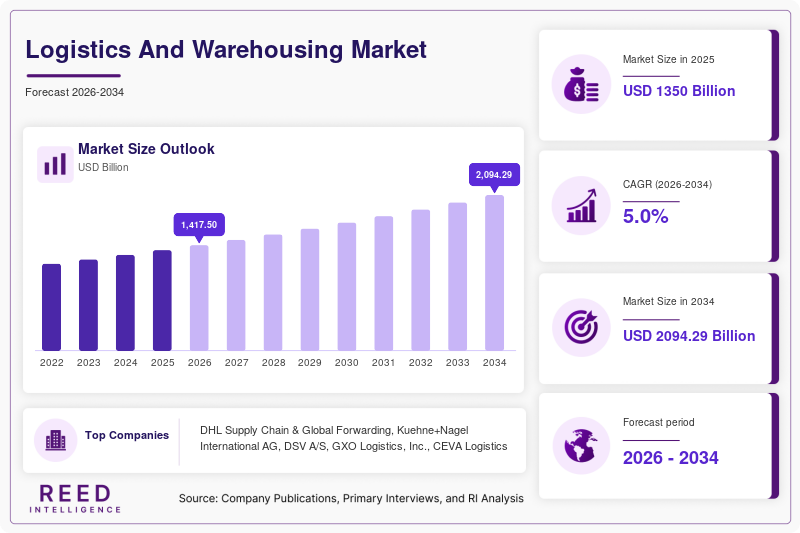
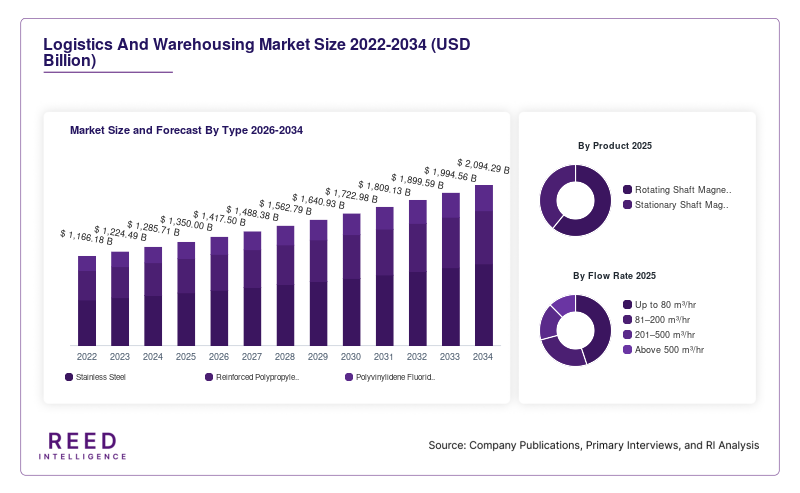
The global logistics and warehousing market size was valued at USD 1,350 billion in 2025 and is projected to grow from USD 1,417.50 billion in 2026 to USD 2,94.29 billion by 2034, registering a CAGR of 5.0% during the forecast period from 2026 to 2034.
The logistics and warehousing market encompasses services and infrastructure used to transport, store, handle, manage, and distribute goods throughout domestic and international supply chains. It includes freight transportation, warehousing, inventory management, order fulfilment, packaging, material handling, distribution, and value-added logistics services. These activities support manufacturing, retail, e-commerce, healthcare, automotive, food and beverage, and other industries that depend on the timely movement of raw materials and finished products.
Market development is being shaped by expanding e-commerce activity, international trade, increasingly complex supply chains, and the adoption of digital technologies. Businesses are investing in warehouse automation, real-time shipment tracking, transportation management systems, and integrated inventory platforms to improve visibility and operational efficiency. Third-party logistics providers are also expanding their service portfolios to offer integrated transportation, storage, fulfilment, and distribution solutions.
Logistics and Warehousing Market Drivers
Expansion of E-Commerce and Omnichannel Retail
The continued expansion of online retail is increasing demand for integrated logistics and warehousing services. E-commerce businesses require strategically located fulfilment centres, inventory storage, parcel sorting, last-mile delivery, and reverse-logistics capabilities. Omnichannel retail models also require coordination between physical stores, online orders, distribution centres, and customer returns. Logistics providers are responding through regional warehouse networks, flexible fulfilment services, and technology-enabled inventory management.
Growth in Global Trade and Manufacturing
Manufacturing expansion and cross-border trade support demand for freight transportation, industrial warehousing, customs coordination, and distribution services. Automotive, electronics, machinery, chemicals, consumer goods, and other industries rely on logistics providers to move components and finished products between suppliers, factories, ports, and end markets. Businesses increasingly use integrated logistics services to coordinate international shipments, reduce supply-chain complexity, and maintain continuity across geographically dispersed production networks.
Adoption of Automation and Digital Logistics Technologies
Warehouse automation and digital supply-chain platforms are supporting improvements in productivity, inventory accuracy, and shipment visibility. Automated storage systems, robotics, transport management software, warehouse management systems, and predictive analytics help operators coordinate labour, space, equipment, and transport capacity. As supply chains become more data-intensive, logistics providers are investing in integrated systems that improve planning, customer communication, and operational responsiveness.
Logistics and Warehousing Market Restraints
High Capital and Operating Costs
Developing and operating warehouses, distribution centres, transport fleets, and automated facilities requires substantial investment. Costs include land, construction, equipment, energy, labour, vehicle maintenance, insurance, and information technology. Automation can improve long-term productivity but may require significant upfront expenditure and system integration. Smaller logistics providers can face challenges financing infrastructure upgrades while maintaining competitive service pricing.
Supply-Chain Disruptions and Infrastructure Constraints
Port congestion, geopolitical disruptions, extreme weather, customs delays, labour shortages, and transport bottlenecks can affect delivery schedules and operating costs. Inadequate road, rail, port, and warehouse infrastructure can limit logistics efficiency in developing and remote markets. Businesses may need to maintain additional inventory, diversify suppliers, or use alternative transport routes to manage disruption, increasing the complexity and cost of supply-chain operations.
Logistics and Warehousing Market Opportunities
Smart Warehousing and Integrated Third-Party Logistics
The increasing outsourcing of logistics activities creates opportunities for third-party logistics providers to deliver integrated storage, transportation, order fulfilment, packaging, inventory control, and returns management. Multi-client warehouses and shared distribution networks can help customers access logistics capabilities without investing in their own facilities. Providers that combine operational expertise with scalable technology platforms can serve businesses with changing seasonal and geographic requirements.
Sustainable Logistics and Emerging Supply Chains
The transition toward lower-emission transport and energy-efficient warehouses is creating opportunities for investments in electric delivery vehicles, alternative fuels, renewable energy, route optimization, and improved packaging. Growth in healthcare distribution, cold-chain logistics, high-value electronics, and data-centre infrastructure also creates demand for specialized handling, secure storage, temperature control, and time-sensitive deliveries. These services can help logistics operators diversify their customer base and develop specialized capabilities.
Logistics and Warehousing Market Segmental Analysis
By Service Type
Transportation and freight services support the movement of raw materials, intermediate goods, and finished products through domestic and international supply chains. Warehousing and storage services provide inventory holding, consolidation, cross-docking, and distribution support. Distribution and fulfilment services are increasingly important for e-commerce and omnichannel retail, while freight forwarding and customs brokerage help businesses coordinate international shipments and regulatory requirements.
By Mode of Transportation
Road transportation supports flexible, door-to-door delivery and is widely used for regional distribution and last-mile delivery. Railways serve bulk freight and long-distance inland transport, while air freight supports time-sensitive, high-value, and perishable shipments. Seaways are important for international trade and large-volume cargo movements. Intermodal transportation combines two or more transport modes to balance cost, transit time, and network coverage.
By Warehousing Type
General warehousing serves a broad range of storage and distribution needs, while refrigerated and cold storage facilities support temperature-sensitive food, pharmaceutical, and healthcare products. Automated warehouses use robotics and integrated software to improve handling efficiency and inventory control. Bonded warehouses support goods awaiting customs clearance, while distribution and fulfilment centres focus on order processing, sorting, packing, and dispatch.
By End-Use Industry
Retail and e-commerce generate demand for flexible inventory positioning, parcel fulfilment, last-mile delivery, and returns processing. Manufacturing and industrial customers depend on inbound logistics, component storage, production-line replenishment, and finished-goods distribution. Automotive logistics involves the movement of parts, assemblies, and vehicles. Food and beverage and healthcare customers require specialized storage and handling, including temperature-controlled environments where necessary. Electronics, consumer goods, chemicals, and other industries require logistics solutions tailored to product value, safety, shelf life, and delivery schedules.
Logistics and Warehousing Market Regional Analysis
North AmericaLogistics and Warehousing Market
North America is an established logistics and warehousing market supported by extensive distribution networks, advanced transportation infrastructure, high e-commerce penetration, and strong demand for third-party logistics services. The United States represents a major market for fulfilment centres, contract logistics, freight transportation, and technology-enabled warehousing. Canada contributes through cross-border trade, manufacturing, retail distribution, and international freight connections.
Regional demand is influenced by warehouse automation, inventory optimization, parcel delivery, cold-chain services, and the movement of industrial goods. Businesses are investing in strategically located distribution facilities to improve delivery speed and supply-chain resilience. Mexico also contributes through manufacturing supply chains, cross-border trade, automotive production, and distribution activity linked to North American trade networks.
Europe Logistics and Warehousing Market
Europe's logistics and warehousing market is supported by integrated regional trade, established road and rail networks, major seaports, and cross-border distribution requirements. Germany, the United Kingdom, France, Italy, and the Netherlands are important logistics markets because of their manufacturing bases, consumer markets, industrial clusters, and connections to international trade routes.
Demand is shaped by e-commerce fulfilment, industrial distribution, sustainable transport, and warehouse modernization. Operators are adopting digital freight platforms, automated material handling, energy-efficient facilities, and multimodal transport solutions. Customs procedures, regulatory requirements, labour availability, and differing infrastructure conditions across European countries influence logistics costs and network planning.
Asia Pacific Logistics and Warehousing Market
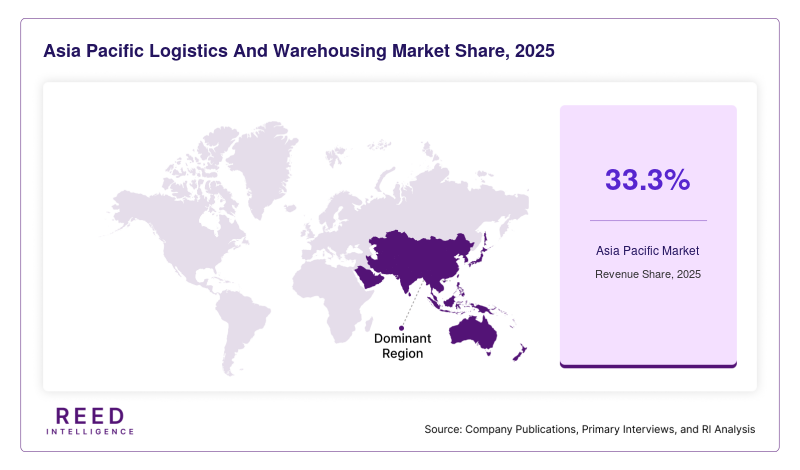
Asia Pacific is the dominant region, accounting for 33.33% of the global warehousing and distribution logistics market in 2025, according to a market estimate reporting the same supplied global market-size series. Regional growth is supported by manufacturing activity, e-commerce expansion, urbanization, infrastructure development, and increasing demand for integrated storage and distribution services. China, India, Japan, South Korea, and Southeast Asian economies contribute to regional logistics demand.
China's manufacturing and export networks, India's expanding domestic distribution infrastructure, Japan's advanced supply-chain systems, and Southeast Asia's growing industrial and e-commerce activity support the region's development. Investment in logistics parks, multimodal freight corridors, automated fulfilment centres, and digital inventory platforms is improving distribution capabilities. Differences in infrastructure quality, labour costs, customs processes, and national regulations continue to shape logistics performance across the region.
Latin America Logistics and Warehousing Market
Latin America's logistics and warehousing market is supported by domestic consumption, agricultural exports, manufacturing, retail distribution, and cross-border trade. Brazil and Mexico are important markets because of their industrial bases, large consumer populations, and connections to international supply chains. Chile, Colombia, Argentina, and other regional economies contribute through agricultural logistics, mining-related freight, and consumer-goods distribution.
Regional logistics demand depends on improvements in road and port infrastructure, warehouse availability, customs processes, and transport connectivity. E-commerce growth is increasing the need for parcel fulfilment, regional distribution centres, and last-mile delivery services. Infrastructure gaps, currency fluctuations, security concerns, and uneven access to modern logistics technology can raise operating costs and complicate regional network development.
Middle East & Africa Logistics and Warehousing Market
The Middle East & Africa logistics and warehousing market benefits from strategic trade routes, major ports, industrial diversification, energy-related freight, and investment in logistics infrastructure. The United Arab Emirates and Saudi Arabia are significant regional logistics hubs, supported by port facilities, free zones, airports, industrial development, and international distribution activity. South Africa and other African economies contribute through retail distribution, mining, agriculture, and regional trade.
Growth opportunities are associated with logistics parks, e-commerce fulfilment, cold-chain infrastructure, port connectivity, and the development of integrated freight networks. Gulf countries are investing in supply-chain infrastructure and services to support manufacturing, trade, and economic diversification. Across Africa, demand for modern warehousing is influenced by urbanization, consumer-market expansion, agricultural distribution, and improvements in transport connectivity, although infrastructure limitations and customs complexity remain challenges.
Logistics and Warehousing Market Competitive Landscape
The Logistics and Warehousing Market is characterized by international freight operators, contract logistics providers, integrated supply-chain companies, courier networks, and warehouse infrastructure operators. Competition is influenced by service coverage, delivery reliability, warehouse capacity, technology integration, industry specialization, and the ability to coordinate transportation and inventory across multiple geographies.
Companies are expanding through new facilities, customer contracts, acquisitions, automation, and digital logistics platforms. Third-party logistics providers are increasingly offering end-to-end services that combine freight forwarding, transportation, warehousing, fulfilment, customs support, and supply-chain visibility. Operators also compete through specialized services for healthcare, high-value electronics, automotive manufacturing, food distribution, and e-commerce.
Key Market Players
- DHL Supply Chain & Global Forwarding
- Kuehne+Nagel International AG
- DSV A/S
- GXO Logistics, Inc.
- CEVA Logistics
- C.H. Robinson Worldwide, Inc.
- UPS Supply Chain Solutions
- FedEx Logistics
- DB Schenker
- Nippon Express Holdings, Inc.
- Expeditors International of Washington, Inc.
Logistics and Warehousing Market Recent Developments
- March 2026 - DHL Supply Chain: DHL announced an expansion of its North American data-centre logistics infrastructure, adding 10 dedicated warehouse sites with more than 7 million square feet of capacity planned to go live in 2026. The facilities are intended to support specialized storage, rack pre-configuration, and transport for data-centre equipment
- March 2026 - GXO Logistics and Prologis: The companies announced a new 47,000-square-metre distribution centre in Rijsbergen, the Netherlands. GXO will operate the facility to store and distribute critical data-centre spare parts across the Netherlands and Belgium, supporting time-sensitive supply requirements for digital infrastructure.
Logistics And Warehousing Market Segments
By Type
- Stainless Steel
- Reinforced Polypropylene
- Polyvinylidene Fluoride (PVDF)
By Product
- Rotating Shaft Magnetic Drive Pumps
- Stationary Shaft Magnetic Drive Pumps
By Flow Rate
- Up to 80 m³/hr
- 81–200 m³/hr
- 201–500 m³/hr
- Above 500 m³/hr
By Application
- Chemical Industry
- Oil and Gas
- Pharmaceuticals
- Aerospace and Defence
- Food and Beverages
By Region
- North America
- Europe
- APAC
- Middle East and Africa
- LATAM