Lost Found Software Market Size, Share & Demand Report By Deployment Mode (Cloud-Based, On-Premise, Hybrid), By Component (Software, Services), By End-Use Industry (Transportation, Hospitality, Retail, Healthcare, Public Sector), By Organization Size (Large Enterprises, SMEs) & Segment Forecasts, 2025–2034
USD 3950
Market Overview
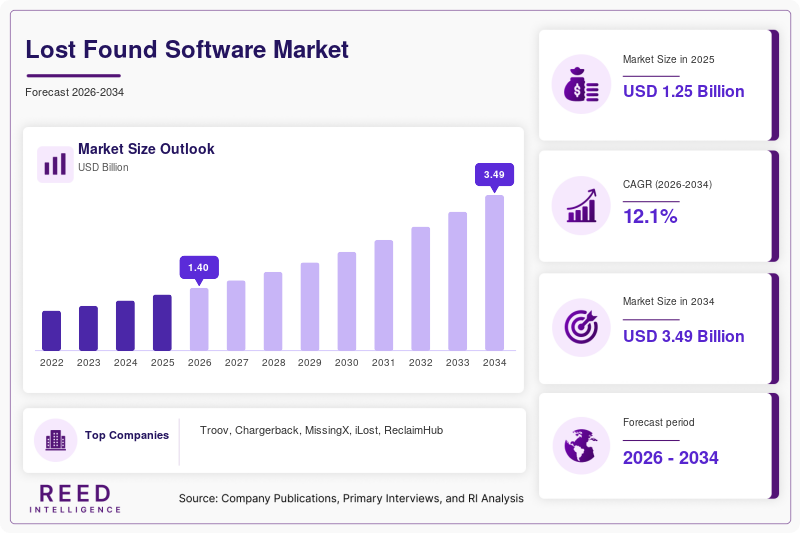
The Lost Found Software Market size was valued at approximately USD 1.25 billion in 2025 and is projected to reach USD 3.48 billion by 2034, expanding at a CAGR of 12.1% from 2025 to 2034. The market has witnessed consistent growth due to increasing digital transformation across industries such as transportation, hospitality, retail, and public infrastructure, where efficient management of lost and found items is becoming operationally critical.
A key global factor supporting market expansion is the rapid adoption of automation and cloud-based platforms across service industries. Organizations are increasingly replacing manual tracking systems with centralized lost and found software solutions that enhance efficiency, reduce human error, and improve customer experience. Additionally, rising customer expectations for quick item recovery and real-time updates have encouraged businesses to invest in intelligent tracking and reporting systems.
Key Highlights
- North America dominated the market with 38.5% share in 2025, while Asia Pacific is expected to grow at a CAGR of 14.3%
- Cloud-based deployment led with 62% share, while AI-enabled platforms are projected to grow at a 15.1% CAGR
- Transportation end-use dominated with 34% share, while hospitality is the fastest-growing at 13.8% CAGR
- The United States market was valued at USD 420 million in 2025 and is expected to reach USD 455 million in 2026
Market Trends
Integration of AI and Automation in Lost Item Management
The integration of artificial intelligence (AI) and automation technologies is transforming the Lost Found Software Market. Modern platforms are increasingly equipped with AI-driven image recognition, automated tagging, and predictive analytics. These tools enable faster identification and categorization of lost items, significantly reducing manual effort. AI-powered chatbots and automated notifications are also enhancing customer engagement by providing real-time updates on lost item status. As organizations strive to improve operational efficiency and customer satisfaction, the adoption of intelligent systems is expected to accelerate further.
Growing Adoption of Cloud-Based and Mobile-First Solutions
Cloud-based solutions are gaining strong traction due to their scalability, flexibility, and cost-effectiveness. Businesses are shifting toward Software-as-a-Service (SaaS) models, which allow centralized data storage and easy access across multiple locations. Additionally, mobile-first platforms are enabling employees to log, track, and manage lost items using smartphones and tablets. This trend is particularly prominent in sectors such as airports, hotels, and public transportation systems where mobility and real-time access are critical. Enhanced data security features and seamless integration with existing enterprise systems are further driving the adoption of cloud-based lost found software solutions.
Market Drivers
Increasing Demand for Operational Efficiency Across Service Industries
Organizations across industries such as aviation, hospitality, and retail are focusing on improving operational efficiency. Manual lost and found processes often lead to delays, mismanagement, and customer dissatisfaction. Lost found software solutions offer streamlined workflows, centralized databases, and automated tracking, enabling faster resolution of customer queries. This efficiency not only reduces operational costs but also enhances brand reputation. As competition intensifies across service sectors, businesses are increasingly investing in digital solutions to optimize their internal processes.
Rising Customer Expectations for Faster Recovery and Transparency
Customers today expect quick and transparent processes when reporting and retrieving lost items. Delays or lack of communication can negatively impact customer satisfaction and loyalty. Lost found software solutions address this issue by providing real-time tracking, automated notifications, and user-friendly interfaces. Customers can easily report lost items online and receive updates on their status. This enhanced transparency improves trust and strengthens customer relationships. As customer experience becomes a key differentiator, businesses are adopting advanced lost found systems to meet evolving expectations.
Market Restraint
Data Privacy and Security Concerns
One of the major challenges in the Lost Found Software Market is data privacy and security concerns. These systems often store sensitive customer information, including personal identification details and contact information. Any breach or misuse of this data can lead to legal complications and loss of customer trust. Organizations must comply with stringent data protection regulations, which can increase implementation costs and complexity. Additionally, concerns regarding cloud security may discourage some businesses from adopting cloud-based solutions. Addressing these challenges requires robust cybersecurity measures and continuous monitoring, which can be resource-intensive for smaller organizations.
Market Opportunities
Expansion in Smart Cities and Public Infrastructure Projects
The development of smart cities and modernization of public infrastructure present significant opportunities for the Lost Found Software Market. Governments and municipal authorities are increasingly investing in digital solutions to enhance public services. Integrating lost found software into transportation hubs, public spaces, and government facilities can improve efficiency and citizen satisfaction. This trend is expected to create new growth avenues for software providers.
Integration with IoT and Smart Tracking Devices
The integration of Internet of Things (IoT) technologies with lost found software offers promising growth potential. Smart tags, RFID systems, and GPS-enabled devices can provide real-time tracking of items, improving recovery rates. By combining software platforms with IoT-enabled hardware, organizations can offer more advanced and reliable solutions. This integration is expected to drive innovation and expand the application scope of lost found systems.
Segmental Analysis
By Deployment Mode
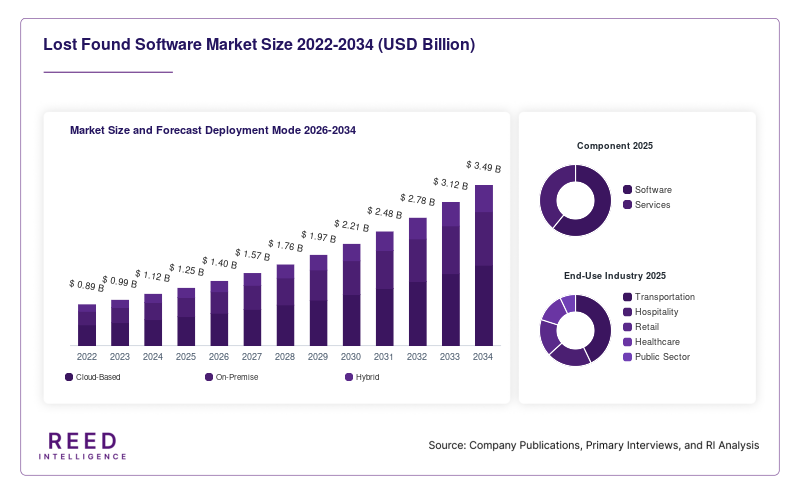
The cloud-based segment dominated the Lost Found Software Market with a 62% share in 2025. This dominance was attributed to its scalability, cost-effectiveness, and ease of deployment. Cloud solutions allow organizations to manage lost and found operations across multiple locations through a centralized platform. The ability to access data remotely and integrate with existing systems further supported its widespread adoption.
The on-premise segment is expected to witness steady growth, while hybrid deployment models are projected to grow at the fastest rate with a CAGR of 13.6%. Hybrid solutions combine the benefits of cloud flexibility and on-premise security, making them suitable for organizations with strict data control requirements. This flexibility will drive adoption in regulated industries.
By Component
The software segment accounted for the largest share of 68% in 2025, driven by increasing demand for advanced tracking and management solutions. Software platforms provide features such as automated workflows, reporting tools, and user interfaces that enhance operational efficiency.
The services segment is expected to grow at the fastest rate with a CAGR of 13.9%. This growth will be driven by increasing demand for implementation, training, and maintenance services. As organizations adopt complex systems, the need for technical support and customization will rise.
By End-Use Industry
The transportation sector dominated the market with a 34% share in 2025. Airports, railways, and public transit systems generate a high volume of lost items, necessitating efficient management solutions. The adoption of lost found software in this sector helps improve operational efficiency and customer satisfaction.
The hospitality sector is expected to grow at the fastest rate with a CAGR of 13.8%. Hotels and resorts are increasingly adopting digital systems to manage lost items and enhance guest experience. The growing focus on customer service will drive demand in this segment.
By Organization Size
Large enterprises held a dominant share of 61% in 2025, as they have the resources to invest in advanced software solutions. These organizations operate across multiple locations and require centralized systems for efficient management.
Small and medium-sized enterprises (SMEs) are expected to grow at the fastest rate with a CAGR of 14.1%. The availability of affordable cloud-based solutions is enabling SMEs to adopt lost found software. This trend will expand the market’s reach.
Regional Analysis
North America
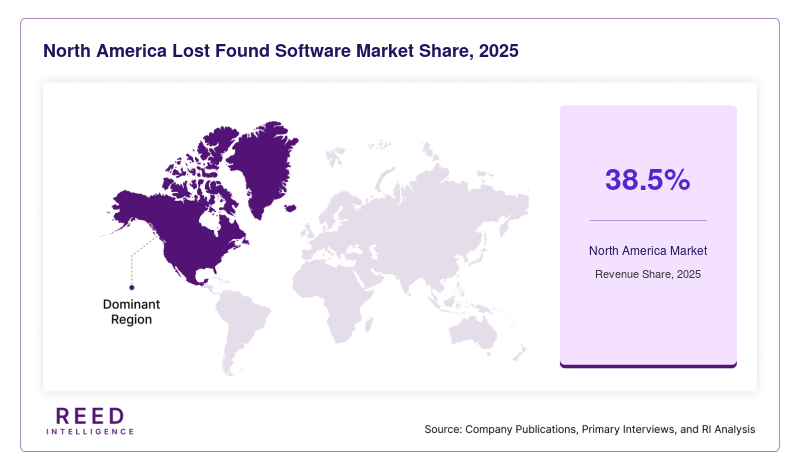
North America accounted for 38.5% of the Lost Found Software Market share in 2025 and is expected to grow at a CAGR of 11.5% during the forecast period. The region’s strong technological infrastructure and early adoption of digital solutions supported its dominant position. High demand from sectors such as aviation, hospitality, and retail contributed to market expansion.
The United States dominated the regional market due to its advanced service industry ecosystem. A key growth factor is the widespread adoption of customer experience management solutions, which has encouraged businesses to implement lost found software systems. The presence of major airports, hotel chains, and retail networks further supports market growth.
Europe
Europe held approximately 27.2% market share in 2025 and is projected to grow at a CAGR of 10.8%. The region’s focus on regulatory compliance and data protection influenced the adoption of structured lost and found systems. Increasing digitization across public services also contributed to market development.
Germany emerged as the dominant country in Europe, driven by its strong transportation infrastructure and emphasis on operational efficiency. The country’s well-developed railway and airport systems have created significant demand for advanced lost found software solutions.
Asia Pacific
Asia Pacific accounted for 21.6% share in 2025 and is expected to register the fastest growth at a CAGR of 14.3%. Rapid urbanization, expanding transportation networks, and increasing digital adoption are key factors driving the market in this region.
China dominated the Asia Pacific market due to large-scale investments in smart infrastructure and public transportation systems. The growing adoption of digital platforms across airports and railway networks is supporting the implementation of lost found software solutions.
Middle East & Africa
The Middle East & Africa region held 7.4% market share in 2025 and is projected to grow at a CAGR of 11.2%. Increasing investments in tourism and infrastructure development are driving demand for efficient lost and found management systems.
The United Arab Emirates led the regional market, supported by its rapidly growing aviation and hospitality sectors. The country’s focus on enhancing customer experience in airports and hotels has encouraged the adoption of advanced software solutions.
Latin America
Latin America accounted for 5.3% market share in 2025 and is expected to grow at a CAGR of 10.5%. The region’s growth is supported by gradual digital transformation across industries and increasing awareness of operational efficiency.
Brazil dominated the Latin American market due to its large urban population and expanding retail sector. The growing adoption of digital tools in public and private sectors is contributing to the demand for lost found software solutions.
Competitive Landscape
The Lost Found Software Market is moderately fragmented, with several players focusing on innovation and strategic partnerships. Key companies are investing in AI integration, cloud capabilities, and user-friendly interfaces to strengthen their market position.
Troov emerged as a leading player due to its advanced platform and strong presence in transportation and hospitality sectors. The company recently introduced an AI-powered item recognition feature, enhancing automation and efficiency.
Other prominent players are focusing on expanding their product portfolios and entering new geographic markets. Strategic collaborations with airports, hotels, and public institutions are common approaches to gaining competitive advantage.
Key Players
- Troov
- Chargerback
- MissingX
- iLost
- ReclaimHub
- Lostings
- Foundrop
- Pixit
- NotLost
- Boomerang
- Crowdfind
- Trackit Systems
- Reclaimit
- Lost Property Desk
- ReturnMe
Recent Developments
- 2025: Troov launched AI-based automation tools for item identification and tracking
- 2024: Chargerback expanded its cloud platform with mobile-first capabilities
- 2024: iLost partnered with European airports to enhance lost item recovery systems
- 2023: MissingX introduced advanced analytics dashboards for operational insights
- 2023: ReclaimHub integrated IoT-based tracking features into its platform
Lost Found Software Market Segments
Deployment Mode
- Cloud-Based
- On-Premise
- Hybrid
Component
- Software
- Services
End-Use Industry
- Transportation
- Hospitality
- Retail
- Healthcare
- Public Sector
Organization Size
- Large Enterprises
- Small and Medium Enterprises (SMEs)
By Region
- North America
- Europe
- APAC
- Middle East and Africa
- LATAM