Low Voltage Commercial Electric Boiler Market Size, Share Demand Report By Type (Standard Electric Boilers, Modular Electric Boilers), By Application (Space Heating, Water Heating), By End-Use (Healthcare, Hospitality, Office Buildings, Educational Institutions) By Region & Segment Forecasts, 2025–2034
USD 3950
Market Overview
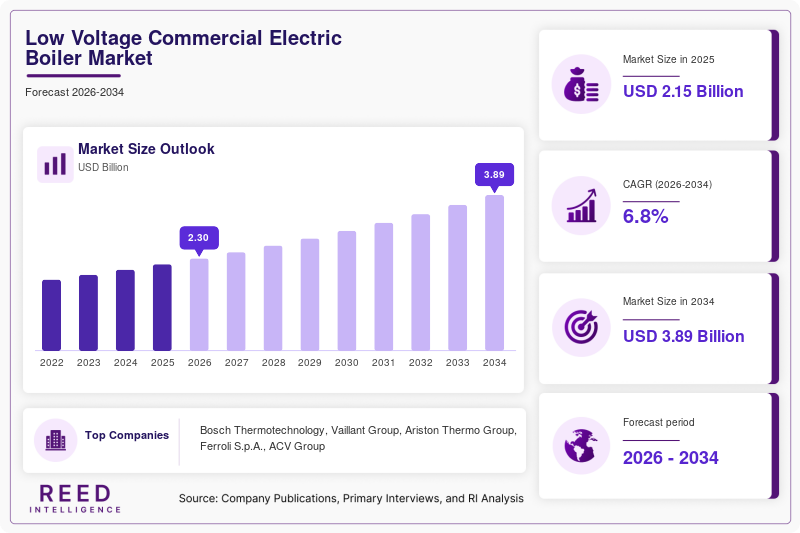
The Low Voltage Commercial Electric Boiler Market size was estimated at USD 2.15 billion in 2025 and is expected to reach approximately USD 2.34 billion in 2026. Over the forecast period from 2025 to 2034, the market is projected to grow at a compound annual growth rate (CAGR) of 6.8%, reaching nearly USD 3.85 billion by 2034.
This growth trajectory is primarily driven by the rising adoption of low-emission heating systems across commercial buildings such as offices, hospitals, educational institutions, and retail spaces. Governments and regulatory bodies are increasingly promoting electric heating technologies as part of broader decarbonization initiatives. Low voltage electric boilers, which operate efficiently within controlled electrical loads, are gaining traction due to their safety features, ease of installation, and reduced maintenance requirements.
Key Highlights
- The market is projected to grow from USD 2.15 billion in 2025 to USD 3.85 billion by 2034, reflecting steady expansion across commercial sectors. This growth highlights increasing reliance on electric heating solutions as businesses transition toward efficient and sustainable systems.
- The market is expected to register a CAGR of 6.8% during the forecast period from 2025 to 2034. This consistent growth rate indicates stable demand supported by technological advancements and regulatory support.
- Strong demand is driven by ongoing decarbonization goals and the global shift toward electrification in heating systems. Organizations are actively adopting low-emission technologies to meet environmental targets and reduce carbon footprints.
- Rising adoption in commercial buildings is supported by infrastructure modernization and replacement of outdated heating systems. Businesses are increasingly investing in efficient electric boilers to improve performance and comply with energy standards.
Market Trends
Integration of Smart and IoT-Enabled Boiler Systems
One of the notable trends in the Low Voltage Commercial Electric Boiler Market is the growing integration of smart technologies and IoT-enabled systems. Manufacturers are increasingly incorporating advanced control systems that allow real-time monitoring, remote operation, and predictive maintenance. These smart boilers help facility managers optimize energy consumption by adjusting heating loads based on occupancy patterns and environmental conditions. This not only reduces operational costs but also enhances system efficiency and lifespan.
Furthermore, digitalization is enabling seamless integration of boilers with building management systems (BMS), allowing centralized control across large commercial facilities. Data analytics and cloud-based platforms are providing actionable insights, enabling proactive maintenance and minimizing downtime. As commercial buildings continue to adopt automation technologies, the demand for intelligent electric boilers is expected to rise significantly, making this a key trend shaping the market landscape.
Shift Toward Compact and Modular Boiler Designs
Another emerging trend is the increasing preference for compact and modular boiler systems. Commercial spaces often face limitations in terms of installation area, especially in urban environments where space optimization is critical. Manufacturers are responding by designing boilers that are smaller in size yet capable of delivering high efficiency and performance. Modular systems allow scalability, enabling users to add or remove units based on heating demand.
This flexibility is particularly beneficial for facilities with fluctuating heating requirements, such as hotels and hospitals. Modular designs also improve system redundancy, ensuring uninterrupted operation even if one unit fails. Additionally, these systems simplify installation and reduce upfront infrastructure costs. As commercial construction continues to prioritize space efficiency and operational flexibility, the adoption of compact and modular electric boilers is expected to increase steadily.
Market Drivers
Increasing Focus on Decarbonization and Energy Efficiency
The global push toward reducing carbon emissions is a major driver for the Low Voltage Commercial Electric Boiler Market. Governments and regulatory authorities are implementing stringent emission standards, encouraging the transition from fossil fuel-based heating systems to electric alternatives. Electric boilers produce zero on-site emissions, making them an attractive solution for commercial facilities aiming to meet sustainability targets.
In addition, energy efficiency standards are becoming more rigorous, prompting businesses to invest in advanced heating technologies. Low voltage electric boilers offer high efficiency levels, often exceeding traditional systems, which helps reduce energy consumption and operational costs. Incentives such as tax benefits, subsidies, and grants for energy-efficient installations are further accelerating adoption. As organizations increasingly prioritize environmental responsibility, the demand for electric boilers is expected to grow consistently.
Expansion of Commercial Infrastructure and Urban Development
Rapid urbanization and the expansion of commercial infrastructure are significantly contributing to market growth. Developing regions are witnessing increased construction of office buildings, shopping centers, healthcare facilities, and educational institutions, all of which require efficient heating solutions. Low voltage electric boilers are well-suited for these applications due to their reliability, safety, and ease of installation.
Moreover, the trend toward green buildings and sustainable construction practices is encouraging developers to adopt electric heating systems from the outset. Retrofitting older buildings with modern electric boilers is also becoming common in developed economies. As urban populations continue to grow and demand for commercial spaces rises, the need for efficient and environmentally friendly heating solutions will further drive the market.
Market Restraint
High Initial Installation and Electricity Cost Concerns
One of the primary restraints affecting the Low Voltage Commercial Electric Boiler Market is the relatively high initial installation cost compared to conventional boiler systems. While electric boilers offer long-term savings through reduced maintenance and energy efficiency, the upfront investment required for system installation and electrical infrastructure upgrades can be significant. This is particularly challenging for small and medium-sized enterprises with limited capital budgets.
Additionally, electricity costs remain a concern in several regions, especially where power tariffs are high or unstable. In such cases, operating electric boilers may become less cost-effective compared to gas or oil-based alternatives. For example, in regions with inconsistent power supply, businesses may need to invest in backup systems, further increasing costs. These factors can slow down adoption, particularly in price-sensitive markets, despite the environmental and operational benefits offered by electric boilers.
Market Opportunities
Growing Adoption of Renewable Energy Integration
The increasing integration of renewable energy sources presents a significant opportunity for the Low Voltage Commercial Electric Boiler Market. As solar and wind power generation expands, electric boilers can be used to efficiently utilize excess renewable energy for heating purposes. This not only enhances energy efficiency but also reduces dependency on fossil fuels, aligning with global sustainability goals.
Commercial facilities are increasingly adopting hybrid energy systems that combine renewable sources with electric heating technologies. Electric boilers can be easily integrated into these systems, providing flexibility and reliability. As renewable energy infrastructure continues to develop, particularly in regions with strong government support, the demand for electric boilers is expected to rise, creating new growth avenues for market players.
Retrofitting of Existing Commercial Buildings
Another key opportunity lies in the retrofitting of existing commercial buildings with modern electric boiler systems. Many older buildings still rely on outdated and inefficient heating systems that consume more energy and produce higher emissions. Upgrading these systems to low voltage electric boilers can significantly improve energy efficiency and reduce operational costs.
Governments and organizations are increasingly promoting retrofitting initiatives to enhance building performance and sustainability. Financial incentives and regulatory requirements are encouraging building owners to replace conventional boilers with electric alternatives. This trend is particularly prominent in developed regions, where aging infrastructure is being modernized. As awareness of energy efficiency and environmental impact grows, the retrofitting segment is expected to contribute substantially to market expansion.
Segmental Analysis
By Type
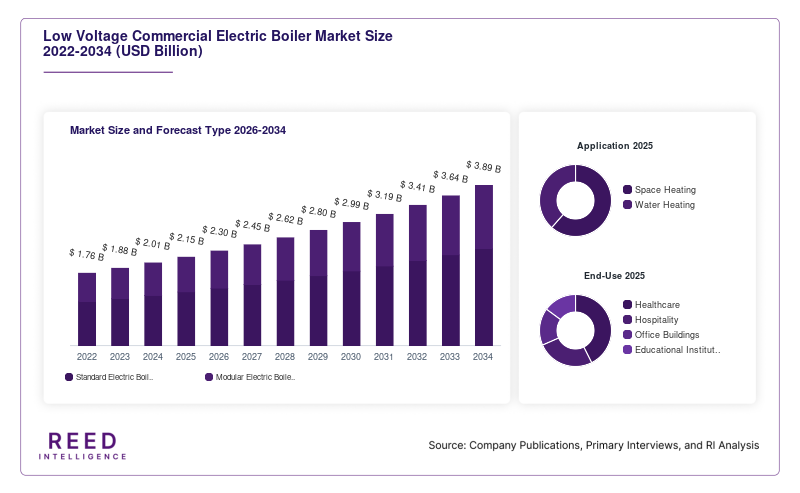
The low voltage electric boilers segment dominated the market in 2024, accounting for approximately 62% of the total share. These systems are widely used in commercial applications due to their efficiency, safety, and ease of installation. Their ability to operate within standard electrical systems without requiring extensive modifications makes them highly suitable for commercial buildings. Additionally, advancements in heating elements and control systems have improved performance, making these boilers more reliable and cost-effective.
The fastest-growing subsegment is modular electric boilers, expected to grow at a CAGR of 7.6% during the forecast period. The growth is driven by their scalability and flexibility, allowing users to adjust capacity based on demand. These systems are particularly beneficial for large commercial facilities with varying heating requirements, enabling efficient energy utilization and reduced operational costs.
By Application
Space heating applications dominated the market in 2024, accounting for nearly 58% of the total share. Commercial buildings such as offices, schools, and healthcare facilities require consistent and efficient heating systems, making electric boilers a preferred choice. Their ability to provide uniform heating and integrate with existing systems enhances their adoption across various applications.
The fastest-growing application segment is water heating, with a projected CAGR of 7.2%. The increasing demand for hot water in commercial facilities such as hotels and hospitals is driving this growth. Electric boilers offer precise temperature control and quick heating capabilities, making them ideal for water heating applications. The growing focus on hygiene and sanitation is further boosting demand in this segment.
By End-Use
The healthcare sector dominated the market in 2024, accounting for approximately 35% of the share. Hospitals and healthcare facilities require reliable and efficient heating systems to maintain optimal conditions. Electric boilers provide consistent performance and meet stringent safety and hygiene standards, making them a preferred choice in this sector.
The fastest-growing end-use segment is the hospitality sector, expected to grow at a CAGR of 7.8%. The increasing number of hotels and resorts, along with rising tourism, is driving demand for efficient heating solutions. Electric boilers offer benefits such as low maintenance, high efficiency, and quiet operation, making them suitable for hospitality applications.
Regional Analysis
North America
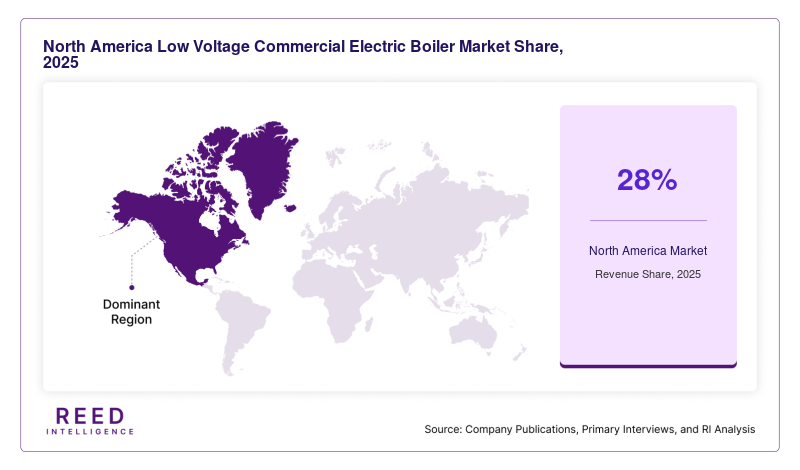
North America held a significant share of the Low Voltage Commercial Electric Boiler Market in 2025, accounting for approximately 28% of global revenue. The region is expected to grow at a CAGR of 6.5% during the forecast period, driven by strong regulatory support and increasing adoption of energy-efficient technologies. The presence of advanced infrastructure and high awareness regarding sustainable solutions further contributes to market growth.
The United States dominates the regional market, supported by stringent environmental regulations and widespread adoption of green building standards. A unique growth factor in this region is the increasing investment in smart building technologies, which integrate electric boilers with advanced control systems to optimize energy consumption and improve operational efficiency.
Europe
Europe accounted for nearly 25% of the market share in 2025 and is projected to grow at a CAGR of 6.7% through 2034. The region’s strong commitment to reducing carbon emissions and achieving climate neutrality is a key driver for market expansion. Government policies promoting electrification of heating systems are further boosting demand.
Germany leads the European market, driven by its focus on renewable energy and energy-efficient building practices. A unique growth factor is the widespread adoption of district heating systems that incorporate electric boilers, enabling efficient heat distribution across commercial and residential sectors.
Asia Pacific
Asia Pacific is the fastest-growing region, holding around 30% market share in 2025 and expected to grow at a CAGR of 7.5%. Rapid urbanization, industrialization, and increasing investments in commercial infrastructure are key factors driving growth in this region.
China dominates the market due to its large-scale construction activities and government initiatives to reduce air pollution. A unique growth factor is the shift from coal-based heating systems to electric alternatives, which is significantly increasing demand for low voltage electric boilers.
Middle East & Africa
The Middle East & Africa region accounted for approximately 9% of the market share in 2025 and is projected to grow at a CAGR of 6.2%. The market is driven by increasing investments in commercial infrastructure and growing awareness of energy efficiency.
The United Arab Emirates is a key market in the region, supported by rapid urban development and smart city initiatives. A unique growth factor is the adoption of energy-efficient technologies in large commercial projects, such as hotels and shopping complexes, to reduce operational costs.
Latin America
Latin America held around 8% of the market share in 2025 and is expected to grow at a CAGR of 6.0%. The region is witnessing gradual adoption of electric heating solutions, supported by improving economic conditions and infrastructure development.
Brazil dominates the regional market, driven by increasing construction of commercial buildings and rising focus on energy efficiency. A unique growth factor is the growing adoption of sustainable building practices, which is encouraging the use of electric boilers in new construction projects.
Competitive Landscape
The Low Voltage Commercial Electric Boiler Market is moderately fragmented, with several global and regional players competing based on product innovation, efficiency, and pricing. Leading companies are focusing on developing advanced boiler systems with improved energy efficiency and smart control features to gain a competitive edge.
One of the key market leaders is Bosch Thermotechnology, known for its extensive product portfolio and strong global presence. The company has recently introduced advanced electric boiler systems with integrated digital controls, enhancing operational efficiency and user convenience. Other major players are also investing in research and development to improve product performance and meet evolving customer demands.
Strategic collaborations, mergers, and acquisitions are common in this market, as companies aim to expand their geographic reach and strengthen their product offerings. The increasing focus on sustainability and energy efficiency is driving innovation, with manufacturers developing solutions that align with environmental regulations and customer expectations.
Key Players List
- Bosch Thermotechnology
- Vaillant Group
- Ariston Thermo Group
- Ferroli S.p.A.
- ACV Group
- Slant/Fin Corporation
- Lochinvar LLC
- Thermon Group Holdings
- Chromalox Inc.
- Precision Boilers
- Electro Industries
- Thermolec Ltd.
- Elnur Gabarron
- Stiebel Eltron
- Danstoker A/S
Recent Developments
- In 2024, Bosch Thermotechnology launched a new range of smart electric boilers with enhanced energy monitoring capabilities.
- In 2023, Vaillant Group expanded its electric boiler production capacity to meet rising demand in Europe.
- In 2024, Ariston Thermo introduced compact modular electric boilers designed for commercial applications with limited installation space.
Low Voltage Commercial Electric Boiler Market Segments
Type
- Standard Electric Boilers
- Modular Electric Boilers
Application
- Space Heating
- Water Heating
End-Use
- Healthcare
- Hospitality
- Office Buildings
- Educational Institutions
By Region
- North America
- Europe
- APAC
- Middle East and Africa
- LATAM