Low Voltage Composite Insulator Market Size, Share & Demand Report By Type (Pin Insulators, Post Insulators, Suspension Insulators), By Material (Silicone Rubber, EPDM, Other Polymer Materials), By Application (Distribution Lines, Railway Electrification, Industrial Power Systems, Renewable Energy Installations), By End-Use Industry (Utilities, Industrial Sector, Renewable Energy Sector) & Segment Forecasts, 2025–2034
USD 3950
Market Overview
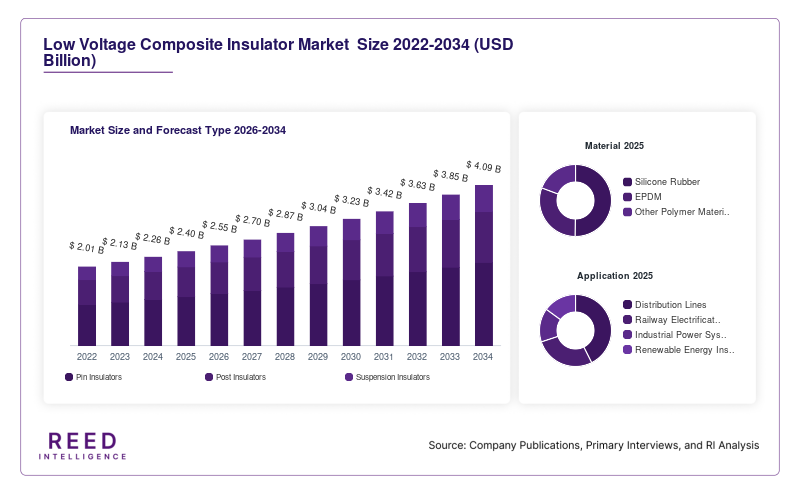
The Low Voltage Composite Insulator Market was valued at approximately USD 2.4 billion in 2025 and is projected to reach USD 4.1 billion by 2034, expanding at a CAGR of 6.1% from 2025 to 2034. The market size growth is primarily supported by the increasing demand for reliable and lightweight insulation solutions in modern electrical distribution systems. Composite insulators, made from polymer-based materials, are increasingly replacing conventional porcelain and glass insulators due to their superior performance in harsh environmental conditions and lower maintenance requirements.
A key global factor contributing to the growth of the Low Voltage Composite Insulator Market is the rising investment in smart grid infrastructure. Governments and utilities worldwide are modernizing aging electrical networks, driving the adoption of advanced insulation technologies that offer improved durability, hydrophobic properties, and resistance to contamination.
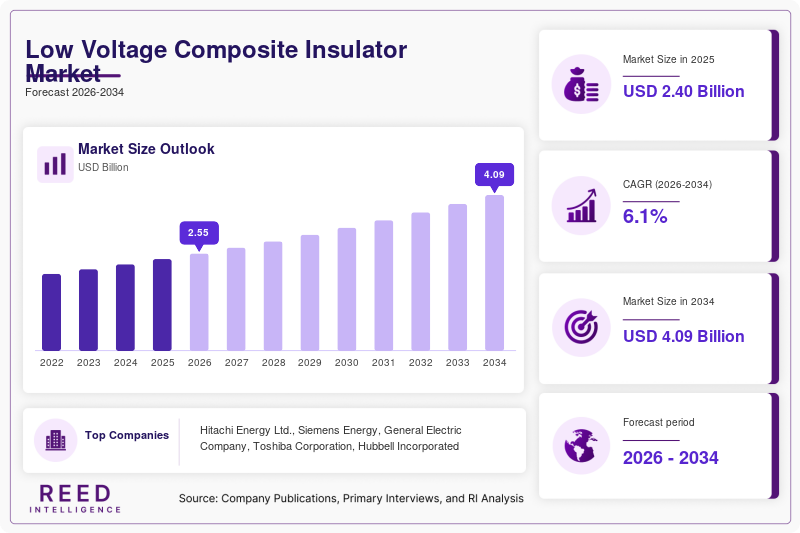
Key Highlights:
- Asia Pacific dominated the market with a share of 38.5% in 2025, while it is expected to register the fastest CAGR of 6.8% during the forecast period.
- By type, pin insulators led with a share of 34.2%, while post insulators are projected to grow fastest at a CAGR of 6.9%.
- By application, distribution lines held the dominant share of 46.7%, whereas railway electrification is expected to grow at a CAGR of 7.2%.
- China remained the dominant country, with market values of USD 620 million in 2024 and USD 655 million in 2025.
Market Trends
Shift Toward Polymer-Based Insulation Technologies
The Low Voltage Composite Insulator Market is witnessing a strong transition from traditional ceramic insulators to polymer-based alternatives. Composite insulators offer advantages such as lightweight construction, enhanced mechanical strength, and resistance to pollution and moisture. Utilities are increasingly adopting these solutions to reduce installation costs and improve grid reliability. Additionally, polymer insulators demonstrate better performance in coastal and industrial environments, where contamination can degrade conventional materials.
Integration with Smart Grid and Renewable Infrastructure
Another key trend shaping the market is the integration of composite insulators within smart grid systems and renewable energy networks. As distributed energy generation increases, especially from solar and wind sources, the demand for flexible and durable insulation solutions has grown. Composite insulators support real-time monitoring and predictive maintenance systems, aligning with digital grid transformation. This trend is expected to strengthen the market forecast, particularly in regions investing heavily in clean energy and grid modernization.
Market Drivers
Expansion of Power Distribution Networks
Rapid urbanization and industrial growth are driving the expansion of power distribution networks globally. The Low Voltage Composite Insulator Market is benefiting from increased demand for reliable insulation components in new and upgraded distribution systems. Governments are investing in rural electrification and infrastructure development, which requires cost-effective and durable insulators. Composite insulators provide a suitable solution due to their longer service life and reduced maintenance requirements.
Growing Demand for Lightweight and Durable Materials
The increasing need for lightweight and mechanically robust components is another major driver. Traditional insulators are heavier and more prone to breakage, leading to higher transportation and installation costs. Composite insulators, on the other hand, are easier to handle and install. Their resistance to vandalism, UV radiation, and environmental stress enhances their adoption across various applications, contributing to overall market growth and improved industry outlook.
Market Restraint
High Initial Cost Compared to Conventional Insulators
Despite the advantages, the Low Voltage Composite Insulator Market faces a restraint in the form of higher upfront costs compared to traditional ceramic and glass insulators. The manufacturing process of composite insulators involves advanced materials and technologies, leading to increased production expenses. For cost-sensitive markets, especially in developing regions, this can limit adoption.
Additionally, concerns regarding long-term performance and aging characteristics of polymer materials create hesitation among some utilities. Although composite insulators offer lower lifecycle costs, the initial investment can act as a barrier, particularly for small-scale projects. This restraint may slow down market penetration in price-sensitive segments, affecting overall market growth in the short term.
Market Opportunities
Growth in Renewable Energy Projects
The expansion of renewable energy installations presents a significant opportunity for the Low Voltage Composite Insulator Market. Solar and wind farms require reliable insulation systems capable of withstanding environmental stress. Composite insulators are well-suited for such applications due to their durability and resistance to harsh weather conditions. As countries increase their renewable energy capacity, the demand for advanced insulation solutions is expected to rise.
Increasing Adoption in Emerging Economies
Emerging economies in Asia, Africa, and Latin America are investing heavily in power infrastructure development. This creates a favorable environment for the adoption of composite insulators. Governments are focusing on improving grid reliability and reducing power losses, which supports the use of high-performance insulation materials. The growing electrification rate and infrastructure modernization efforts in these regions will provide long-term growth opportunities for market players.
Segmental Analysis
By Type
Pin insulators dominated the Low Voltage Composite Insulator Market, accounting for 34.2% of the share in 2024. Their widespread use in distribution lines and cost-effectiveness contributed to their leading position. These insulators are commonly used in low voltage applications due to their simplicity and ease of installation.
Post insulators are expected to be the fastest-growing segment, with a projected CAGR of 6.9%. Their ability to provide higher mechanical strength and improved performance in compact substations will drive their adoption. Increasing demand for space-efficient solutions in urban areas will support their growth.
By Material
Silicone rubber-based composite insulators held the dominant share of 41.5% in 2024. Their excellent hydrophobic properties and resistance to environmental stress made them a preferred choice. These materials offer long-term reliability and reduced maintenance requirements.
EPDM (ethylene propylene diene monomer) is anticipated to grow at a CAGR of 6.7%. Its flexibility and resistance to UV radiation will drive its adoption in challenging environments. The growing need for durable materials in outdoor applications will support this segment.
By Application
Distribution lines accounted for the largest share of 46.7% in 2024. The extensive use of composite insulators in power distribution networks contributed to this dominance. Increasing electrification projects and infrastructure development supported this segment.
Railway electrification is expected to grow at the fastest CAGR of 7.2%. The expansion of electric rail networks and high-speed rail projects will increase demand for reliable insulation solutions. Composite insulators provide the required durability and performance for such applications.
By End-Use Industry
Utilities dominated the market with a share of 52.8% in 2024. The need for efficient power distribution and maintenance of grid reliability drove the adoption of composite insulators in this segment.
The renewable energy sector is projected to grow at a CAGR of 7.0%. Increasing installations of solar and wind energy systems will create demand for advanced insulation solutions. The need for long-lasting and weather-resistant materials will support this growth.
Regional Analysis
North America
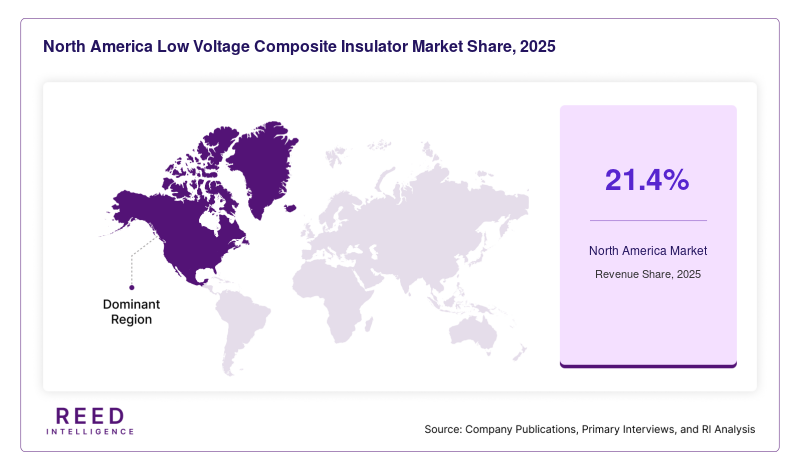
North America accounted for approximately 21.4% of the Low Voltage Composite Insulator Market share in 2025 and had demonstrated steady adoption across utility and industrial sectors. The region is expected to grow at a CAGR of 5.4% during the forecast period. Market growth will be supported by ongoing grid modernization initiatives and replacement of aging infrastructure.
The United States remained the dominant country due to its strong focus on upgrading transmission and distribution networks. Investments in resilient grid systems and the integration of renewable energy sources have increased demand for advanced insulation solutions. The emphasis on reducing outage frequency and improving energy efficiency will continue to support market growth.
Europe
Europe held a market share of 19.8% in 2025 and had shown consistent demand for composite insulators in power distribution systems. The market is projected to expand at a CAGR of 5.6% from 2025 to 2034. Strict regulatory frameworks and sustainability goals are influencing the adoption of advanced materials.
Germany led the regional market due to its strong renewable energy sector and focus on grid stability. The country’s transition toward decentralized energy systems has increased the need for reliable insulation solutions. This trend will contribute to sustained growth in the region.
Asia Pacific
Asia Pacific dominated the Low Voltage Composite Insulator Market with a share of 38.5% in 2025 and is expected to grow at the fastest CAGR of 6.8%. The region had experienced rapid infrastructure development and increased electricity demand.
China remained the leading country, driven by large-scale investments in power distribution and industrial expansion. The country’s focus on upgrading grid infrastructure and supporting renewable energy projects has created strong demand for composite insulators. Continued urbanization and industrialization will further strengthen market growth.
Middle East & Africa
The Middle East & Africa region accounted for 10.3% of the market share in 2025 and is anticipated to grow at a CAGR of 6.2%. Increasing investments in power infrastructure and electrification projects are supporting market expansion.
Saudi Arabia emerged as the dominant country due to its infrastructure development initiatives and focus on energy diversification. The demand for reliable insulation systems in extreme climatic conditions has driven the adoption of composite insulators in the region.
Latin America
Latin America held a share of 10.0% in 2025 and is expected to grow at a CAGR of 5.9% during the forecast period. The region had shown gradual improvement in power infrastructure and distribution networks.
Brazil led the market due to its expanding energy sector and investments in grid reliability. The country’s efforts to reduce transmission losses and improve energy access have increased the adoption of composite insulators, supporting overall market growth.
Competitive Landscape
The Low Voltage Composite Insulator Market is moderately fragmented, with several global and regional players competing based on product innovation, quality, and pricing. Leading companies are focusing on expanding their product portfolios and strengthening distribution networks.
One prominent market leader is Hitachi Energy Ltd., which has maintained a strong presence through continuous innovation and strategic partnerships. The company recently introduced advanced polymer insulators designed for improved performance in extreme environments, enhancing its competitive position.
Other key players are investing in research and development to improve material properties and extend product lifespan. Strategic collaborations, mergers, and regional expansions are common strategies adopted by market participants to increase market share and strengthen their global footprint.
Key Players List
- Hitachi Energy Ltd.
- Siemens Energy
- General Electric Company
- Toshiba Corporation
- Hubbell Incorporated
- MacLean Power Systems
- TE Connectivity
- LAPP Insulators
- NGK Insulators Ltd.
- Seves Group
- Aditya Birla Insulators
- Zhejiang Tailun Insulator Co., Ltd.
- INAEL Electrical Systems
- Pfisterer Holding AG
- Orient Insulators
Recent Developments
- In 2024, Hitachi Energy Ltd. launched a new range of composite insulators designed for high pollution environments.
- Siemens Energy expanded its manufacturing capacity for polymer insulators in Asia Pacific.
- TE Connectivity introduced lightweight insulator solutions for smart grid applications.
- Hubbell Incorporated enhanced its product portfolio with improved silicone-based insulators.
- NGK Insulators Ltd. invested in advanced material research to improve product durability.
Low Voltage Composite Insulator Market Segments
Type
- Pin Insulators
- Post Insulators
- Suspension Insulators
Material
- Silicone Rubber
- EPDM
- Other Polymer Materials
Application
- Distribution Lines
- Railway Electrification
- Industrial Power Systems
- Renewable Energy Installations
End-Use Industry
- Utilities
- Industrial Sector
- Renewable Energy Sector
By Region
- North America
- Europe
- APAC
- Middle East and Africa
- LATAM