Lube Truck Market Size, Share & Demand Report By Truck Type (Standard Lube Trucks, Customized Heavy-Duty Lube Trucks, Compact Lube Trucks, Off-Road Lube Trucks), By Application (Mining Operations, Construction Equipment Servicing, Agriculture Equipment Maintenance, Oil and Gas Operations, Industrial Machinery Servicing), By End Use (Fleet Management Companies, Oilfield Service Providers, Mining Contractors, Construction Companies, Municipal Service Operators, Equipment Rental Providers) By Regio
USD 3950
Market Overview
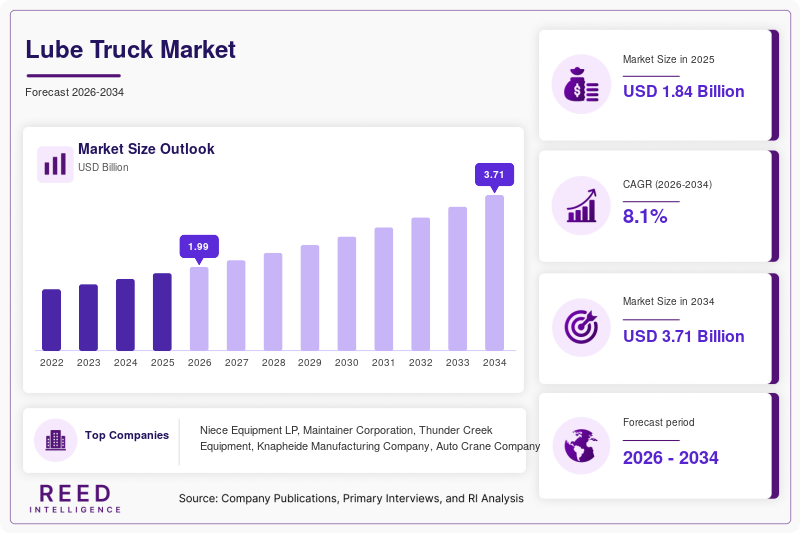
The global Lube Truck Market size was valued at USD 1.84 billion in 2026 and is projected to reach USD 3.42 billion by 2034, expanding at a CAGR of 8.1% during the forecast period. The market is witnessing stable expansion due to increasing mining, construction, agriculture, and heavy industrial activities across both developed and emerging economies. Lube trucks are specialized service vehicles designed to transport, dispense, and manage lubricants, fuels, coolants, hydraulic fluids, and grease for heavy-duty equipment operating in remote or high-demand environments. Rising pressure on fleet operators to reduce equipment downtime and improve maintenance efficiency has increased the adoption of advanced lube trucks with automated dispensing systems and digital fluid monitoring solutions.
A major global factor supporting market growth is the ongoing rise in infrastructure development and resource extraction projects. Governments and private operators are investing heavily in road construction, mining operations, renewable energy projects, and industrial manufacturing facilities. These activities require continuous operation of excavators, haul trucks, bulldozers, cranes, tractors, and industrial machinery, creating sustained demand for mobile lubrication and preventive maintenance solutions. In addition, fleet operators are increasingly prioritizing predictive maintenance practices to lower repair costs and improve operational efficiency, further strengthening market demand.
Key Highlights
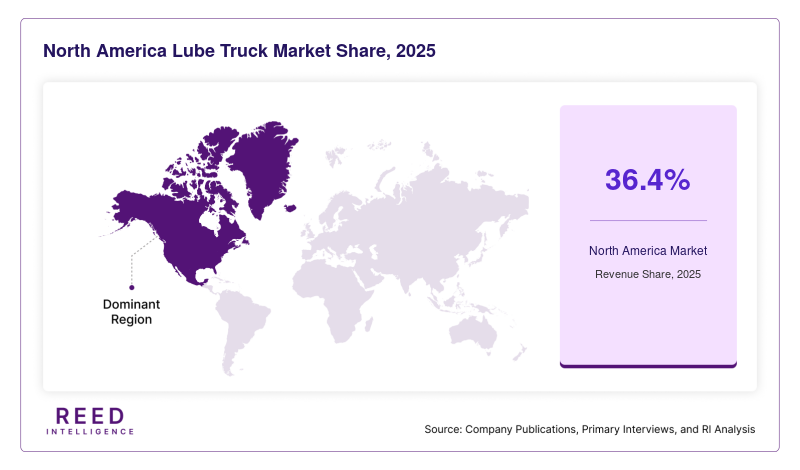
- North America dominated the market with a 36.4% share in 2025, while Asia Pacific is expected to grow at the fastest CAGR of 9.8% during 2026–2034.
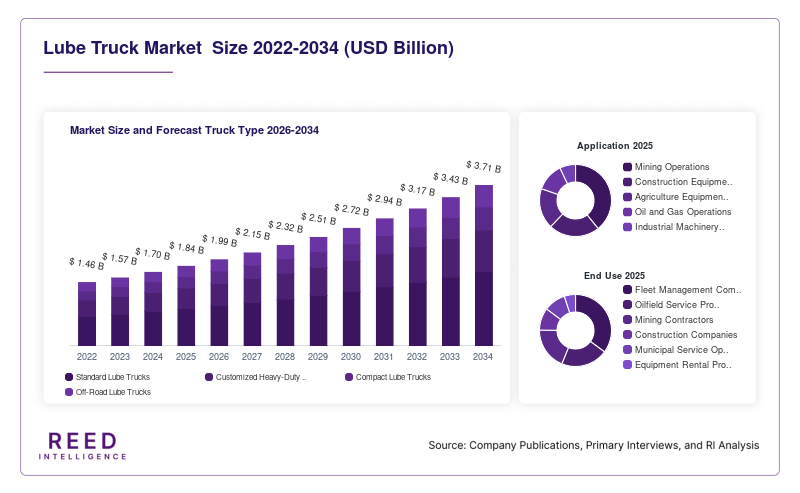
- By truck type, standard lube trucks accounted for the largest share of 42.8%, while customized heavy-duty lube trucks are projected to grow at a CAGR of 10.2%.
- By application, mining operations led with a 39.7% share, whereas construction equipment servicing is expected to expand at a CAGR of 9.9%.
- By end use, fleet management companies held the dominant share of 34.1%, while oilfield service providers are anticipated to grow at a CAGR of 9.5%.
- The United States remained the dominant country, with market values of USD 420 million in 2024 and USD 455 million in 2025.
Market Trends
Integration of Smart Monitoring and Automated Dispensing Systems
The Lube Truck Market is experiencing a growing shift toward digital monitoring and automated dispensing technologies. Fleet operators are increasingly investing in lube trucks equipped with electronic metering systems, fluid management software, telematics platforms, and automated hose reel systems. These technologies help operators monitor fluid consumption, schedule preventive maintenance, and reduce lubricant waste across large fleets of industrial and construction equipment. Smart dispensing systems also minimize human error and improve fluid handling accuracy, which supports operational efficiency in mining and construction sites. As industries continue to adopt connected maintenance solutions, demand for digitally enabled lube trucks is expected to rise steadily.
Manufacturers are also integrating cloud-based inventory management systems into lube truck platforms. These systems allow maintenance teams to track lubricant usage in real time and improve supply chain coordination. The adoption of automation is particularly high among large mining operators and infrastructure contractors that manage equipment across multiple remote locations. In addition, environmental compliance requirements are encouraging companies to use sealed dispensing systems that reduce leakage and contamination risks. This trend is expected to accelerate as industrial operators continue modernizing maintenance operations.
Rising Demand for Customized Heavy-Duty Service Vehicles
The market is also witnessing increasing demand for customized lube trucks designed for specialized industrial applications. Mining companies, oilfield operators, and large agricultural enterprises are seeking vehicles tailored to specific operating conditions, climate requirements, and equipment categories. Customized trucks often include larger fluid capacities, reinforced chassis systems, multi-compartment tanks, advanced pumping equipment, and off-road mobility features. These vehicles support operations in harsh environments where standard lubrication systems may not deliver adequate performance.
Demand for heavy-duty customization is particularly strong in large mining regions across Australia, Canada, South Africa, and Latin America. Companies operating in these regions require reliable maintenance support vehicles capable of functioning under extreme temperatures and rugged terrain conditions. Manufacturers are responding by offering modular truck designs and flexible storage configurations. In addition, the expansion of renewable energy infrastructure and remote construction projects is creating new opportunities for tailored lubrication vehicles. This trend is expected to encourage higher investment in specialized truck manufacturing and aftermarket customization services.
Market Drivers
Expansion of Mining and Construction Activities Worldwide
The continued growth of global mining and construction activities is a major driver supporting the Lube Truck Market. Governments across Asia Pacific, the Middle East, and Latin America are increasing investments in transportation infrastructure, energy projects, urban development, and industrial facilities. These projects require extensive use of heavy machinery, including excavators, loaders, dump trucks, cranes, and drilling equipment. Since such machinery operates under demanding conditions, regular lubrication and fluid maintenance are critical for maintaining operational reliability and reducing downtime.
Mining companies are also expanding production capacities to meet growing global demand for minerals, metals, and battery materials. Large-scale mining operations often function in remote areas where mobile lubrication services are essential. Lube trucks enable on-site servicing without transporting equipment to maintenance facilities, helping operators save time and improve productivity. Rising equipment utilization rates and the increasing complexity of heavy machinery are expected to sustain strong market demand during the forecast period.
Increasing Focus on Preventive Maintenance and Fleet Efficiency
Industrial operators are increasingly prioritizing preventive maintenance strategies to lower equipment failure rates and reduce operating costs. This shift is significantly contributing to the growth of the Lube Truck Market. Preventive maintenance programs require regular lubrication, oil replacement, and fluid monitoring for heavy equipment fleets. Lube trucks provide efficient mobile servicing capabilities that help companies maintain machinery performance while reducing unscheduled downtime.
Fleet operators in sectors such as logistics, agriculture, construction, and oil and gas are adopting centralized maintenance practices supported by advanced lubrication vehicles. Modern lube trucks help maintenance teams improve service scheduling, track fluid inventory, and optimize labor utilization. Companies are also focusing on extending equipment lifespan to reduce capital replacement costs, further increasing demand for reliable lubrication support systems. The adoption of predictive maintenance technologies and telematics platforms is expected to strengthen this growth trend over the coming years.
Market Restraint
High Initial Investment and Maintenance Costs
The high acquisition and operational costs associated with advanced lube trucks remain a key challenge for market expansion. Modern lubrication trucks equipped with automated dispensing systems, digital inventory management tools, off-road chassis configurations, and telematics platforms require significant capital investment. Small fleet operators and medium-sized construction contractors often face budget limitations that restrict adoption of technologically advanced service vehicles. In developing economies, companies may continue relying on conventional maintenance methods instead of purchasing dedicated lubrication trucks.
In addition to purchase costs, ongoing maintenance expenses also create financial pressure for fleet operators. Components such as pumps, hoses, metering systems, storage tanks, and electronic control units require regular inspection and servicing to maintain operational efficiency. Operators working in remote mining regions often encounter higher repair and transportation costs due to limited access to technical support infrastructure. Furthermore, fluctuations in steel prices, vehicle manufacturing costs, and fuel expenses can increase overall ownership costs. These factors may slow adoption rates among cost-sensitive industries despite the long-term operational benefits offered by advanced lubrication vehicles.
Market Opportunities
Growth Potential in Emerging Infrastructure Economies
Emerging economies across Asia Pacific, Africa, and Latin America are creating substantial opportunities for the Lube Truck Market. Rapid industrialization, urban expansion, and infrastructure modernization projects are increasing the demand for heavy construction and mining equipment. Countries such as India, Indonesia, Brazil, Vietnam, and South Africa are investing in highways, railways, ports, renewable energy facilities, and mining operations, creating favorable conditions for lubrication service vehicle adoption.
As infrastructure projects expand into remote areas, mobile maintenance capabilities become increasingly important for equipment operators. Lube trucks enable field servicing without interrupting construction or extraction activities, improving project efficiency and reducing downtime. International equipment manufacturers and regional fleet operators are expected to increase investment in specialized service fleets to support long-term infrastructure development programs. The rising presence of rental equipment providers in emerging markets is also expected to create additional growth opportunities for compact and mid-sized lube trucks.
Adoption of Environmentally Sustainable Fluid Management Solutions
The increasing focus on environmental sustainability is opening new opportunities for manufacturers operating in the Lube Truck Market. Industrial companies are under growing pressure to reduce fluid leakage, minimize contamination risks, and improve waste management practices. This trend is encouraging the adoption of eco-friendly lubrication vehicles equipped with sealed dispensing systems, spill containment technologies, and digital fluid tracking solutions.
Manufacturers are developing advanced lube trucks that support biodegradable lubricants, low-emission vehicle platforms, and improved recycling capabilities for used oils and fluids. Regulatory authorities in North America and Europe are also introducing stricter environmental compliance standards related to industrial fluid handling and waste disposal. These regulations are encouraging companies to modernize maintenance fleets and invest in cleaner servicing technologies. In addition, the electrification of commercial vehicles may create opportunities for electric or hybrid-powered lubrication trucks designed for urban and environmentally sensitive operating environments.
Segmental Analysis
By Truck Type
Standard lube trucks accounted for the largest share of the global Lube Truck Market in 2024, representing 42.8% of total revenue. These vehicles are widely used across construction, transportation, municipal services, and medium-scale industrial operations due to their cost efficiency and operational flexibility. Standard lube trucks typically include multiple storage compartments for lubricants, coolants, grease, and hydraulic fluids, allowing maintenance crews to service various equipment categories during field operations. Their relatively lower acquisition cost compared to customized heavy-duty units has supported strong adoption among contractors and fleet operators. Manufacturers are increasingly offering standard models with improved hose reel systems, digital flow meters, and ergonomic vehicle layouts to enhance servicing efficiency. In addition, rental equipment companies continue utilizing standard lube trucks to support preventive maintenance programs for large machinery fleets.
Customized heavy-duty lube trucks are expected to register the fastest CAGR of 10.2% during the forecast period. Growth in this segment is primarily driven by rising demand from mining, oilfield, and remote industrial operations requiring specialized service capabilities. These vehicles are designed with reinforced chassis structures, high-capacity tanks, advanced pumping systems, and off-road mobility features to support harsh operating conditions. Mining companies operating in isolated regions increasingly prefer customized trucks that can handle large equipment fleets while minimizing maintenance downtime. Manufacturers are also integrating automation technologies, telematics systems, and modular tank configurations into heavy-duty models. As infrastructure and resource extraction activities continue expanding into remote areas, demand for highly durable and application-specific lubrication trucks is expected to increase significantly over the coming years.
By Application
Mining operations represented the dominant application segment in the Lube Truck Market in 2024, accounting for 39.7% of global revenue. Mining activities require continuous operation of haul trucks, loaders, drilling equipment, and excavation machinery that must undergo regular lubrication and fluid replacement. Mobile lube trucks play a critical role in maintaining operational continuity in remote mining environments where access to fixed maintenance facilities may be limited. Companies operating large extraction sites prioritize efficient preventive maintenance systems to reduce costly equipment downtime and improve productivity. Demand for mining-focused lubrication vehicles is particularly strong in regions with extensive mineral extraction industries, including Australia, Canada, South Africa, Chile, and China. Manufacturers are also developing high-capacity lubrication systems specifically designed to support ultra-class mining equipment and extended operating cycles.
Construction equipment servicing is projected to grow at the fastest CAGR of 9.9% during the forecast period. Increasing global investments in transportation infrastructure, residential development, commercial construction, and renewable energy projects are driving demand for efficient field maintenance solutions. Construction contractors are expanding equipment fleets that include bulldozers, cranes, excavators, loaders, and compact machinery requiring regular lubrication and fluid monitoring. Mobile lube trucks help reduce maintenance delays by enabling on-site servicing during active project operations. The adoption of compact and mid-sized lubrication vehicles is increasing among urban contractors that require flexible servicing capabilities in space-constrained construction zones. Additionally, rising equipment rental activity is encouraging service providers to invest in mobile maintenance fleets that improve asset utilization and minimize operational disruptions.
By End Use
Fleet management companies held the largest share of the global Lube Truck Market in 2024, contributing 34.1% of total revenue. These companies manage extensive fleets of commercial vehicles, industrial machinery, construction equipment, and transportation assets that require regular maintenance and lubrication services. Fleet operators increasingly depend on dedicated lube trucks to improve maintenance scheduling, reduce downtime, and extend equipment lifespan. Mobile servicing capabilities are particularly valuable for companies operating across multiple locations where transporting equipment to centralized workshops may increase operational delays. Fleet management providers are also adopting digital maintenance platforms integrated with lube trucks to monitor lubricant consumption, schedule servicing activities, and optimize labor utilization. Rising outsourcing of equipment maintenance services is further supporting demand for specialized lubrication vehicles among commercial fleet operators.
Oilfield service providers are expected to expand at the fastest CAGR of 9.5% during the forecast period. The segment is benefiting from increasing upstream exploration activities and rising investment in energy production infrastructure across North America, the Middle East, and selected African markets. Oilfield operations often involve heavy machinery functioning in remote and harsh environments where mobile lubrication systems are essential for maintaining operational reliability. Advanced lube trucks equipped with high-capacity pumping systems, rugged chassis designs, and multi-fluid storage compartments are increasingly being adopted across drilling and extraction sites. In addition, service providers are investing in automated dispensing systems and digital monitoring technologies that improve maintenance accuracy and reduce fluid wastage. The expansion of unconventional energy exploration projects is expected to further strengthen demand within this segment.
Regional Analysis
North America
North America accounted for 36.4% of the global Lube Truck Market in 2025 and is expected to maintain a stable growth trajectory with a CAGR of 7.4% during the forecast period. The region benefits from well-established mining, construction, oilfield, and agricultural industries that require consistent heavy equipment maintenance services. Fleet operators across the United States and Canada are increasingly adopting advanced lubrication vehicles integrated with telematics and automated dispensing technologies. Strong aftermarket support infrastructure and high awareness regarding preventive maintenance practices also contribute to market growth across the region.
The United States remained the dominant country within North America due to its extensive construction equipment fleet and large-scale mining activities. A major growth factor supporting the national market is the continued expansion of infrastructure modernization programs, including highway upgrades, industrial facility development, and renewable energy projects. These initiatives are increasing equipment utilization rates and driving demand for efficient mobile servicing solutions. In addition, large oilfield operators in states such as Texas and North Dakota continue investing in customized lube trucks designed for remote operational environments.
Europe
Europe represented 24.1% of the global Lube Truck Market in 2025 and is projected to expand at a CAGR of 7.1% through 2034. The region’s market is supported by rising investments in industrial automation, construction activities, and advanced fleet maintenance systems. European operators are increasingly prioritizing environmental sustainability and efficient fluid management practices, encouraging the adoption of modern lubrication vehicles with sealed dispensing technologies and digital monitoring systems. Demand for specialized maintenance trucks is particularly strong in mining, logistics, and municipal utility applications.
Germany emerged as the leading country within the European market due to its strong industrial manufacturing base and extensive commercial vehicle sector. One unique growth factor supporting the German market is the increasing adoption of predictive maintenance technologies across industrial operations. Manufacturing companies are integrating connected maintenance platforms that require accurate fluid management and scheduled lubrication services. In addition, the region’s emphasis on reducing environmental risks related to industrial fluid handling is encouraging fleet modernization and adoption of cleaner servicing vehicles.
Asia Pacific
Asia Pacific held 22.7% of the global Lube Truck Market in 2025 and is anticipated to register the fastest CAGR of 9.8% during the forecast period. Rapid urbanization, industrial expansion, and infrastructure investment are creating strong demand for heavy equipment servicing solutions throughout the region. Countries including China, India, Indonesia, and Australia are witnessing growing mining and construction activities, which require reliable lubrication support systems. Increasing awareness regarding equipment maintenance efficiency is also contributing to market expansion.
China dominated the regional market due to its extensive industrial infrastructure and large construction equipment fleet. A key growth factor supporting the country’s market is the rapid expansion of mining operations related to battery minerals, coal, and industrial metals. Large-scale infrastructure programs and transportation projects are further increasing machinery utilization across the country. Additionally, regional equipment rental companies are expanding their maintenance capabilities by investing in advanced lubrication service vehicles that improve fleet uptime and reduce operational delays.
Middle East & Africa
The Middle East & Africa region accounted for 9.6% of the global Lube Truck Market in 2025 and is expected to grow at a CAGR of 8.3% during the forecast period. The market is supported by strong demand from oilfield operations, mining projects, and infrastructure development activities. Countries across the Gulf region are investing in industrial diversification initiatives and transportation projects that require continuous operation of heavy machinery. Mining activities in Africa are also increasing demand for mobile lubrication solutions capable of supporting equipment in remote environments.
Saudi Arabia emerged as the leading country within the regional market due to its large oil and gas industry and expanding industrial infrastructure projects. One important growth factor is the country’s ongoing investment in economic diversification and smart city development initiatives. Large-scale construction projects require efficient maintenance systems to support extensive equipment fleets. In addition, mining expansion programs across Africa are creating demand for heavy-duty lubrication trucks capable of operating in challenging terrain and extreme weather conditions.
Latin America
Latin America captured 7.2% of the global Lube Truck Market in 2025 and is forecast to grow at a CAGR of 8.0% through 2034. The region’s market is benefiting from increasing mining investments, agricultural expansion, and transportation infrastructure development. Heavy machinery utilization in copper, lithium, and iron ore extraction projects is creating sustained demand for mobile maintenance solutions. Agricultural equipment servicing is also contributing to market growth in countries with large farming industries.
Brazil remained the dominant country within Latin America due to its extensive mining and agricultural operations. A unique growth factor supporting the Brazilian market is the increasing mechanization of large-scale farming activities. Agricultural operators are investing in advanced maintenance systems to improve equipment reliability during peak harvesting periods. Furthermore, mining companies operating in remote regions continue adopting customized lubrication vehicles that reduce service interruptions and improve operational productivity across extraction sites.
Competitive Landscape
The Lube Truck Market is moderately fragmented, with regional manufacturers and global commercial vehicle equipment providers competing through product innovation, customization capabilities, and aftermarket support services. Companies are increasingly focusing on integrating digital monitoring systems, automated dispensing technologies, and environmentally sustainable fluid handling solutions into their product portfolios. Strategic partnerships with mining operators, construction contractors, and fleet management companies are also becoming common as manufacturers seek long-term service agreements and recurring revenue opportunities.
Niece Equipment LP remains one of the leading participants in the market due to its broad portfolio of customized lubrication service vehicles designed for mining, construction, and oilfield operations. The company continues investing in modular truck designs and advanced fluid management technologies to strengthen its competitive position. Recent market developments also indicate growing investment in electric-powered service vehicle platforms and telematics integration. Other major companies are expanding manufacturing capacities and strengthening regional distribution networks to support rising demand from emerging infrastructure economies. Competitive differentiation increasingly depends on customization flexibility, equipment durability, digital maintenance integration, and aftersales support capabilities.
Key Players
- Niece Equipment LP
- Maintainer Corporation
- Thunder Creek Equipment
- Knapheide Manufacturing Company
- Auto Crane Company
- Curry Supply Company
- Ground Force Worldwide
- Elliot Machine Works
- Taylor Pump and Lift
- Amthor International
- Ledwell & Son Enterprises
- Service Trucks International
- Stellar Industries
- Hydraulex Global
- LubeMate Solutions
Recent Developments
- In February 2026, Thunder Creek Equipment introduced a next-generation lube truck platform featuring automated fluid inventory tracking and remote monitoring capabilities for mining applications.
- In August 2025, Niece Equipment LP expanded its manufacturing facility in Texas to increase production capacity for customized heavy-duty lubrication vehicles used in oilfield and construction operations.
- In November 2025, Maintainer Corporation launched a modular lubrication service truck equipped with advanced spill containment systems and digital dispensing controls for environmentally sensitive industrial operations.
- In March 2026, Curry Supply Company announced a strategic partnership with a fleet telematics provider to integrate predictive maintenance monitoring into its lubrication vehicle portfolio.
Lube Truck Market Segments
Truck Type
- Standard Lube Trucks
- Customized Heavy-Duty Lube Trucks
- Compact Lube Trucks
- Off-Road Lube Trucks
Application
- Mining Operations
- Construction Equipment Servicing
- Agriculture Equipment Maintenance
- Oil and Gas Operations
- Industrial Machinery Servicing
End Use
- Fleet Management Companies
- Oilfield Service Providers
- Mining Contractors
- Construction Companies
- Municipal Service Operators
- Equipment Rental Providers
By Region
- North America
- Europe
- APAC
- Middle East and Africa
- LATAM