Lung Cancer Screening Software Market Size, Share & Demand Report By Deployment (Cloud-Based, On-Premise), By Application (Nodule Detection, Risk Assessment, Reporting & Workflow Management), By Component (Software, Services), By End-Use (Hospitals, Diagnostic Imaging Centers, Research Institutions) & Segment Forecasts, 2026–2034
USD 3950
Market Overview
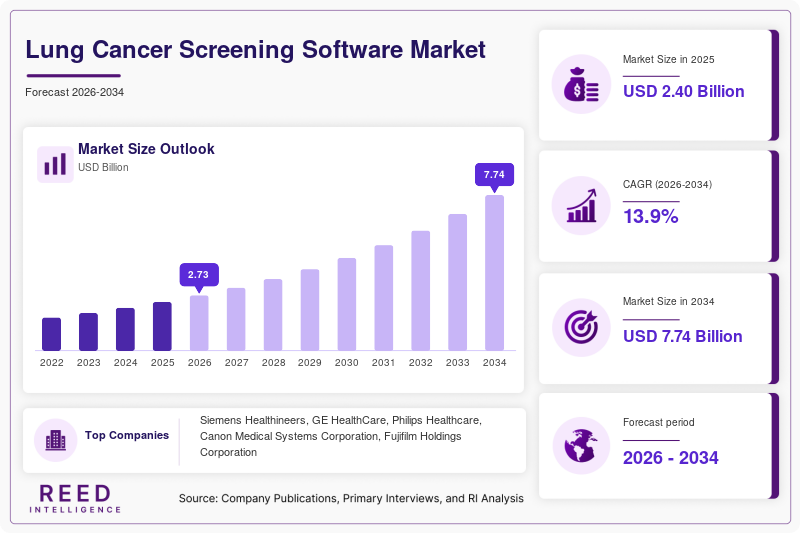
The Lung Cancer Screening Software Market size was valued at USD 2.4 billion in 2026 and is projected to reach USD 6.8 billion by 2034, expanding at a CAGR of 13.9% during the forecast period (2026–2034). The market growth is primarily supported by the global rise in early detection initiatives and increasing adoption of low-dose computed tomography (LDCT) screening programs, which are driving demand for advanced software solutions that enhance diagnostic accuracy and workflow efficiency.
Healthcare systems worldwide are transitioning toward preventive care, leading to a surge in screening volumes. This shift has encouraged the deployment of artificial intelligence (AI)-enabled platforms that assist radiologists in identifying pulmonary nodules with improved precision. Additionally, advancements in cloud computing and image analytics have further enabled scalable and integrated screening software solutions across hospitals and diagnostic centers.
Key Highlights
- North America dominated the market with a 38.5% share in 2025, while Asia Pacific is expected to register the fastest growth at a CAGR of 15.6% (2026–2034).
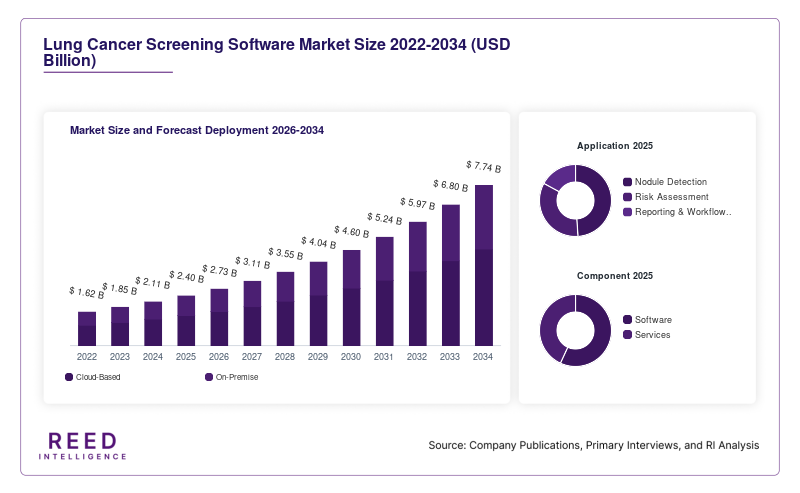
- By deployment, cloud-based software held the largest share of 54.2% in 2025, whereas AI-integrated platforms are projected to be the fastest-growing with a CAGR of 16.4%.
- By end-use, hospitals accounted for 46.8% market share in 2025, while diagnostic imaging centers are anticipated to expand at a CAGR of 14.8%.
- The United States remained the dominant country, with market values of USD 820 million in 2024 and USD 910 million in 2025, driven by established screening guidelines and high healthcare spending.
Market Trends
Increasing Integration of Artificial Intelligence in Screening Workflows
AI-based lung cancer screening software is gaining traction due to its ability to reduce false positives and enhance detection rates. These solutions leverage deep learning algorithms to analyze imaging data, assisting clinicians in identifying subtle abnormalities that may be missed during manual review.
Shift Toward Cloud-Based and Interoperable Platforms
Healthcare providers are adopting cloud-enabled software solutions that allow seamless integration with existing hospital information systems. This trend is improving data accessibility, enabling remote diagnostics, and supporting collaborative decision-making across healthcare networks.
Mrket Drivers
Rising Adoption of Early Screening Programs
The expansion of national and regional lung cancer screening initiatives is significantly boosting demand for advanced software solutions. Governments and healthcare organizations are promoting routine screening among high-risk populations, leading to increased imaging volumes and a need for efficient analysis tools.
Technological Advancements in Medical Imaging Software
Continuous innovation in imaging technologies and software capabilities is driving market growth. Enhanced visualization tools, automated reporting features, and improved algorithm accuracy are enabling faster and more reliable diagnoses, encouraging widespread adoption across healthcare facilities.
Market Restraint
High Implementation and Integration Costs
The adoption of lung cancer screening software often involves substantial initial investment, including infrastructure upgrades and system integration. These costs can limit adoption, particularly in small healthcare facilities and emerging markets.
Market Opportunities
Expansion in Emerging Healthcare Markets
Developing regions are witnessing rapid improvements in healthcare infrastructure. Increasing awareness of early cancer detection and growing investments in diagnostic technologies are creating new growth opportunities for market players.
Development of Personalized Screening Solutions
The integration of patient-specific data, including genetic and lifestyle factors, is enabling the development of personalized screening approaches. This advancement offers significant potential to improve diagnostic accuracy and treatment outcomes.
Segmental Analysis
By Deployment
Cloud-based solutions dominated the Lung Cancer Screening Software Market with a 54.2% share in 2025, driven by their scalability and ease of integration. On-premise solutions remained relevant for institutions requiring enhanced data control.
AI-integrated cloud platforms are expected to be the fastest-growing subsegment, with a projected CAGR of 16.4%, due to their ability to deliver real-time analytics and improved diagnostic efficiency.
By Application
Nodule detection and analysis emerged as the dominant subsegment, accounting for 48.6% share in 2025, owing to its critical role in early cancer identification.
Risk assessment and predictive analytics are anticipated to grow at a CAGR of 15.2%, supported by advancements in data modeling and personalized healthcare approaches.
By End-Use
Hospitals held the largest share of 46.8% in 2025, benefiting from high patient volumes and access to advanced imaging systems.
Diagnostic imaging centers are projected to grow at a CAGR of 14.8%, driven by increasing outsourcing of diagnostic services and rising demand for specialized imaging solutions.
By Component
Software solutions accounted for the majority share of 61.3% in 2025, while services, including maintenance and training, are expected to grow at a CAGR of 14.5%, driven by the need for ongoing technical support.
Regional Analysis
North America
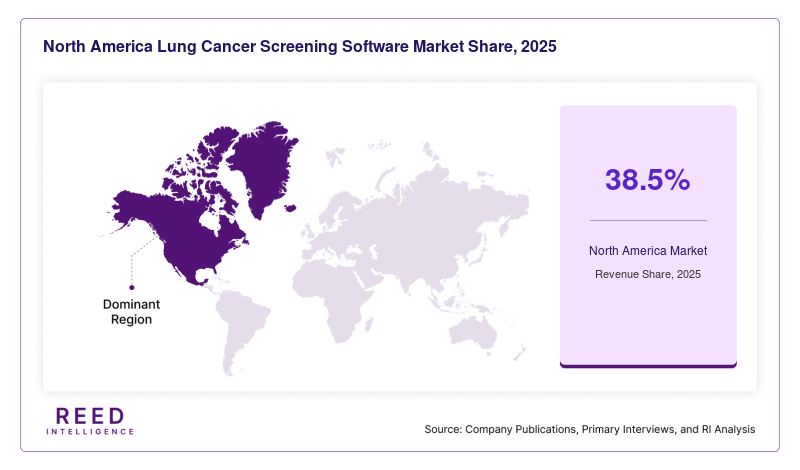
North America accounted for 38.5% of the Lung Cancer Screening Software Market share in 2025 and will grow at a CAGR of 12.8% during 2026–2034. The United States dominated the region due to well-established screening programs and advanced healthcare infrastructure. Increasing adoption of AI-driven diagnostic tools continues to support regional growth.
Europe
Europe held 26.7% market share in 2025 and is expected to expand at a CAGR of 13.1% over the forecast period. Germany led the region, supported by strong government initiatives promoting cancer screening and increasing adoption of digital health technologies.
Asia Pacific
Asia Pacific captured 21.4% share in 2025 and is projected to grow at the fastest CAGR of 15.6%. China dominated the region, driven by rising healthcare investments and growing awareness of early cancer detection among its large population.
Middle East & Africa
The Middle East & Africa region accounted for 7.2% share in 2025 and will grow at a CAGR of 12.5%. The United Arab Emirates led the region, supported by expanding healthcare infrastructure and increasing adoption of advanced diagnostic solutions.
Latin America
Latin America held 6.2% market share in 2025 and is expected to grow at a CAGR of 12.9%. Brazil dominated the region due to improving access to healthcare services and rising investments in diagnostic imaging technologies.
Competitive Landscape
The Lung Cancer Screening Software Market is moderately fragmented, with key players focusing on technological innovation and strategic partnerships. Leading companies are investing in AI-driven platforms to enhance diagnostic accuracy and workflow efficiency. The market leader, Siemens Healthineers, continues to strengthen its position through advanced imaging software and integrated AI solutions.
Recent developments include the launch of enhanced lung screening modules designed to improve early detection rates. Other major players such as GE HealthCare, Philips Healthcare, and Canon Medical Systems are expanding their product portfolios and global presence through collaborations and acquisitions. Emerging companies are focusing on niche innovations, particularly in predictive analytics and cloud-based platforms. Competitive strategies include product differentiation, geographic expansion, and continuous research and development to address evolving healthcare needs.
Key Players List
- Siemens Healthineers
- GE HealthCare
- Philips Healthcare
- Canon Medical Systems Corporation
- Fujifilm Holdings Corporation
- Zebra Medical Vision
- Aidoc
- Arterys
- Riverain Technologies
- Infervision
- Qure.ai
- Vuno Inc.
- DeepHealth (RadNet)
- Median Technologies
- Volpara Health Technologies
Recent Developments
- In 2025, Siemens Healthineers introduced an upgraded AI-powered lung screening module to enhance diagnostic precision.
- GE HealthCare expanded its cloud-based imaging platform to support large-scale screening programs.
- Philips Healthcare launched a new integrated workflow solution aimed at improving radiology efficiency.
- Qure.ai enhanced its AI algorithms for early-stage lung cancer detection with improved accuracy rates.
- Canon Medical Systems strengthened its presence in Asia Pacific through strategic collaborations with regional healthcare providers.
Lung Cancer Screening Software Market Segments
Deployment
- Cloud-Based
- On-Premise
Application
- Nodule Detection
- Risk Assessment
- Reporting & Workflow Management
Component
- Software
- Services
End-Use
- Hospitals
- Diagnostic Imaging Centers
- Research Institutions
By Region
- North America
- Europe
- APAC
- Middle East and Africa
- LATAM