Lung In Vitro Model Market Size, Share & Demand Report By Type (2D Lung Models, 3D Lung Models, Lung-on-Chip Models), By Application (Drug Discovery, Toxicity Testing, Disease Modeling), By End-Use (Pharmaceutical & Biotechnology Companies, Academic & Research Institutes, Contract Research Organizations), By Technology (Cell Culture-Based Models, Microfluidic Systems, Bioprinting Technologies), By Region & Segment Forecasts, 2026–2034
USD 3950
Market Overview
The global Lung In Vitro Model Market size was valued at USD 1.42 billion in 2026 and is projected to reach USD 3.18 billion by 2034, expanding at a CAGR of 10.6% during the forecast period (2026–2034). The market is gaining traction as pharmaceutical and biotechnology companies increasingly adopt alternative testing models to reduce reliance on animal studies and improve translational accuracy in respiratory research.
A key global factor supporting market growth is the rising demand for predictive preclinical models in drug development pipelines. Lung in vitro systems offer controlled, reproducible environments that simulate human lung physiology, making them essential for studying pulmonary diseases, toxicity, and drug delivery mechanisms. Increasing regulatory emphasis on ethical testing and advancements in tissue engineering have further accelerated adoption across research institutions and contract research organizations.
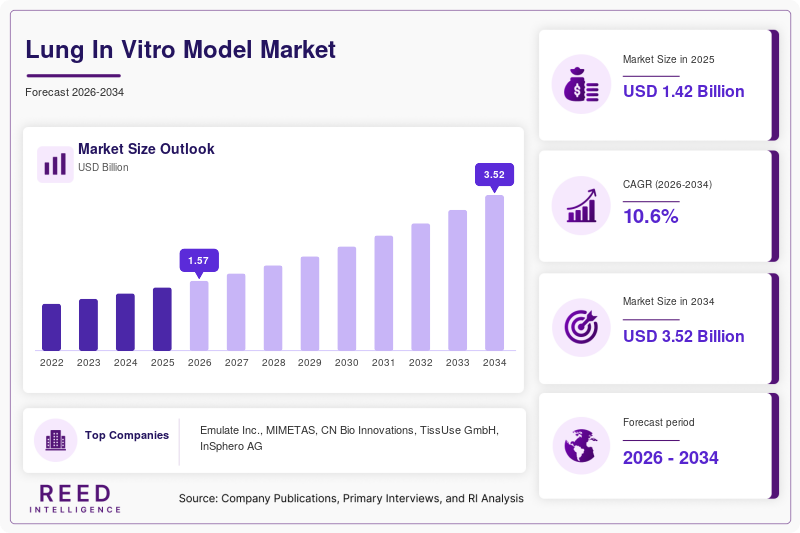
Key Highlights:
- North America dominated the market with a 38.5% share in 2025, while Asia Pacific is expected to register the fastest CAGR of 12.8%.
- The 3D lung models segment led the market in 2025 with a 44.2% share, while lung-on-chip models are projected to grow at a CAGR of 13.5%.
- Drug discovery applications accounted for the largest share at 46.7% in 2025, whereas toxicity testing is expected to grow at a CAGR of 12.1%.
- The U.S. market was valued at USD 420 million in 2024 and USD 455 million in 2025.
Market Trends
Increasing Adoption of Organ-on-Chip Technologies
The integration of microfluidic technologies into lung models has significantly improved the physiological accuracy of in vitro systems. Lung-on-chip platforms mimic breathing motions and air-liquid interfaces, enabling more realistic simulation of human lung functions. These systems are increasingly being adopted in drug screening and disease modeling, especially for infectious and inflammatory respiratory conditions. The trend is supported by collaborations between academic institutions and biotech firms focused on refining chip-based models for commercial applications.
Expansion of 3D Bioprinted Lung Models
3D bioprinting is transforming the Lung In Vitro Model Market by enabling the fabrication of complex lung tissue architectures. These models replicate cellular heterogeneity and extracellular matrix structures, providing deeper insights into disease mechanisms. Researchers are leveraging bioprinted lung tissues for personalized medicine and precision drug testing. The ability to customize models based on patient-specific data is driving demand in oncology and rare lung disease research. As printing technologies become more accessible and cost-effective, adoption is expected to increase across pharmaceutical and academic sectors.
Market Drivers
Rising Prevalence of Respiratory Diseases
The increasing global burden of respiratory disorders such as chronic obstructive pulmonary disease (COPD), asthma, and lung cancer is a major driver for the Lung In Vitro Model Market. These conditions require extensive research for effective drug development and treatment strategies. In vitro lung models provide a controlled platform for studying disease progression and therapeutic responses, reducing dependency on animal models and accelerating research timelines.
Growth in Pharmaceutical R&D Investments
The expansion of pharmaceutical and biotechnology research activities is significantly contributing to market growth. Companies are investing heavily in advanced testing models to improve drug development efficiency and reduce failure rates in clinical trials. Lung in vitro models offer high reproducibility and scalability, making them suitable for high-throughput screening. Increased funding from governments and private organizations for life sciences research is further strengthening the adoption of these models across laboratories worldwide.
Market Restraint
High Development and Operational Costs
The Lung In Vitro Model Market faces challenges due to the high costs associated with developing and maintaining advanced in vitro systems. Technologies such as organ-on-chip and 3D bioprinting require specialized equipment, skilled personnel, and complex protocols, which can limit adoption among smaller research facilities and academic institutions. Additionally, the lack of standardized protocols across different platforms may lead to variability in results, affecting reliability and scalability.
While large pharmaceutical companies can absorb these costs, smaller players may struggle to integrate such technologies into their workflows. The need for continuous technological upgrades further adds to operational expenses, potentially restraining market growth in cost-sensitive regions.
Market Opportunities
Integration with Artificial Intelligence in Drug Testing
The incorporation of artificial intelligence (AI) and machine learning into lung in vitro modeling presents significant growth opportunities. AI-driven analytics can enhance data interpretation, improve predictive accuracy, and streamline drug discovery processes. By combining computational models with biological systems, researchers can identify potential drug candidates more efficiently, reducing time-to-market and development costs.
Emerging Demand in Personalized Medicine
The shift toward personalized healthcare is creating new opportunities for the Lung In Vitro Model Market. Patient-specific lung models derived from stem cells enable tailored drug testing and treatment planning. This approach is particularly valuable in oncology and rare respiratory diseases, where individual variability plays a critical role in treatment outcomes. Increasing adoption of precision medicine frameworks is expected to drive demand for customizable in vitro lung models.
Segmental Analysis
By Type
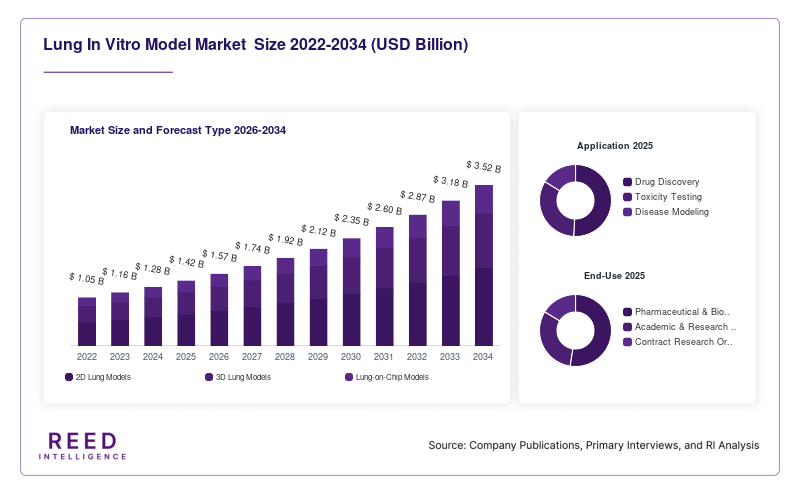
The 3D lung models segment dominated the Lung In Vitro Model Market in 2025, accounting for 44.2% of the total share. These models provided enhanced physiological relevance compared to traditional 2D cultures, making them widely used in disease modeling and drug testing. Their ability to replicate complex lung structures supported their adoption across pharmaceutical and academic research settings.
Lung-on-chip models are expected to be the fastest-growing subsegment, with a projected CAGR of 13.5% during the forecast period. The integration of microfluidics and real-time monitoring capabilities will drive their adoption. These models will gain traction due to their ability to simulate dynamic lung environments, including airflow and mechanical stress.
By Application
Drug discovery held the largest share of 46.7% in 2025 within the Lung In Vitro Model Market. The segment benefited from increasing demand for efficient and reliable preclinical testing models. Lung in vitro systems enabled researchers to evaluate drug efficacy and safety before clinical trials, reducing development risks.
Toxicity testing is anticipated to grow at the fastest CAGR of 12.1% over the forecast period. The need for accurate toxicity assessment without animal testing will drive demand. Regulatory agencies are encouraging the use of alternative models, which will further support growth in this segment.
By End-Use
Pharmaceutical and biotechnology companies dominated the market in 2025, accounting for 51.3% of the total share. These organizations relied heavily on in vitro models to streamline drug development processes and improve research outcomes. Their strong financial capabilities allowed them to invest in advanced technologies.
Academic and research institutes are expected to witness the fastest growth, with a CAGR of 11.8%. Increasing funding for life sciences research and rising collaborations with industry players will drive adoption. These institutions will play a key role in developing innovative lung models.
By Technology
Cell culture-based models led the Lung In Vitro Model Market in 2025 with a share of 48.9%. These models were widely used due to their simplicity and cost-effectiveness. They served as foundational tools for studying basic cellular responses in lung tissues.
Microfluidic technology is projected to grow at the fastest CAGR of 13.2%. The ability to replicate physiological conditions and enable real-time analysis will drive its adoption. Advancements in chip design and integration with sensors will further enhance their utility.
Regional Analysis
North America
North America accounted for 38.5% of the Lung In Vitro Model Market share in 2025 and is expected to grow at a CAGR of 9.8% during the forecast period. The region benefited from advanced research infrastructure and strong adoption of innovative technologies in pharmaceutical development.
The United States remained the dominant country due to extensive investments in biomedical research. The presence of leading pharmaceutical companies and well-established regulatory frameworks supported the adoption of advanced in vitro models. Increased focus on reducing animal testing further strengthened market growth.
Europe
Europe held a 27.3% share of the Lung In Vitro Model Market in 2025 and is projected to expand at a CAGR of 10.1% through 2034. The region experienced steady growth due to regulatory policies promoting alternative testing methods.
Germany emerged as the leading country, driven by strong government support for research and development. The country’s emphasis on innovation in biotechnology and tissue engineering contributed to the increasing adoption of lung in vitro models across academic and industrial sectors.
Asia Pacific
Asia Pacific captured 21.6% of the Lung In Vitro Model Market in 2025 and is expected to register the fastest CAGR of 12.8% over the forecast period. Rapid expansion of the pharmaceutical industry and increasing healthcare investments supported market growth.
China led the region due to its growing focus on biopharmaceutical research and infrastructure development. The government’s initiatives to enhance domestic drug development capabilities played a significant role in driving the adoption of advanced testing models.
Middle East & Africa
The Middle East & Africa region held a 6.8% share of the Lung In Vitro Model Market in 2025 and is projected to grow at a CAGR of 8.9% during the forecast period. Growth in this region was supported by increasing investments in healthcare infrastructure and research facilities.
Saudi Arabia dominated the regional market due to its expanding life sciences sector and government-backed research initiatives. Efforts to modernize healthcare systems and promote innovation contributed to the gradual adoption of in vitro technologies.
Latin America
Latin America accounted for 5.8% of the Lung In Vitro Model Market share in 2025 and is expected to grow at a CAGR of 9.2% through 2034. The region showed moderate growth driven by increasing awareness of advanced research methodologies.
Brazil emerged as the leading country, supported by improving research infrastructure and rising investments in pharmaceutical development. Growing collaborations between academic institutions and industry players further supported market expansion.

Competitive Landscape
The Lung In Vitro Model Market is moderately competitive, with several global and regional players focusing on innovation and strategic collaborations. Companies are investing in advanced technologies such as organ-on-chip systems and 3D bioprinting to strengthen their market position.
Emulate Inc. is recognized as a market leader due to its strong portfolio of organ-on-chip platforms. The company recently introduced an advanced lung-chip system designed for infectious disease research, enhancing its product offerings. Other players are focusing on partnerships with research institutions to expand their technological capabilities and market reach.
Continuous innovation and increasing investments in research and development are expected to intensify competition in the coming years.
Key Players List
- Emulate Inc.
- MIMETAS
- CN Bio Innovations
- TissUse GmbH
- InSphero AG
- MatTek Corporation
- Lonza Group
- Thermo Fisher Scientific Inc.
- Corning Incorporated
- Hesperos Inc.
- AxoSim Inc.
- BioIVT
- Epithelix Sàrl
- Cherry Biotech
- AlveoliX AG
Recent Developments
- Emulate Inc. launched an upgraded lung-on-chip platform with enhanced simulation capabilities for respiratory infections.
- MIMETAS expanded its organ-on-chip portfolio with improved microfluidic designs.
- CN Bio Innovations partnered with pharmaceutical firms to advance preclinical testing models.
- Lonza Group introduced new cell culture solutions for lung tissue modeling.
- Thermo Fisher Scientific expanded its product line for 3D cell culture systems.
Lung In Vitro Model Market Segments
Type
- 2D Lung Models
- 3D Lung Models
- Lung-on-Chip Models
Application
- Drug Discovery
- Toxicity Testing
- Disease Modeling
End-Use
- Pharmaceutical & Biotechnology Companies
- Academic & Research Institutes
- Contract Research Organizations
Technology
- Cell Culture-Based Models
- Microfluidic Systems
- Bioprinting Technologies
By Region
- North America
- Europe
- APAC
- Middle East and Africa
- LATAM