Luxury Car Leasing Market Size, Share & Trends Analysis Report By Vehicle Type (Luxury Sedans, Luxury SUVs & Crossovers, Luxury Coupes & Convertibles), By Lease Type (Closed-End Leasing, Open-End Leasing, Operating Leasing), By End User (Individuals, Corporate & Business Users), By Vehicle Powertrain (Internal Combustion Engine, Hybrid Electric, Battery Electric), By Distribution Channel (OEM Captive Finance, Independent Leasing Companies) Forecasts, 2026–2034
USD 3950
Luxury Car Leasing Market Size
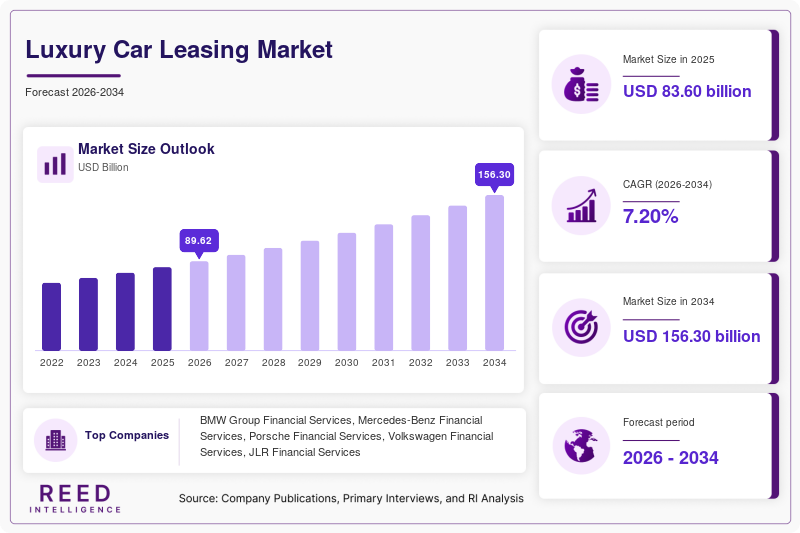
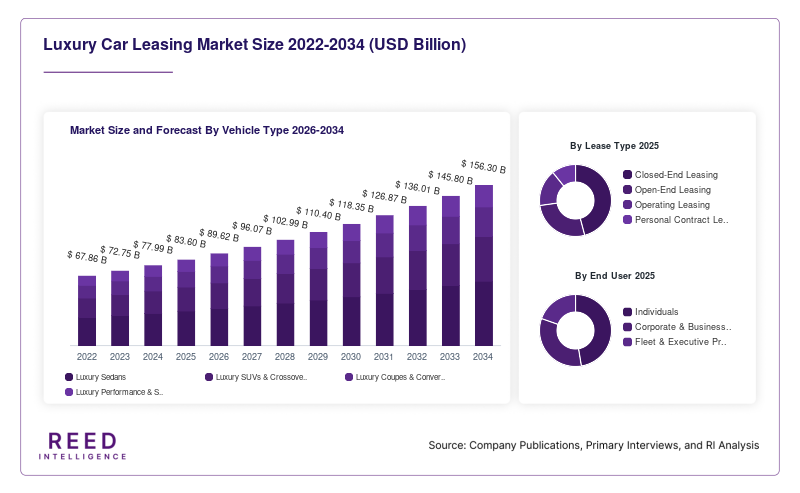
The global Luxury Car Leasing Market size was valued at USD 83.60 billion in 2025 and is projected to grow from USD 89.62 billion in 2026 to USD 156.30 billion by 2034, registering a CAGR of 7.20% during the forecast period from 2026 to 2034.
Luxury car leasing is becoming an important access model for premium vehicles because it reduces the upfront capital requirement while allowing customers to change vehicles more frequently. The model also gives manufacturers and finance companies a recurring relationship with customers through lease payments, insurance, maintenance and vehicle remarketing.
The European Commission notes that leasing represented more than 40% of new corporate-car registrations in Europe in 2024, equivalent to approximately 2.4 million leased new cars. The European leasing market is concentrated among large multi-brand operators and manufacturer-owned finance companies, with vehicles commonly returning to the market after three to five years.
Premium manufacturers already have large financing and leasing portfolios. BMW Group reported 4.93 million vehicles under credit-financing or leasing contracts at the end of 2025, up 1.6% year over year. Porsche reported a 41.5% penetration rate for leased or financed new vehicles in 2025, up from 39.6% in 2024, while its financing and leasing contract base increased 1.6% to 355,000 contracts.
The transition toward electrification is also changing leasing economics because customers can avoid taking the full residual-value risk associated with rapidly changing EV technology, battery development and used-EV pricing.
Luxury Car Leasing Market Drivers
Leasing Reduces the Upfront Cost of Premium Vehicle Ownership
Luxury vehicles have high acquisition prices, making monthly leasing payments an attractive alternative to paying the full purchase price. Leasing also allows customers to use a premium vehicle for a defined period without taking direct responsibility for its eventual resale value.
This structure is especially relevant for corporate users. The European Commission found that leasing accounted for more than 40% of new corporate-car registrations in Europe in 2024 and that corporate customers represented roughly two-thirds of European leasing customers.
The commercial mechanism extends beyond affordability. Leasing companies can bundle maintenance, insurance and roadside services, creating predictable monthly expenses. OEM captive finance companies also gain recurring access to customers when contracts mature, creating opportunities for replacement vehicles and upgrades.
Premium brands benefit because leasing can make higher-priced vehicles accessible to customers who might otherwise select lower-priced models. BMW's Financial Services business illustrates the scale of this model, with nearly 4.93 million vehicles under financing or leasing contracts at the end of 2025.
Frequent Model Replacement Supports Premium Leasing
Luxury customers tend to place greater value on new technology, design changes, performance improvements and brand experience. Leasing aligns with this behavior because contracts generally return vehicles to the finance company after a defined period.
The European Commission notes that leased vehicles are typically resold after three to five years, creating relatively rapid movement from new-vehicle leasing into the used-car market.
Premium manufacturers are accelerating product updates, particularly through electrification and software. BMW plans to bring 40 new models and model updates incorporating Neue Klasse technologies to global markets by 2027. JLR is simultaneously preparing the Range Rover Electric and new Jaguar models as part of its next-generation product strategy.
For leasing companies, frequent model introductions create replacement opportunities when existing contracts mature. For customers, leasing can reduce the inconvenience of owning a vehicle that becomes technologically outdated during a longer ownership cycle.
Captive Finance Companies Are Expanding the Leasing Ecosystem
Luxury vehicle manufacturers increasingly combine vehicle sales with financing and leasing. This gives OEMs greater control over customer acquisition, payment structures, residual-value management and vehicle remarketing.
Mercedes-Benz Financial Services added €11.9 billion of leased equipment in 2025, compared with €11.4 billion in 2024, while operating-lease vehicles generated recurring lease-payment revenue and subsequent resale income.
Porsche's financial-services penetration increased to 41.5% in 2025, while the number of financing and leasing contracts reached 355,000.
This creates a reinforcing commercial cycle: the manufacturer sells the vehicle, the captive finance company originates the lease, the dealer manages delivery and servicing, and the finance company ultimately controls the vehicle's remarketing channel.
Luxury Car Leasing Market Restraints
Residual-Value Risk Can Pressure Leasing Economics
Residual value is one of the most important variables in a lease. The leasing company estimates what a vehicle will be worth when the contract expires and incorporates that value into the monthly payment.
BMW Financial Services' 2025 disclosures show the scale of this exposure: 96,599 vehicles were scheduled to terminate during 2025, with an initial residual value of approximately USD 3.20 billion for the relevant portfolio. BMW Financial Services recorded gains on returned vehicles, but the magnitude of the portfolio illustrates why used-car prices directly affect leasing economics.
The risk becomes more complicated for EVs because battery technology, incentives, charging infrastructure and rapid model improvements can influence used-vehicle values. Porsche reported higher provisions for residual-value risks and credit risks in 2025, demonstrating that premium vehicle leasing remains exposed to changes in asset values.
Premium Vehicle Demand Remains Sensitive to Economic and Trade Conditions
Luxury vehicles are discretionary purchases and can therefore be affected by consumer confidence, interest rates, tariffs and economic conditions.
BMW reported that 2025 sales in China declined 12.5%, while Europe and the Americas grew 7.3% and 5.6%, respectively. Porsche's 2025 deliveries declined 10.1%, with declines in Germany, Europe excluding Germany and China.
JLR also reported that tariffs, difficult conditions in China and a cyber incident affected FY2025/26 results, although it continued to report demand for its luxury brands.
These conditions can reduce new lease originations and increase pressure on monthly payments, incentives and residual-value assumptions.
Luxury Car Leasing Market Opportunities
Growth of Luxury EV Leasing
The shift toward electrification creates a particular opportunity for leasing because customers can access new EV technology without committing to long-term ownership. BMW delivered 442,000 fully electric vehicles in 2025, representing almost 18% of its deliveries, while its total electrified share exceeded 26%.
JLR is also transitioning its portfolio toward electrification while retaining hybrid and combustion options to match different market conditions.
For leasing providers, shorter replacement cycles can reduce customers' exposure to technology obsolescence. The challenge is maintaining accurate residual-value forecasts as EV used-car markets mature.
Digital Leasing and Subscription-Like Customer Journeys
Digital platforms can simplify vehicle configuration, credit assessment, contract signing, delivery and renewal. This is particularly relevant to luxury customers who increasingly expect the purchasing process to match the digital experience of other premium services.
The opportunity is strongest when digital leasing is connected to OEM captive finance, dealer inventory and used-vehicle remarketing. A digitally originated lease can create a continuous customer lifecycle rather than a single vehicle transaction.
Corporate Executive and Premium Fleet Programs
Corporate leasing provides an important route into luxury vehicles because companies often use premium vehicles for executive mobility, employee benefits and customer-facing roles. European data shows that corporate customers account for the majority of leasing activity.
Luxury brands can use fleet programs to introduce customers to higher trim levels, electrified vehicles and service packages. Leasing companies can also bundle maintenance, charging solutions and insurance, increasing revenue per contract.
Segmental Analysis
By Vehicle Type
Luxury SUVs & Crossovers represent approximately 44% of the global market in 2025, making them the dominant vehicle category. Demand is supported by the combination of premium interiors, higher seating position, utility and increasingly broad electrified product portfolios.
BMW reported strong 2025 demand for the X1, X3 and X5, while the company said its 2025 growth in Europe and the Americas offset weaker Chinese sales.
Luxury Sedans account for approximately 29%, while Luxury Performance & Sports Cars represent 15% and Luxury Coupes & Convertibles account for 12%.
Luxury SUVs & Crossovers also remain among the fastest-growing categories, with approximately 8.1% CAGR, supported by product launches, electrification and customer preference for versatile premium vehicles.
By Lease Type
Closed-End Leasing represents approximately 48% of the market in 2025. Under this structure, the leasing company generally retains the residual-value risk, making the contract attractive to customers seeking predictable payments.
Operating Leasing represents approximately 27%, followed by Personal Contract Leasing at 17% and Open-End Leasing at 8%.
Personal Contract Leasing is the fastest-growing lease format, with approximately 8.3% CAGR, supported by its combination of lower monthly payments, flexible ownership options and access to newer vehicles.
The European Commission describes operating leasing as essentially a long-term rental arrangement that can include maintenance and insurance services.
By End User
Individuals account for approximately 54% of the global market in 2025. Personal customers use leasing to access premium vehicles while avoiding the full upfront purchase cost and long-term resale risk.
Corporate & Business Users represent approximately 32%, supported by executive fleets, employee-car programs and corporate mobility policies.
Fleet & Executive Programs account for approximately 14%.
Corporate & Business Users are the fastest-growing end-user segment, with approximately 8.0% CAGR. European leasing data demonstrates the importance of corporate demand, with more than 40% of new corporate registrations leased in 2024.
By Vehicle Powertrain
Internal Combustion Engine vehicles represent approximately 52% of the market in 2025, reflecting their established installed base and broad model availability.
Battery Electric Vehicles account for approximately 23%, while Hybrid Electric Vehicles represent approximately 25%.
Battery Electric Vehicles are the fastest-growing powertrain segment, with approximately 14.2% CAGR. BMW's 2025 results illustrate the transition: fully electric vehicles accounted for almost 18% of group deliveries, while total electrified vehicles exceeded 26%.
The leasing model can support EV adoption because customers can change vehicles at contract maturity rather than retaining the vehicle through multiple technology cycles.
By Distribution Channel
OEM Captive Finance represents approximately 46% of the market in 2025. Manufacturer-owned financial services businesses benefit from direct access to vehicle inventory, dealers and customer data.
Independent Leasing Companies account for approximately 31%, while Dealerships & Brokers represent 16%.
Digital Leasing Platforms account for approximately 7% but are the fastest-growing channel, with approximately 13.0% CAGR.
OEM captive finance remains powerful because the manufacturer can coordinate financing, incentives, maintenance, insurance and vehicle remarketing. BMW, Mercedes-Benz and Porsche all demonstrate the importance of financial-services operations within premium automotive ecosystems.
Regional Analysis
North America Luxury Car Leasing Market
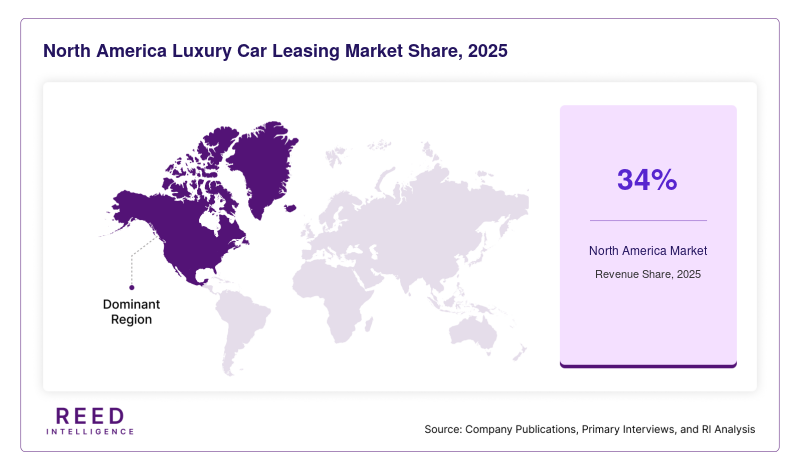
North America represents approximately 34% of the global Luxury Car Leasing Market in 2025. The region benefits from high premium-vehicle penetration, developed automotive-finance infrastructure, large corporate fleets and mature dealership networks.
The U.S. market is particularly important because luxury brands have extensive captive-finance operations and customers commonly evaluate vehicles through monthly-payment economics rather than purchase price alone.
BMW's 2025 results showed strong performance in the Americas, with regional sales growth helping offset weaker China performance. Porsche also maintains a significant financial-services operation across North America, with demand for its financing and leasing products increasing in several international regions during 2025.
North America is projected to grow at approximately 6.6% CAGR through 2034. Luxury SUVs, premium EVs and corporate leasing are important demand areas.
The main constraints are interest-rate sensitivity, used-car residual values and the potential impact of tariffs on imported luxury vehicles.
Europe Luxury Car Leasing Market
Europe accounts for approximately 31% of the global market in 2025. Leasing is structurally embedded in the European automotive market, particularly for corporate vehicles. The European Commission reports that more than 40% of new corporate-car registrations were leased in 2024, equivalent to about 2.4 million new leased cars.
The market is concentrated among major leasing companies including Ayvens, Arval, Alphabet and Athlon, alongside manufacturer-owned finance businesses.
Europe is projected to expand at approximately 7.0% CAGR. Electrification is an important factor because corporate fleets are transitioning toward lower-emission vehicles and customers increasingly require access to newer powertrains.
The region also benefits from strong premium brands including BMW, Mercedes-Benz, Porsche, Audi, Range Rover and Volvo. The main counterbalances are high vehicle taxes in some countries, changing EV incentives and macroeconomic pressure on household purchasing power.
APAC Luxury Car Leasing Market
APAC represents approximately 22% of the global market in 2025 and is the fastest-growing region, with a CAGR of approximately 9.1%.
China, Japan, South Korea, Australia and India provide the principal demand bases. The region is also undergoing rapid change in premium-vehicle powertrains, particularly in China, where domestic EV manufacturers are challenging traditional luxury brands with technology-rich vehicles.
BMW reported a 12.5% decline in China sales during 2025, but also reported 5.9% global sales growth excluding China, highlighting the highly competitive conditions facing premium manufacturers in the Chinese market.
BMW's financial-services portfolio shows the region's continuing importance: Asia accounted for 17.1% of its global financed or leased vehicle portfolio at the end of 2025.
The APAC leasing market is expected to benefit from expanding premium vehicle availability, rising urban incomes, corporate mobility and EV adoption. Digital leasing platforms can further reduce barriers to accessing premium vehicles.
The principal constraints are intense competition in China, rapidly changing EV residual values and differences in leasing regulations between individual countries.
Middle East and Africa Luxury Car Leasing Market
Middle East and Africa represents approximately 7% of the global market in 2025 and is projected to grow at approximately 7.8% CAGR.
The Middle East is the main premium-vehicle center within the region, supported by high concentrations of luxury consumers, expatriate professionals, corporate fleets and premium tourism. Luxury SUVs and performance vehicles have a particularly strong fit with the region's road infrastructure and consumer preferences.
OEMs can use leasing and financial-services packages to reduce the upfront cost of high-value vehicles while maintaining customer relationships through service contracts.
The region's constraints include differences in financial regulation, relatively smaller leasing infrastructure in many African markets and currency volatility outside the Gulf economies.
LATAM Luxury Car Leasing Market
LATAM accounts for approximately 6% of the global Luxury Car Leasing Market in 2025 and is expected to expand at approximately 7.4% CAGR.
Brazil and Mexico provide the region's largest premium-vehicle markets. Leasing remains less deeply embedded than in Europe, leaving room for growth as financial-service providers expand digital origination, maintenance packages and corporate mobility products.
The commercial opportunity is strongest in corporate fleets and premium SUVs, where monthly leasing structures can reduce the initial capital requirement.
LATAM's principal constraints are interest rates, currency volatility, import duties and uneven availability of premium financial products. Greater integration between dealerships, captive finance companies and digital platforms can reduce these barriers.
Competitive Landscape
The Luxury Car Leasing Market has a distinctive competitive structure because the largest vehicle manufacturers also operate captive finance businesses. This creates competition between OEM-controlled leasing programs and independent multi-brand leasing companies.
BMW Group Financial Services manages one of the industry's largest premium financing and leasing portfolios, with 4.93 million financed or leased vehicles at the end of 2025. BMW's product strategy is closely connected to its Neue Klasse rollout, with 40 new models and updates planned through 2027.
Mercedes-Benz Financial Services operates a large operating-lease portfolio. In 2025, additions to leased equipment reached €11.9 billion, while the company also manages the subsequent resale of returned leased vehicles.
Porsche Financial Services increased its penetration rate to 41.5% in 2025 and expanded its financing and leasing contract base to 355,000 contracts.
Key Market Players
- BMW Group Financial Services
- Mercedes-Benz Financial Services
- Porsche Financial Services
- Volkswagen Financial Services
- JLR Financial Services
- Audi Financial Services
- Lexus Financial Services
- Toyota Financial Services
- Ayvens
- Arval
- Alphabet
- Athlon
- Leasys
- Santander Consumer Finance
- Enterprise Fleet Management
- Sixt Leasing
Recent Market Developments
- September 2026 – BMW continued its Neue Klasse product rollout. BMW said it plans to bring 40 models and model updates using Neue Klasse technologies to global markets by 2027, expanding the pipeline of premium vehicles that can enter future leasing cycles.
- September 2026 – Luxury EV competition intensified. New premium EV launches and faster technology cycles are changing how luxury customers assess vehicle ownership and resale risk, increasing the relevance of leasing as a way to access newer technology without committing to long-term ownership.
Luxury Car Leasing Market Segments
By Vehicle Type
- Luxury Sedans
- Luxury SUVs & Crossovers
- Luxury Coupes & Convertibles
- Luxury Performance & Sports Cars
By Lease Type
- Closed-End Leasing
- Open-End Leasing
- Operating Leasing
- Personal Contract Leasing
By End User
- Individuals
- Corporate & Business Users
- Fleet & Executive Programs
By Vehicle Powertrain
- Internal Combustion Engine
- Hybrid Electric
- Battery Electric
By Distribution Channel
- OEM Captive Finance
- Independent Leasing Companies
- Dealerships & Brokers
- Digital Leasing Platforms
By Region
- North America
- Europe
- APAC
- Middle East and Africa
- LATAM