Luxury Coaches Market Size, Share & Trends Analysis Report By Deck (Single Deck Luxury Coaches, Double Deck Luxury Coaches), By Propulsion Type (ICE, Electric), By Application (Tourism & Charter Services, Corporate Transport & Executive Shuttles, Airport & Hotel Transfers), By Seating Capacity (Up to 30 Seats, 31–45 Seats, 46–55 Seats, Above 55 Seats) and By Region (North America, Europe, APAC, Middle East and Africa, LATAM) Forecasts, 2026–2034
USD 3950
Luxury Coaches Market Size
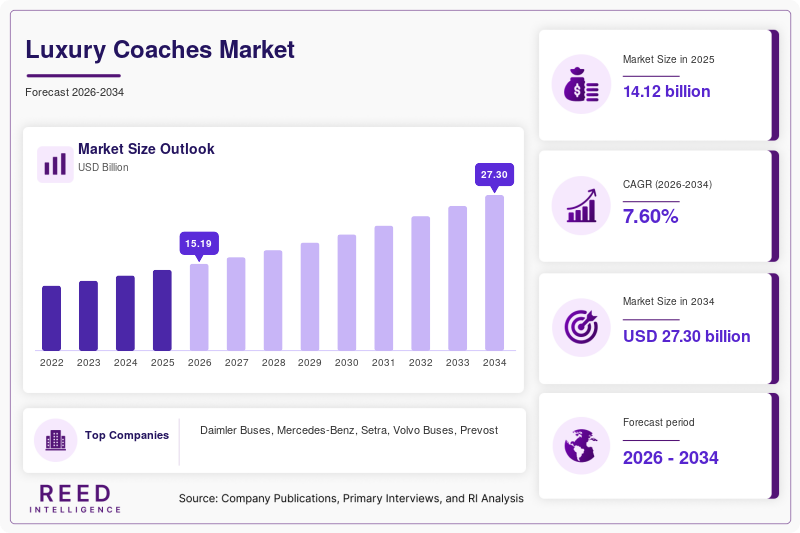
The global Luxury Coaches Market size was valued at USD 14.12 billion in 2025 and is projected to grow from USD 14.60 billion in 2026 to USD 26.32 billion by 2034, registering a CAGR of 7.60% during the forecast period from 2026 to 2034.
Luxury coaches are premium buses designed for long-distance, tourism, charter, executive and other passenger services where comfort, safety, luggage capacity, onboard amenities and operating efficiency influence vehicle selection. The category includes premium single-deck and double-deck coaches, with configurations ranging from conventional diesel and alternative-fuel powertrains to emerging battery-electric and hydrogen solutions.
Demand is supported by the continued importance of motorcoach travel in tourism and group transportation. The American Bus Association's 2026 census found that U.S. and Canadian motorcoach operators ran 50,968 coaches in 2025, with 86.9% of companies offering charter service, 31% offering tours and 27.6% offering sightseeing. The industry employed 77,176 people, while the average coach traveled 40,297 miles during the year.
The economic value of coach-based tourism also provides a direct demand signal. U.S. motorcoach group travel generated an estimated 41.1 billion passenger miles and USD 72.5 billion in direct spending in 2025, supporting transportation, accommodation, food and beverage activity.
At the vehicle level, manufacturers are differentiating through premium interiors, advanced driver assistance, connectivity, fuel efficiency and alternative powertrains. Setra's TopClass range, Volvo's 9700 and B13R platforms, Prevost's H3-45 and Irizar's i6S family illustrate the premium-coach product architecture.
Luxury Coaches Market Drivers
Tourism and Charter Activity Is Sustaining Demand for Premium Coaches
Tourism and charter operations represent a major commercial use of luxury coaches because operators must transport passengers over long distances while maintaining comfort and service quality. The American Bus Association reported that charter service was offered by 86.9% of U.S. and Canadian motorcoach companies in 2025, while tour and sightseeing services were offered by 31% and 27.6%, respectively.
The demand mechanism extends beyond vehicle purchases. Tour operators and charter companies compete on passenger experience, reliability, luggage capacity, seating comfort and onboard amenities. This creates a replacement incentive for older coaches even when fleet operators are not expanding the number of vehicles.
Luxury coaches also enable operators to package transportation with higher-value travel experiences. Premium seating, entertainment, Wi-Fi, climate control, toilets and onboard catering can differentiate a coach journey from lower-cost transportation.
The counterbalance is utilization volatility. Tourism demand can vary by season and destination, while fuel prices, labor costs and financing rates influence operators' ability to purchase new vehicles. Consequently, manufacturers increasingly emphasize total cost of ownership alongside comfort.
Fleet Replacement and Higher Coach Utilization Are Supporting New Vehicle Demand
The installed coach fleet creates a recurring replacement market because vehicles accumulate mileage and operating wear across high-frequency intercity and tourism routes. The 2026 American Bus Association census found that the average motorcoach traveled approximately 40,297 miles in 2025, while the industry operated nearly 51,000 coaches in the U.S. and Canada.
European data also indicates an active replacement environment. The EU had approximately 699,238 buses in circulation, with an average fleet age of 12.2 years, while 38,238 new buses and coaches were registered in 2025.
This creates a commercial mechanism for luxury-coach manufacturers: high annual mileage accelerates maintenance requirements, while aging fleets create opportunities for operators to upgrade passenger amenities, safety systems and powertrain efficiency at replacement.
Volvo's 2026 B13R UNVI XL program illustrates this dynamic. The manufacturer shifted body production to Portugal because demand for the new luxury coach exceeded expectations, with orders from 12 customers before the first customer had operated the vehicle.
Premium Comfort and Safety Technology Are Increasing Product Differentiation
Luxury coaches increasingly compete on the passenger experience as well as mechanical performance. Setra's TopClass and ComfortClass ranges incorporate premium seating, infotainment, connectivity, climate control and driver-assistance systems. The Setra TopClass was named Coach of the Year 2026 following evaluation of its safety and driver-assistance technology.
Regulatory requirements are reinforcing this investment. Daimler Buses began equipping Mercedes-Benz and Setra buses with enhanced safety systems ahead of the EU General Safety Regulation C requirements that became mandatory for newly registered buses from July 2026. These include improved emergency braking and driver-distraction warning functions.
For operators, the commercial benefit is a combination of passenger safety, driver support, insurance considerations and vehicle productivity. For manufacturers, the result is a higher technology content per vehicle and more opportunities to differentiate premium models from standard intercity buses.
Luxury Coaches Market Restraints
High Acquisition and Operating Costs Limit Premium-Coach Replacement
Luxury coaches require significantly greater capital expenditure than standard buses because they combine large passenger capacity with premium seating, entertainment, HVAC, toilets, luggage systems, advanced safety technology and higher-grade interiors.
Operators also face fuel, insurance, driver, maintenance and financing costs. This is particularly relevant to smaller charter companies. The American Bus Association found that 87.3% of motorcoach companies operated fewer than 25 coaches in 2025, indicating a fragmented operator base in which financing and utilization can materially affect vehicle-purchase decisions.
Manufacturers are responding with more efficient drivetrains and service programs. Volvo's 9700 Double Decker, for example, incorporates technologies that can reduce fuel consumption by up to 9% compared with its previous engine generation, while Prevost's redesigned H3-45 delivers up to 12% greater fuel economy.
Long-Distance Electrification Faces Range and Infrastructure Constraints
Electrification is progressing rapidly in the wider bus market, but coaches face more difficult operating requirements because long-distance routes demand greater range, luggage capacity and rapid turnaround.
The IEA reported that global electric-bus sales reached nearly 70,000 units in 2025, up 12%, but zero-emission vehicles represented only around 10% of coach sales in China. The agency specifically notes that intercity coaches are harder to electrify than urban buses.
The European market shows the same transition challenge. Electrically chargeable vehicles represented 23.8% of new EU bus sales in 2025, but this aggregate includes urban and intercity buses.
Consequently, luxury-coach manufacturers are pursuing multiple powertrain pathways rather than relying solely on batteries. Hydrogen fuel cells, hybrid systems, HVO-compatible diesel platforms and battery-electric coaches are all being developed for different operating profiles.
Luxury Coaches Market Opportunities
Electric and Hydrogen Luxury Coaches
The transition toward lower-emission passenger transportation is opening a new product cycle for premium coaches. MAN's Lion's Coach E is available to order as a fully electric coach, while Irizar's second-generation i6S Efficient H2 FCEV is designed for medium- and long-distance operation with more than 1,000 km of range and approximately 10–15-minute hydrogen refueling.
Irizar began real-world passenger operation of the hydrogen coach with Alsa in Madrid during June and July 2026, allowing the technology to be evaluated under intercity and long-distance operating conditions.
The commercial opportunity is strongest on routes where operators can access suitable charging or hydrogen infrastructure and where regulatory requirements create a value for zero-emission operation.
Premium Double-Deck Coaches for High-Density Tourism
Double-deck coaches offer operators greater passenger capacity without proportionally increasing the vehicle footprint. Volvo's 9700 Double Decker can accommodate up to 97 passengers and is specifically marketed for premium tour and charter operations.
The format is particularly relevant to high-volume tourism corridors, city sightseeing, airport transfers and intercity services where passenger capacity directly influences revenue per vehicle.
Higher capacity can also reduce the number of vehicles required for a given group-travel schedule, although operators must balance this benefit against route restrictions, vehicle weight and infrastructure compatibility.
Premium Coach Partnerships and Regional Customization
Coach manufacturers are increasingly using partnerships between chassis suppliers and bodybuilders to broaden their regional product offerings. Volvo Buses and Marcopolo launched the B13R–Paradiso G8 premium coach for Southern Europe, combining Volvo's chassis with Marcopolo's body and targeting long-distance and tourism operators. First orders were secured in France, Italy and Portugal, with deliveries expected from early 2027.
The partnership model reduces the need for a manufacturer to develop every body configuration internally while giving operators more choice in seating, interior layouts and regional specifications.
Segmental Analysis
By Deck
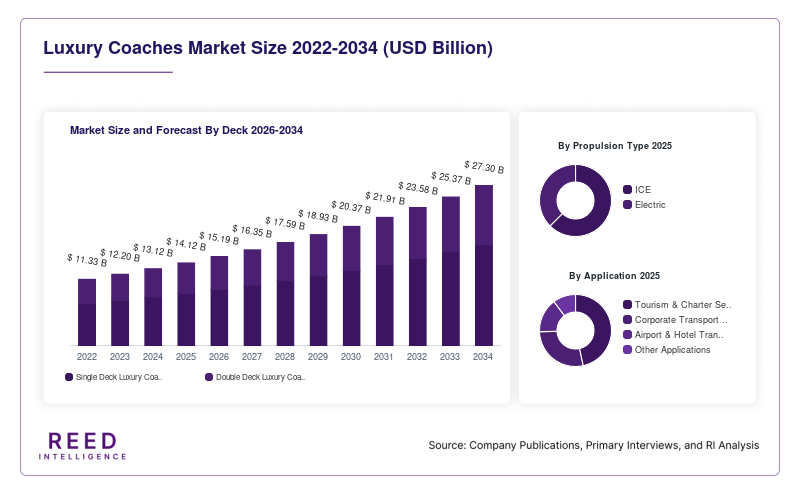
Single Deck Luxury Coaches represent approximately 72% of the global market in 2025, making them the dominant deck configuration. They offer a balance between passenger capacity, luggage volume, maneuverability and operating flexibility, making them suitable for tourism, charter, corporate and intercity applications.
Volvo's 9700 and B13R platforms, Setra ComfortClass and TopClass coaches, and Prevost's H3-45 demonstrate the breadth of the single-deck premium-coach market.
Double Deck Luxury Coaches account for approximately 28% but are the fastest-growing deck segment, with a CAGR of approximately 8.9%. Their higher passenger capacity is attractive on high-volume tourism, sightseeing and intercity routes. Volvo's 9700 Double Decker supports configurations of up to 97 seats while retaining premium equipment options.
By Propulsion Type
ICE Luxury Coaches account for approximately 88% of the market in 2025. Diesel remains dominant because long-distance coaches require high range, rapid refueling and established fueling infrastructure.
Manufacturers are improving ICE efficiency rather than simply retaining legacy designs. Volvo's latest 9700 uses fuel-saving technologies, while Prevost's redesigned H3-45 provides improved fuel economy.
Electric Luxury Coaches represent approximately 12% but are the fastest-growing propulsion segment, with a CAGR of approximately 10.0%. The IEA reported that electric bus sales grew 12% globally in 2025, although long-distance coaches remain slower to electrify.
Battery-electric, hydrogen and hybrid development is therefore creating a transition period in which multiple powertrains coexist.
By Application
Tourism & Charter Services represent approximately 45% of the market in 2025 and form the largest application segment. The American Bus Association's 2026 census shows the importance of charter, tour and sightseeing operations within the motorcoach industry.
Corporate Transport & Executive Shuttles account for approximately 21%, supported by premium employee transportation, executive mobility and event transportation.
Airport & Hotel Transfers represent approximately 16%, particularly in destinations with high visitor volumes and large hotel clusters.
Other Applications account for approximately 18%.
Corporate Transport & Executive Shuttles are the fastest-growing application, with approximately 8.4% CAGR, supported by corporate mobility programs, premium event transportation and demand for comfortable group travel.
By Seating Capacity
46–55 Seats represent approximately 41% of the market in 2025. This configuration balances passenger capacity with luggage requirements and remains well suited to conventional tour and charter operations.
31–45 Seats account for approximately 27%, while Above 55 Seats represents 23% and Up to 30 Seats accounts for 9%.
Above 55 Seats is the fastest-growing seating category, with approximately 8.5% CAGR. Higher-capacity coaches can improve operator economics on dense tourism and intercity routes by moving more passengers per vehicle. Volvo's 9700 Double Decker demonstrates the upper-capacity opportunity, with configurations reaching up to 97 seats.
Regional Analysis
North America Luxury Coaches Market
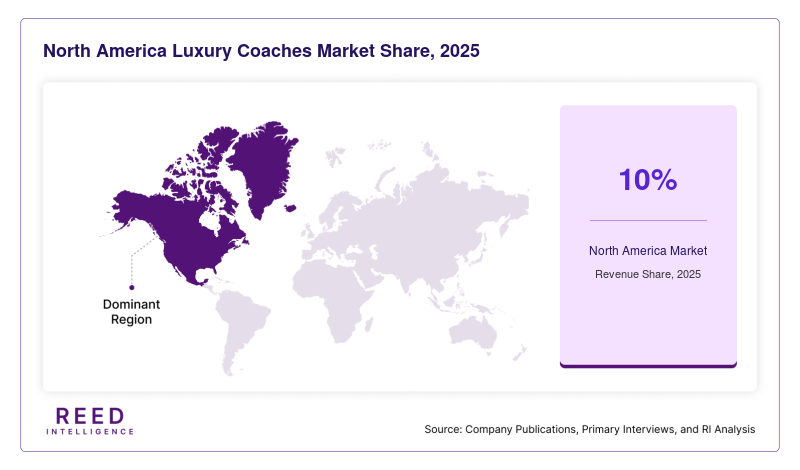
North America represents approximately 10% of the global Luxury Coaches Market in 2025 and is projected to grow at approximately 6.6% CAGR through 2034.
The region has a mature motorcoach operating base. The 2026 American Bus Association census identified 50,968 motorcoaches operating in the U.S. and Canada during 2025, while the average coach traveled 40,297 miles. Large operators accounted for 50.8% of the fleet.
The commercial environment supports premium coach purchases because charter, tour, sightseeing and group travel generate recurring demand. The 2025 motorcoach group-travel economy generated USD 72.5 billion in direct spending in the United States, illustrating the economic scale supported by the vehicle category.
Prevost has a particularly strong competitive position in North America. In March 2026, the company reported the leading overall North American motorcoach market position and said its H3-45 was the best-selling 45-foot motorcoach based on registration data.
The region's principal constraint is the capital intensity of premium vehicles and the fragmented operator base. However, high mileage and established service networks support replacement demand.
Europe Luxury Coaches Market
Europe accounts for approximately 18% of the global market in 2025 and is projected to expand at approximately 7.5% CAGR.
The region combines a mature tourism economy with established premium-coach manufacturers including Daimler Buses, Volvo Buses, MAN and Irizar. The EU had 699,238 buses in operation in 2025, with an average fleet age of 12.2 years. New bus and coach registrations reached 38,238 units during the year.
Europe is also becoming a major testing ground for alternative coach powertrains. Irizar's i6S Efficient H2 FCEV began passenger operation in Madrid in 2026, while MAN's Lion's Coach E is available to order.
Safety regulation is another demand mechanism. Daimler Buses introduced enhanced safety and driver-assistance systems ahead of the EU General Safety Regulation C requirements that became mandatory for new bus registrations in July 2026.
Europe is therefore combining fleet replacement with technological upgrades. The main constraints are high vehicle costs, infrastructure requirements for alternative powertrains and uneven demand across individual tourism markets.
APAC Luxury Coaches Market
APAC represents approximately 65% of the global Luxury Coaches Market in 2025 and is the fastest-growing region, with a CAGR of approximately 8.1%.
The region's dominance reflects the scale of premium intercity transportation, tourism, coach manufacturing and long-distance passenger travel across China, Japan, India, Southeast Asia and Australia.
China is particularly important for coach manufacturing and electric-bus production. The IEA reported that China accounted for around 60% of global electric-bus sales in 2025, while more than 60% of China's total bus sales were electric. However, zero-emission penetration in the coach segment remained around 10%, indicating a substantial transition opportunity specifically for intercity and premium vehicles.
Regional manufacturers such as Yutong, King Long and other Chinese producers benefit from large domestic demand and manufacturing scale, while international manufacturers continue to develop premium offerings for Asian tourism and intercity operators.
The market is also influenced by expanding tourism, premium group transportation and increasing interest in higher-capacity coaches. The key constraint is the uneven adoption of premium products across countries, with operators in some markets remaining highly price-sensitive.
Middle East and Africa Luxury Coaches Market
Middle East and Africa represents approximately 4% of the global market in 2025 and is projected to grow at approximately 7.9% CAGR.
The Middle East provides a strong premium-transport environment because of international tourism, luxury hospitality, airport transfers, religious travel and major events. Gulf markets also have a high concentration of premium hotels and organized group transportation.
Africa has a more varied market structure, with luxury coaches serving safari tourism, intercity transportation, tour operators and premium group travel. The business case is strongest in destinations where tourism operators require reliable long-distance vehicles with high passenger comfort.
Alternative powertrains are likely to develop more gradually because long-distance routes, high temperatures, infrastructure availability and operating distances can complicate electrification.
The principal opportunity is therefore a combination of premium diesel/HVO-compatible coaches, higher-capacity models and gradual introduction of electric or hydrogen vehicles on suitable routes.
LATAM Luxury Coaches Market
LATAM represents approximately 3% of the global market in 2025 and is expected to grow at approximately 7.2% CAGR.
Brazil is particularly important because of its large bus-manufacturing industry and Marcopolo's international coach-body production. Volvo and Marcopolo's 2026 European partnership combines a Volvo B13R chassis produced in Sweden with Marcopolo's Paradiso G8 body produced in Brazil, demonstrating the region's role in the global coach supply chain.
Luxury coaches serve intercity transportation, tourism, charter operations and corporate travel. Operators often prioritize durability, fuel economy, passenger capacity and after-sales support because long-distance routes can produce high annual mileage.
The region's main constraints include currency volatility, financing costs and uneven infrastructure. Manufacturers with strong local production and service networks can reduce these barriers by improving parts availability and customization.
Competitive Landscape
The Luxury Coaches Market combines large bus OEMs, premium coach brands, chassis manufacturers and independent bodybuilders. Competition is based on passenger comfort, safety, fuel efficiency, total cost of ownership, customization, drivetrain choice, service coverage and delivery capacity.
Daimler Buses competes through Mercedes-Benz and Setra. Setra's ComfortClass and TopClass cover premium touring applications, while OMNIplus provides aftersales and digital services. In 2026, Daimler Buses upgraded its coach portfolio with new engines, transmissions, electronic architecture and additional safety systems, with fuel-consumption reductions of up to 6% depending on configuration.
Volvo Buses combines coach chassis, complete vehicles and partnerships with body manufacturers. Its 2026 partnership with Marcopolo introduced the B13R–Paradiso G8 premium coach to Southern Europe, with initial orders already placed in France, Italy and Portugal.
Key Market Players
- Daimler Buses
- Mercedes-Benz
- Setra
- Volvo Buses
- Prevost
- MAN Truck & Bus
- Scania
- Irizar Group
- Marcopolo
- Yutong Bus
- King Long
- Van Hool
- Alexander Dennis
- Temsa
- MCI
- Zhongtong Bus
Recent Market Developments
- September 2026 –Volvo Buses and Marcopolo expanded their European premium-coach partnership. The Volvo B13R–Marcopolo Paradiso G8 received initial orders in France, Italy and Portugal, with deliveries scheduled from early 2027. The partnership expands Volvo's premium coach offering without requiring an internally developed body platform for every market.
- September 2026 – Daimler Buses upgraded its coach portfolio. New engines, transmissions, electronic architecture, safety systems and digital services were introduced, with fuel consumption potentially reduced by up to 6% depending on model and configuration.
Luxury Coaches Market Segments
By Deck
- Single Deck Luxury Coaches
- Double Deck Luxury Coaches
By Propulsion Type
- ICE
- Electric
By Application
- Tourism & Charter Services
- Corporate Transport & Executive Shuttles
- Airport & Hotel Transfers
- Other Applications
By Seating Capacity
- Up to 30 Seats
- 31–45 Seats
- 46–55 Seats
- Above 55 Seats
By Region
- North America
- Europe
- APAC
- Middle East and Africa
- LATAM