Luxury Cruise Ship Market Size, Share & Trends Analysis Report By Ship Size (Large Luxury Cruise Ships, Mid-size Luxury Cruise Ships, Small Luxury Cruise Ships, Expedition & Superyacht-Style Ships), By Cruise Type (Luxury Ocean Cruises, Expedition Cruises, Yacht Cruises, Luxury River Cruises), By Booking Channel (Travel Agencies & Cruise Specialists, Direct Sales, Online Travel Agencies), By Destination (Caribbean, Mediterranean, Northern Europe, Asia-Pacific, Alaska & Polar Regions, Other Desti
USD 3950
Luxury Cruise Ship Market Size
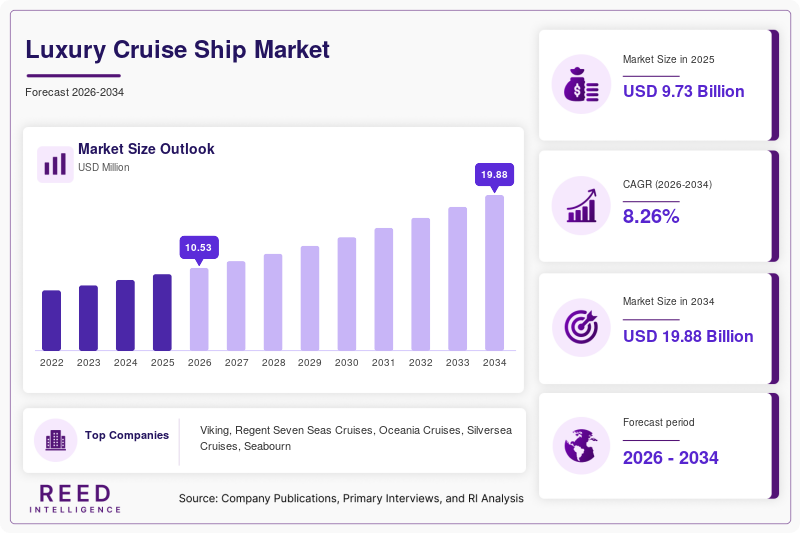
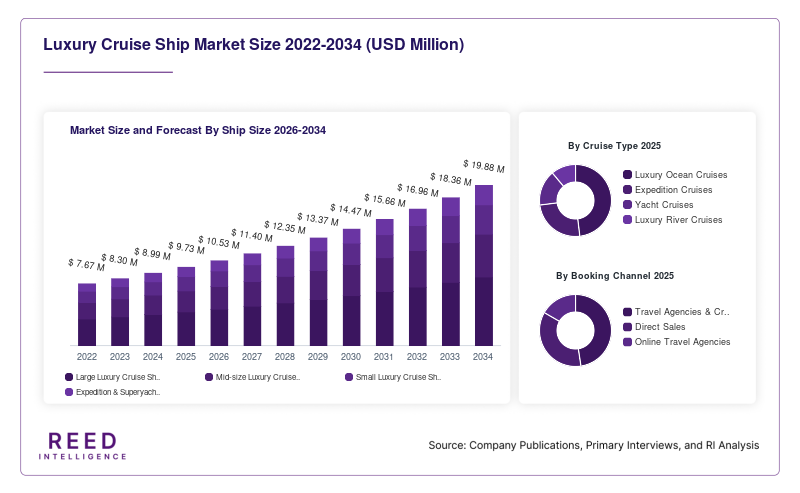
The luxury cruise ship market was valued at USD 9.73 billion in 2025 and is projected to grow from USD 10.53 billion in 2026 to USD 18.36 billion by 2034, registering a CAGR of 8.26% during the forecast period from 2026 to 2034.
Luxury cruising is moving toward smaller-capacity ships, destination-focused itineraries, higher service intensity and increasingly personalized experiences rather than simply larger onboard entertainment complexes. The addressable market includes luxury ocean cruises, expedition vessels, yacht-style cruising and other premium small-ship formats where higher fares are supported by accommodation quality, dining, service, itinerary design and shore experiences.
The wider cruise industry provides a strong demand backdrop. CLIA reported 37.2 million ocean-going cruise passengers in 2025, up from 34.6 million in 2024, while almost 90% of cruisers surveyed indicated an intention to cruise again.
Luxury Cruise Ship Market Drivers
Rising Cruise Participation Creates a Larger Pipeline of Customers for Luxury Upgrades
The broader cruise customer base is expanding, creating a larger pool of travelers who can subsequently trade toward higher-value luxury products. CLIA recorded 37.2 million ocean-going passengers in 2025, an increase of 7.5% from 2024, while its 2025 industry report identified first-time cruisers as an important source of new demand.
The mechanism for luxury cruise demand is not simply passenger-volume growth. First-time or returning cruisers can move toward smaller ships, better accommodation, more inclusive fares and destination-focused itineraries as their familiarity with cruising increases.
Viking's 2025 filing provides evidence of this conversion mechanism: more than 20% of its new-to-brand ocean passengers had never previously taken an ocean cruise.
The counterbalance is that luxury fares remain substantially more discretionary than mass-market cruise products, making the segment more exposed to household wealth and travel-budget changes.
New Luxury Ship Capacity Is Expanding the Premium Product Supply
Cruise companies and shipyards are committing capital to purpose-built luxury vessels, increasing the number of cabins available in the premium segment. Fincantieri launched Seven Seas Prestige in December 2025 for Regent Seven Seas, with delivery scheduled for 2026 and a second vessel scheduled for 2030; an additional ultra-luxury ship has also been ordered for delivery in 2033.
NCLH's current orderbook similarly includes four Prestige Class ships for Regent and five Sonata Class ships for Oceania, with deliveries extending into the 2030s.
The commercial mechanism is additional premium inventory and the ability to introduce new itineraries while retiring or repositioning older ships. Newbuilds can also incorporate more efficient propulsion and updated hospitality spaces.
However, ship construction requires large upfront capital commitments and long lead times, meaning supply cannot be adjusted rapidly if demand weakens.
Destination-Focused and Small-Ship Experiences Increase Luxury Product Differentiation
Luxury operators increasingly differentiate through access to destinations, longer port stays, curated excursions and smaller vessels rather than relying exclusively on onboard amenities. Viking describes its ocean product as smaller-format and destination-focused, while its 2025 filing reported a 27% luxury-ocean market share under its defined competitive set.
The Ritz-Carlton Yacht Collection provides another example: its 2026–2027 winter program includes French Polynesia, Hawaii and additional Asia-Pacific destinations, with 32 new voyages and new ports in Asia.
This creates a pricing mechanism because differentiated access can support higher fares and ancillary spending. The limitation is that destination-dependent products are exposed to port infrastructure, weather, geopolitical conditions and environmental restrictions.
Luxury Cruise Ship Market Restraints
High Shipbuilding Costs and Limited Shipyard Capacity Constrain Fleet Expansion
Luxury cruise ships require substantial capital and specialized shipbuilding capacity. Fincantieri reported a €63.2 billion backlog at the end of 2025, with deliveries scheduled as far out as 2037, illustrating how cruise-ship production is tied to long-duration shipyard commitments.
The economic mechanism is straightforward: higher construction costs increase the capital required for each new cabin, while delayed deliveries postpone the revenue contribution from new capacity. NCLH has also noted that shipyard availability and sustainability-related modifications have contributed to changes in expected delivery schedules.
This constraint particularly affects smaller luxury operators because they have fewer vessels over which to distribute fixed corporate and shipbuilding costs.
Environmental Requirements Increase Fleet Investment Requirements
Cruise companies are investing in more efficient ships and alternative-fuel technologies while responding to increasingly stringent environmental expectations. CLIA's 2026 report highlights continued investment in more efficient ships as the industry works toward its net-zero emissions ambition for 2050.
NCLH's new Prima-class vessels include designs prepared for future green-methanol use, illustrating how environmental considerations are being incorporated into newbuild specifications.
The commercial impact is a higher technology and compliance burden for new vessels. Older ships may become less competitive where ports or customers favor lower-emission operations, while retrofitting can require additional capital and periods out of service.
Luxury Cruise Ship Market Opportunities
Ultra-Luxury Yacht-Style Cruising Creates a Premium Alternative to Conventional Cruise Ships
The emergence of hotel-branded and yacht-style cruise products is expanding the addressable luxury segment. The Ritz-Carlton Yacht Collection entered cruising with Evrima in 2022 and subsequently expanded to three superyachts, including Ilma and Luminara.
The opportunity arises from combining luxury-hotel brand recognition with maritime travel while emphasizing smaller passenger counts, personalized service and curated destinations. Its 2026 program includes new itineraries in Alaska, while its winter 2026–2027 program adds French Polynesia, Hawaii and Asia-Pacific destinations.
The model can attract travelers who would otherwise choose luxury resorts, private yachts or high-end land tours. The limitation is the very high capital and operating cost associated with small-capacity vessels.
Expedition and Remote-Destination Cruising Expands the Premium Experience Proposition
Expedition cruising creates an opportunity to sell access to destinations that are difficult to reach through conventional tourism. CLIA identified expedition and exploration as one of the fastest-growing cruise sectors in its 2024 industry report, with expedition passenger volume up 71% between 2019 and 2023.
Viking has incorporated expedition cruising into its product portfolio with two expedition ships, while luxury operators are extending itineraries into polar, Alaska, Pacific and other remote destinations.
The commercial mechanism is higher-value itinerary differentiation: the experience itself becomes a central component of the fare rather than an add-on to onboard entertainment.
The constraint is operational complexity, including weather, port access, environmental restrictions and the specialized equipment and crew required for expedition operations.
Ship Size Analysis
By Ship Size
Mid-size Luxury Cruise Ships account for approximately 36% of the global market in 2025. Their position reflects the balance between premium onboard amenities and the ability to access a broader range of ports than the largest cruise vessels. Operators can spread hotel, crew and technical costs across more passengers than ultra-small vessels while retaining a more intimate positioning.
Expedition & Superyacht-Style Ships account for approximately 22% and are projected to grow at approximately 10.40% CAGR, making them the fastest-growing ship-size segment. The expansion reflects rising interest in remote destinations and hotel-branded yacht experiences. The Ritz-Carlton Yacht Collection's expansion into Alaska and Asia-Pacific demonstrates how this category is adding differentiated itineraries.
Large Luxury Cruise Ships account for approximately 24% and grow at approximately 7.20% CAGR, while Small Luxury Cruise Ships account for approximately 18% and grow at approximately 8.70% CAGR.
Cruise Type Analysis
By Cruise Type
Luxury Ocean Cruises account for approximately 55% of the market in 2025. Their scale comes from established fleets, year-round itineraries and access to major cruise destinations. Viking had 12 ocean ships at the end of 2025, while its defined luxury-ocean competitive market share reached 27%.
Expedition Cruises account for approximately 20% and are projected to grow at approximately 10.60% CAGR, making them the fastest-growing cruise type. The category benefits from the growing commercialization of remote destinations and experience-led travel. CLIA reported a 71% increase in expedition passengers from 2019 to 2023.
Yacht Cruises represent approximately 15% and grow at approximately 9.40% CAGR, supported by new hotel-branded yacht concepts, while Luxury River Cruises account for approximately 10% and grow at approximately 7.30% CAGR.
Booking Channel Analysis
By Booking Channel
Travel Agencies & Cruise Specialists account for approximately 46% of the market in 2025. Luxury cruises involve itinerary selection, cabin configuration, transfers, excursions and often complex international travel arrangements, making specialist advice valuable.
CLIA reported that 73% of cruise travelers said travel advisors had a meaningful influence on their decision to cruise, highlighting the continued role of intermediated booking.
Online Travel Agencies account for approximately 24% and are projected to grow at approximately 10.10% CAGR, making them the fastest-growing booking channel. Digital platforms improve itinerary discovery and price comparison, particularly for experienced cruise travelers.
Direct Sales account for approximately 30% and grow at approximately 7.60% CAGR, supported by established cruise brands using direct websites, loyalty programs and personalized sales teams.
Destination Analysis
By Destination
The Mediterranean accounts for approximately 29% of the global luxury cruise market in 2025. The region combines a dense concentration of established cultural destinations with multiple countries accessible within a single itinerary, making it suitable for premium destination-focused cruising.
Asia-Pacific accounts for approximately 17% and is projected to grow at approximately 10.20% CAGR, making it the fastest-growing destination segment. Luxury operators are increasing their presence across Asia-Pacific. The Ritz-Carlton Yacht Collection's Luminara introduced voyages across 28 ports in 10 countries during its initial Asia-Pacific season and subsequently expanded the region's itinerary portfolio.
The Caribbean accounts for approximately 25% and grows at approximately 7.40% CAGR, supported by established luxury cruise infrastructure.
Northern Europe accounts for approximately 12% and grows at approximately 8.00% CAGR, while Alaska & Polar Regions account for approximately 9% and grow at approximately 10.00% CAGR. Other Destinations represent approximately 8% and grow at approximately 7.10% CAGR.
Luxury Cruise Ship Market Regional Analysis
North America Holds the Largest Regional Share Through Its Large Cruise Customer Base and Concentration of Luxury Cruise Operators
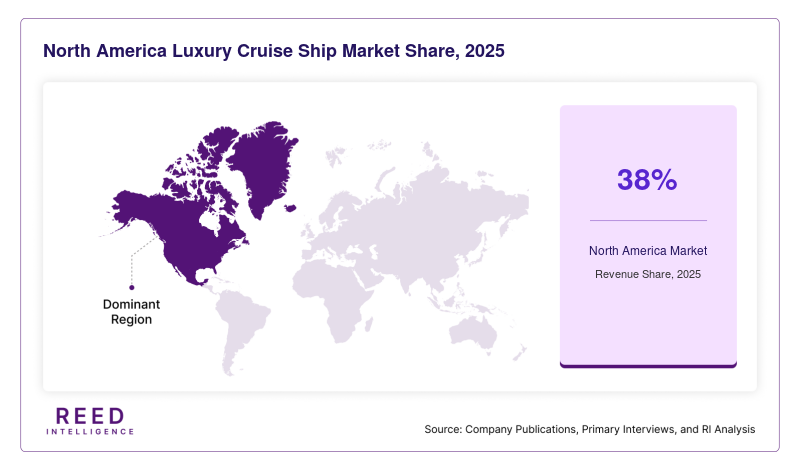
North America accounts for approximately 38% of the global luxury cruise ship market in 2025 and is projected to grow at approximately 7.50% CAGR through 2034.
The region is the largest source market for global cruising. CLIA's 2025 global report recorded just over 22 million North American cruise travelers, representing about three in five global cruisers.
The United States provides the region's principal demand base, supported by established cruise ports, travel-advisor networks and a large population of repeat cruise customers. Luxury brands also use North America as an important source market for Caribbean, European, Alaska and expedition itineraries.
The region benefits from established operators and brands including Regent Seven Seas, Seabourn, Silversea, Viking and The Ritz-Carlton Yacht Collection.
Future growth is linked to premiumization within the existing cruise customer base, new luxury ship deliveries and greater availability of small-ship and yacht-style products.
Constraints include exposure to economic conditions, Caribbean port congestion, hurricane-related disruption and high operating costs.
Europe Maintains a Major Position Through Mediterranean Demand and Strong Luxury Tourism Infrastructure
Europe accounts for approximately 30% of the market in 2025 and is projected to grow at approximately 7.90% CAGR through 2034.
The Mediterranean is a particularly important luxury cruise environment because several countries can be incorporated into a single itinerary, allowing operators to combine cultural destinations, culinary experiences and premium shore excursions.
Europe also serves as a major source market. CLIA reported 8.9 million European source passengers in 2025, up from 8.4 million in 2024.
Italy, Spain, France, the United Kingdom and Germany represent important markets across both source demand and cruise infrastructure.
Shipbuilding is another structural strength. Fincantieri's Italian shipyards are deeply involved in luxury newbuild programs, including Regent Seven Seas' Prestige Class.
Growth depends on premium itinerary development, new ships and shoulder-season cruising. Constraints include environmental regulation, port-capacity limitations and congestion at heavily visited destinations.
Asia-Pacific Is the Fastest-Growing Region as Luxury Operators Expand Into Destination-Rich and Emerging Cruise Markets
Asia-Pacific accounts for approximately 20% of the market in 2025 and is projected to grow at approximately 10.10% CAGR through 2034, making it the fastest-growing region.
The region provides a combination of established luxury tourism markets and developing cruise destinations. Japan, Australia, Singapore and Southeast Asia offer destination diversity that aligns with the luxury sector's emphasis on cultural immersion and smaller ports.
The Ritz-Carlton Yacht Collection has expanded its Asia-Pacific proposition through Luminara, including destinations across Indonesia, Malaysia, the Philippines and other Asian markets. Its 2026–2027 program adds further Asia-Pacific voyages.
China and other Asian markets also represent longer-term source-market opportunities, although cruise recovery has varied by country. CLIA's 2024 report noted that Asia remained below its pre-pandemic demand level.
Growth will depend on port infrastructure, source-market development and the deployment of appropriate small and mid-size vessels.
Middle East and Africa Develop Through Destination Expansion and Luxury Tourism Investment
Middle East and Africa account for approximately 7% of the market in 2025 and are projected to grow at approximately 8.40% CAGR through 2034.
The region's opportunity is closely linked to premium tourism development, new destination infrastructure and cruise itineraries connecting the Middle East, Red Sea, Africa and Indian Ocean.
The United Arab Emirates, Saudi Arabia, South Africa and selected Indian Ocean destinations can support luxury cruise products through high-end tourism infrastructure and differentiated shore experiences.
The growth mechanism is primarily destination diversification: cruise operators can use new ports to develop itineraries outside traditional Mediterranean and Caribbean circuits.
However, geopolitical risk, regional security conditions, port infrastructure and seasonality can materially affect itinerary planning and passenger demand.
Latin America Represents a Developing Market Supported by Caribbean Connections and Premium Coastal Tourism
Latin America accounts for approximately 5% of the global market in 2025 and is projected to grow at approximately 7.80% CAGR through 2034.
Brazil, Mexico and selected Caribbean-adjacent markets provide demand and destination opportunities for luxury cruise operators.
Mexico benefits from proximity to major North American source markets, while Brazil provides a large domestic travel base and access to South Atlantic itineraries.
Luxury growth is connected to boutique vessels, longer itineraries and destination-led experiences rather than high-capacity cruise deployment.
The principal constraints are uneven port infrastructure, currency volatility, economic sensitivity and geopolitical or weather-related itinerary disruptions.
Luxury Cruise Ship Market Competitive Landscape
The competitive structure is characterized by a combination of large cruise groups operating dedicated luxury brands and independent luxury operators competing through ship size, service intensity, itinerary design, inclusions and destination access.
Viking has developed a vertically consistent fleet strategy, operating 12 ocean ships and two expedition ships at the end of 2025. Its standardized ship designs can support operating consistency while its destination-focused proposition differentiates it from larger mainstream cruise brands.
Norwegian Cruise Line Holdings operates Norwegian Cruise Line, Oceania Cruises and Regent Seven Seas Cruises. Its 2025 filing showed 34 ships and approximately 71,400 berths across the group, with a substantial future orderbook for Oceania and Regent.
Key Market Players
- Viking
- Regent Seven Seas Cruises
- Oceania Cruises
- Silversea Cruises
- Seabourn
- The Ritz-Carlton Yacht Collection
- Explora Journeys
- Scenic Luxury Cruises & Tours
- Crystal
- Windstar Cruises
Luxury Cruise Ship Market Recent Developments
- February 2026 — Fincantieri secured an order from Norwegian Cruise Line Holdings for three new cruise ships for Norwegian Cruise Line, Oceania Cruises and Regent Seven Seas Cruises. The order strengthens the long-term shipbuilding relationship and adds future capacity across NCLH's portfolio, including its luxury brands.
- April 2026 — CLIA reported record global cruise passenger volume of 37.2 million in 2025. The organization also reported that almost 90% of cruisers intend to cruise again, reinforcing the industry's repeat-travel component.
Luxury Cruise Ship Market Segments
By Ship Size
- Large Luxury Cruise Ships
- Mid-size Luxury Cruise Ships
- Small Luxury Cruise Ships
- Expedition & Superyacht-Style Ships
By Cruise Type
- Luxury Ocean Cruises
- Expedition Cruises
- Yacht Cruises
- Luxury River Cruises
By Booking Channel
- Travel Agencies & Cruise Specialists
- Direct Sales
- Online Travel Agencies
By Destination
- Caribbean
- Mediterranean
- Northern Europe
- Asia-Pacific
- Alaska & Polar Regions
- Other Destinations
By Region
- North America
- Europe
- APAC
- Middle East and Africa
- LATAM