Luxury Wallpaper Market Size, Share & Trends Analysis Report By Material Type (Vinyl and Vinyl-Coated Wallpaper, Non-Woven Wallpaper), By Design Type (Traditional and Heritage Designs, Contemporary and Geometric Designs), By Application (Residential and Commercial), By Project Type (Renovation and Remodeling and New Construction), By Distribution Channel (Specialty Retailers and Showrooms, Interior Designers and Contract Sales) Forecasts, 2026–2034
USD 3950
Luxury Wallpaper Market Size
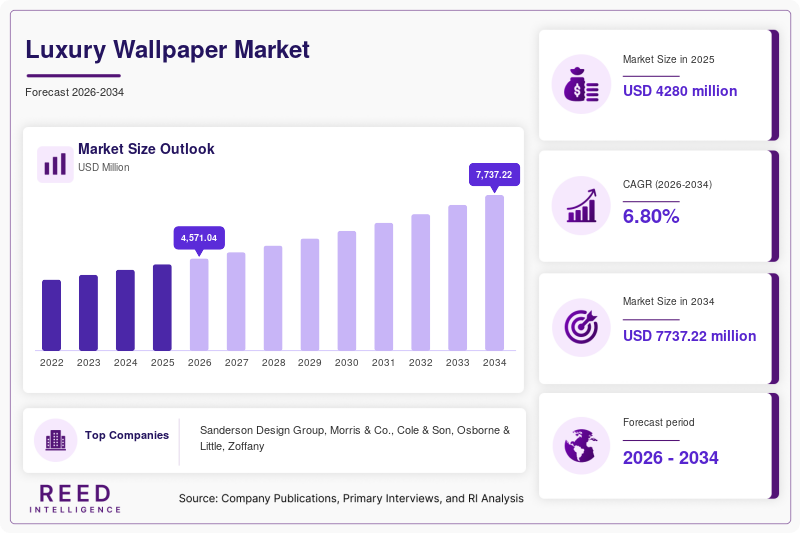
The global Luxury Wallpaper Market was valued at USD 4,280 million in 2025 and is estimated to reach USD 4,570 million in 2026. Based on the supplied forecast, the market is projected to reach USD 7,737.22 million by 2034, registering a stated CAGR of 6.80% during 2026–2034.
The supplied figures are retained as provided. The increase from USD 4,570 million in 2026 to USD 7,737.22 million in 2034 implies a CAGR of approximately 6.92%, slightly above the stated 6.80%. This difference should be reconciled if the figures are intended for a financial model or published forecast.
All market values in this report are expressed in USD million. Segment and regional values are internal analytical allocations rather than independently reported market statistics. The scope focuses on premium and luxury wallpaper, including designer, textile, natural-fiber, specialty-finish and bespoke products. It excludes broader interior-decoration spending unless explicitly stated.
The luxury wallpaper market comprises premium wallcoverings differentiated by design authorship, material quality, surface treatment, craftsmanship, customization and brand positioning. Products can include designer-printed paper and non-woven wallpapers, vinyl-coated luxury designs, textile and grasscloth wallcoverings, metallic finishes, embossed textures, large-format murals and made-to-order patterns. The distinction between luxury and standard wallpaper is commercial rather than universal: brands and buyers may define the premium tier through price, materials, exclusivity, design heritage or customization.
Luxury wallpaper is purchased for residential interiors such as living rooms, bedrooms, dining rooms and entrance halls, as well as hospitality, retail, premium offices and other commercial interiors. In residential projects, a feature wall or coordinated room scheme can provide visual impact without requiring a full interior renovation. In commercial projects, wallcoverings can contribute to a property’s identity and guest experience, but buyers also evaluate durability, cleanability, fire-performance requirements and maintenance.
Luxury Wallpaper Market Drivers
Premium residential renovation supports demand for design-led wallcoverings
Luxury wallpaper can refresh a room without changing its structural layout. Homeowners and interior designers may use patterned, textured or bespoke wallcoverings to establish a room’s visual identity, coordinate with furniture and fabrics, or update an older property. Renovation projects can therefore create demand independently of new housing construction.
The commercial mechanism is particularly relevant to premium products because design decisions often involve the whole room rather than the cost per roll alone. A buyer may prioritize a distinctive pattern, an archival design or a coordinated textile collection over a lower-priced alternative. However, renovation spending remains discretionary, and purchases can be deferred when household budgets tighten or other home-improvement projects take priority.
Heritage design archives and artist collaborations differentiate premium brands
Luxury wallpaper brands can draw on historic pattern libraries, archival prints, textile references and collaborations with artists or cultural institutions. These assets allow manufacturers to reinterpret established designs for contemporary interiors while retaining a recognizable brand identity. Morris & Co., for example, maintains an archive of historical wallpaper and textile designs that informs its current collections.
A design archive can reduce reliance on short-lived fashion trends and support coordinated products across wallpaper, fabric and other interior categories. Collaborations can also generate press coverage and interest among designers. The limitation is that a recognizable heritage name does not guarantee sales: the collection still needs to fit current customer tastes, pricing expectations and the requirements of a particular room or project.
Texture, specialty materials and bespoke printing support premium pricing
Luxury wallpaper can differentiate itself through tactile materials, metallic finishes, raised patterns, large-scale murals, textile surfaces and customized dimensions. These features can create a visual effect that standard printed wallpaper does not reproduce in the same way. Bespoke production can also allow a designer to adapt a pattern to a specific wall, project palette or architectural feature.
The commercial opportunity depends on a customer’s willingness to pay for the finished result. Specialty substrates, complex printing, smaller production runs and manual finishing can increase manufacturing costs, while custom work may require additional sampling and approval stages. Suppliers need to manage production tolerances, lead times and installation instructions to preserve the perceived value of a premium product.
Luxury Wallpaper Market Restraints
High product and installation costs limit adoption
Luxury wallpaper can carry a substantial premium over standard wallcoverings because of design licensing, specialty substrates, intricate printing, small production runs and brand positioning. The final installed cost can also include wall preparation, lining paper, adhesive, specialist labor, pattern matching and waste from complex repeats.
These costs can constrain adoption in price-sensitive households and projects with strict fit-out budgets. A high-cost design may be used on one feature wall rather than throughout a property, limiting the volume purchased per project. Suppliers can address the constraint through multiple product tiers and clear installation guidance, but lowering price without preserving the material or design proposition can weaken the brand’s premium positioning.
Installation complexity can increase project risk
Luxury wallpaper often requires careful surface preparation, correct adhesive selection, matching of pattern repeats and control of seams. Textile, natural-fiber, metallic or highly patterned products may require more specialized handling than simple wallcoverings. Wall irregularities, moisture, poor substrate preparation or inconsistent batches can undermine the final appearance.
For homeowners, installation complexity can increase labor costs and the risk of rework. For commercial projects, defects can delay handover or create costly replacement requirements. Brands that provide accurate specifications, clear instructions, appropriate samples and access to experienced installers can reduce these risks, but installation quality remains partly outside the manufacturer’s direct control.
Exposure to discretionary spending and property cycles creates demand volatility
Luxury wallpaper is usually purchased as part of a broader interior-decorating or refurbishment decision. When household confidence declines or developers postpone projects, consumers may delay decorative upgrades, while commercial customers may prioritize essential repairs over aesthetic improvements. Premium products can be especially exposed when buyers trade down to less expensive materials.
The effect varies by customer group. A hospitality renovation can involve large orders but may be postponed if financing or occupancy conditions weaken. Residential consumers may continue smaller projects while delaying a whole-room redesign. Suppliers benefit from a balanced customer portfolio, but the premium category remains sensitive to renovation budgets and the health of high-end property markets.
Material performance and indoor-environment requirements affect specification
Luxury wallpaper can use paper, non-woven substrates, vinyl coatings, textiles, natural fibers, adhesives and surface treatments. Product suitability depends on the intended environment and on factors such as cleanability, moisture exposure, lightfastness, emissions and the applicable fire-performance requirements. A wallcovering appropriate for a bedroom may not be suitable for a high-traffic hospitality corridor or a humid area.
The European Union’s REACH framework includes restrictions on formaldehyde emissions from certain articles, with specific scope and exemptions. Wallpaper is identified among the indoor sources considered in the regulatory assessment, but the exact requirements depend on the product and applicable rules.
Manufacturers need to verify that material claims and technical documentation are appropriate for each product and market. Compliance, testing and documentation can add cost, while buyers must avoid assuming that every luxury product is automatically lower-emission or more sustainable simply because it is expensive.
Luxury Wallpaper Market Opportunities
Bespoke wall murals and large-scale designs can raise product differentiation
Custom murals and oversized patterns allow designers to tailor a wall treatment to a room’s dimensions, architectural features or creative concept. They can also help a product become a focal point in boutique hotels, premium residential projects, restaurants and retail interiors. Unlike standard repeating patterns, custom murals may require image scaling, panel planning and project-specific production.
Graham & Brown’s 2026 design program includes Eternal City, a bespoke wall mural inspired by Jaipur’s architecture and textiles. This is an example of a supplier using a design story and custom format to differentiate its offer, not evidence of a quantified market-wide growth rate.
The opportunity is strongest when customization improves the fit between product and space. The constraints include artwork preparation, approval time, color reproduction, installation precision and the potential for reprints if a panel is damaged.
Coordinated wallpaper and fabric collections can increase project value
Designers often specify wallpaper alongside curtains, upholstery, cushions and other interior textiles. Coordinated collections can make it easier to build a consistent room scheme and can increase the value of an order for suppliers that offer several matching categories. For premium brands, a shared design language can also strengthen recognition across product lines.
Sanderson Design Group’s 2026 annual report identifies demand from third-party customers for matching wallpaper and fabric, noting that its manufacturing capabilities can support printing across both media.
This model can improve the usefulness of a brand’s design library and deepen relationships with interior designers. It also requires color coordination, consistent design files and dependable availability across product categories. If one item in a coordinated collection is discontinued or delayed, the supplier may be unable to fulfill the full scheme as originally specified.
Online visualization and direct-to-consumer channels broaden discovery
Online catalogs, room visualizers, sample ordering and direct-to-consumer websites can help consumers discover premium designs without first visiting a showroom. These channels can extend the reach of specialist brands and support purchases by customers outside major design centers. However, wallpaper remains a tactile product, and many customers still need physical samples to judge texture, sheen and color.
Sanderson Design Group’s 2026 annual report describes direct-to-consumer websites for its brands and improvements to its digital trade platform, including tools for product visualization, sampling and order management. The company’s experience demonstrates a channel-development strategy rather than proof that online sales dominate luxury wallpaper purchasing.
Brands can use digital tools to reduce friction in discovery and ordering, but they need accurate product imagery, clear batch and repeat information, sample availability and reliable fulfillment. The online channel is most effective when it complements rather than ignores the practical limitations of selecting wallcoverings remotely.
Segmental Analysis
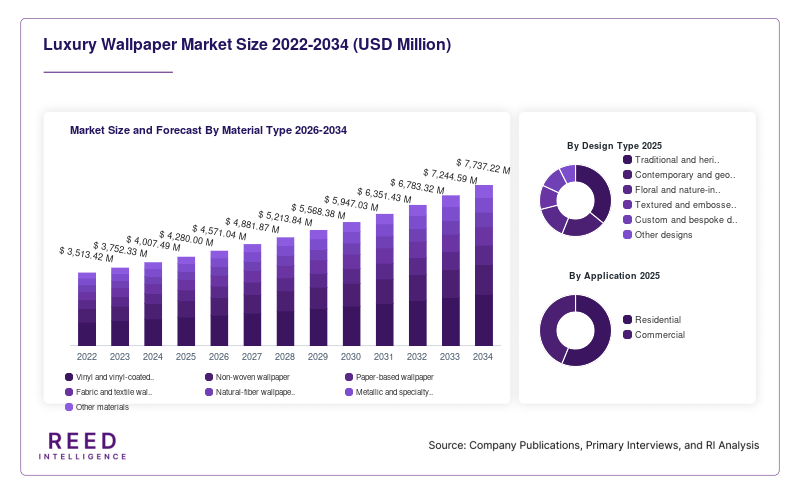
Methodology note: the segment shares and values below are internal analytical allocations, not externally reported market statistics. The 2025 values use the supplied global market size of USD 4,280 million. Each segmentation dimension sums to 100%. The allocations are intended to structure market analysis until comparable product-level revenue data become available.
By Material Type
Vinyl and vinyl-coated wallpaper is modeled at 25% of the 2025 market, equivalent to approximately USD 1,070 million. These products can combine decorative designs with surface characteristics suited to particular cleaning and durability requirements. Premium vinyl wallcoverings can be used in both residential and selected commercial environments, depending on their specifications. Their commercial position depends on design quality, finish, performance and the intended application rather than on material alone.
Non-woven wallpaper represents an internal allocation of 22% of the 2025 market, or approximately USD 942 million. Non-woven substrates are used in a range of decorative products and can support particular installation methods and dimensional-stability requirements. Premium designs may combine non-woven backing with detailed printing, textured finishes or designer patterns. Buyers still need to follow product-specific installation instructions and check suitability for the wall and room conditions.
Paper-based wallpaper accounts for a modeled 15% of the 2025 market, equivalent to approximately USD 642 million. Paper remains relevant for decorative designs, heritage patterns and products where the surface appearance is central to the buying decision. Performance depends on paper quality, printing and finishing processes, room conditions and installation technique. Luxury paper products compete through design and finish but may be less appropriate for some high-moisture or heavy-cleaning environments.
By Design Type
Traditional and heritage designs are modeled at 25% of the 2025 market, equivalent to approximately USD 1,070 million. These products draw on archival motifs, historical patterns and established design traditions. Heritage collections can support brand differentiation and appeal to customers who value continuity with a particular interior style. Their commercial performance depends on the ability to reinterpret familiar designs for current color preferences and contemporary spaces.
Contemporary and geometric designs account for an internal allocation of 20% of the 2025 market, or approximately USD 856 million. This category includes modern pattern repeats, abstract motifs and geometric compositions. These designs can suit contemporary residential interiors and selected commercial settings where a defined visual identity is desired. Demand depends on the relationship between the pattern, room scale, furniture and broader interior trends.
Floral and nature-inspired designs represent a modeled 20% of the 2025 market, equivalent to approximately USD 856 million. Botanical patterns, landscapes and nature-inspired motifs are established themes in premium wallpaper. They can be produced in traditional, modern or highly stylized forms, allowing brands to serve different design preferences. Sales depend on pattern scale, colorway, material finish and the suitability of the design for the intended space.
Textured and embossed designs account for an internal allocation of 15% of the 2025 market, or approximately USD 642 million. These products use relief, surface texture or specialty finishes to create a tactile effect. They may be selected when the designer wants depth without a highly detailed printed motif. The segment’s economics depend on the manufacturing process, consistency of finish and the ability to install the product without damaging its surface.
By Application
Residential applications are modeled at 70% of the 2025 market, equivalent to approximately USD 2,996 million. Residential demand includes premium homes, apartments, second homes and renovation projects where wallpaper is used to create a distinctive interior. Consumers may buy through showrooms, online retailers or interior designers, depending on the complexity and value of the project. The segment is influenced by home-renovation budgets, design preferences, property activity and the availability of skilled installers.
Commercial applications account for an internal allocation of 30% of the 2025 market, or approximately USD 1,284 million. This segment includes hospitality, premium retail, restaurants, offices and other commercial interiors. Wallpaper can help establish a recognizable brand environment or support a specific architectural concept. However, commercial projects often require stronger technical documentation, reliable repeat supply, durability and compliance with project-specific requirements. Orders may be larger than residential purchases but less regular.
By Project Type
Renovation and remodeling represents a modeled 65% of the 2025 market, equivalent to approximately USD 2,782 million. Wallpaper can refresh an existing interior without major structural work and can be used selectively to update a room or complement new furnishings. This creates a route to demand in established housing stock and refurbished commercial properties. Renovation purchases remain sensitive to household confidence, decorating budgets and the cost of labor.
New construction accounts for an internal allocation of 35% of the 2025 market, or approximately USD 1,498 million. New homes, hotels, premium apartments and commercial buildings can specify luxury wallpaper as part of the original interior package. These projects can produce coordinated orders across multiple rooms or properties, but demand depends on construction completions, developer budgets and design specifications. Project delays can shift orders and installation schedules.
By Distribution Channel
Specialty retailers and showrooms are modeled at 35% of the 2025 market, equivalent to approximately USD 1,498 million. Showrooms allow customers and designers to inspect samples, compare finishes and assess color and texture in person. This is valuable for luxury products where visual and tactile qualities influence willingness to pay. The channel requires physical inventory or sample displays, knowledgeable staff and strong relationships with designers and installers.
Interior designers and contract sales represent an internal allocation of 40% of the 2025 market, or approximately USD 1,712 million. Designers, architects and contract specifiers can influence the choice of wallpaper in premium residential and commercial projects. Their role is especially important when products must coordinate with other materials or meet project-specific technical requirements. Suppliers compete through design libraries, sample availability, specification support and dependable delivery.
Online channels account for a modeled 15% of the 2025 market, equivalent to approximately USD 642 million. Digital catalogs and direct-to-consumer websites broaden product discovery and enable sample ordering outside traditional showroom networks. Online channels can support customers who already know a brand or design, but color accuracy, texture representation, roll calculations and installation information remain important. High-value or custom orders may still require physical samples and designer consultation.
Regional Analysis
North America Luxury Wallpaper Market
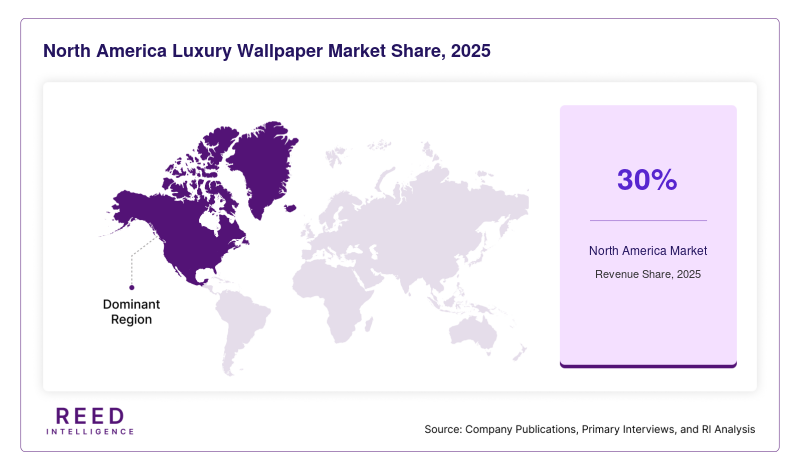
North America is modeled at 30% of the global market in 2025, equivalent to approximately USD 1,284 million. Its modeled share is 29% in 2034, representing approximately USD 2,262 million. The region’s market includes premium residential decoration, hospitality refurbishment, designer-led projects and sales through specialist retailers and online channels. Buyers may be influenced by heritage brands, contemporary collections, large-scale murals and coordinated wallpaper-and-fabric schemes.
Sanderson Design Group identifies North America as a key market for its brands and reports a strategy focused on expanding its position through direct-to-consumer channels, trade relationships and brand-specific positioning. Its disclosures cover a broader portfolio of wallpapers, fabrics and related interior products, so they should be interpreted as evidence of supplier strategy rather than a direct measure of regional luxury-wallpaper sales.
Regional demand depends on renovation spending, premium residential projects, hospitality refurbishment and the performance of specialist distribution. Brands with reliable sampling, digital discovery and designer support can reach customers beyond traditional showroom locations. However, luxury wallpaper remains a discretionary purchase, and shifts in property activity, consumer confidence and project budgets can delay orders.
Europe Luxury Wallpaper Market
Europe is modeled at 32% of the global market in 2025, equivalent to approximately USD 1,370 million. By 2034, its modeled share is 31%, or approximately USD 2,418 million. The region has established wallpaper and textile traditions, specialist manufacturers and design houses with heritage archives. These capabilities support premium positioning through pattern development, printing, surface finishing and coordinated interior collections.
Sanderson Design Group’s portfolio illustrates the combination of historical design assets and contemporary product development within a European luxury-interiors business. Its brands include Morris & Co., Sanderson and Zoffany, while its manufacturing operations serve both its own brands and third-party customers.
European buyers may also place emphasis on product documentation, material performance and suitability for specific residential or contract applications. Regulatory requirements can influence specification, particularly for products used in indoor environments or commercial settings. The region’s outlook depends on renovation activity, design-led spending, export demand and the ability of brands to maintain differentiation in a competitive premium market.
Asia-Pacific Luxury Wallpaper Market
Asia-Pacific is modeled at 22% of the global market in 2025, equivalent to approximately USD 942 million. Its modeled share rises to 25% by 2034, representing approximately USD 1,950 million. The region contains diverse markets with different levels of premium residential development, hospitality investment, interior-design services and access to international brands. Demand can be concentrated in major cities and higher-end projects rather than evenly distributed across all countries.
Luxury wallpaper can serve as a design feature in premium homes, boutique hotels, restaurants and retail environments. International brands may reach these customers through local distributors, design studios, showrooms and project partnerships. Product availability, import costs, local preferences and access to qualified installers influence whether an international collection can be specified successfully.
The region’s modeled share increase reflects an analytical scenario in which premium interior spending and access to design-led products expand relative to the global market. It is not a published regional forecast. Country-level construction activity, renovation patterns, purchasing power and distribution reach would need to be assessed separately to validate the scenario.
Middle East and Africa Luxury Wallpaper Market
The Middle East and Africa region is modeled at 9% of the global market in 2025, equivalent to approximately USD 385 million. Its modeled share increases to 10% by 2034, representing approximately USD 780 million. Demand can arise from premium residential developments, hotels, restaurants, luxury retail and other projects where interior finishes are part of the property’s positioning.
Wallcoverings specified for these environments may need to balance decorative impact with durability, cleaning requirements and project-specific fire-performance criteria. Temperature, humidity, installation conditions and the availability of specialist contractors can also affect product selection. Suppliers with technical documentation, samples and local trade relationships may be better positioned to serve projects that require coordinated procurement.
The regional market is heterogeneous, and opportunities vary by country and project type. Announced developments do not necessarily translate into completed fit-outs or wallpaper orders. Actual demand depends on project financing, completion schedules, design specifications and the share of interior budgets allocated to premium wallcoverings.
Latin America Luxury Wallpaper Market
Latin America is modeled at 7% of the global market in 2025, equivalent to approximately USD 300 million. By 2034, its modeled share remains 5%, representing approximately USD 390 million. Luxury wallpaper demand is linked to premium residential projects, boutique hospitality, upscale retail and interior-design-led renovations in major urban markets.
International brands may reach buyers through specialist showrooms, design professionals and distributors. The final cost can be influenced by import duties, currency movements, shipping and the availability of local installation expertise. These factors can affect whether a customer chooses a fully bespoke product, a standard premium design or a less expensive alternative.
The region should not be treated as a single market. Purchasing power, import conditions, construction cycles and access to premium design services differ by country. The modeled share is an internal allocation rather than a direct estimate of regional equipment or wallcovering sales.
Competitive Landscape
The luxury wallpaper market includes heritage design houses, specialist wallcovering manufacturers, premium interior-furnishing brands, digital printing businesses and companies that sell coordinated wallpaper and fabric collections. Competition depends on the strength of design identity, access to distinctive patterns, product quality, material performance, customization, distribution reach and support for professional specifiers.
Heritage brands can differentiate themselves through archival designs and the ability to reinterpret familiar motifs. Contemporary brands may compete through original artwork, strong color stories, large-scale patterns, specialty finishes and rapid collection launches. Bespoke suppliers compete through customization, production flexibility and the ability to coordinate wallcoverings with a specific interior concept.
Manufacturing capability is another competitive factor. Digital printing can support smaller runs and customized designs, while conventional print methods may remain suitable for particular production volumes or finishes. Suppliers must balance flexibility with consistency, lead times, inventory management and cost. Premium customers expect delivered wallpaper to match approved samples closely, making quality control and repeat-order reliability commercially important.
Key Market Players
Recent Market Developments
- October 2026, Graham & Brown marked International Wallpaper Week, beginning October 5, 2026, with content highlighting leaves, geometric designs, stripes and decorative motifs. The company’s campaign connects established wallpaper patterns with current interior styling and consumer discovery. Market implication: premium brands continue to use design storytelling and curated collections to support product discovery, although a promotional campaign does not establish a market-wide sales increase.
- February 2026, Graham & Brown announced an anniversary collection for launch on February 2, 2026, reinterpreting eight designs associated with eight decades of the brand’s history. The collection includes archival inspiration adapted for contemporary interiors. Heritage-based product development gives premium wallpaper brands a way to connect historical design identity with current customer preferences. Commercial success will depend on the collection’s reception, pricing and distribution rather than the anniversary positioning alone.
Luxury Wallpaper Market Segments
By Material Type
- Vinyl and vinyl-coated wallpaper
- Non-woven wallpaper
- Paper-based wallpaper
- Fabric and textile wallpaper
- Natural-fiber wallpaper
- Metallic and specialty wallpaper
- Other materials
By Design Type
- Traditional and heritage designs
- Contemporary and geometric designs
- Floral and nature-inspired designs
- Textured and embossed designs
- Custom and bespoke designs
- Other designs
By Application
- Residential
- Commercial
By Project Type
- Renovation and remodeling
- New construction
By Distribution Channel
- Specialty retailers and showrooms
- Interior designers and contract sales
- Online channels
- Other channels
By Region
- North America
- Europe
- APAC
- Middle East and Africa
- LATAM