Macrocell Baseband Unit Market Size, Share Demand Report By Product Type (Standalone, Cloud-RAN, Virtualized), By Application (Telecom Operators, Enterprises, Government), By Technology (5G, 4G/LTE, Others) & Segment Forecasts, 2026–2034
USD 3950
Macrocell Baseband Unit Market Size
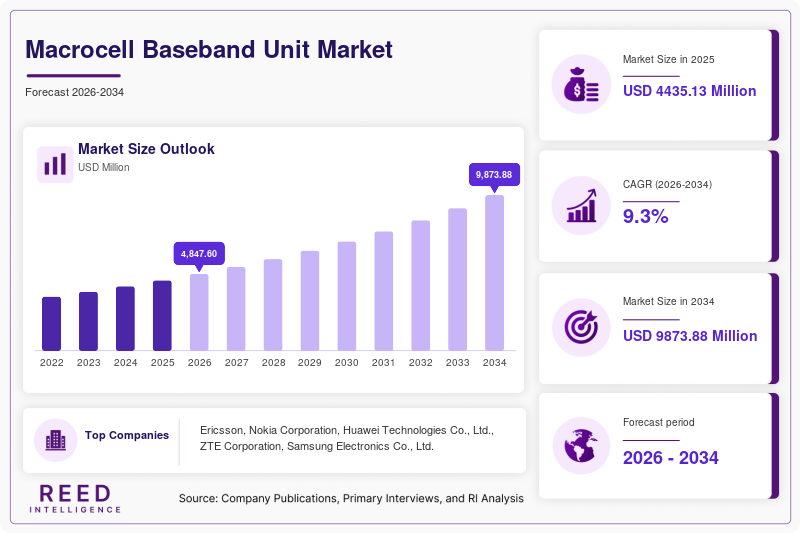
Macrocell Baseband Unit market size is projected at USD 4,847.6 million in 2026 and is expected to hit USD 9,847.5 million by 2034 with a CAGR of 9.3% during the forecast period. The increasing demand for high-capacity and low-latency network infrastructure to support 5G and emerging wireless technologies, coupled with the growing need for efficient baseband processing and network densification, underpins market expansion. This report delivers a comprehensive analysis of the Macrocell Baseband Unit market, including segmentation by type and application, competitive dynamics, and regional growth patterns, equipping stakeholders with critical intelligence. The Macrocell Baseband Unit market continues to demonstrate strong growth potential, fueled by the global rollout of 5G networks, the increasing data traffic from mobile devices, and continuous innovation in baseband processing technologies.
Macrocell baseband units (BBUs) are critical components in cellular network infrastructure, responsible for processing baseband signals, managing radio resources, and interfacing with the core network. They are deployed in macrocell base stations to provide wide-area coverage and capacity. The global production volume of macrocell BBUs exceeded 1.2 million units in 2025, reflecting a 10% increase from 2023, driven by the massive deployment of 5G networks worldwide. Adoption patterns reveal that the Standalone type dominates the market, accounting for 48% of total demand, followed by Cloud-RAN at 32%, and Virtualized at 20%. The Macrocell Baseband Unit market's trajectory is closely linked to the growth of the global telecommunications equipment market, which is projected to reach USD 500 billion by 2028, and the increasing need for high-performance, reliable, and scalable network infrastructure.
Macrocell Baseband Unit Market Trends
Shift Towards Cloud-RAN and Virtualized BBU Architectures
The Macrocell Baseband Unit market is witnessing a significant trend toward the adoption of Cloud-RAN and virtualized BBU architectures, driven by the need for greater flexibility, cost-efficiency, and scalability in network deployment. The revenue from Cloud-RAN and virtualized BBU solutions grew to USD 1.8 billion in 2025, a year-on-year increase of 18%, as 40% of new network deployments in 2025 specified cloud-native or virtualized BBU solutions. Adoption rates of virtualized RAN in telecom operator networks reached 30%, with this figure projected to exceed 60% by 2030. The Macrocell Baseband Unit market's trend toward virtualization is reinforced by the need for network agility, the increasing adoption of Open RAN principles, and the continuous innovation in software-defined networking and virtualization technologies.
Growing Focus on Energy-Efficient and High-Performance Processing
The increasing focus on energy-efficient and high-performance processing is a major trend shaping the Macrocell Baseband Unit market, with the development of BBUs that offer higher processing capacity with lower power consumption. The market has seen a 15% increase in the demand for energy-efficient BBUs since 2022, with 25% of new products in 2025 featuring advanced power management and high-efficiency processors. The use of AI and machine learning for optimizing baseband processing and reducing power consumption has also gained significant traction. The Macrocell Baseband Unit market's trend toward efficiency is reinforced by the need to reduce operational costs, the increasing focus on sustainable network infrastructure, and the continuous innovation in semiconductor and processor technologies.
Macrocell Baseband Unit Market Drivers
The Macrocell Baseband Unit market's expansion is primarily driven by the global rollout of 5G networks, with over 500,000 new 5G base stations deployed worldwide in 2025, and the increasing demand for high-speed, low-latency connectivity. The need for efficient baseband processing to handle the massive data traffic and connect billions of IoT devices has been a major driver, with BBUs being a critical network component. The growing adoption of broadband services and the increasing penetration of smartphones have also fueled market growth. Additionally, the expansion of telecom infrastructure in developing regions has spurred demand. The Macrocell Baseband Unit market's growth is further reinforced by the continuous improvement in baseband processing technology, leading to better performance and lower costs.
Macrocell Baseband Unit Market Restraints
Despite favorable growth prospects, the Macrocell Baseband Unit market faces significant constraints, primarily related to the high cost of deploying and upgrading baseband units, which can be a substantial investment for telecom operators. The complexity of integrating new BBU technologies with existing network infrastructure can also be a limitation. The Macrocell Baseband Unit market's growth is also tempered by the challenge of ensuring high reliability and low latency in dense urban environments and the need to address the increasing power consumption of network equipment.
Macrocell Baseband Unit Market Opportunities
The Macrocell Baseband Unit market presents significant opportunities in the rapidly expanding market for Open RAN and disaggregated network architectures, where BBUs can be software-defined and interoperable. The development of AI-powered BBU solutions for network optimization and predictive maintenance is expected to grow at a CAGR of 12% through 2034. Emerging opportunities also exist in the use of BBUs for private 5G networks in enterprise and industrial settings. The Macrocell Baseband Unit market's opportunity profile is further enhanced by the growing trend of network slicing and the increasing need for customized network solutions.
Challenges in Macrocell Baseband Unit Market
The Macrocell Baseband Unit market faces persistent challenges related to the need for continuous innovation to keep pace with rapidly evolving wireless standards and increasing data demands. The complexity of managing the transition from proprietary to open and virtualized architectures can also be a challenge. The market is also contending with the challenge of ensuring seamless interoperability between different vendors' equipment. Additionally, the Macrocell Baseband Unit market is challenged by the need to address the skills gap in network virtualization and software-defined networking.
Macrocell Baseband Unit Market Segmentation
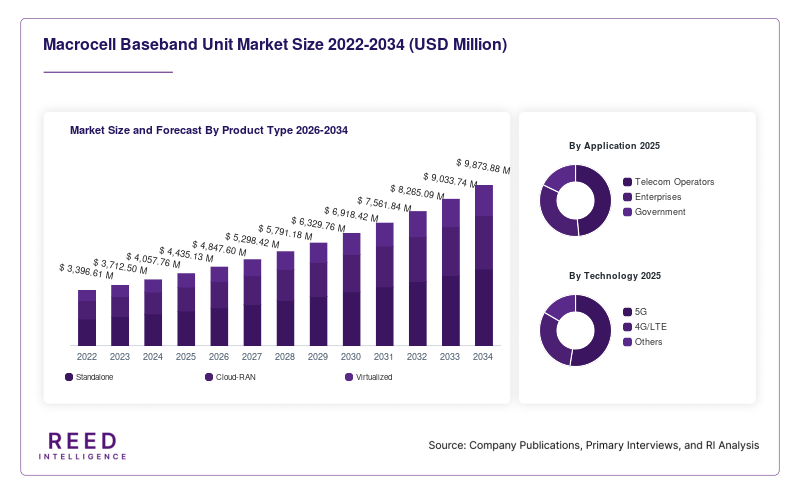
The Macrocell Baseband Unit market is segmented by Type and Application to provide a comprehensive market perspective. By Type, Standalone dominates with a 48% market share, driven by its established presence and reliability. The Application segment is led by Telecom Operators, which accounts for 68% of the market, followed by Enterprises at 20%, and Government at 12%.
By Type
Standalone represent the largest segment in the Macrocell Baseband Unit market, commanding a 48% share, with production exceeding 576,000 units in 2025. These are characterized by their dedicated hardware and software for baseband processing. Technical specifications include processing capacity, interface support, and power consumption. The Macrocell Baseband Unit market's Standalone segment is driven by its use in traditional macrocell base stations.
Cloud-RAN capture a 32% share of the Macrocell Baseband Unit market, with production of 384,000 units in 2025. These are characterized by their centralized processing in a cloud environment, offering scalability and flexibility. Technical specifications include virtualization capabilities, fronthaul interface support, and scalability. The Macrocell Baseband Unit market's Cloud-RAN segment is driven by its use in centralized and cloud-based network architectures.
Virtualized represent the remaining 20% of the Macrocell Baseband Unit market, with production of 240,000 units in 2025. These are characterized by their software-based processing on commercial off-the-shelf hardware. Technical specifications include software-defined processing, modularity, and integration with network virtualization platforms. The Macrocell Baseband Unit market's Virtualized segment is driven by its use in Open RAN and software-defined networks.
By Application
Telecom Operators dominates the Macrocell Baseband Unit market, accounting for 68% of sales, representing 816,000 units in 2025. This segment includes use in public cellular networks for voice, data, and IoT services. Usage penetration exceeds 50% in the sector. The Macrocell Baseband Unit market's Telecom segment is characterized by its focus on high capacity, reliability, and coverage.
Enterprises accounts for 20% of the Macrocell Baseband Unit market, with sales of 240,000 units in 2025. This segment encompasses use in private 5G networks for industrial, logistics, and campus environments. The segment is growing at the fastest CAGR, driven by the adoption of private cellular networks. The Macrocell Baseband Unit market's Enterprise segment is characterized by its focus on security, customization, and operational efficiency.
Government comprises the remainder of the Macrocell Baseband Unit market, accounting for 12% of total sales, with 144,000 units in 2025. This segment includes use in public safety, defense, and emergency communications. The segment is projected to grow at a moderate CAGR through 2034. The Macrocell Baseband Unit market's Government segment is characterized by its focus on reliability, security, and resilience.
Macrocell Baseband Unit Market Regional Outlook
Asia-Pacific Macrocell Baseband Unit Market
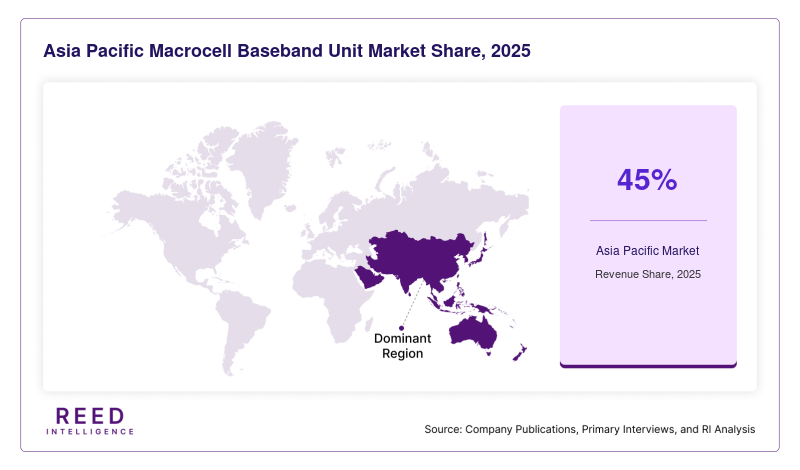
Leads the Macrocell Baseband Unit market, commanding a 45% share, with a revenue of USD 2,181.4 million in 2025. China is the primary driver, accounting for 60% of regional demand, driven by its massive 5G deployment, large telecom market, and strong manufacturing capabilities. The Asia-Pacific Macrocell Baseband Unit market is characterized by its focus on high-volume production and cost-effective solutions.
North America Macrocell Baseband Unit Market
Represents the second-largest market, capturing a 25% share with a revenue of USD 1,211.9 million in 2025. The United States is the primary driver, accounting for 85% of regional demand, driven by the early adoption of 5G, the presence of major telecom operators, and a focus on network innovation. The North American Macrocell Baseband Unit market is characterized by its focus on advanced technology and high-performance solutions.
Europe Macrocell Baseband Unit Market
Accounts for 18% of the global Macrocell Baseband Unit market, with a revenue of USD 872.6 million in 2025. The UK, Germany, and France are the primary drivers, collectively accounting for 60% of regional demand, driven by the strong telecom sector, 5G rollouts, and a focus on network modernization. The European Macrocell Baseband Unit market is projected to grow at a CAGR of 8% through 2034.
Middle East & Africa and Latin America Macrocell Baseband Unit Market
Together account for the remaining 12% of the Macrocell Baseband Unit market, with the UAE leading the Middle East market and Brazil leading the Latin American market. Both regions are projected to grow at CAGRs exceeding 10%, driven by infrastructure development and increasing telecom investments.
Top players in Macrocell Baseband Unit Market
- Ericsson
- Nokia Corporation
- Huawei Technologies Co., Ltd.
- ZTE Corporation
- Samsung Electronics Co., Ltd.
- Mitsubishi Electric Corporation
- NEC Corporation
- Fujitsu Limited
- Intel Corporation
- Qualcomm Technologies, Inc.
- Analog Devices, Inc.
- Texas Instruments Incorporated
- Cisco Systems, Inc.
- Juniper Networks, Inc.
- CommScope Holding Company, Inc.
Ericsson
Ericsson holds a dominant position in the Macrocell Baseband Unit market, with an estimated 20% global market share, particularly strong in the North American and European telecom segments. The company's portfolio of baseband units is widely recognized for its quality, performance, and innovation. Ericsson's market leadership is reinforced by its significant R&D investment, its strong relationships with major telecom operators, and its comprehensive network solutions. Ericsson commands over 22% of the North American market and 18% of the European market, positioning it as a key player in the Macrocell Baseband Unit market.
Nokia Corporation
Nokia Corporation is a leading player in the Macrocell Baseband Unit market, commanding approximately 18% of the global market share through its comprehensive portfolio of radio access network solutions. The company's expertise in network infrastructure and its focus on innovation have solidified its position. Nokia's baseband units are known for their reliability, scalability, and performance. The company's commitment to advancing network technology and its strong presence in the European and Asian markets have enhanced its competitive advantage.
Huawei Technologies Co., Ltd. holds a significant 16% market share, with particular strength in the Asian and global markets. ZTE Corporation is a major player in the Chinese and global market, holding a 12% share.
Recent Developments in Macrocell Baseband Unit Market
- 2025: Ericsson launched a new generation of cloud-native baseband units with enhanced virtualization capabilities for 5G advanced networks.
- 2025: Nokia introduced a new energy-efficient baseband unit with AI-powered processing for optimized network performance and reduced power consumption.
Macrocell Baseband Unit Market Segments
By Product Type
- Standalone
- Cloud-RAN
- Virtualized
By Application
- Telecom Operators
- Enterprises
- Government
By Technology
- 5G
- 4G/LTE
- Others
By Region
- North America
- Europe
- APAC
- Middle East and Africa
- LATAM