Macroglossia Market Size, Share & Demand Report By Treatment Type (Surgical Interventions, Pharmacological Therapies, Supportive Care), By Condition Type (Congenital Macroglossia, Acquired Macroglossia), By Diagnosis Method (Imaging Techniques, Genetic Testing, Clinical Examination), By End-Use (Hospitals, Specialty Clinics, Ambulatory Surgical Centers), By Region & Segment Forecasts, 2025–2034
USD 3950
Market Overview
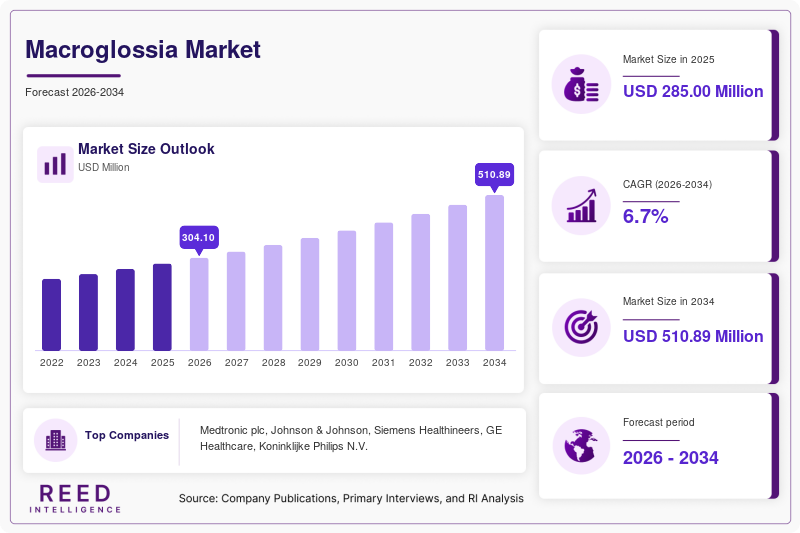
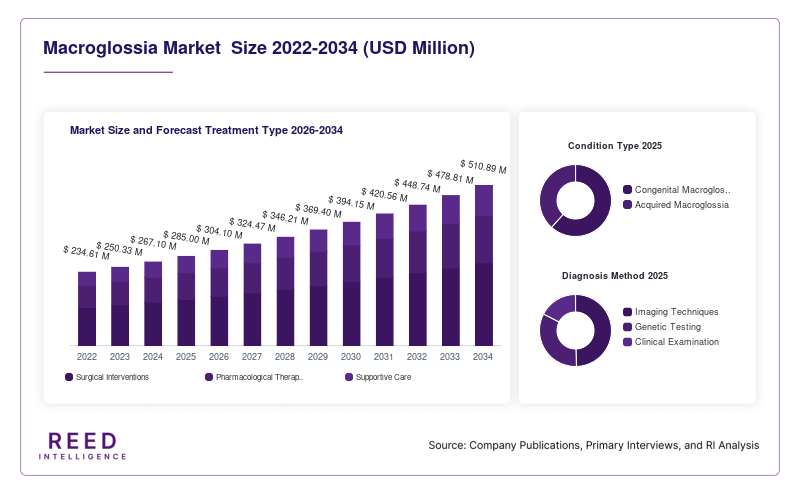
The global Macroglossia Market size was valued at approximately USD 285 million in 2025 and is projected to reach around USD 510 million by 2034, expanding at a CAGR of 6.7% during the forecast period (2025–2034). Macroglossia, characterized by abnormal enlargement of the tongue, is associated with congenital disorders, endocrine conditions, and certain malignancies. Increasing awareness regarding rare diseases and advancements in diagnostic imaging have contributed to improved identification and management, thereby supporting market expansion.
A major global factor supporting the growth of the Macroglossia Market is the rising prevalence of genetic and metabolic disorders such as Down syndrome and amyloidosis, which often present macroglossia as a clinical symptom. Improvements in neonatal screening programs and healthcare infrastructure have further enabled early diagnosis and timely intervention, boosting demand for treatment options.
Key Highlights:
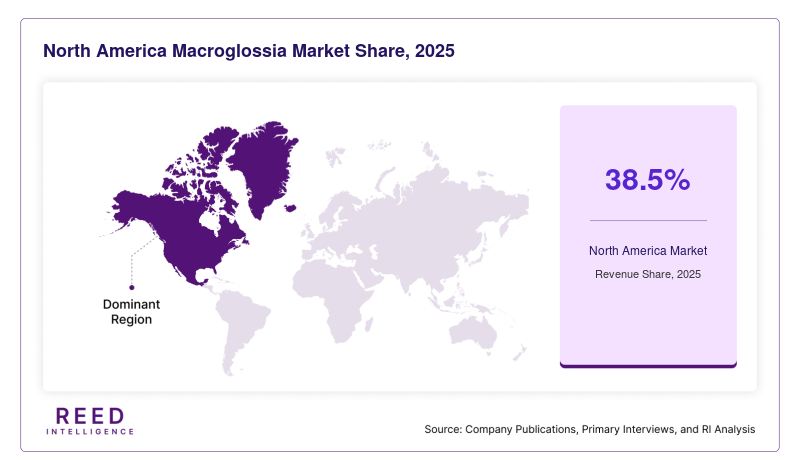
- North America dominated the Macroglossia Market with a 38.5% share in 2025, while Asia Pacific is projected to grow at the fastest CAGR of 7.9%.
- By treatment type, surgical interventions accounted for the largest share at 46% in 2024, whereas pharmacological therapies are expected to grow at the fastest CAGR of 7.5%.
- By end-use, hospitals remained the leading segment with a 52% share, while specialty clinics are anticipated to expand at a CAGR of 7.2%.
- The United States led the market with USD 102 million in 2024 and USD 108 million in 2025, driven by advanced healthcare systems and high diagnosis rates.
Market Trends
Advancements in Minimally Invasive Surgical Techniques
The Macroglossia Market is experiencing a shift toward minimally invasive and precision-based surgical approaches. Traditional tongue reduction surgeries are being replaced by laser-assisted and robotic procedures, which offer reduced recovery time, minimal scarring, and improved patient outcomes. Surgeons are increasingly adopting these advanced techniques, particularly in developed healthcare systems, to enhance procedural efficiency and safety. This trend is expected to reshape treatment protocols and increase patient acceptance of surgical interventions.
Integration of Genetic Diagnostics and Personalized Care
Another notable trend is the growing integration of genetic testing and personalized medicine in macroglossia diagnosis and management. Healthcare providers are increasingly using genomic tools to identify underlying genetic causes, enabling tailored treatment strategies. This approach improves clinical outcomes, particularly for patients with congenital conditions. The adoption of precision diagnostics is also fostering collaboration between research institutions and healthcare providers, contributing to innovation within the Macroglossia Market.
Market Drivers
Rising Prevalence of Congenital and Rare Disorders
The increasing incidence of congenital conditions such as Beckwith-Wiedemann syndrome and Down syndrome is a key driver of the Macroglossia Market. These conditions often present macroglossia as a primary symptom, necessitating early medical intervention. Growing awareness among healthcare professionals and caregivers has led to improved diagnosis rates, driving demand for both surgical and non-surgical treatment options.
Expansion of Healthcare Infrastructure and Diagnostic Capabilities
The global expansion of healthcare infrastructure, particularly in emerging economies, has significantly contributed to market growth. Improved access to advanced diagnostic tools such as MRI, CT scans, and genetic screening has enhanced early detection rates. Additionally, government initiatives aimed at strengthening pediatric and rare disease care have supported the adoption of advanced treatment modalities, fueling the overall growth of the Macroglossia Market.
Market Restraint
High Cost of Treatment and Limited Accessibility
One of the primary challenges in the Macroglossia Market is the high cost associated with diagnosis and treatment, particularly surgical interventions. Advanced procedures such as laser-assisted tongue reduction surgeries require specialized equipment and skilled professionals, leading to elevated treatment costs. This financial burden limits accessibility, especially in low- and middle-income countries where healthcare resources are constrained.
Additionally, the rarity of macroglossia-related conditions often results in delayed diagnosis due to limited awareness among general practitioners. The lack of standardized treatment protocols further complicates patient management, leading to variability in clinical outcomes. Insurance coverage for rare disease treatments also remains inconsistent across regions, restricting patient access to advanced care options.
These factors collectively hinder market penetration in underserved regions and pose a challenge to the overall growth of the Macroglossia Market.
Market Opportunities
Growth in Pediatric Specialty Care Centers
The increasing establishment of pediatric specialty care centers presents a significant opportunity for the Macroglossia Market. These centers are equipped with multidisciplinary teams capable of managing complex congenital conditions, including macroglossia. The focus on early intervention and comprehensive care is expected to drive demand for specialized treatment solutions, particularly in urban healthcare settings.
Development of Non-Surgical Therapeutic Approaches
The emergence of non-surgical treatment options, including targeted pharmacological therapies and supportive devices, offers new growth avenues. Research efforts are focused on developing drugs that address underlying causes such as hormonal imbalances and amyloid deposition. These alternatives are particularly beneficial for patients who are not suitable candidates for surgery, expanding the addressable patient population within the Macroglossia Market.
Segmental Analysis
By Treatment Type
Surgical interventions dominated the Macroglossia Market, accounting for 46% of the share in 2024. These procedures had been widely adopted due to their effectiveness in reducing tongue size and alleviating associated complications such as airway obstruction and speech difficulties. The availability of advanced surgical techniques and skilled professionals further supported the dominance of this segment.
Pharmacological therapies are expected to grow at the fastest CAGR of 7.5% during the forecast period. This growth will be driven by ongoing research into targeted treatments addressing underlying conditions such as hormonal imbalances and amyloidosis. The development of novel drugs is anticipated to expand treatment options and improve patient outcomes.
By Condition Type
Congenital macroglossia held the largest share of 54% in 2024, as it is commonly associated with genetic disorders diagnosed early in life. Early detection through neonatal screening programs contributed to the dominance of this segment.
Acquired macroglossia is projected to grow at a CAGR of 7.1%, driven by increasing cases linked to systemic diseases such as hypothyroidism and tumors. Improved diagnostic capabilities will support the identification and management of these conditions.
By End-Use
Hospitals accounted for 52% of the Macroglossia Market share in 2024, owing to their comprehensive treatment capabilities and access to advanced medical equipment. The presence of multidisciplinary teams enabled effective management of complex cases.
Specialty clinics are anticipated to grow at a CAGR of 7.2%, supported by increasing patient preference for specialized and personalized care. These clinics offer focused expertise and shorter waiting times, enhancing patient experience.
By Diagnosis Method
Imaging techniques dominated the segment with a 48% share in 2024, as they provide accurate visualization of tongue structure and underlying conditions. Technologies such as MRI and CT scans played a critical role in diagnosis.
Genetic testing is expected to grow at a CAGR of 7.8%, driven by the rising adoption of precision medicine. This method enables early detection of genetic abnormalities, facilitating targeted treatment approaches.
Regional Analysis
North America
North America accounted for 38.5% of the Macroglossia Market share in 2025 and is expected to grow at a CAGR of 6.2% during the forecast period. The region had benefited from advanced healthcare infrastructure and high awareness of rare diseases, enabling early diagnosis and effective treatment. Strong reimbursement frameworks and access to specialized surgical procedures further supported market growth.
The United States dominated the regional market due to the presence of well-established healthcare systems and a high prevalence of congenital disorders. The country’s emphasis on research and development in rare diseases has led to continuous innovation in treatment approaches. Additionally, collaborations between academic institutions and healthcare providers have strengthened clinical outcomes.
Europe
Europe held a 27.3% share of the Macroglossia Market in 2025 and is projected to grow at a CAGR of 6.4%. The region had shown consistent adoption of advanced diagnostic technologies and a strong focus on patient-centric care. Government support for rare disease research and treatment had also contributed to market expansion.
Germany emerged as the dominant country in Europe, driven by its robust healthcare system and emphasis on medical innovation. The availability of skilled professionals and advanced surgical facilities supported the adoption of complex procedures, enhancing treatment outcomes.
Asia Pacific
Asia Pacific represented 19.6% of the Macroglossia Market in 2025 and is anticipated to grow at the fastest CAGR of 7.9%. The region had witnessed increasing investments in healthcare infrastructure and rising awareness regarding congenital disorders. Rapid urbanization and improving access to healthcare services had further supported market growth.
China led the regional market due to its large population base and increasing focus on healthcare modernization. Government initiatives aimed at improving pediatric care and expanding diagnostic capabilities played a significant role in driving demand for macroglossia treatments.
Middle East & Africa
The Middle East & Africa accounted for 8.1% of the Macroglossia Market share in 2025 and is expected to grow at a CAGR of 5.8%. The region had experienced gradual improvements in healthcare infrastructure, particularly in urban centers. However, limited awareness and access to specialized care remained challenges.
Saudi Arabia emerged as a key contributor to regional growth, supported by government investments in healthcare development. The country’s focus on expanding medical facilities and adopting advanced technologies has enhanced diagnostic and treatment capabilities.
Latin America
Latin America held a 6.5% share of the Macroglossia Market in 2025 and is projected to grow at a CAGR of 6.0%. The region had shown increasing adoption of modern healthcare practices and improved access to medical services. Growing awareness of rare diseases had also contributed to market expansion.
Brazil dominated the regional market due to its relatively advanced healthcare system and rising investments in medical infrastructure. Efforts to improve early diagnosis and treatment accessibility have supported the growth of the Macroglossia Market in the country.
Competitive Landscape
The Macroglossia Market is moderately fragmented, with several global and regional players focusing on innovation and strategic collaborations. Leading companies are investing in research and development to introduce advanced treatment options and improve clinical outcomes.
Medtronic plc emerged as a market leader, leveraging its strong portfolio of surgical devices and continuous investment in minimally invasive technologies. The company recently introduced an advanced surgical tool designed to enhance precision in tongue reduction procedures, strengthening its competitive position.
Other key players are focusing on expanding their geographic presence and enhancing their product offerings through partnerships and acquisitions. The competitive landscape is expected to remain dynamic, with innovation and technological advancements playing a crucial role in shaping market growth.
Key Players List
- Medtronic plc
- Johnson & Johnson
- Siemens Healthineers
- GE Healthcare
- Koninklijke Philips N.V.
- Stryker Corporation
- Boston Scientific Corporation
- Abbott Laboratories
- B. Braun Melsungen AG
- Zimmer Biomet Holdings, Inc.
- Olympus Corporation
- Smith & Nephew plc
- Terumo Corporation
- Danaher Corporation
- Fujifilm Holdings Corporation
Recent Developments
- In 2024, Medtronic plc launched an advanced surgical device aimed at improving precision in macroglossia procedures.
- In 2023, Siemens Healthineers expanded its imaging portfolio with enhanced diagnostic tools for rare conditions.
- In 2023, GE Healthcare introduced AI-based imaging solutions to support early diagnosis of congenital disorders.
- In 2024, Philips Healthcare partnered with research institutions to develop personalized diagnostic solutions.
- In 2023, Stryker Corporation invested in minimally invasive surgical technologies to improve patient outcomes.
Macroglossia Market Segments
Treatment Type
- Surgical Interventions
- Pharmacological Therapies
- Supportive Care
Condition Type
- Congenital Macroglossia
- Acquired Macroglossia
Diagnosis Method
- Imaging Techniques
- Genetic Testing
- Clinical Examination
End-Use
- Hospitals
- Specialty Clinics
- Ambulatory Surgical Centers
By Region
- North America
- Europe
- APAC
- Middle East and Africa
- LATAM