Maggot Debridement Market Size, Share & Demand Report By Type (Medical-Grade Larvae, Loose Larvae, Bagged Larvae), By Application (Chronic Wounds, Diabetic Foot Ulcers, Pressure Ulcers, Venous Leg Ulcers, Burn Wounds), By End-Use (Hospitals, Clinics, Home Healthcare), By Distribution Channel (Direct Sales, Distributors, Online Channels), By Region & Segment Forecasts, 2025–2034
USD 3950
Market Overview
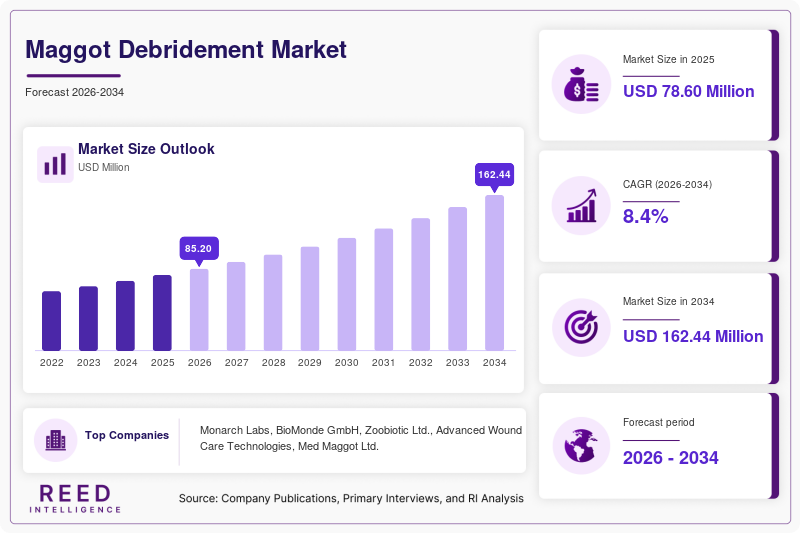
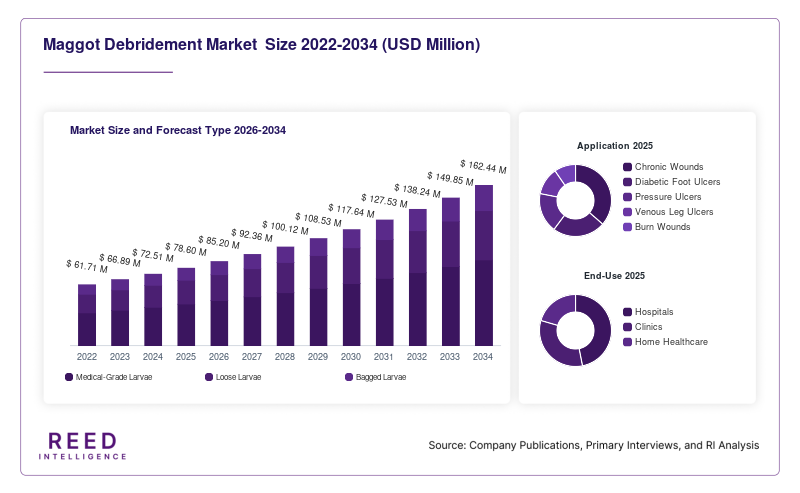
The global Maggot Debridement Market size was valued at USD 78.6 million in 2025 and is projected to reach USD 162.4 million by 2034, expanding at a CAGR of 8.4% during the forecast period (2025–2034). The market growth is primarily supported by the rising global burden of chronic wounds, including diabetic foot ulcers, pressure ulcers, and venous leg ulcers, which require effective and cost-efficient wound management solutions.
Maggot debridement therapy (MDT), a biologically driven wound care technique, has gained increasing acceptance due to its ability to selectively remove necrotic tissue, reduce bacterial load, and promote faster healing. The shift toward minimally invasive and non-surgical treatment approaches has further accelerated adoption, particularly in healthcare systems seeking to optimize outcomes while reducing hospital stays and surgical costs.
Key Highlights
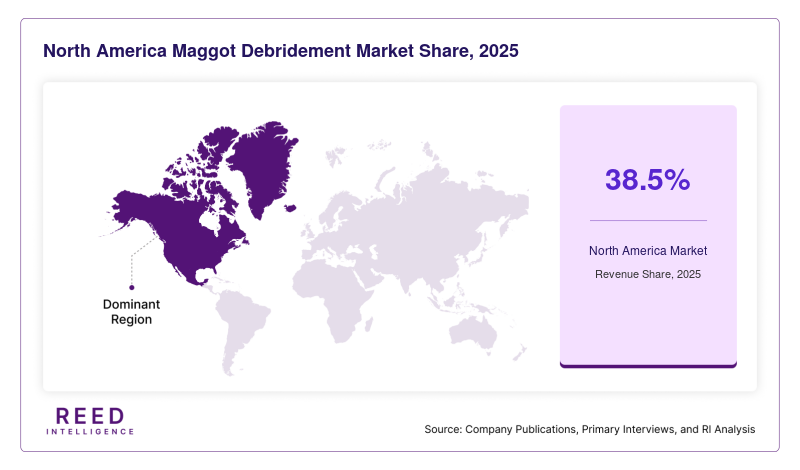
- North America dominated the market with a 38.5% share in 2025, while Asia Pacific is projected to grow at the fastest CAGR of 9.6%.
- By application, chronic wounds led with 62.3% share, while diabetic foot ulcers are expected to grow fastest at 9.2% CAGR.
- By end-use, hospitals dominated with 54.1% share, while home healthcare settings are projected to grow at 10.1% CAGR.
- The U.S. remained the dominant country, with market values of USD 27.4 million in 2025 and USD 29.1 million in 2026.
Market Trends
Integration of Biotherapy in Modern Wound Care
The Maggot Debridement Market is witnessing a steady integration of biotherapy into standardized wound care practices. Healthcare providers are increasingly incorporating MDT into treatment protocols for non-healing wounds due to its precision in removing necrotic tissue without damaging viable cells. This trend reflects a broader movement toward biologically derived therapies that align with regenerative medicine principles.
Rising Adoption in Outpatient and Home Care Settings
Another notable trend shaping the Maggot Debridement Market is the growing use of MDT in outpatient clinics and home healthcare environments. With healthcare systems aiming to reduce inpatient costs, MDT offers a practical solution that can be administered with minimal infrastructure. The availability of pre-packaged sterile larvae kits has made it easier for trained professionals to deliver treatment outside hospital settings, improving patient accessibility and compliance.
Market Drivers
Increasing Prevalence of Chronic Wounds
The rising incidence of chronic wounds, particularly among aging populations and individuals with diabetes, is a major driver of the Maggot Debridement Market. Chronic wounds often resist conventional treatments, creating demand for alternative therapies such as MDT that offer targeted and effective debridement.
Cost-Effectiveness Compared to Surgical Debridement
Maggot debridement therapy presents a cost-efficient alternative to surgical procedures. It reduces the need for operating room resources, anesthesia, and extended hospital stays. Healthcare providers and payers are increasingly recognizing these economic benefits, leading to broader adoption across public and private healthcare systems.
Market Restraint
Limited Patient Acceptance and Psychological Barriers
Despite its clinical effectiveness, the Maggot Debridement Market faces a significant restraint in the form of patient reluctance. The use of live larvae can evoke discomfort and psychological resistance among patients, which may limit acceptance and adherence to treatment. Cultural perceptions and lack of awareness further compound this challenge, particularly in developing regions. Additionally, some healthcare professionals remain hesitant to recommend MDT due to concerns about patient perception and limited training in its application. These factors collectively hinder widespread adoption, especially in markets where advanced wound care alternatives are readily available.
Market Opportunities
Expansion in Emerging Healthcare Markets
Emerging economies present substantial growth opportunities for the Maggot Debridement Market. Increasing healthcare investments, improving infrastructure, and rising awareness of advanced wound care therapies are creating favorable conditions for MDT adoption. Governments and healthcare organizations are focusing on cost-effective treatment options, positioning MDT as a viable solution.
Technological Advancements in Larval Packaging and Delivery
Innovations in sterile larval containment systems and application techniques are expected to drive market growth. The development of biobags and controlled delivery mechanisms enhances patient comfort and simplifies treatment administration. These advancements are likely to increase acceptance among both patients and healthcare providers, opening new avenues for market expansion.
Segmental Analysis
By Type
Medical-grade larvae dominated the Maggot Debridement Market with a 71.4% share in 2025, as they are widely used in clinical settings due to their sterility and controlled production.
Loose larvae are expected to witness the fastest growth at a CAGR of 9.1%, driven by their effectiveness in treating complex wound structures and increasing adoption in specialized care.
By Application
Chronic wounds led the market with a 62.3% share in 2025, owing to the high prevalence of long-term non-healing wounds.
Diabetic foot ulcers are projected to grow at a CAGR of 9.2%, supported by the rising global diabetic population and need for advanced wound care solutions.
By End-Use
Hospitals accounted for 54.1% share in 2025, as they remain the primary centers for wound management treatments.
Home healthcare settings will grow at the fastest CAGR of 10.1%, driven by the shift toward decentralized healthcare and patient convenience.
By Distribution Channel
Direct sales dominated with a 48.7% share in 2025, due to strong relationships between manufacturers and healthcare providers.
Online distribution channels are expected to grow at a CAGR of 10.5%, supported by digital transformation in healthcare procurement.
Regional Analysis
North America
North America accounted for 38.5% of the Maggot Debridement Market share in 2025 and will continue to lead, growing at a projected CAGR of 7.9% through 2034. The region’s dominance is attributed to well-established healthcare infrastructure and early adoption of advanced wound care technologies.
The United States led the region due to strong reimbursement frameworks and the presence of specialized wound care centers. The increasing prevalence of diabetic foot ulcers and favorable regulatory approvals have supported market growth.
Europe
Europe held 27.2% market share in 2025 and is expected to grow at a CAGR of 8.1%. The region benefits from widespread awareness of biotherapy and supportive healthcare policies.
Germany emerged as the dominant country, driven by its advanced healthcare system and strong emphasis on evidence-based treatment approaches. The integration of MDT into clinical guidelines has enhanced its adoption.
Asia Pacific
Asia Pacific captured 18.6% share in 2025 and will grow at the fastest CAGR of 9.6%. Rapid healthcare development and increasing chronic disease burden are key growth factors.
China dominated the region due to its large patient pool and expanding healthcare infrastructure. Government initiatives to improve wound care management are accelerating adoption.
Middle East & Africa
The Middle East & Africa accounted for 8.1% share in 2025 and will grow at a CAGR of 8.3%. The region is gradually adopting advanced wound care therapies.
Saudi Arabia led the market, supported by healthcare modernization efforts and increasing investments in medical technologies.
Latin America
Latin America held 7.6% share in 2025 and is expected to grow at a CAGR of 8.0%. Improving healthcare access and awareness are driving growth.
Brazil dominated the region due to its expanding healthcare sector and increasing focus on cost-effective treatment solutions.
Competitive Landscape
The Maggot Debridement Market is moderately fragmented, with several specialized players focusing on medical-grade larvae production and wound care solutions. The market leader, Monarch Labs, has maintained its position through continuous product innovation and strong distribution networks. The company recently introduced advanced biobag systems that improve patient comfort and treatment efficiency.
Other key players are investing in research and partnerships to expand their product portfolios and geographic presence. Companies are also focusing on regulatory approvals and clinical trials to strengthen their market positions. The competitive environment is characterized by innovation, strategic collaborations, and increasing emphasis on education and awareness initiatives to drive adoption.
Key Players List
- Monarch Labs
- BioMonde GmbH
- Zoobiotic Ltd.
- Advanced Wound Care Technologies
- Med Maggot Ltd.
- BioTherapeutics Education & Research Foundation
- WoundCare Innovations LLC
- Microbial Therapeutics Inc.
- Larval Solutions Inc.
- Precision Biologics
- MediLarv Technologies
- BioHealing Systems
- Regen BioSolutions
- Dermacure Biotech
- NextGen Wound Care
Recent Developments
- 2024: Monarch Labs launched an improved larval containment system enhancing patient comfort.
- 2023: BioMonde expanded its production facilities to meet rising global demand.
- 2023: Zoobiotic Ltd. introduced training programs for healthcare professionals.
- 2022: Advanced Wound Care Technologies partnered with hospitals to expand MDT adoption.
- 2022: Med Maggot Ltd. received regulatory approval in new regional markets.
Maggot Debridement Market Segments
Type
- Medical-Grade Larvae
- Loose Larvae
- Bagged Larvae
Application
- Chronic Wounds
- Diabetic Foot Ulcers
- Pressure Ulcers
- Venous Leg Ulcers
- Burn Wounds
End-Use
- Hospitals
- Clinics
- Home Healthcare
Distribution Channel
- Direct Sales
- Distributors
- Online Channels
By Region
- North America
- Europe
- APAC
- Middle East and Africa
- LATAM