Magnesium Alloy Market Size, Share & Demand Report By Type (Cast Magnesium Alloys), By Application (Automotive Components, Aerospace Components, Electronics Components), By End-Use Industry (Transportation, Electronics, Aerospace & Defense, Industrial Manufacturing, Construction, Others), By Region & Segment Forecasts, 2026–2034
USD 3950
Market Overview
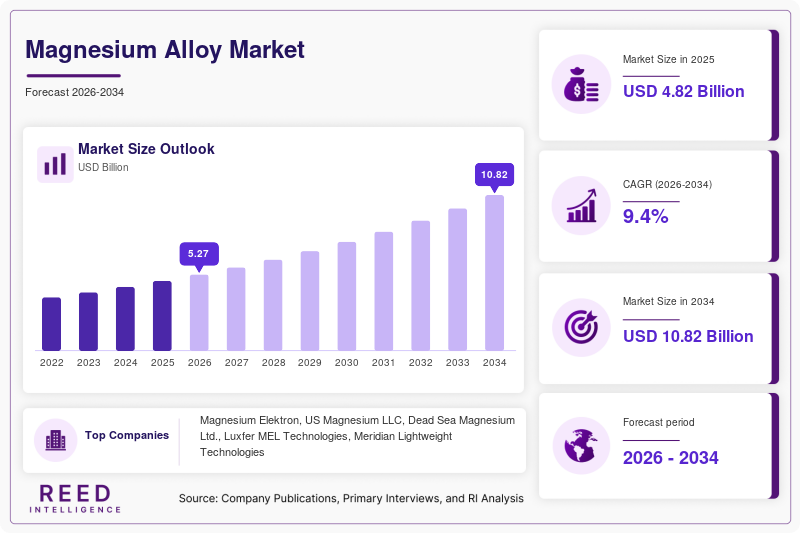
The global Magnesium Alloy Market size was valued at USD 4.82 billion in 2026 and is projected to reach USD 9.87 billion by 2034, expanding at a CAGR of 9.4% during 2026–2034. The market continues to gain momentum as industries seek lightweight materials capable of improving energy efficiency, reducing emissions, and enhancing product performance. Magnesium alloys are increasingly adopted across transportation, aerospace, electronics, medical devices, and industrial manufacturing due to their favorable strength-to-weight ratio, machinability, and recyclability.
A major global factor supporting market growth is the accelerating transition toward lightweight engineering solutions. Automotive manufacturers are under increasing pressure to improve fuel economy and extend electric vehicle driving range. Magnesium alloys offer significant weight reductions compared to conventional steel and aluminum components, making them attractive for structural and semi-structural applications. Similarly, aerospace manufacturers are integrating advanced magnesium alloy components to reduce aircraft weight and operational costs.
Key Highlights
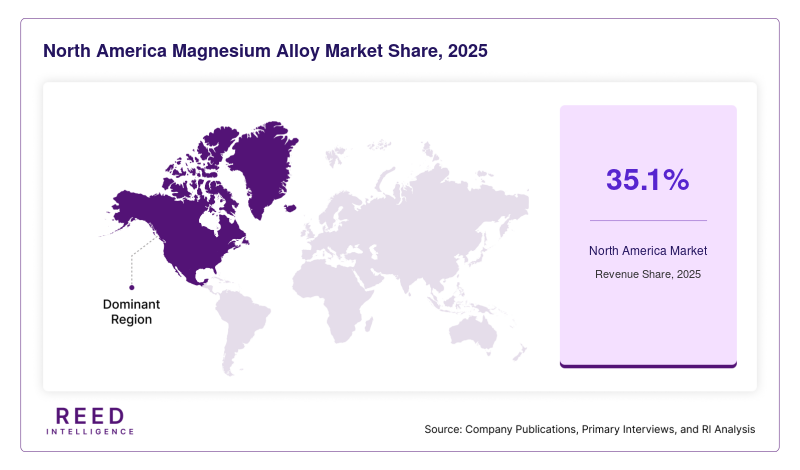
- North America dominated the market with a 35.1% share in 2025.
- Asia Pacific is expected to grow at the fastest CAGR of 10.8% during 2026–2034.
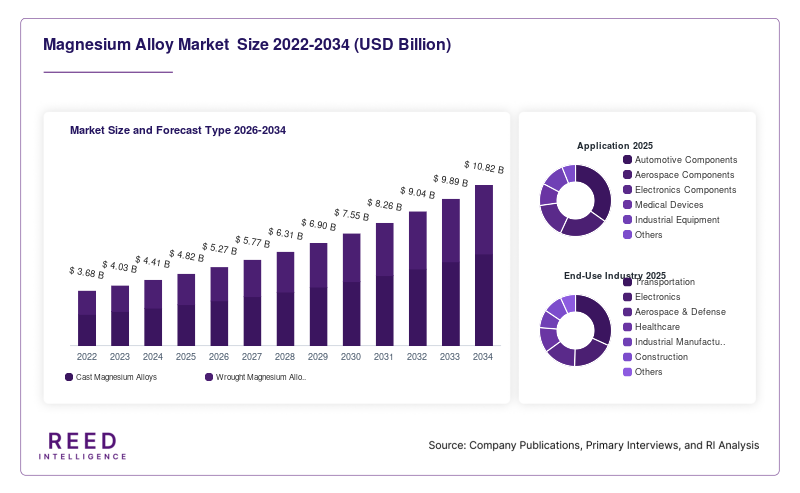
- By type, cast magnesium alloys accounted for the largest share of 61.4%.
- while wrought magnesium alloys are projected to grow at a CAGR of 10.3%.
- By application, automotive components led with a 39.8% share.
- whereas aerospace components are expected to expand at a CAGR of 11.1%.
- By end-use industry, transportation held the largest share of 44.6%.
- while electronics is projected to grow at a CAGR of 10.7%.
- The United States remained the dominant country, with market values of USD 1.12 billion in 2024 and USD 1.21 billion in 2025.
Market Trends
Rising Integration of Magnesium Alloys in Electric Vehicles
The electric vehicle industry is increasingly incorporating magnesium alloy components to improve vehicle efficiency and battery performance. Lightweight materials have become a central design priority as manufacturers seek to maximize driving range while maintaining safety standards. Magnesium alloys are being utilized in steering wheels, seat frames, transmission housings, battery enclosures, and structural brackets. Their ability to reduce overall vehicle mass contributes directly to lower energy consumption and improved operational efficiency. As governments continue promoting vehicle electrification and automakers invest heavily in next-generation mobility platforms, demand for magnesium alloys is expected to increase substantially across passenger and commercial electric vehicle segments.
Expansion of High-Performance Aerospace Applications
The aerospace sector is witnessing growing adoption of advanced magnesium alloys in both commercial and defense applications. Manufacturers are focusing on materials that can reduce aircraft weight without compromising mechanical performance. New alloy formulations with improved corrosion resistance and thermal stability are enabling broader deployment in cabin interiors, gearboxes, brackets, and structural assemblies. The growing volume of aircraft production, fleet modernization programs, and increasing air travel demand are contributing to market expansion. In addition, aerospace companies are investing in advanced manufacturing processes that improve the reliability and consistency of magnesium alloy components, creating favorable conditions for sustained market growth.
Market Drivers
Growing Demand for Lightweight Transportation Materials
The increasing emphasis on fuel efficiency and emission reduction is driving significant demand for lightweight materials across transportation industries. Magnesium alloys provide a unique combination of low density, high strength, and design flexibility, making them suitable for automotive and aerospace applications. Regulatory agencies worldwide continue implementing stringent emission standards, encouraging manufacturers to reduce vehicle weight wherever possible. Lightweight magnesium components help improve fuel economy and lower carbon emissions throughout a vehicle's operational life. As transportation manufacturers pursue aggressive sustainability targets and electrification strategies, magnesium alloy adoption is expected to accelerate, creating substantial opportunities for material suppliers and component manufacturers.
Advancements in Manufacturing Technologies
Continuous innovation in casting, forging, extrusion, and surface treatment technologies is enhancing the commercial viability of magnesium alloys. Modern manufacturing techniques have improved product quality, dimensional accuracy, and corrosion resistance, addressing historical limitations associated with magnesium materials. Automated production systems are enabling higher-volume manufacturing while reducing operational costs. Furthermore, advances in alloy chemistry are producing materials with superior mechanical and thermal properties suitable for demanding industrial applications. These technological improvements are expanding the range of potential uses for magnesium alloys and encouraging industries to replace heavier traditional materials with lightweight alternatives that offer improved performance and cost efficiency.
Market Restraint
Volatility in Raw Material Supply and Production Costs
The Magnesium Alloy Market faces challenges associated with fluctuations in raw material availability and production expenses. Magnesium production is concentrated in a limited number of countries, creating supply chain vulnerabilities and pricing uncertainty. Energy-intensive extraction and refining processes can significantly influence production costs, particularly during periods of rising energy prices. Manufacturers often encounter difficulties maintaining stable profit margins when raw material costs fluctuate unexpectedly. These challenges can affect long-term procurement strategies and investment decisions among end users. For example, automotive manufacturers operating under strict cost targets may delay material substitution projects when magnesium prices rise substantially. Additionally, geopolitical developments, trade restrictions, and supply disruptions can create uncertainty throughout the value chain. While technological improvements and recycling initiatives are helping mitigate some risks, cost volatility remains a notable factor influencing market adoption rates and competitive positioning across various industrial sectors.
Market Opportunities
Expansion of Consumer Electronics Manufacturing
The rapid growth of consumer electronics production presents a substantial opportunity for magnesium alloy manufacturers. Smartphones, laptops, tablets, wearable devices, and advanced computing equipment increasingly require lightweight yet durable materials. Magnesium alloys provide excellent electromagnetic shielding, thermal conductivity, and structural integrity, making them attractive for electronic housings and internal components. Manufacturers are continuously seeking materials that support thinner product designs while maintaining durability standards. As demand for portable electronic devices grows globally, particularly in emerging economies, magnesium alloy suppliers are expected to benefit from expanding production volumes and diversified application opportunities across the electronics value chain.
Increasing Investments in Sustainable Material Solutions
Sustainability initiatives are creating new growth opportunities for the Magnesium Alloy Market. Governments and corporations are placing greater emphasis on reducing environmental impacts through material efficiency and recyclability. Magnesium alloys align with these objectives because they can be recycled and reused in various manufacturing applications. Industries pursuing carbon reduction strategies are evaluating lightweight materials that contribute to lower energy consumption during product use. Furthermore, growing investments in circular economy programs are encouraging the development of advanced recycling technologies for magnesium-based products. These trends are expected to create long-term demand for environmentally responsible material solutions while supporting innovation across production and processing technologies.
Segmental Analysis
By Type
Cast magnesium alloys represented the dominant subsegment, accounting for approximately 61.4% of market share in 2024. Their widespread adoption is primarily attributed to excellent castability, cost efficiency, and suitability for high-volume manufacturing processes. Automotive manufacturers extensively use cast magnesium alloys in transmission cases, steering components, instrument panels, and engine-related parts. The ability to produce complex geometries with minimal machining requirements makes these alloys highly attractive for industrial production environments. Additionally, continuous improvements in die-casting technologies have enhanced product quality and dimensional accuracy. Demand remains particularly strong in transportation and industrial machinery sectors where lightweight components contribute to performance improvements and operational efficiency.
Wrought magnesium alloys are expected to be the fastest-growing subsegment, expanding at a CAGR of 10.3% through 2034. These materials offer improved mechanical properties, higher strength, and enhanced ductility compared with many cast alternatives. Growing aerospace applications are a major growth factor, as manufacturers seek materials capable of meeting demanding structural performance requirements. Wrought alloys are increasingly used in extruded and rolled products for aircraft structures, defense equipment, and specialized industrial components. Advances in forming technologies and alloy chemistry are also improving manufacturing feasibility. As industries continue prioritizing lightweight designs and superior mechanical performance, demand for wrought magnesium alloys is projected to increase steadily throughout the forecast period.
By Application
Automotive components emerged as the largest application segment, accounting for approximately 39.8% of total market share in 2024. Vehicle manufacturers are increasingly integrating magnesium alloy components to reduce overall vehicle weight and improve fuel efficiency. Common applications include steering wheels, seat structures, dashboard supports, transmission housings, and battery system components. The material's favorable strength-to-weight ratio enables manufacturers to meet regulatory requirements while maintaining vehicle performance standards. Increasing consumer demand for energy-efficient vehicles and growing electric vehicle production continue to support segment expansion. Moreover, ongoing advancements in manufacturing technologies have improved the reliability and affordability of magnesium alloy automotive components, encouraging broader adoption.
Aerospace components represent the fastest-growing application segment and are forecast to register a CAGR of 11.1% during 2026–2034. Aircraft manufacturers are continuously seeking lightweight materials that reduce fuel consumption and operating costs. Magnesium alloys are increasingly used in cabin structures, gear housings, brackets, and various non-critical structural applications. Enhanced corrosion resistance and improved thermal stability achieved through modern alloy development are expanding aerospace utilization. Growth in global air travel, fleet expansion programs, and rising defense expenditures are additional factors supporting demand. As aerospace manufacturers pursue efficiency improvements and sustainability objectives, magnesium alloy adoption is expected to increase significantly across commercial and military aviation applications.
By End-Use Industry
The transportation industry accounted for the largest share, representing approximately 44.6% of market revenue in 2024. This dominance reflects extensive utilization across automotive, aerospace, rail, and commercial vehicle applications. Transportation manufacturers continue emphasizing lightweight materials to enhance energy efficiency and reduce operating costs. Magnesium alloys support these objectives by enabling substantial weight reductions without sacrificing performance characteristics. Regulatory pressure related to emissions reduction further accelerates material adoption. Growing investments in electric mobility, advanced transportation technologies, and sustainable vehicle development are strengthening demand across the transportation sector. These factors collectively reinforce the segment's leading position within the global market.
The electronics industry is anticipated to be the fastest-growing end-use segment, expanding at a CAGR of 10.7% through 2034. Consumer demand for thinner, lighter, and more durable electronic devices is driving increased use of magnesium alloy housings and structural components. The material's excellent electromagnetic shielding properties and thermal management capabilities make it suitable for advanced electronic products. Manufacturers of laptops, tablets, smartphones, and wearable devices are increasingly adopting magnesium alloys to improve product functionality and user experience. Rapid technological innovation, rising global electronics consumption, and growing production capacities in emerging economies are expected to sustain strong growth within this segment over the forecast period
Regional Analysis
North America
North America accounted for approximately 35.1% of the global Magnesium Alloy Market in 2025, maintaining its position as the leading regional market. The region is projected to expand at a CAGR of 8.9% through 2034. Strong demand from automotive, aerospace, and defense industries continues to support market growth. Manufacturers across the region are increasingly investing in lightweight material technologies to improve operational efficiency and comply with environmental regulations. Technological advancements in casting and alloy development further strengthen the regional market outlook.
The United States represents the dominant country within North America. A unique growth factor is the country's extensive aerospace manufacturing ecosystem, which continuously demands lightweight structural materials. Growing investments in commercial aircraft production, defense modernization programs, and electric vehicle manufacturing are increasing magnesium alloy consumption. Strong research capabilities and collaboration between material suppliers and end-use industries also contribute to continued market expansion.
Europe
Europe held approximately 27.4% of the global market share in 2025 and is anticipated to register a CAGR of 8.6% during the forecast period. The region benefits from strict environmental regulations that encourage vehicle lightweighting and energy efficiency improvements. Automotive manufacturers are increasingly incorporating magnesium alloy components into vehicle platforms to reduce emissions and improve performance. In addition, advanced industrial manufacturing capabilities support widespread adoption across multiple sectors.
Germany remains the dominant country in the European market. A distinctive growth factor is the country's leadership in premium automotive engineering and advanced manufacturing technologies. German automakers continue investing in lightweight material innovation to enhance vehicle efficiency and meet evolving regulatory requirements. This sustained commitment to engineering excellence is expected to drive magnesium alloy demand across both domestic production and export-oriented manufacturing operations.
Asia Pacific
Asia Pacific represented approximately 24.8% of the global market in 2025 and is forecast to achieve the fastest CAGR of 10.8% through 2034. Rapid industrialization, expanding manufacturing activities, and increasing vehicle production are key factors supporting regional growth. The region also benefits from growing consumer electronics manufacturing, creating substantial demand for lightweight metal components. Continuous infrastructure development and industrial modernization further contribute to favorable market conditions.
China dominates the Asia Pacific market due to its large-scale manufacturing base and significant magnesium production capacity. A unique growth factor is the country's integrated supply chain ecosystem, which supports efficient raw material sourcing and component production. Expanding electric vehicle manufacturing, growing electronics exports, and ongoing investments in advanced materials research are expected to strengthen regional market growth over the forecast period.
Middle East & Africa
The Middle East & Africa accounted for nearly 6.5% of the global market share in 2025 and is expected to grow at a CAGR of 8.1% during 2026–2034. Industrial diversification initiatives across several economies are creating opportunities for advanced materials adoption. Manufacturing investments, infrastructure development projects, and increasing industrial automation are contributing to market expansion. Demand remains relatively concentrated but is steadily increasing across multiple sectors.
Saudi Arabia leads the regional market owing to its ongoing industrial transformation initiatives. A distinctive growth factor is the government's focus on developing non-oil manufacturing industries and attracting foreign investment into advanced production sectors. Industrial diversification programs are encouraging the adoption of lightweight materials in transportation, machinery, and construction applications, supporting gradual but consistent growth in magnesium alloy demand.
Latin America
Latin America captured approximately 6.2% of the global Magnesium Alloy Market in 2025 and is projected to expand at a CAGR of 8.3% through 2034. The region benefits from increasing industrial production, growing automotive assembly operations, and rising investments in manufacturing modernization. Economic development initiatives are encouraging industrial diversification and creating new opportunities for advanced materials. Demand is gradually expanding across transportation, industrial equipment, and consumer product manufacturing sectors.
Brazil remains the dominant country in the region. A unique growth factor is the country's expanding automotive manufacturing sector, which continues adopting lightweight materials to improve vehicle efficiency and competitiveness. Investments in industrial technology upgrades and increasing integration into global manufacturing supply chains are expected to support future demand for magnesium alloys across multiple industrial applications.
Competitive Landscape
The Magnesium Alloy Market is characterized by the presence of established global manufacturers and regional producers competing through product innovation, capacity expansion, and strategic partnerships. Companies are focusing on developing advanced alloy formulations with improved corrosion resistance, strength, and thermal performance to address evolving industry requirements. Investments in research and development remain a key competitive strategy across the market.
Magnesium Elektron is widely recognized as a leading participant due to its extensive product portfolio and strong presence across aerospace, automotive, and industrial sectors. The company recently expanded its advanced alloy development initiatives to support growing demand for lightweight high-performance materials.
Other major participants are emphasizing manufacturing efficiency, recycling capabilities, and supply chain integration to strengthen market positioning. Strategic collaborations with automotive and aerospace manufacturers are becoming increasingly common as companies seek long-term supply agreements and application-specific product development opportunities. Competitive intensity is expected to increase as demand for lightweight materials continues rising across multiple end-use industries.
Key Players
- Magnesium Elektron
- US Magnesium LLC
- Dead Sea Magnesium Ltd.
- Luxfer MEL Technologies
- Meridian Lightweight Technologies
- Shanghai Regal Magnesium Limited
- RIMA Industrial S.A.
- POSCO Holdings Inc.
- Yinguang Magnesium Industry Group
- Nanjing Yunhai Special Metals Co., Ltd.
- Wenxi YinGuang Magnesium Industry Co., Ltd.
- Taiyuan Tongxiang Magnesium Co., Ltd.
- Shanxi Bada Magnesium Co., Ltd.
- Qinghai Salt Lake Industry Co., Ltd.
- Latrobe Magnesium Limited
Recent Developments
- Magnesium Elektron introduced a new high-strength magnesium alloy platform designed for aerospace structural applications and lightweight transportation systems.
- Nanjing Yunhai Special Metals expanded its magnesium alloy production capacity to support increasing demand from electric vehicle and electronics manufacturers.
- Meridian Lightweight Technologies announced investments in advanced die-casting technologies aimed at improving production efficiency and component quality.
- POSCO Holdings strengthened research initiatives focused on corrosion-resistant magnesium alloy solutions for automotive and industrial applications.
- US Magnesium LLC enhanced its recycling and sustainability programs to improve resource efficiency and support circular manufacturing objectives.
Magnesium Alloy Market Segments
Type
- Cast Magnesium Alloys
- Wrought Magnesium Alloys
Application
- Automotive Components
- Aerospace Components
- Electronics Components
- Medical Devices
- Industrial Equipment
- Others
End-Use Industry
- Transportation
- Electronics
- Aerospace & Defense
- Healthcare
- Industrial Manufacturing
- Construction
- Others
By Region
- North America
- Europe
- APAC
- Middle East and Africa
- LATAM