Magnesium Diboride Powder Market Size, Share & Demand Report By Type (High-Purity Magnesium Diboride Powder, Nano-Structured Magnesium Diboride Powder), By Application (Superconducting Wires, Magnetic Systems), By End-Use Industry (Healthcare Equipment, Research Laboratories, Energy & Power) By Region & Segment Forecasts, 2022–2034
USD 3950
Market Overview
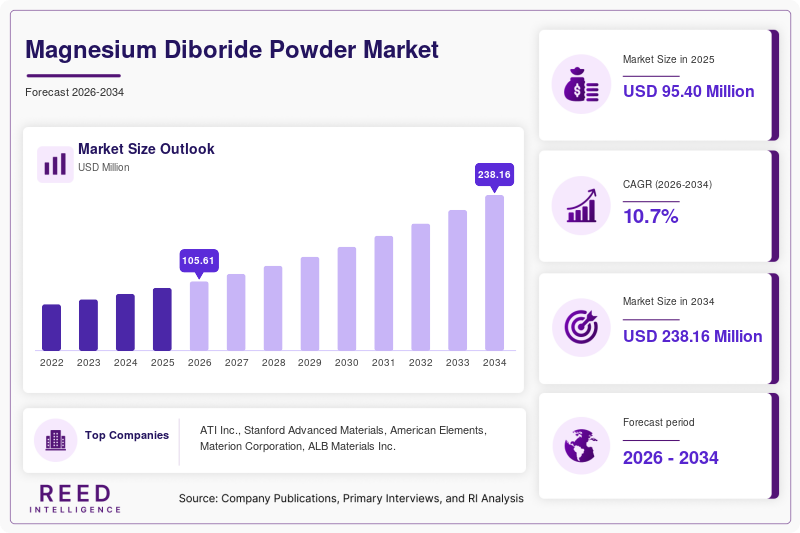
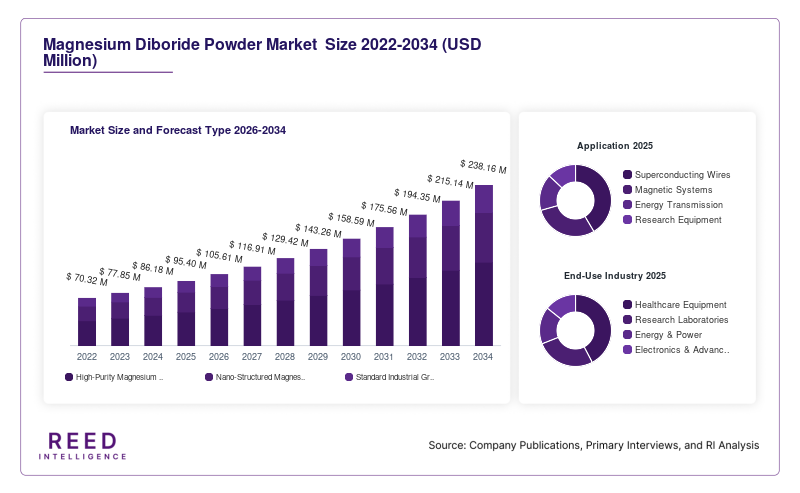
The Magnesium Diboride Powder Market size was valued at USD 95.4 million in 2024 and is projected to reach USD 238.7 million by 2033, registering a compound annual growth rate (CAGR) of 10.7% during 2025–2033. Magnesium diboride powder (MgB₂) is widely recognized for its superconducting properties, thermal conductivity, and lightweight composition, making it increasingly relevant across advanced electronics, medical imaging systems, and energy infrastructure applications.
A major global factor supporting the expansion of the Magnesium Diboride Powder Market is the rising adoption of superconducting materials in energy-efficient power transmission and advanced medical technologies. Governments and private organizations are investing in next-generation superconductors for power grids, magnetic resonance imaging (MRI) systems, and high-field magnets. Magnesium diboride powder provides advantages such as relatively high critical temperature and lower production cost compared with many conventional superconductors, strengthening its industrial appeal.
Key Highlights
- Dominant Region: Asia Pacific accounted for 38.6% market share in 2025, while North America is projected to record the fastest CAGR of 11.6% during the forecast period.
- Leading Subsegments:
- Type: High-Purity Magnesium Diboride Powder led with 52.3% share in 2024
- Application: Superconducting Wires dominated with 41.5% share
- End-Use Industry: Healthcare Equipment accounted for 36.4% share
- Fastest-growing subsegment: Energy Transmission Applications, projected CAGR 12.4%.
- Dominant Country: The United States recorded USD 24.6 million in 2024 and is estimated to reach USD 26.9 million in 2025.
Market Trends
Increasing Integration of Superconducting Materials in Medical Systems
The Magnesium Diboride Powder Market is experiencing strong momentum due to the increasing integration of superconducting materials in advanced medical equipment. Magnesium diboride powder is used in superconducting magnets that power MRI scanners and research imaging systems. Healthcare institutions are focusing on technologies that enhance imaging precision while reducing operating costs. MgB₂-based superconductors operate at relatively higher temperatures compared with traditional materials, enabling simplified cooling systems and improved efficiency. This trend is encouraging equipment manufacturers to explore magnesium diboride for next-generation imaging devices and laboratory instruments.
Expansion of Energy Infrastructure Using Superconducting Cables
Another notable trend shaping the Magnesium Diboride Powder Market is the development of superconducting cables for modern energy infrastructure. Energy utilities and grid operators are investigating superconducting transmission lines to reduce energy losses and improve capacity in densely populated regions. Magnesium diboride powder is used in the fabrication of superconducting wires that can transmit electricity with minimal resistance. As urban power demand continues to grow, particularly in technologically advanced economies, superconducting cable research programs are expanding. This trend is expected to stimulate continuous demand for high-quality magnesium diboride powder used in conductor manufacturing and energy system components.
Market Drivers
Rising Demand for High-Performance Superconductors
The Magnesium Diboride Powder Market is being driven by increasing demand for high-performance superconductors across scientific and industrial sectors. Superconductors are widely used in particle accelerators, fusion research, magnetic levitation systems, and high-field laboratory magnets. Magnesium diboride powder has attracted attention because it provides superconductivity at temperatures significantly higher than many metallic superconductors. This property reduces cooling complexity and operational costs. As research institutions and industrial laboratories continue to invest in advanced magnet technologies, the requirement for reliable superconducting materials is expanding, supporting steady market growth.
Growth of Advanced Materials Research Programs
Another important driver influencing the Magnesium Diboride Powder Market is the expansion of global advanced materials research initiatives. Governments and academic institutions are increasing funding for nanomaterials, superconductors, and high-performance alloys to support future technologies. Magnesium diboride powder is frequently studied for applications ranging from energy systems to aerospace components. Continuous improvements in powder synthesis methods, including chemical vapor deposition and mechanical alloying, are enhancing product purity and performance. These developments are encouraging commercial adoption across multiple high-technology sectors.
Market Restraint
High Production Complexity and Material Processing Challenges
One significant limitation affecting the Magnesium Diboride Powder Market is the complexity associated with large-scale production and processing of the material. Magnesium diboride powder requires precise synthesis conditions, including controlled temperature environments and specialized equipment to maintain high purity and stable crystalline structure. Achieving consistent particle size distribution and minimizing oxidation during production can be technically challenging.
These processing constraints can increase manufacturing costs and limit scalability for industrial applications. In addition, the fabrication of superconducting wires or tapes using magnesium diboride powder requires specialized engineering techniques such as powder-in-tube methods and controlled sintering processes. Such requirements may restrict adoption among smaller manufacturers lacking advanced material processing capabilities.
Another challenge relates to the competition from alternative superconducting materials such as niobium-titanium and high-temperature ceramic superconductors, which are already integrated into certain commercial systems. These alternatives often have established supply chains and long-term operational data, which can influence procurement decisions in infrastructure and research projects.
Despite ongoing research aimed at simplifying production methods, these technical barriers continue to affect cost efficiency and slow the large-scale commercialization of magnesium diboride powder across several industrial segments.
Market Opportunities
Development of Superconducting Power Grid Projects
A major emerging opportunity in the Magnesium Diboride Powder Market lies in the development of superconducting power grid projects. Power transmission networks are seeking innovative materials capable of reducing electrical losses while improving grid reliability. Magnesium diboride powder enables the production of superconducting wires that can carry large currents without resistance under specific conditions. As governments pursue energy efficiency initiatives and modernization of transmission infrastructure, superconducting cables are receiving increased attention. These initiatives could create long-term demand for MgB₂ powder in large-scale energy systems.
Expansion of Quantum and High-Field Research Applications
Another promising opportunity for the Magnesium Diboride Powder Market is the expansion of quantum technology and high-field research applications. Laboratories studying quantum computing, particle physics, and advanced magnetic materials rely on superconducting components capable of maintaining stable magnetic fields. Magnesium diboride powder offers unique performance characteristics suitable for experimental superconducting magnets and cryogenic devices. With research institutions worldwide increasing investments in quantum technologies and fundamental physics experiments, demand for specialized superconducting materials is expected to grow steadily over the forecast period.
Segmental Analysis
By Type
High-purity magnesium diboride powder dominated the Magnesium Diboride Powder Market with 52.3% share in 2024. High-purity variants are widely used in superconducting applications where precise chemical composition and stable crystal structure are essential. Research laboratories and industrial manufacturers require high-quality powder to produce superconducting wires and experimental magnetic systems. Consistent particle size and minimal impurities enable improved superconducting performance, which has strengthened the adoption of high-purity MgB₂ powder across advanced technological applications.
Nano-structured magnesium diboride powder is projected to be the fastest-growing subsegment with a CAGR of 12.1% during the forecast period. Nano-scale particle structures enhance surface area and improve superconducting properties in certain applications. Ongoing research in nanomaterials and superconductivity is expected to support the development of nano-engineered MgB₂ powders. These materials will likely gain importance in high-performance electronics and advanced experimental devices.
By Application
Superconducting wires represented the largest application segment with 41.5% share in 2024. Magnesium diboride powder is used in the production of superconducting wires through specialized manufacturing processes. These wires are utilized in magnetic systems, experimental power transmission technologies, and scientific equipment requiring stable magnetic fields. The ability of magnesium diboride to achieve superconductivity at relatively higher temperatures has encouraged its use in experimental conductor technologies.
Energy transmission applications are anticipated to register the fastest CAGR of 12.4% through 2033. As global electricity consumption continues to increase, energy systems are exploring innovative materials capable of improving transmission efficiency. Superconducting cables fabricated using magnesium diboride powder could provide higher current capacity with reduced energy loss. Continued research in superconducting cable technology will likely support demand for MgB₂ powder in energy infrastructure projects.
By End-Use Industry
Healthcare equipment held the largest share of 36.4% in the Magnesium Diboride Powder Market in 2024. Superconducting magnets used in MRI systems require advanced materials capable of producing strong and stable magnetic fields. Magnesium diboride powder is studied as an alternative superconducting material for certain medical imaging components. Research institutions and healthcare technology developers continue to evaluate MgB₂-based superconductors for potential integration in future imaging systems.
The research laboratories segment will record the fastest growth with a CAGR of 11.8% during the forecast period. Scientific institutions are increasingly conducting studies on superconducting materials, quantum technologies, and cryogenic devices. These research programs require high-quality magnesium diboride powder for experimental work. Expanding global investment in scientific research infrastructure will likely contribute to the growth of this segment.
Regional Analysis
North America
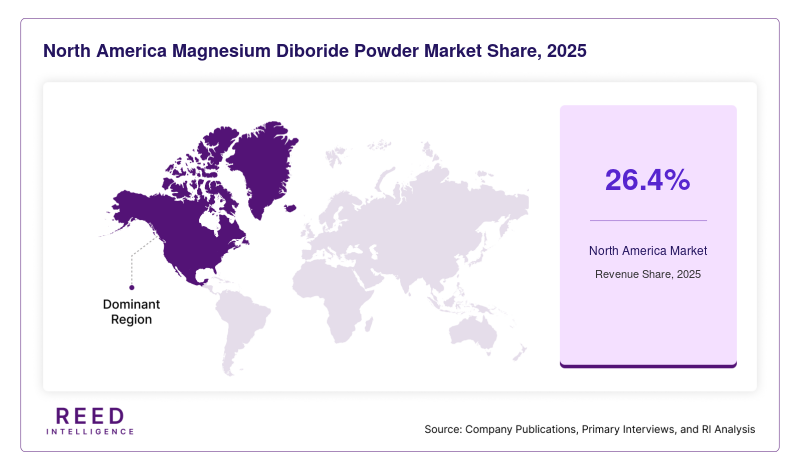
North America accounted for 26.4% of the Magnesium Diboride Powder Market share in 2025, reflecting strong adoption across research laboratories and high-technology industries. The region’s market will expand at a CAGR of 11.6% during 2025–2033, supported by technological innovation and industrial demand for advanced superconducting materials. The presence of leading research institutions and scientific laboratories has supported ongoing material science experimentation involving magnesium diboride powder. Continuous collaboration between universities, technology companies, and national laboratories has created a favorable environment for product development and specialized applications.
The United States dominated the regional market due to the strong presence of national laboratories and advanced research facilities focusing on superconductivity. High investments in particle physics experiments and magnet research have supported demand for high-purity magnesium diboride powder. Additionally, research programs related to advanced materials science continue to explore new formulations and processing methods. These initiatives are expected to sustain market demand across scientific and industrial sectors in the country.
Europe
Europe represented 22.1% of the Magnesium Diboride Powder Market in 2025. The region is projected to grow at a CAGR of 10.3% through 2033. European countries have established extensive research infrastructure for superconducting materials and cryogenic systems. The region’s strong focus on technological innovation and energy efficiency has created a favorable landscape for magnesium diboride powder applications. Several academic research centers continue to explore advanced superconducting wire manufacturing using MgB₂ materials.
Germany emerged as the dominant country in the European Magnesium Diboride Powder Market due to its advanced materials research ecosystem and industrial engineering expertise. German research institutes frequently collaborate with industrial partners to develop superconducting technologies used in experimental devices and specialized engineering systems. These partnerships have enabled progress in the synthesis and processing of magnesium diboride powder.
Asia Pacific
Asia Pacific held the largest share of the Magnesium Diboride Powder Market at 38.6% in 2025 and is expected to expand at a CAGR of 10.9% through 2033. Rapid technological development, increasing manufacturing capabilities, and expanding research programs across universities have contributed to the region’s leading position. Several countries in Asia Pacific are investing heavily in advanced materials research, including superconductors and nanomaterials.
China dominated the regional market due to strong government support for advanced material science and industrial innovation. Numerous research institutions are focusing on superconducting materials for scientific equipment and experimental power technologies. The country’s expanding research ecosystem and growing industrial base have strengthened its position as a key contributor to the global magnesium diboride powder supply chain.
Middle East & Africa
The Middle East & Africa represented 6.2% of the Magnesium Diboride Powder Market in 2025. The region will grow at a CAGR of 9.2% during the forecast period. Although adoption remains relatively limited compared with other regions, scientific research initiatives and technology development programs are gradually increasing demand for advanced materials. Universities and research institutions are investing in laboratory infrastructure to support materials science studies.
Saudi Arabia emerged as the leading country in the region due to expanding investment in scientific research infrastructure and technological education programs. Research universities are exploring advanced materials such as superconductors and nanomaterials to support scientific innovation. These initiatives are contributing to the gradual expansion of magnesium diboride powder applications within the region.
Latin America
Latin America held 6.7% share of the Magnesium Diboride Powder Market in 2025 and is projected to grow at a CAGR of 9.6% through 2033. The region’s growth is influenced by expanding academic research activities and the gradual development of advanced technology sectors. Universities and national laboratories are increasingly participating in international collaborations related to superconductivity research.
Brazil dominated the regional market due to its active academic research ecosystem and increasing investments in advanced materials laboratories. Several universities and research centers conduct studies on superconducting materials for experimental applications. These research activities have supported a stable demand for magnesium diboride powder used in scientific investigations.
Competitive Landscape
The Magnesium Diboride Powder Market is moderately consolidated with the presence of several specialized materials manufacturers and research-oriented companies. Key participants focus on high-purity powder production, customized formulations, and strategic collaborations with scientific institutions.
ATI Inc. is recognized as a leading participant in the market due to its advanced materials expertise and manufacturing capabilities. The company continues to develop specialized superconducting materials used in research and industrial applications. Recently, ATI expanded its advanced materials portfolio to support superconducting research programs.
Other companies are investing in improved synthesis techniques and high-performance powder formulations to strengthen their market presence. Collaboration with research institutions and technology companies is a common strategy adopted by industry participants to enhance product innovation and application development.
Growing interest in superconductivity and advanced materials research is expected to encourage competition and technological development within the Magnesium Diboride Powder Market during the forecast period.
Key Players
- ATI Inc.
- Stanford Advanced Materials
- American Elements
- Materion Corporation
- ALB Materials Inc.
- Edgetech Industries LLC
- SkySpring Nanomaterials Inc.
- Nanografi Nano Technology
- ESPI Metals
- Nanoshel LLC
Recent Developments
- In 2024, several advanced materials laboratories expanded research programs focused on magnesium diboride superconductors for high-field magnet applications.
- In 2023, materials manufacturers introduced improved purification processes for MgB₂ powder to enhance superconducting performance.
- In 2024, collaborations between universities and materials suppliers accelerated research into nano-structured magnesium diboride formulations for advanced electronics and superconducting components.
Magnesium Diboride Powder Market Segments
Type
- High-Purity Magnesium Diboride Powder
- Nano-Structured Magnesium Diboride Powder
- Standard Industrial Grade Magnesium Diboride Powder
Application
- Superconducting Wires
- Magnetic Systems
- Energy Transmission
- Research Equipment
End-Use Industry
- Healthcare Equipment
- Research Laboratories
- Energy & Power
- Electronics & Advanced Materials
By Region
- North America
- Europe
- APAC
- Middle East and Africa
- LATAM