Magnesium Lactate Market Size, Share & Demand Report By Form (Powder Magnesium Lactate, Liquid Magnesium Lactate), By Application (Pharmaceuticals, Dietary Supplements, Food & Beverages), By End-Use Industry (Healthcare, Nutraceutical Industry, Food Industry), By Distribution Channel (Online Retail, Pharmacies & Drug Stores, Supermarkets & Hypermarkets, Specialty Health Stores), By Region & Segment Forecasts, 2025–2034
USD 3950
Market Overview
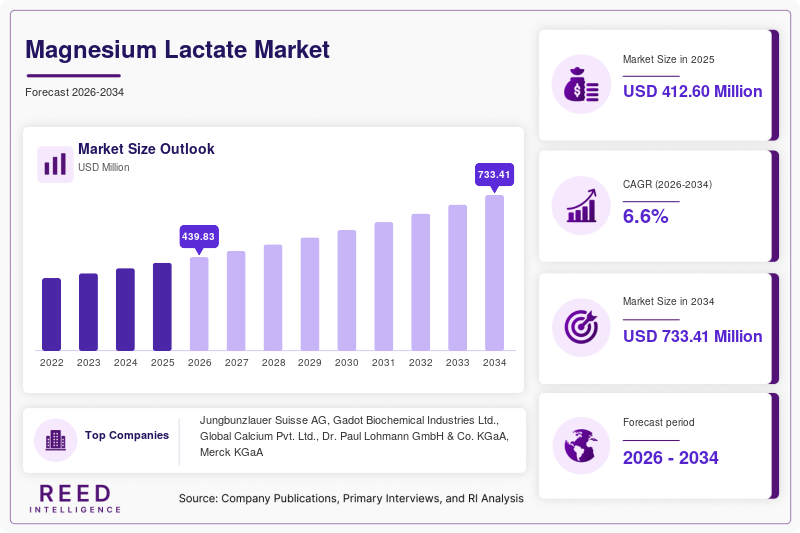
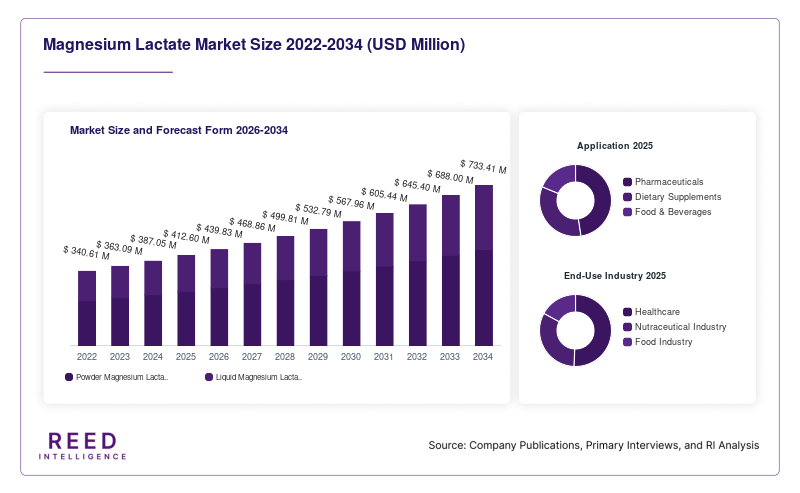
The global Magnesium Lactate Market size was valued at USD 412.6 million in 2025 and is projected to reach USD 731.4 million by 2034, expanding at a CAGR of 6.6% from 2025 to 2034. The market growth is primarily supported by increasing global demand for bioavailable mineral supplements, particularly in nutraceuticals and pharmaceutical formulations. Magnesium lactate, known for its high absorption rate and gastrointestinal tolerance, has gained traction as a preferred magnesium source across health-focused industries.
A key global factor contributing to market expansion is the rising prevalence of magnesium deficiency due to changing dietary patterns and processed food consumption. This has encouraged manufacturers to incorporate magnesium lactate into fortified food, beverages, and dietary supplements, thereby boosting demand across developed and emerging economies.
Key Highlights:
- North America dominated the market with a 34.8% share in 2025, while Asia Pacific is expected to register the fastest CAGR of 7.8% during the forecast period.
- By application, pharmaceuticals was the leading segment with a 41.2% share in 2024, while dietary supplements is projected to grow at a CAGR of 7.4%.
- By form, powder form held the largest share of 58.5% in 2024, whereas liquid form is anticipated to grow at a CAGR of 7.1%.
- The U.S. accounted for a dominant country share with market values of USD 108.2 million in 2024 and USD 113.7 million in 2025.
Market Trends
Increasing Adoption in Functional Foods and Beverages
The Magnesium Lactate Market is witnessing a growing shift toward functional foods and beverages enriched with essential minerals. Consumers are increasingly seeking products that offer both nutritional and functional benefits, such as improved muscle function and cardiovascular health. Magnesium lactate’s neutral taste and high solubility make it suitable for fortified beverages, dairy products, and sports nutrition formulations. This trend is driving manufacturers to innovate and expand their product portfolios.
Shift Toward Clean-Label and Plant-Based Ingredients
Another significant trend shaping the Magnesium Lactate Market is the rising preference for clean-label and plant-derived ingredients. Consumers are becoming more conscious about ingredient sourcing and product transparency. As a result, manufacturers are focusing on producing magnesium lactate through sustainable fermentation processes using plant-based raw materials. This aligns with broader industry trends toward natural and environmentally friendly products, enhancing the appeal of magnesium lactate across various end-use sectors.
Market Drivers
Rising Demand for Nutraceutical Products
The growing global awareness of preventive healthcare has significantly increased the demand for nutraceuticals. Magnesium lactate is widely used in dietary supplements due to its superior bioavailability and reduced gastrointestinal side effects compared to other magnesium salts. This has encouraged supplement manufacturers to adopt magnesium lactate in capsules, tablets, and powder formulations, thereby driving the Magnesium Lactate Market.
Expanding Pharmaceutical Applications
Magnesium lactate is extensively used in pharmaceutical formulations for treating magnesium deficiency and related conditions such as muscle cramps and cardiovascular disorders. The increasing incidence of such health issues, coupled with advancements in drug formulation technologies, has expanded its usage in prescription and over-the-counter medications. This growing pharmaceutical demand continues to contribute to steady market growth.
Market Restraint
Availability of Alternative Magnesium Compounds
One of the major challenges facing the Magnesium Lactate Market is the widespread availability of alternative magnesium salts such as magnesium oxide, magnesium citrate, and magnesium sulfate. These alternatives are often more cost-effective and widely used across industrial and pharmaceutical applications. While magnesium lactate offers better absorption and tolerability, its relatively higher production cost limits its adoption in price-sensitive markets. Additionally, some manufacturers prefer established compounds with longer market presence and standardized supply chains, which further restricts the growth potential of magnesium lactate. This competitive landscape poses a barrier to widespread penetration, particularly in developing regions.
Market Opportunities
Growth in Sports Nutrition Products
The rising popularity of fitness and active lifestyles has created significant opportunities in the sports nutrition segment. Magnesium lactate is increasingly being used in energy drinks, recovery supplements, and electrolyte formulations due to its role in muscle function and energy metabolism. This trend is expected to open new avenues for market players targeting health-conscious consumers.
Expansion in Emerging Economies
Emerging markets in Asia Pacific, Latin America, and the Middle East & Africa present untapped growth opportunities for the Magnesium Lactate Market. Increasing disposable incomes, urbanization, and growing awareness of dietary supplements are driving demand in these regions. Companies are focusing on expanding their distribution networks and launching affordable product variants to capture these high-growth markets.
Segmental Analysis
By Form
The powder form segment dominated the Magnesium Lactate Market with a 58.5% share in 2024. This dominance is attributed to its ease of handling, longer shelf life, and widespread use in pharmaceutical and nutraceutical formulations. Powdered magnesium lactate is preferred for tablet and capsule manufacturing due to its stability and compatibility with other ingredients.
The liquid form segment is expected to grow at a CAGR of 7.1% during the forecast period. This growth will be driven by increasing demand for ready-to-consume supplements and functional beverages. Liquid formulations offer faster absorption and convenience, making them suitable for sports nutrition and pediatric applications.
By Application
The pharmaceuticals segment held the largest share of 41.2% in 2024. Magnesium lactate is widely used in medications for treating magnesium deficiency and related health conditions. Its high bioavailability and low risk of gastrointestinal irritation make it a preferred choice in pharmaceutical formulations.
The dietary supplements segment is projected to grow at a CAGR of 7.4%. The increasing focus on preventive healthcare and wellness will drive demand for magnesium-based supplements. Consumers are expected to adopt dietary supplements to address nutritional gaps, boosting this segment’s growth.
By End-Use Industry
The healthcare sector dominated the market with a 46.8% share in 2024. The widespread use of magnesium lactate in hospitals and clinics for treating deficiency-related conditions has supported this dominance.
The food and beverage industry is anticipated to grow at a CAGR of 7.3%. The incorporation of magnesium lactate in fortified foods and beverages will increase as manufacturers respond to consumer demand for functional products.
By Distribution Channel
Offline channels accounted for the largest share of 63.5% in 2024, driven by strong retail networks and pharmacy sales. Consumers often prefer purchasing health supplements from physical stores for authenticity and professional guidance.
Online channels are expected to grow at a CAGR of 8.1%. The expansion of e-commerce platforms and increasing digital adoption will drive this segment. Online sales offer convenience, competitive pricing, and a wider product range, attracting a growing consumer base.
Regional Analysis
North America
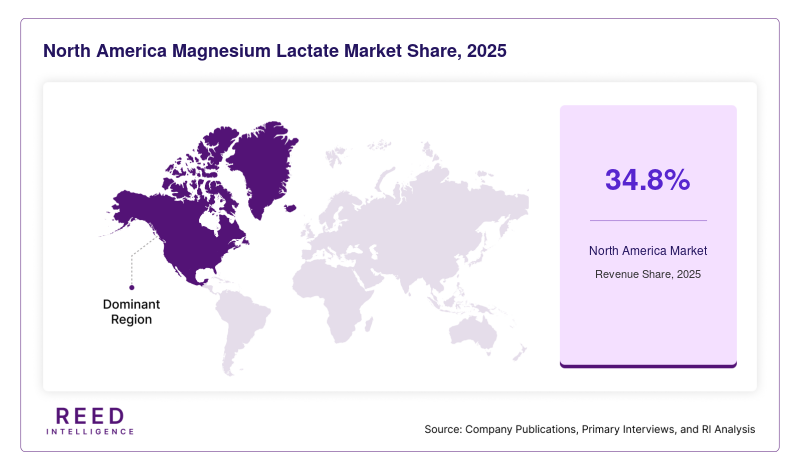
North America accounted for 34.8% of the Magnesium Lactate Market share in 2025 and maintained its position as the leading regional market. The region will continue to grow at a CAGR of 5.9% from 2025 to 2034. The growth is attributed to well-established pharmaceutical and nutraceutical industries, along with high consumer awareness regarding mineral supplementation.
The United States emerged as the dominant country due to strong demand for dietary supplements and fortified foods. A key growth factor is the increasing adoption of preventive healthcare practices, where consumers actively seek magnesium-based products to support overall wellness.
Europe
Europe held a 27.6% market share in 2025 and will expand at a CAGR of 6.2% over the forecast period. The region benefits from strict regulatory frameworks that promote high-quality pharmaceutical and food-grade ingredients.
Germany dominated the European market due to its robust pharmaceutical manufacturing sector. The country’s emphasis on clinical-grade formulations and quality standards has supported the demand for magnesium lactate in both medical and nutritional applications.
Asia Pacific
Asia Pacific represented 22.4% of the Magnesium Lactate Market share in 2025 and is expected to grow at the fastest CAGR of 7.8%. Rapid urbanization, increasing health awareness, and expanding middle-class population are key factors driving regional growth.
China led the region due to its large population base and growing nutraceutical industry. The increasing consumption of dietary supplements and government initiatives promoting health awareness have significantly contributed to market expansion.
Middle East & Africa
The Middle East & Africa accounted for 7.2% of the market share in 2025 and will grow at a CAGR of 6.5%. The region is witnessing gradual growth due to improving healthcare infrastructure and rising awareness of nutritional deficiencies.
Saudi Arabia dominated the regional market, driven by increasing investments in healthcare and a growing demand for pharmaceutical products. Government initiatives aimed at improving public health are supporting market growth.
Latin America
Latin America held a 8.0% share of the Magnesium Lactate Market in 2025 and is projected to grow at a CAGR of 6.7%. The region’s growth is fueled by increasing adoption of dietary supplements and expanding pharmaceutical industries.
Brazil emerged as the dominant country due to its large consumer base and growing health awareness. The rising demand for functional foods and supplements has played a crucial role in driving market growth.
Competitive Landscape
The Magnesium Lactate Market is moderately fragmented, with several global and regional players competing based on product quality, pricing, and innovation. Key companies are focusing on expanding their product portfolios and strengthening distribution networks.
A leading player in the market is Jungbunzlauer Suisse AG, known for its extensive range of biodegradable ingredients and strong presence in the nutraceutical sector. The company recently introduced a high-purity magnesium lactate variant aimed at pharmaceutical applications, enhancing its competitive position.
Other prominent players are investing in research and development to improve product formulations and meet evolving consumer demands. Strategic partnerships and regional expansions are common strategies adopted to gain market share.
Key Players
- Jungbunzlauer Suisse AG
- Gadot Biochemical Industries Ltd.
- Global Calcium Pvt. Ltd.
- Dr. Paul Lohmann GmbH & Co. KGaA
- Merck KGaA
- Alfa Aesar
- Noah Technologies Corporation
- American Elements
- Spectrum Chemical Manufacturing Corp.
- Tokyo Chemical Industry Co., Ltd.
- Parchem Fine & Specialty Chemicals
- Tai’an Health Chemical Co., Ltd.
- Fengchen Group Co., Ltd.
- Zhengzhou Ruipu Biological Engineering Co., Ltd.
- Shanxi Zhaoyi Chemical Co., Ltd.
Recent Developments
- 2024: Jungbunzlauer expanded its magnesium lactate production capacity in Europe to meet rising pharmaceutical demand.
- 2024: Gadot Biochemical introduced a new food-grade magnesium lactate formulation for beverage applications.
- 2025: Global Calcium Pvt. Ltd. launched a high-solubility variant targeting nutraceutical manufacturers.
- 2025: Dr. Paul Lohmann GmbH developed customized magnesium lactate blends for clinical nutrition.
- 2025: Merck KGaA invested in research to enhance the bioavailability of magnesium-based compounds.
Magnesium Lactate Market Segments
Form
- Powder Magnesium Lactate
- Liquid Magnesium Lactate
Application
- Pharmaceuticals
- Dietary Supplements
- Food & Beverages
End-Use Industry
- Healthcare
- Nutraceutical Industry
- Food Industry
Distribution Channel
- Online Retail
- Pharmacies & Drug Stores
- Supermarkets & Hypermarkets
- Specialty Health Stores
By Region
- North America
- Europe
- APAC
- Middle East and Africa
- LATAM